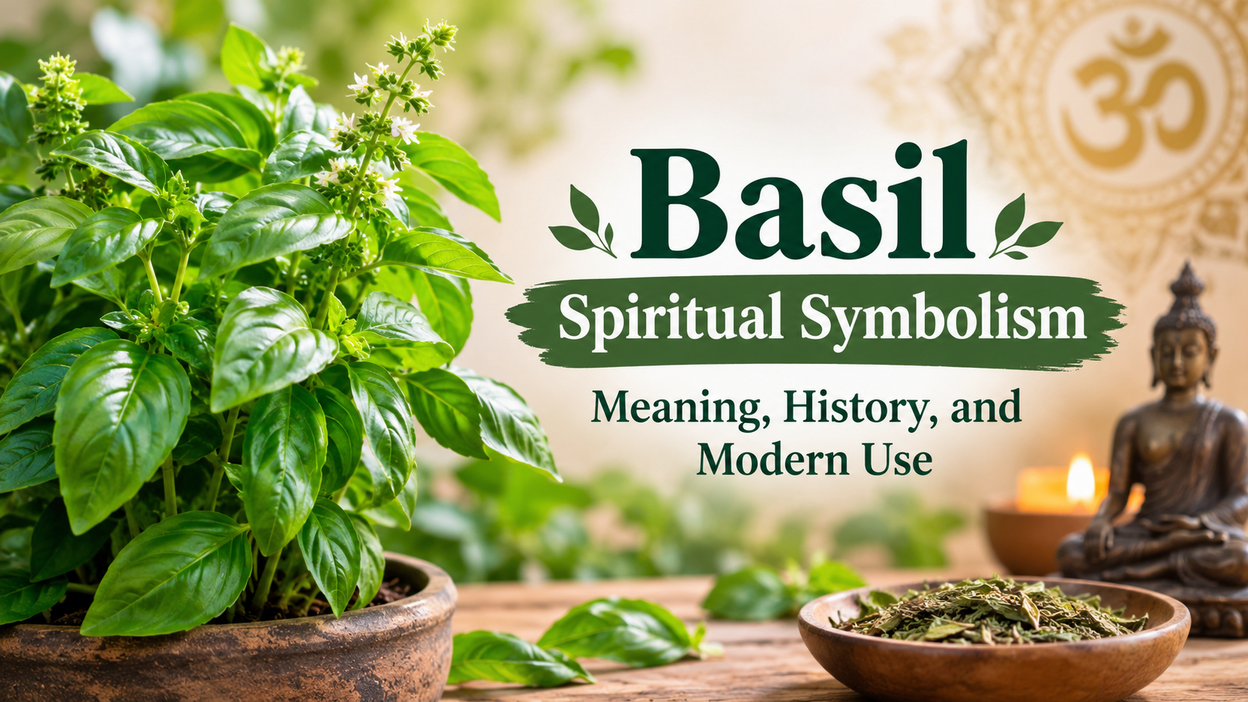
Basil spiritual symbolism connects an ordinary aromatic herb with ideas of holiness, protection, love, renewal, and remembrance. In American homes, basil is most familiar as a culinary plant used in pesto, pasta, salads, and home gardens. Yet its fragrant green leaves also carry religious and cultural meanings that reach far beyond the kitchen.
Basil has a particularly varied history. In Hindu traditions, holy basil, known as tulsi, holds sacred status and is associated with devotion and spiritual purity. In some Christian traditions, basil is connected with the discovery of the cross of Jesus, while European folklore has linked the plant with romance, good fortune, mourning, and even misfortune.
These meanings are not universal, and they do not all refer to the same botanical variety. Understanding basil as a spiritual symbol requires looking at the plant itself, the traditions surrounding it, and the personal beliefs people bring to it today.
Quick Answer
Basil spiritual symbolism commonly represents protection, spiritual devotion, renewal, and positive intentions in modern spiritual practice. Historically, different traditions have associated basil with sacred worship, divine connection, romantic love, mourning, and the care of the home.
TL;DR
- Basil often symbolizes protection, purification, devotion, and renewal.
- Holy basil, or tulsi, holds sacred importance in Hindu traditions.
- Some Christian traditions connect basil with the discovery of the True Cross.
- European folklore associates basil with romance, prosperity, mourning, and conflicting beliefs.
- In the United States, basil can represent mindful living and spiritual intention.
- Basil’s meaning depends on cultural tradition, botanical variety, and personal context.
1. What Basil Represents in Spiritual Symbolism
Basil’s spiritual meaning often begins with its life as a fragrant, living plant. Its green leaves, fresh scent, and ability to grow in a garden or pot make it a natural symbol of vitality, care, and renewal. In traditions that regard particular herbs as sacred, basil can also serve as a reminder of the relationship between everyday life and spiritual practice.
The plant is commonly associated with five ideas:
- Protection: Keeping a home or sacred space spiritually safe.
- Purification: Representing cleanliness, renewal, or preparation for prayer.
- Devotion: Expressing reverence toward a deity or religious tradition.
- Love: Signaling affection, courtship, and commitment in certain folk traditions.
- Remembrance: Connecting the living with ancestors, death, or religious stories.
These meanings developed in different places and circumstances. A Hindu household that grows tulsi for worship does not necessarily understand the plant in the same way as a Christian community that uses basil in a blessing ceremony or an American gardener who sees it as a symbol of fresh beginnings.
Basil therefore has no single spiritual message that applies to everyone. Its meaning comes from the traditions and experiences associated with it.
2. Why Basil Is Associated With Protection
Protection is one of the recurring themes in basil folklore. Across different regions, people have placed meaningful plants near homes, temples, or graves because they believed plants could help mark a boundary between ordinary life and sacred space. Basil became part of some of these practices.
In certain European traditions, people kept basil near doors or windows and associated it with good fortune or protection from unwanted influences. Some accounts also describe basil being used in folk rituals intended to ward off harmful spirits. These were cultural beliefs rather than scientifically established effects.
In modern American spiritual practice, basil may be included in a personal ritual focused on feeling safe, establishing boundaries, or creating a peaceful home. Someone might grow it on a windowsill as a reminder to care for their living space and protect their emotional well-being.
The distinction matters: basil can represent protection without literally guaranteeing protection. Its spiritual value may lie in the intention attached to it, the routine of caring for the plant, or the religious tradition that gives it meaning.
3. Basil as a Symbol of Purification and Renewal
Basil’s fresh scent and green appearance help explain its association with cleansing and renewal. Many cultures use plants, water, smoke, or fragrant materials in rituals that mark a transition from an ordinary setting to a sacred one. Basil appears in some traditions as part of that preparation.
In Greek Orthodox Christianity, basil has a role in certain ceremonies involving holy water. A sprig can be used to sprinkle blessed water, including during home-blessing practices. The act gives the plant a religious function: it becomes a tool used within a ceremony, rather than merely a decorative herb.
Outside formal religious settings, basil may symbolize the desire to begin again. A person starting a garden, moving into a new home, or establishing a daily meditation routine might use a basil plant as a living reminder of a fresh start.
Its symbolism is especially suited to renewal because the plant requires ongoing care. Watering it, trimming its leaves, and noticing new growth can turn an abstract intention into a repeated, practical action.
However, basil is not a universal cleansing symbol. Its role depends on the beliefs of the people using it, and its presence alone does not make a space spiritually pure.
4. Holy Basil and the Sacred Meaning of Tulsi
Holy basil, commonly called tulsi or tulasi, is especially important in Hindu traditions. It is botanically distinct from the sweet basil commonly used in Italian cooking, although both belong to the same genus. The two plants should not automatically be treated as interchangeable in religious or cultural discussions.
Tulsi is associated with devotion, purity, protection, and auspiciousness. In many Hindu households, people grow and care for the plant as part of their religious life. Daily acts of tending tulsi, offering prayers, or observing rituals around it can express devotion and help organize a household’s spiritual routine.
Tulsi is also connected with the Hindu deity Vishnu and with traditions involving the goddess Tulasi. Religious stories vary in their details, but the plant’s sacred status is well established within Hindu practice. It can represent the presence of the divine in domestic life, bringing worship into a space where people cook, gather, work, and raise families.
For many devotees, tulsi is not simply a symbol that can be separated from the plant. Its living presence and ritual treatment are part of its religious significance.
This distinction is important in the United States, where spiritual discussions sometimes group every type of basil under a single label. Respectful interpretation recognizes tulsi’s specific Hindu context instead of reducing it to a generic tool for attracting good luck or personal energy.
5. Basil in Christian Traditions
Basil also appears in some Christian traditions, particularly in Eastern Orthodox communities. One well-known religious legend links the herb to Saint Helena, the mother of Emperor Constantine, and the discovery of the True Cross, the cross associated with the crucifixion of Jesus.
According to versions of this story, basil grew near the place where the cross was found. This connection helped establish basil as a sacred plant in parts of the Christian world. In Greek Orthodox practice, basil may be used in ceremonies involving holy water, and some communities bring basil to church for a blessing.
Within this setting, basil can symbolize reverence, the remembrance of Christ’s crucifixion, and the connection between the natural world and religious history. A sprig used during a blessing has a meaning shaped by the ceremony and the community’s beliefs.
It is important not to confuse religious legend with a claim established by historical evidence. The story of basil growing near the True Cross belongs to Christian tradition, and its significance comes from its place within that tradition.
Basil is not explicitly named in the Bible as a sacred herb. Its Christian associations developed through later religious stories and practices, not from a direct biblical instruction to use the plant.
6. Ancient Origins and Changing Beliefs About Basil
Basil has been cultivated for thousands of years, with historical connections to parts of Asia and Africa and long-standing use across the Mediterranean. As people traded plants, spices, medicines, and cultural ideas, basil entered different societies and accumulated new meanings.
The name basil is commonly linked to a Greek word associated with royalty or kingship. This connection helped encourage the familiar description of basil as the “king of herbs.” The precise history of the plant’s name and movement across regions is complex, so simple stories about one person introducing basil to the entire ancient world should be treated cautiously.
Ancient and medieval beliefs about basil were far from consistent. Some traditions treated it as beneficial or sacred, while others associated it with hatred, poverty, danger, or misfortune. Historical herbals sometimes recorded conflicting claims about the plant’s medicinal properties, reflecting the limits and disagreements of earlier medical knowledge.
Basil’s history shows how symbolism develops. A plant’s scent, practical uses, availability, religious role, and place in local stories can all influence what it represents. The same herb may acquire very different meanings when it enters a new community.
Rather than assuming that basil has always meant protection or purity, it is more accurate to see its symbolism as a collection of traditions that changed over time.
7. Basil as a Symbol of Love and Relationships
In parts of Europe, basil became associated with romantic affection, courtship, and fidelity. Folklore from Italy and parts of Eastern Europe describes basil as a love token, with a sprig or potted plant sometimes serving as a sign of interest in a potential partner.
These customs gave basil a social meaning beyond its role in cooking or traditional medicine. Offering a plant could communicate affection without requiring a formal declaration. In some stories, accepting a sprig was associated with falling in love or committing to a relationship.
Basil’s connection with love was not always straightforward. Folklore can attach contradictory meanings to the same plant, and basil has also been linked with jealousy, chastity, grief, and unhappy love. The meanings varied by place and story rather than forming a single European belief.
In modern American settings, basil may represent affection through its associations with home cooking, shared meals, gardening, and hospitality. A person might give a potted herb to someone moving into a new home or growing a garden together.
These everyday gestures do not necessarily reflect an inherited spiritual tradition. Sometimes the symbolism is personal: a plant becomes meaningful because two people care for it, share meals made with it, or associate it with a particular memory.
8. Basil, Mourning, and Remembrance
Basil’s associations with death may surprise people who know it mainly as a kitchen herb. Yet historical accounts describe basil in burial customs, grave-related practices, and traditions connected with remembrance. In some regions, it has been used in ways intended to honor the dead or express grief.
In parts of the Mediterranean and elsewhere, basil has been associated with mourning. Historical traditions from ancient Greece, for example, connect the plant with sorrow and misfortune, while other accounts describe basil being placed on graves or used in funeral-related customs.
These practices differ across communities, and they should not be treated as a universal custom. Basil does not symbolize death in every culture, nor does its presence automatically signal mourning.
The connection may be understood through the role of plants in rituals surrounding death. Living greenery can mark remembrance, continuity, or the bond between a household and those who have died. A plant that appears in a funeral or grave tradition can acquire meaning through that repeated use.
In contemporary American life, basil is not a widespread national symbol of mourning. However, someone familiar with a family’s cultural or religious tradition may associate it with remembrance. Personal and inherited meanings can persist even when they are unfamiliar to the wider public.
9. What Basil Symbolizes in the United States Today
In the United States, basil’s most familiar meaning is culinary, but its symbolism can extend into home life, gardening, religion, and personal spirituality. There is no single national belief about basil. Americans encounter it through many cultural traditions, and their interpretations vary accordingly.
For home gardeners, basil can represent growth, self-sufficiency, patience, and the satisfaction of caring for something living. A small pot on a kitchen windowsill offers a practical reminder that growth depends on regular attention. These associations may be spiritual for some people and entirely secular for others.
Basil also appears in American homes through cultural and religious practices brought by immigrant communities and maintained across generations. Hindu households may cultivate tulsi as part of devotional life, while Greek Orthodox Christians may recognize basil’s role in particular church ceremonies.
Its culinary popularity adds another layer. Basil is strongly associated with Italian American food, especially pesto, tomato dishes, and pizza. Through these familiar meals, it can evoke family gatherings, hospitality, heritage, and comfort.
These interpretations overlap, but they are not identical. A basil plant in a kitchen might symbolize practical freshness to one person, cultural identity to another, and religious devotion to someone else. Its American meaning is best understood as a combination of everyday use and diverse cultural histories.
10. Basil and the Spiritual Meaning of Green
Basil’s green leaves contribute to its modern symbolic associations. Green commonly suggests plant life, growth, renewal, and the return of vitality after a period of dormancy. Because basil is a living herb, these associations arise naturally from its appearance and growth habits.
In contemporary American spiritual settings, green may also represent balance, hope, abundance, and a connection with nature. A person who places basil near a meditation space or grows it as part of a personal ritual might use its color as a reminder to remain grounded and attentive to everyday life.
However, green does not carry exactly the same meaning in every culture or religious tradition. Its interpretation depends on context, and basil’s spiritual significance cannot be explained by color alone.
The plant’s fragrance, its use in religious ceremonies, and the effort required to care for it all contribute to its symbolic associations. Green reinforces those meanings but does not replace the cultural history behind them.
11. Basil in Meditation, Prayer, and Personal Rituals
Some people use basil as a physical reminder of spiritual commitments. Its presence can help establish a routine, whether that routine involves prayer, meditation, journaling, gratitude, or simply spending a few quiet minutes caring for a plant.
For example, someone beginning a new personal practice might grow basil near a window and use the time spent tending it to reflect on patience and consistency. Another person might keep basil in a garden associated with family memories or religious observance.
In established religious traditions, basil’s ritual role should be understood within the community that practices it. Tulsi’s place in Hindu devotion and basil’s role in certain Christian ceremonies have specific histories that differ from modern, individually created rituals.
People who use basil in personal spirituality may associate it with intentions such as:
- Grounding: Paying attention to the present rather than becoming absorbed in worries.
- Gratitude: Recognizing the food, care, and natural resources that sustain daily life.
- Renewal: Marking a fresh beginning or a change in personal priorities.
- Devotion: Creating a visible reminder of a religious or spiritual commitment.
- Reflection: Using routine plant care as an opportunity for quiet thought.
These are personal interpretations rather than guaranteed effects of the plant. Basil does not need to possess supernatural properties to serve as a meaningful reminder of a person’s values.
12. Basil in Home Decor, Gifts, and Modern Lifestyle
Basil appears in modern American homes primarily as a living herb, but its everyday uses can carry symbolic meaning. A pot on a windowsill, a small indoor garden, or a collection of kitchen herbs may communicate care, hospitality, and a preference for a home that feels alive and welcoming.
A basil plant can also make a practical housewarming gift. The gift may suggest good wishes for a new home, especially when presented with other kitchen herbs or gardening supplies. The symbolism comes partly from the plant itself and partly from the gesture of giving something that can be used and nurtured.
In contemporary lifestyle settings, basil may fit naturally into ideas about sustainable living, cooking at home, and reconnecting with nature. Someone who grows herbs may see the practice as a way to slow down, reduce waste, or become more aware of the food they eat.
Basil is less commonly recognized as a standardized symbol in American tattoos, jewelry, or fashion. When it appears in botanical artwork or personal designs, its meaning is usually individual or connected to a specific cultural background. A basil sprig might represent family heritage, a meaningful garden, religious devotion, or a memory associated with cooking.
Social media can encourage people to share these personal interpretations, but a popular caption does not establish a universal spiritual meaning. A plant’s significance remains tied to the person, tradition, or experience behind its use.
13. Positive and Negative Interpretations of Basil
Basil is a useful example of why plant symbolism should not be reduced to a simple list of universally positive meanings. While many modern spiritual interpretations emphasize protection, devotion, and renewal, historical folklore includes less favorable associations.
Some European traditions connected basil with hatred, poverty, grief, or misfortune. Other traditions treated it as a sign of romantic affection, good fortune, or sacred presence. These contradictions reflect differences in local belief and historical context, not proof that basil has an inherently good or bad spiritual quality.
The following table compares several major interpretations.
| Context | Common symbolic meaning | Important distinction |
|---|---|---|
| Hindu devotion | Holiness, devotion, purification, and protection | Usually refers specifically to tulsi |
| Greek Orthodox practice | Sacred remembrance and blessing | Connected with particular religious ceremonies |
| European love folklore | Affection, courtship, and fidelity | Customs differed by region |
| Mourning traditions | Grief, remembrance, and death | Not a universal association |
| Modern American gardening | Growth, care, renewal, and hospitality | Often personal or secular rather than religious |
| Contemporary personal spirituality | Intention, reflection, and a sense of protection | Depends on individual beliefs |
When basil appears in a spiritual setting, the surrounding details matter more than a generic symbolism chart. A plant kept near a religious altar, given as a romantic gesture, or grown to remember a family member may communicate different things.
Negative associations also need historical context. Folklore about misfortune is not evidence that keeping basil in a home causes harm. Treating an old superstition as a fact can create unnecessary fear and obscure the cultural circumstances in which the belief developed.
14. Common Misunderstandings About Basil Spiritual Symbolism
Several misconceptions can lead to inaccurate interpretations of basil.
All basil varieties have the same religious meaning. Sweet basil and holy basil are related plants, but they do not have identical roles in every tradition. Tulsi has a specific place in Hindu religious life that should not be casually transferred to culinary basil.
Basil always symbolizes protection. Protection is an important association in some traditions, but other historical interpretations connect basil with romance, mourning, or misfortune. The meaning depends on context.
Basil is a biblical plant with an explicit spiritual instruction. Basil is not specifically named in the Bible as a sacred herb. Some Christian associations come from later legends and religious practices.
Basil automatically brings luck or spiritual cleansing. These ideas belong to particular beliefs and folk practices. There is no reliable evidence that the plant itself guarantees supernatural protection, prosperity, or purification.
A basil plant has the same significance for every American. The United States includes many religious, cultural, and secular perspectives. For one person, basil may be a sacred plant; for another, it may simply be an ingredient for dinner.
A careful interpretation recognizes the difference between documented cultural practices, religious beliefs, folk stories, and individual symbolism. This approach makes room for spiritual meaning without presenting every traditional claim as an established fact.
Frequently Asked Questions
What does basil mean spiritually?
Basil is commonly associated with protection, devotion, purification, love, and renewal, although its meaning varies across cultures. Its significance may come from religious ceremonies, folklore, or personal experiences with the plant.
Is basil considered a sacred plant?
Yes, basil has sacred importance in certain religious traditions. Holy basil, or tulsi, is especially revered in Hinduism, while basil also has ceremonial uses in some Christian communities, including Greek Orthodox practice.
What does basil symbolize in Hinduism?
Holy basil, known as tulsi, is associated with devotion, purity, protection, and auspiciousness. It is connected with Vishnu and the goddess Tulasi, and many Hindu households cultivate and care for it as part of religious practice.
Does basil symbolize protection and good luck?
Basil has been associated with protection and good fortune in some folk traditions. These are cultural and spiritual beliefs rather than proven effects, and the plant does not have the same meaning in every community.
What does it mean to keep basil in your home?
A basil plant may represent growth, hospitality, renewal, or spiritual devotion, depending on the person and cultural context. It can also be a practical kitchen herb with no intended spiritual meaning.
Why is basil associated with Christianity?
Some Christian traditions connect basil with a legend about Saint Helena and the discovery of the True Cross. Basil is also used in certain Greek Orthodox ceremonies involving holy water, giving it a place in religious practice.
Does basil have a negative spiritual meaning?
Some historical traditions associated basil with grief, hatred, poverty, or misfortune, while others regarded it as sacred or fortunate. These conflicting beliefs reflect different cultural histories and do not mean that basil causes negative events.
Conclusion
Basil spiritual symbolism brings together devotion, protection, renewal, love, and remembrance, but its meaning is shaped by the tradition in which the plant appears. Tulsi holds a distinct sacred role in Hinduism, basil participates in certain Christian ceremonies, and European folklore has connected the herb with both affection and mourning.
In modern American life, basil can be a culinary staple, a marker of cultural heritage, a living reminder of personal values, or an element of religious practice. Its significance depends on how people grow it, use it, and understand its history.
The most thoughtful way to interpret basil is to consider the plant alongside the beliefs and experiences that give it meaning. A familiar herb can connect everyday routines with larger questions of faith, care, memory, and belonging.