Quick Answer: What Does a Crown Symbolize Spiritually?
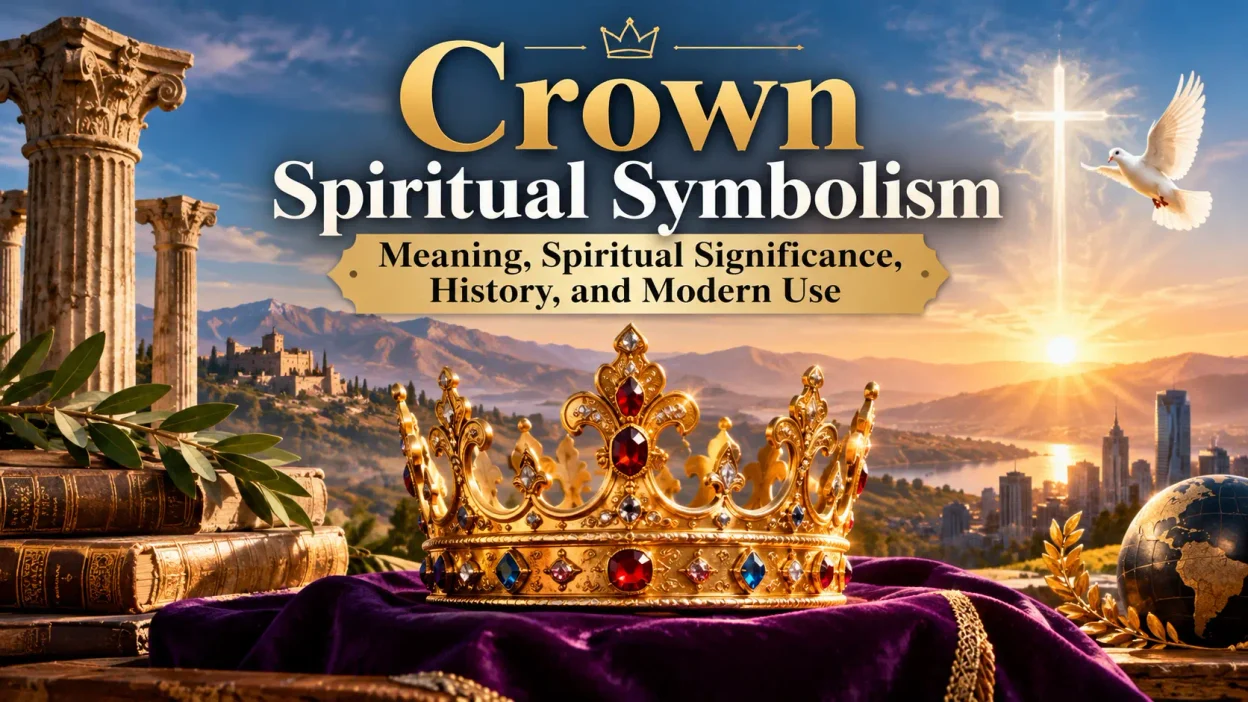
Crown spiritual symbolism is commonly associated with divine authority, spiritual wisdom, enlightenment, victory, dignity, leadership, and personal transformation. Because a crown sits above the head, it can represent a higher perspective, elevated consciousness, or a connection between earthly life and the spiritual realm.
Depending on the tradition, a crown may symbolize God’s authority, a spiritual achievement, the responsibilities of leadership, or the reward for enduring hardship. Its meaning can change according to its appearance, cultural context, and the circumstances in which it appears.
TL;DR: Crown Spiritual Symbolism
- Divine authority: A connection with sacred power or a higher purpose.
- Spiritual enlightenment: Wisdom, awareness, and a higher understanding of life.
- Victory and achievement: Overcoming obstacles and reaching an important goal.
- Self-worth: Recognizing your dignity, value, and inner strength.
- Leadership: Accepting responsibility and guiding others with integrity.
- Faith and endurance: Remaining committed to your values through difficult times.
- Transformation: Moving from an old way of living toward a more conscious life.
- Humility: Understanding that genuine authority comes with responsibility, not simply status.
1. The Core Spiritual Meaning of a Crown
A crown is more than a decorative object. Throughout history, it has served as a visible sign of authority, honor, and elevated status. In spiritual symbolism, these associations often extend beyond political power to include inner development and sacred responsibility.
The crown’s position on the head is especially significant. The head is associated with thought, identity, judgment, and awareness. Placing a symbolic crown above it can suggest that a person has developed greater wisdom or is being called to use their abilities in a more meaningful way.
A crown may therefore represent three interconnected ideas:
Elevation: Rising above fear, confusion, or limiting beliefs.
Responsibility: Using influence and personal strengths wisely.
Recognition: Acknowledging growth, achievement, or a deeper understanding of oneself.
These interpretations do not mean that seeing a crown automatically indicates divine favor or a guaranteed future success. Rather, the symbol can serve as a reminder to reflect on how you use your power, what you value, and where you want your life to go.
2. Crown Symbolism and Divine Authority
One of the most enduring meanings of a crown is divine authority. In many religious and historical traditions, rulers wore crowns to express the belief that their position was connected to sacred power.
This association can make the crown a symbol of spiritual order, faith, and accountability. It may represent the idea that power should be guided by principles greater than personal ambition.
In Christian coronation traditions, for example, the crown is part of a wider collection of ceremonial objects that express the relationship between monarchy, faith, and public duty. Westminster Abbey describes the coronation regalia as carrying symbolic meanings connected with royal authority and the Christian tradition. Source: Westminster Abbey
In a personal spiritual context, divine authority does not have to mean ruling over others. It can instead represent the responsibility to live according to conscience, compassion, honesty, and a meaningful sense of purpose.
A crown can remind you that true authority begins with how you govern yourself.
3. Crown Spiritual Meaning: Wisdom and Enlightenment
Because the crown sits at the highest point of the body, it can symbolize expanded awareness and a search for wisdom.
Spiritually, enlightenment generally refers to a deeper understanding of reality, the self, or the nature of existence. The crown can serve as a visual metaphor for reaching a higher level of understanding after learning from experience.
This interpretation may resonate when you are:
- Reconsidering beliefs that no longer serve you.
- Becoming more aware of your emotions and habits.
- Seeking clarity about your purpose.
- Learning to respond thoughtfully rather than react impulsively.
- Developing a more compassionate understanding of other people.
In Buddhist art, crowned figures can carry meanings related to elevated spiritual status and attainment. Scholarly discussion of crowned Buddha imagery connects the crown, in certain Mahayana contexts, with advanced knowledge and the attainment of Buddhahood. These meanings belong to particular artistic and religious traditions rather than to every Buddhist practice. Source: Arts, MDPI
For modern spiritual reflection, the crown can represent the continuing process of learning rather than the claim that a person has become perfect or all-knowing.
4. Crown Symbolism and the Crown Chakra
In contemporary spiritual and yogic discussions, the crown is frequently associated with the crown chakra, commonly called Sahasrara in Sanskrit.
The crown chakra is traditionally described in some yogic systems as the highest of the principal chakras. Modern interpretations often associate it with spiritual awareness, consciousness, connection, and the search for a reality beyond the individual ego.
Its symbolic associations commonly include:
- Awareness: Observing thoughts without being completely controlled by them.
- Connection: Feeling connected to life, humanity, or a greater spiritual reality.
- Wisdom: Seeking understanding beyond immediate desires.
- Inner peace: Developing a sense of perspective during uncertainty.
- Transcendence: Exploring questions that extend beyond material concerns.
The crown chakra and an actual royal crown are not the same thing. Their association is symbolic: both suggest something elevated above ordinary concerns.
It is also important to distinguish spiritual beliefs from medical facts. Chakra interpretations belong to religious and spiritual frameworks; they are not scientifically established anatomical structures.
5. Crown Spiritual Symbolism in Christianity and the Bible
In Christianity, crowns can symbolize victory, honor, righteousness, eternal life, and the reward associated with faithfulness.
Biblical references to crowns often use them figuratively rather than describing literal royal headwear.
The crown of life
The phrase “crown of life” appears in James 1:12 and Revelation 2:10. It is associated with perseverance, faithfulness, and remaining steadfast through trials.
Spiritually, this crown can represent the hope that hardship does not have the final word.
The crown of righteousness
In 2 Timothy 4:8, Paul refers to a “crown of righteousness.” Within Christian interpretation, it is associated with righteousness and the hope of divine reward.
The symbol encourages believers to consider the relationship between faith, conduct, and the way they live.
The crown of glory
The expression “crown of glory” appears in 1 Peter 5:4, where it is connected with the appearance of the Chief Shepherd and a crown that does not fade away.
This imagery can be understood as a reminder that faithful service and humility matter more than temporary recognition.
The crown of thorns
The crown of thorns placed on Jesus before his crucifixion is one of Christianity’s most recognizable crown symbols. It represents suffering, humiliation, and the cruel mockery of kingship. In Christian faith, it also points toward sacrifice and redemption.
Together, these biblical images reveal that a crown does not always mean comfort, wealth, or worldly success. It can symbolize the dignity of enduring suffering, the responsibility of serving others, or the hope of spiritual victory.
6. Crown Symbolism Across Different Cultures
Crowns appear in many societies, but their meanings are not identical. The design, materials, ceremonies, and religious beliefs surrounding a crown all affect its significance.
| Cultural or spiritual context | Common symbolic associations |
|---|---|
| Christianity | Eternal life, righteousness, victory, sacrifice, and divine authority |
| Ancient Greek and Roman traditions | Honor, glory, achievement, and association with particular deities |
| Hindu traditions | Royal authority and divine or sacred status in specific religious imagery |
| Tibetan and Nepalese Vajrayana Buddhism | Ritual authority, initiation, and spiritual teachings |
| Yoruba traditions | Sacred royal authority, ancestry, and the legitimacy of the ruler |
In ancient Greek and Roman settings, wreaths made from leaves and plants could honor achievement, glory, or a connection with a deity. These wreaths were not always the same as jeweled royal crowns, but they share the broader idea of honoring or elevating a person. Source: Getty
In Nepalese Vajrayana Buddhist traditions, particular ritual crowns are worn by initiated priests during ceremonies and can express religious status and ritual identity. Source: The Metropolitan Museum of Art
Among the Yoruba, the beaded adé crown is associated with the sacred authority of the ọba, or king. A crown in this tradition may carry meanings involving royal ancestry, communal identity, and spiritual power. Source: Princeton University Art Museum
These examples demonstrate why crown symbolism should be understood within its cultural setting rather than treated as one universal belief.
7. Crown Symbolism: Victory, Achievement, and Perseverance
A crown is often awarded or displayed to mark a victory. This association extends naturally into spiritual interpretations of overcoming adversity.
The victory represented by a crown does not have to involve competition against another person. It can mean overcoming an internal struggle, developing patience, recovering confidence, or remaining true to your principles during a difficult period.
A crown may therefore serve as a reminder of:
- Progress after a long period of effort.
- Courage in the face of uncertainty.
- Personal growth after a disappointment.
- The discipline required to achieve a meaningful goal.
- The importance of recognizing your own progress.
Historical funeral symbolism offers another dimension. The Smithsonian’s collection notes that crown-shaped funeral arrangements in nineteenth-century mourning traditions could represent victory over death and the hope of heavenly honors. Source: Smithsonian Institution
This meaning transforms the crown from a sign of worldly success into a symbol of hope, endurance, and the possibility of life beyond present suffering within the relevant faith tradition.
8. The Crown as a Symbol of Self-Worth and Personal Power
A crown can also symbolize the recognition of one’s own value.
In this interpretation, wearing a crown does not mean believing you are better than everyone else. It means understanding that your dignity does not depend entirely on external approval.
The symbol may encourage you to set healthy boundaries, take your abilities seriously, and stop measuring your worth only through other people’s opinions.
Personal power can include the ability to make responsible decisions, express your needs clearly, admit mistakes, and treat others respectfully.
A balanced interpretation of the crown combines confidence with humility. A crown that represents only superiority may become a symbol of vanity, whereas a crown associated with self-respect can represent maturity and responsibility.
9. Crown Symbolism in Dreams
Dream interpretations are personal and cannot reliably predict future events. However, a crown in a dream may offer a useful starting point for reflection.
Wearing a crown
Wearing a crown may reflect a desire for recognition, a growing sense of confidence, or a new responsibility in your waking life.
Consider whether you are stepping into a leadership role or learning to trust your judgment.
Seeing someone else wearing a crown
Another person wearing a crown may bring attention to authority, admiration, rivalry, or your feelings about someone who has influence over you.
The emotion you experience in the dream may be more revealing than the crown itself.
Receiving a crown
Receiving a crown may symbolize a desire to be acknowledged, a new commitment, or the feeling that you are ready to take on a challenge.
It may also prompt you to consider whether you are prepared for the responsibility that comes with recognition.
Losing a crown
Losing a crown may reflect concerns about status, confidence, control, or the possibility of failure.
It can be an opportunity to ask whether your sense of self-worth has become too dependent on achievements or other people’s approval.
A broken or damaged crown
A broken crown may symbolize disappointment, a challenge to your identity, or a change in how you understand authority.
It does not necessarily predict a real-life loss. It may simply reflect uncertainty or a need to reassess your priorities.
10. The Spiritual Meaning of Gold, Silver, and Other Crown Colors
The appearance of a crown can influence its symbolic interpretation. These meanings are interpretive associations, not universal rules.
| Crown color or materialPossible spiritual meaning | |
|---|---|
| Gold | Wisdom, achievement, sacred honor, or abundance |
| Silver | Reflection, intuition, clarity, or emotional awareness |
| White | Purity, peace, sincerity, or spiritual renewal |
| Black | Mystery, authority, boundaries, or the unknown |
| Red | Courage, vitality, passion, or sacrifice |
| Green | Growth, renewal, harmony, or prosperity |
| Flowers and leaves | Natural beauty, celebration, renewal, and connection with life |
| Thorns | Suffering, endurance, sacrifice, or difficult lessons |
Gold crowns often communicate prestige and sacred honor, while crowns made of leaves or flowers can suggest natural beauty, seasonal renewal, or a particular kind of achievement. In classical traditions, the plant used in a wreath could also carry its own associations. Source: Getty
When interpreting a crown, consider its material alongside its setting and the feelings it evokes.
11. Crown Spiritual Meaning in Love and Relationships
In relationships, a crown can symbolize dignity, mutual respect, loyalty, and the responsibility of caring for another person.
The crown may serve as a reminder that healthy love should not require someone to surrender their self-respect. It can also represent the importance of recognizing a partner’s individuality rather than treating the relationship as a competition for control.
A crown in this context may invite reflection on several questions:
- Do both people feel respected and valued?
- Is responsibility shared fairly?
- Are confidence and humility balanced?
- Does the relationship support personal growth?
- Is admiration accompanied by genuine care?
A crown is not a guarantee of a soulmate, marriage, or romantic success. Its value lies in the principles it can represent: respect, honesty, commitment, and dignity.
12. Crown Symbolism in Career, Leadership, and Life Purpose
Because crowns have long been associated with leadership, they can symbolize professional achievement, responsibility, and the desire to make a meaningful contribution.
A crown may feel especially relevant when you are considering a promotion, launching a project, starting a business, or accepting a role that requires you to guide others.
However, spiritual leadership is not simply about holding a high position. It involves using influence constructively and recognizing the needs of the people affected by your decisions.
The crown can represent:
- Confidence in your skills.
- Recognition earned through consistent effort.
- Ethical decision-making.
- Accountability for your actions.
- A commitment to serve rather than dominate.
- The courage to pursue a meaningful purpose.
A useful question is not only, “What do I want to achieve?” but also, “What kind of person do I want to become while achieving it?”
13. What Does It Mean Spiritually to See a Crown Repeatedly?
If you repeatedly notice crown imagery in jewelry, artwork, dreams, books, or everyday surroundings, you may choose to use it as a prompt for personal reflection.
Some spiritual traditions interpret recurring symbols as meaningful signs. From a psychological perspective, repeated attention to a particular image can also occur because it has become important to you or because you are more likely to notice it after thinking about it.
Neither explanation proves that an external force is sending you a message.
Instead, consider what the crown brings to mind in your current circumstances. Are you being asked to accept greater responsibility? Are you learning to recognize your worth? Are you pursuing wisdom, or are you struggling with pride and the need for recognition?
The most useful interpretation is one that encourages thoughtful, constructive action rather than fear or certainty about an unseen prediction.
14. The Shadow Side of Crown Symbolism
Although crowns often symbolize honor and spiritual elevation, they can also represent the misuse of power.
A crown may become an image of arrogance, entitlement, domination, or an excessive desire for recognition. Its negative meaning becomes especially relevant when authority is treated as a right to control others rather than a responsibility to act fairly.
This creates an important contrast:
- Healthy authority respects others and accepts accountability.
- Unhealthy authority demands obedience without accepting responsibility.
- Healthy confidence recognizes personal value without diminishing anyone else.
- Unhealthy pride depends on superiority and constant admiration.
The crown can therefore be a symbol of inner discipline. It asks whether your ambition is guided by wisdom and compassion or by the desire to appear powerful.
15. How to Use Crown Symbolism in Everyday Life
You do not need to own a crown or follow a particular spiritual tradition to reflect on its meaning.
You can use the symbol as a reminder to act with dignity, cultivate wisdom, and take responsibility for your choices.
For meditation: Visualize a crown as a personal reminder of clarity, awareness, and the qualities you want to develop. Treat the exercise as reflection rather than proof of supernatural energy.
For journaling: Write about a situation in which you need greater confidence, patience, or responsibility. Ask what a wise and compassionate response would look like.
For personal goals: Use crown imagery to celebrate progress without allowing success to become your entire identity.
For artwork or jewelry: Choose a crown design whose meaning resonates with your values, such as a floral crown for renewal or a simple gold crown for dignity and achievement.
For personal growth: Remember that a crown represents not only recognition but also the responsibility to use your abilities wisely.
Frequently Asked Questions
1. What does a crown symbolize spiritually?
A crown commonly symbolizes divine authority, wisdom, spiritual growth, victory, dignity, leadership, and personal responsibility. Its precise meaning depends on the religious tradition and context.
2. Is a crown a symbol of spiritual awakening?
It can be. In contemporary spiritual interpretation, a crown may represent expanded awareness, enlightenment, or the search for a deeper connection with life. However, seeing a crown does not establish that spiritual awakening has occurred.
3. What does a crown symbolize in the Bible?
Biblical crowns can represent the crown of life, righteousness, glory, victory, and eternal reward. The crown of thorns associated with Jesus represents suffering and humiliation, while also holding deep significance for Christian teachings about sacrifice and redemption.
4. What does a crown symbolize in a dream?
A crown in a dream may reflect confidence, recognition, leadership, responsibility, or concerns about status. The dream’s emotional atmosphere and your current life circumstances can help you explore its personal meaning.
5. What does a gold crown mean spiritually?
A gold crown may represent sacred honor, wisdom, achievement, abundance, or elevated responsibility. These associations are symbolic and vary between cultures.
6. What does a crown symbolize in love?
In love, a crown may represent mutual respect, dignity, loyalty, and commitment. It can remind people to value themselves while treating their partners as equals.
7. Is a crown a symbol of power or humility?
It can represent both. A crown may symbolize authority and influence, but spiritual interpretations often emphasize that true leadership requires humility, compassion, and accountability.
8. What does a broken crown symbolize?
A broken crown may suggest a change in identity, a challenge to authority, disappointment, or the need to reconsider what gives you a sense of worth. It is not a reliable prediction of future events.
9. Is the crown chakra the same as crown spiritual symbolism?
No. The crown chakra is a concept in certain yogic and spiritual systems, while crown symbolism has a much broader history across cultures and religions. The two overlap in some modern interpretations through themes of higher awareness and spiritual connection.
10. What is the main spiritual lesson of a crown?
One central lesson is that elevation comes with responsibility. A crown can encourage wisdom, self-respect, perseverance, and the use of personal power in ways that benefit both yourself and others.
Conclusion
Crown spiritual symbolism brings together the ideas of authority, wisdom, victory, enlightenment, dignity, and responsibility. Across different traditions, crowns have represented everything from earthly leadership and sacred status to perseverance, spiritual achievement, and hope beyond suffering.
The crown’s deepest personal meaning depends on the context in which it appears and the values it inspires. It can encourage you to recognize your worth without becoming arrogant, pursue knowledge without claiming perfection, and accept responsibility without seeking control over others.
Ultimately, the crown is not simply a symbol of being above other people. It can be a reminder to rise above fear, act with integrity, and use your strengths with wisdom and compassion.