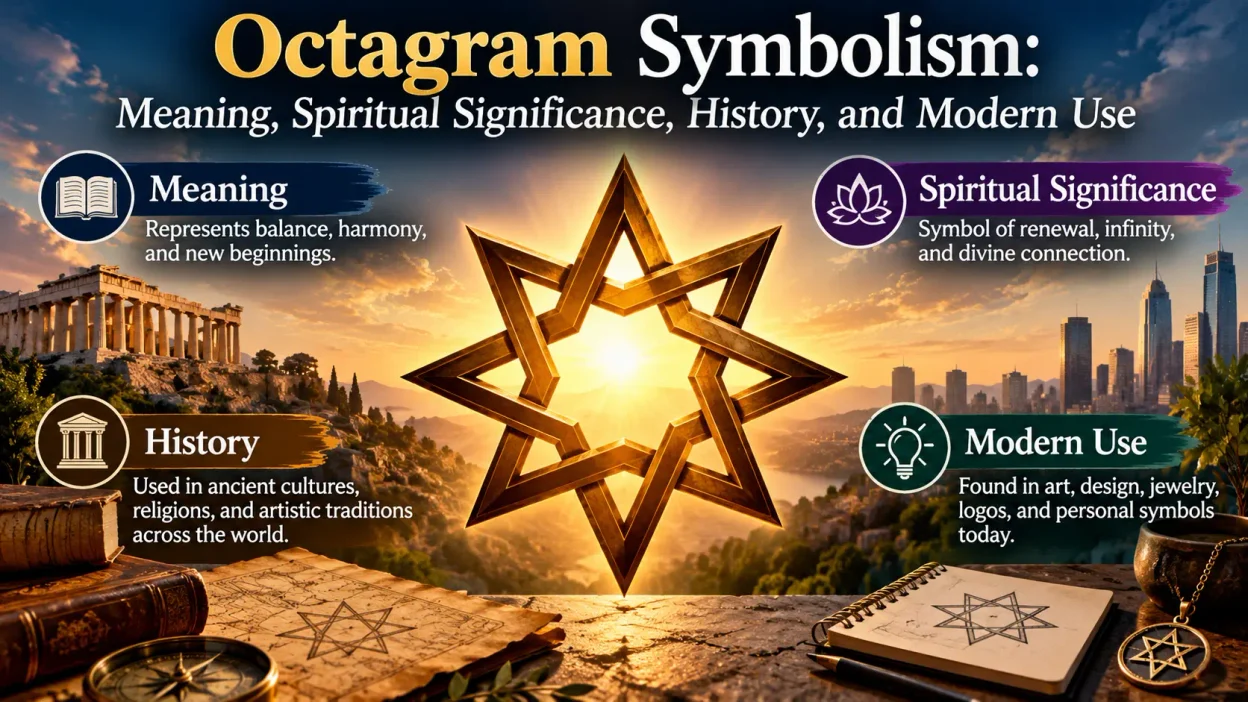
Octagram symbolism is connected with balance, harmony, renewal, infinity, and the relationship between the physical and spiritual worlds. An octagram is an eight-pointed star created by overlapping or intersecting geometric shapes. Its symmetrical design makes it a powerful symbol in mathematics, art, architecture, religious traditions, and contemporary spiritual practices.
Throughout history, eight-pointed stars have appeared in different cultural and artistic settings. Depending on the context, they may represent celestial power, divine order, regeneration, protection, or the balance of opposing forces. The number eight also carries symbolic importance in several traditions, often relating to cycles, completeness, and new beginnings.
However, the octagram does not have one universal meaning. Its interpretation depends on its design, historical setting, cultural background, and the beliefs of the person using it.
In this guide, we explore octagram symbolism, its spiritual meanings, historical associations, religious and cultural uses, and its role in modern art and personal expression.
What Is an Octagram?
An octagram is a geometric figure with eight points. It is commonly represented as an eight-pointed star formed by overlapping squares, although other constructions can also produce an octagram-like shape.
The word comes from the Greek elements octa, meaning eight, and gramma, meaning something written or drawn.
Octagrams can vary in appearance. Some have long, narrow points, while others feature intersecting lines, decorative patterns, or symmetrical geometric arrangements.
Because the design combines multiple lines into a unified figure, it can inspire interpretations involving structure, balance, interconnectedness, and the relationship between individual parts and a larger whole.
Common Features of an Octagram
- Eight points: Often associated symbolically with balance, renewal, and completeness.
- Geometric symmetry: Suggests order, structure, and harmony.
- Intersecting lines: Can represent interconnected ideas or relationships.
- Circular or decorative surroundings: May connect the star with cycles, continuity, or unity in particular designs.
These associations are interpretations rather than fixed meanings. An octagram used in a mathematical diagram, religious artwork, or decorative pattern may serve very different purposes.
Octagram Symbolism: Core Meanings
The octagram’s distinctive shape supports several common symbolic interpretations.
1. Balance and Harmony
One of the most common modern interpretations of the octagram is balance. Its eight points can be arranged symmetrically around a central area, creating a visual impression of stability and proportion.
This symmetry may represent the importance of balancing different parts of life, including work and rest, independence and cooperation, or ambition and contentment.
The octagram can also serve as a reminder that harmony does not require every aspect of life to be identical. Different elements can contribute to a balanced whole.
Symbolic lesson: Seek a healthy relationship between your responsibilities, relationships, personal goals, and well-being.
2. Infinity and Continuity
Although an octagram has a definite number of points, its intersecting lines can suggest connections that extend beyond any single point.
In some contemporary interpretations, this quality makes the symbol an image of continuity, interconnectedness, and the ongoing nature of personal growth.
The octagram is not the mathematical infinity symbol, but particular designs may be used artistically to suggest enduring relationships or recurring cycles.
Symbolic lesson: Life is made up of connected experiences, and one stage can influence the next.
3. Renewal and New Beginnings
The number eight is associated with renewal in some symbolic and religious traditions. One example is the Christian association of the eighth day with resurrection and new creation.
In broader modern symbolism, the octagram may therefore represent the completion of one phase and the beginning of another.
This interpretation can be meaningful during transitions such as starting a new career, rebuilding a relationship, or developing a different personal identity.
Symbolic lesson: Endings can create opportunities for growth and change.
4. Spiritual Awareness
In contemporary spiritual interpretations, the octagram may represent the connection between everyday experience and a broader search for meaning.
Its central point and outward-facing directions can be used metaphorically to describe the relationship between inner reflection and engagement with the outside world.
Some people use the design in meditation spaces, journals, or personal artwork as a visual reminder to remain attentive to their values and beliefs.
These uses reflect individual spiritual practice rather than a universal religious definition.
Symbolic lesson: Make time to reflect on your priorities and the principles that guide your decisions.
5. Protection and Security
Certain eight-pointed stars appear in protective designs, decorative objects, and religious or folk-art settings. In contemporary symbolism, an octagram may be chosen to represent safety, strength, and personal boundaries.
Its enclosed geometric structure can suggest a sense of order and stability.
However, not every octagram is historically a protective symbol, and there is no scientific evidence that wearing or displaying one provides supernatural protection.
Symbolic lesson: Let the symbol remind you to establish healthy boundaries and create supportive environments.
6. Unity and Interconnectedness
An octagram brings several lines and points together in one design. This can make it a useful metaphor for unity, especially when different parts contribute to a shared structure.
It may represent relationships among family members, cooperation within a community, or the idea that seemingly separate aspects of life influence one another.
Symbolic lesson: Recognize how your choices and relationships connect with the wider world.
7. Order and Structure
The octagram’s precise geometry can evoke mathematical order, symmetry, and carefully organized systems.
In symbolic artwork, it may represent the search for clarity in a complicated situation or the desire to create structure from uncertainty.
This association also reflects the octagram’s genuine mathematical properties: it can be studied through geometry, angles, symmetry, and the relationships between intersecting lines.
Symbolic lesson: Clear organization can help turn complicated goals into manageable steps.
The Spiritual Meaning of an Octagram
The spiritual meaning of an octagram varies according to the tradition and design in which it appears. Some modern spiritual interpretations associate the figure with harmony, renewal, wholeness, and the alignment of different aspects of life.
Balance Between Inner and Outer Life
The octagram can serve as a visual metaphor for balancing inner reflection with external responsibilities.
For example, a person may use the symbol as a reminder to make time for personal values while remaining engaged with family, work, and community.
A Symbol of Personal Growth
Its association with renewal may encourage reflection on habits, beliefs, and choices that are changing over time.
Rather than viewing growth as a single dramatic event, the octagram can represent the gradual process of learning from experiences and developing new perspectives.
Connection and Wholeness
Because the design combines several elements, some people interpret it as a representation of wholeness.
This meaning can apply to the integration of different aspects of identity, such as emotional, intellectual, creative, and social life.
A Reminder of Intention
Some people incorporate geometric symbols into meditation or personal rituals because a recognizable image can help them focus their attention.
An octagram might serve this purpose as a personal reminder of balance, patience, or a chosen goal. Its effectiveness in this context comes from the meaning the individual assigns to it, rather than from a guaranteed supernatural effect.
Octagram Symbolism in History
Eight-pointed stars have appeared in a variety of historical settings. However, similar geometric shapes do not necessarily share the same origin or meaning.
Ancient Mesopotamia
Eight-pointed stars are associated with ancient Mesopotamian art and religious imagery. One important example is the star associated with Inanna, a Mesopotamian goddess later identified with Ishtar in Akkadian tradition.
Inanna and Ishtar had complex associations that included love, sexuality, political power, and warfare. Their symbols and representations varied across periods and locations.
The eight-pointed star associated with these deities is a significant historical example, but it should not be assumed that every octagram represents Inanna or Ishtar.
Ancient and Later Decorative Art
Geometric stars have been used in many decorative traditions because they can be constructed through repeated shapes, overlapping lines, and symmetrical arrangements.
Their meanings depend on the objects, buildings, manuscripts, or artworks in which they appear.
Some designs were primarily decorative or mathematical, while others were incorporated into settings with religious, political, or cultural significance.
Medieval and Islamic Geometric Art
Eight-pointed stars are prominent in various forms of Islamic geometric ornament, including patterns created by combining squares and other geometric shapes.
Such patterns often demonstrate symmetry, repetition, proportion, and intricate mathematical relationships.
Their role should be understood within the broader traditions of Islamic art and architecture rather than assigned one universal spiritual meaning. Depending on the setting, an eight-pointed star may contribute to a larger ornamental system without functioning as an independent religious emblem.
Religious Art and Symbolic Interpretation
Eight-pointed stars also appear in different Christian and other religious contexts, although their meanings vary.
In some Christian symbolism, the number eight is associated with resurrection, baptism, and new creation. An eight-pointed design may be used in artwork connected with these ideas, but the interpretation depends on the specific object and tradition.
The presence of eight points alone does not prove that a design carries a particular religious meaning.
Octagram Symbolism Across Cultures and Traditions
The octagram’s appearance in different settings illustrates an important distinction: the same geometric form can acquire different meanings depending on its cultural context.
Mesopotamian Symbolism
In ancient Mesopotamian contexts, an eight-pointed star could be associated with Inanna or Ishtar. This is one of the more clearly identifiable historical associations of an eight-pointed star.
The meaning comes from a particular religious and cultural setting, not from a universal rule that all octagrams symbolize a goddess.
Islamic Geometric Traditions
In Islamic decorative art, eight-pointed stars may form part of complex patterns that emphasize geometric order, repetition, and symmetry.
These designs can demonstrate the relationship between individual shapes and an organized whole. Their significance is often connected to the artistic and architectural context in which they are used.
Christian Interpretations of the Number Eight
In some Christian traditions, eight is associated with resurrection and new creation. This association can inform the use of eight-sided or eight-pointed designs in certain religious settings.
However, Christian symbolism is diverse, and an octagram is not universally recognized as a standard Christian emblem.
Contemporary Spirituality
In modern spiritual and decorative contexts, the octagram may be used to represent balance, personal growth, continuity, or protection.
These meanings are often personal interpretations inspired by geometry and the symbolic associations of the number eight. They should be distinguished from documented historical meanings.
Octagram vs. Other Eight-Pointed Stars
The term octagram refers to a geometric figure with eight points, but it is not the only way to describe or interpret an eight-pointed star.
Different eight-pointed designs can look similar while having different construction methods or cultural associations.
| Symbol or design | General description | Important distinction |
|---|---|---|
| Octagram | An eight-pointed geometric star, often made from intersecting shapes | A geometric category rather than one universal religious symbol |
| Eight-pointed star | A broad descriptive term for a star with eight points | May or may not be a formal octagram |
| Eight-pointed star of Inanna/Ishtar | A historical religious symbol associated with Mesopotamian goddesses | Has a specific historical and cultural context |
| Islamic eight-pointed geometric pattern | A star formed as part of a larger ornamental arrangement | Often emphasizes symmetry and repeated geometry |
| Eight-spoked wheel | A circular design with eight spokes | May carry meanings distinct from an eight-pointed star |
The design’s construction and historical context are essential when identifying its symbolism.
Octagram Symbolism in Art and Architecture
The octagram is visually versatile, making it useful in decorative and architectural settings.
Geometric Ornament
Designers can use octagrams to create repeating patterns, tiled surfaces, borders, and symmetrical compositions.
The figure’s angles and intersections make it suitable for complex arrangements that appear orderly even when the overall pattern is intricate.
Architecture and Interior Design
Eight-pointed stars may appear in floors, ceilings, windows, decorative panels, and other architectural elements.
In these settings, they may contribute to a larger geometric pattern or reference a particular cultural style. Their meaning should be interpreted in relation to the building’s history and design.
Contemporary Graphic Design
Modern designers sometimes use octagrams in logos, illustrations, and decorative identities because the shape is distinctive and symmetrical.
Depending on the visual style, it can suggest precision, sophistication, tradition, or balance.
A design’s intended message depends on its wider branding and context rather than on the star shape alone.
Octagram Symbolism in Modern Spiritual Practices
Today, the octagram may be incorporated into personal artwork, jewelry, meditation spaces, and symbolic designs.
Meditation and Reflection
Some people use geometric figures as focal points during meditation or quiet reflection. An octagram can be chosen as a reminder to return attention to a specific intention, such as balance or patience.
There is no requirement to use a particular symbol for meditation, and the octagram has no universally prescribed practice.
Jewelry and Personal Accessories
An octagram pendant, ring, or decorative accessory may express a personal interest in geometry, cultural history, or spiritual symbolism.
Before interpreting such an object, it is helpful to identify the particular design and understand whether it comes from a specific cultural or religious tradition.
Personal Symbols and Intentions
Some people select the octagram as a personal emblem for a period of change or a long-term goal.
For example, someone working to improve work-life balance might use an eight-pointed star as a visual reminder of the different responsibilities they want to manage thoughtfully.
This is a personal use of symbolism, not evidence that the shape itself changes external circumstances.
Octagram Symbolism in Dreams
Dreams involving an octagram may feel significant because the symbol has a distinctive geometric appearance. However, there is no established scientific interpretation that assigns one universal meaning to an octagram dream.
You can use the image as a starting point for personal reflection.
Dreaming of a Bright Octagram
A bright or glowing octagram may evoke clarity, inspiration, or a desire for direction.
Consider whether you are seeking a clearer understanding of a decision or situation.
Dreaming of a Broken Octagram
A damaged or incomplete design might bring feelings of imbalance, uncertainty, or interrupted plans to mind.
This does not predict misfortune. It may simply offer a way to explore concerns you already have.
Dreaming of an Octagram in a Circle
A star enclosed by a circle can suggest wholeness or continuity in a personal interpretation.
The exact meaning depends on the dream’s emotional tone and the associations you already have with geometric symbols.
Drawing an Octagram in a Dream
Drawing the symbol may reflect an interest in creating order, expressing an idea, or finding a structured way to approach a problem.
Rather than relying on a fixed dream dictionary, consider what the symbol means to you and what was happening in your life when you had the dream.
What Does an Octagram Mean in Everyday Life?
The octagram can be used as a metaphor for balancing priorities and recognizing connections between different aspects of life.
| Life situation | Possible symbolic interpretation |
|---|---|
| Starting a new chapter | Renewal and fresh opportunities |
| Managing competing responsibilities | Balance and organization |
| Reflecting on personal beliefs | Spiritual awareness and intention |
| Working with a team | Interconnectedness and cooperation |
| Studying or solving a complex problem | Structure and clarity |
| Exploring cultural art | Historical context and geometric beauty |
| Building personal habits | Patience and gradual growth |
For example, if you feel overwhelmed by competing priorities, you might use the octagram’s symmetrical design as a reminder to review your commitments and decide where your attention is most needed.
The symbol becomes useful when it supports reflection and practical action.
Is the Octagram a Religious or Magical Symbol?
The octagram is not exclusively religious or magical. It is first and foremost a geometric design that appears in a range of artistic, cultural, and historical contexts.
Some eight-pointed stars have specific religious associations, including the star linked with Inanna and Ishtar in Mesopotamian traditions. Other examples appear in Islamic geometric ornament and in selected Christian contexts.
Modern spiritual practices may also assign personal meanings to the figure, including balance, protection, or renewal.
It is important to distinguish documented cultural uses from contemporary interpretations. There is no scientific evidence that an octagram inherently provides supernatural protection, attracts wealth, or controls events.
Frequently Asked Questions
1. What does an octagram symbolize?
An octagram may symbolize balance, harmony, renewal, continuity, interconnectedness, or spiritual reflection in modern interpretations. Its meaning depends on its design and cultural context.
2. What is the spiritual meaning of an octagram?
In contemporary spiritual symbolism, the octagram may represent personal growth, balance, and the connection between different aspects of life. These associations are not universal religious teachings.
3. What does an eight-pointed star mean in ancient history?
One important historical example is the eight-pointed star associated with Inanna in Sumerian tradition and Ishtar in later Mesopotamian contexts. Other eight-pointed stars have different histories and uses.
4. Is the octagram a symbol of protection?
Some modern interpretations use the octagram as a symbol of protection or security. However, not all octagrams have this meaning, and the symbol has no scientifically demonstrated protective power.
5. What does the number eight represent symbolically?
Depending on the tradition, eight may be associated with renewal, completeness, cycles, or new beginnings. Its meaning varies among cultures and should not be treated as universal.
6. Is an octagram the same as an eight-pointed star?
The terms are closely related. An octagram is a geometric star with eight points, while eight-pointed star is a broader descriptive phrase that can refer to several designs.
7. What does an octagram mean in Islamic art?
In Islamic geometric art, eight-pointed stars often form part of intricate patterns built around symmetry, repetition, and mathematical relationships. Their significance depends on the artistic and architectural context.
8. What does an octagram mean in Christianity?
In some Christian contexts, the number eight is associated with resurrection and new creation. An eight-pointed design may reflect those ideas in certain settings, but the octagram is not a universal Christian symbol.
9. What does dreaming of an octagram mean?
An octagram in a dream may inspire reflection on balance, clarity, personal growth, or uncertainty. Dream symbolism is subjective and does not reliably predict future events.
10. Can an octagram be used as a personal symbol?
Yes. People may use an octagram in jewelry, artwork, or meditation as a reminder of personal values or goals. Its meaning can be individual rather than tied to a specific tradition.
Conclusion
Octagram symbolism brings together geometry, cultural history, artistic expression, and modern spiritual interpretation. Its eight-pointed structure can suggest balance, order, renewal, continuity, and interconnectedness, while specific historical examples reveal meanings rooted in particular religious and cultural settings.
The eight-pointed star associated with Inanna and Ishtar provides an important example of its historical significance, while Islamic geometric art demonstrates how octagram-like designs can contribute to elaborate patterns and architectural decoration.
In contemporary life, the octagram may serve as a personal reminder to seek balance, approach change thoughtfully, and recognize the relationships between different parts of one’s life. Ultimately, its meaning depends on the context in which it appears and the interpretation supported by that context.