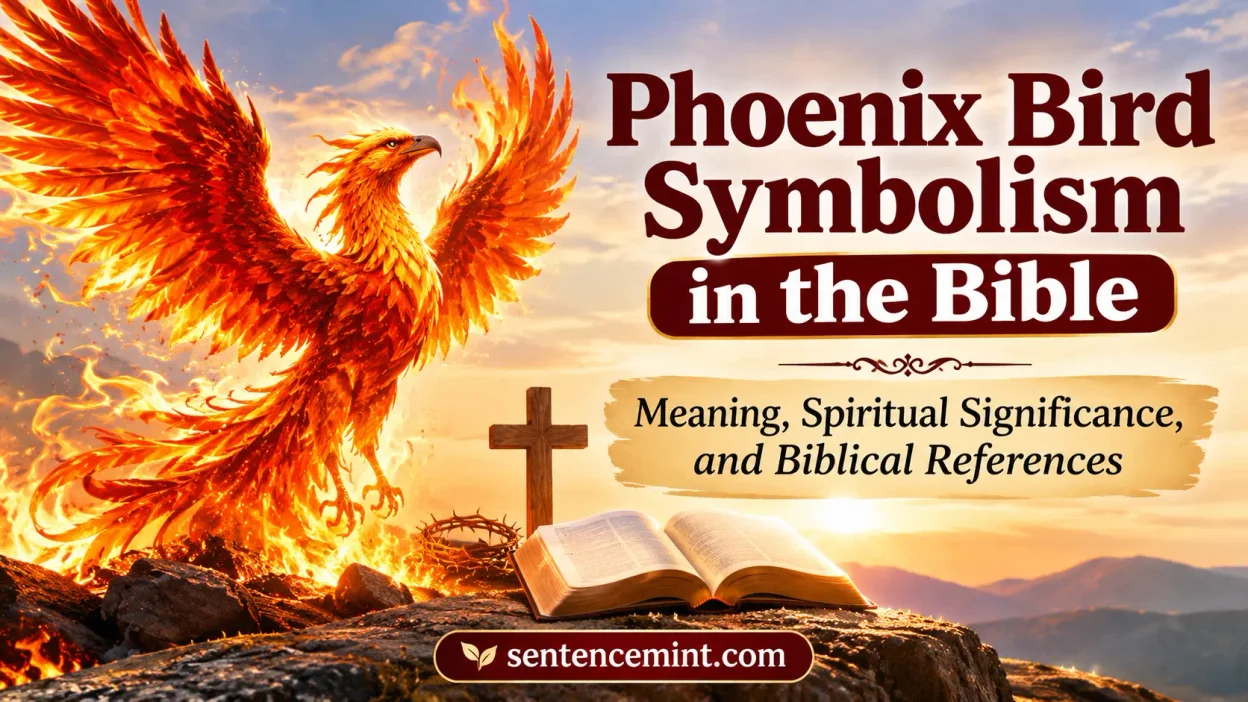
The phoenix is a legendary bird known for its remarkable ability to rise from its ashes after death. Across different cultures, it has become a powerful symbol of renewal, resurrection, immortality, hope, and transformation. Its story has also attracted Christian interest because of its similarities to themes found in the Bible, particularly resurrection and eternal life.
Phoenix bird symbolism in the Bible requires some historical and religious context. The phoenix is not a central biblical creature, and Scripture does not directly teach the familiar story of a bird dying in flames and being reborn from its ashes. However, an ancient reference to the phoenix appears in some translations and interpretations of Job 29:18. Early Christian writers also used the legendary bird as an illustration of resurrection.
Understanding this distinction helps explain why the phoenix is sometimes associated with Christian hope, spiritual renewal, and the promise of life beyond death.
What Does the Phoenix Symbolize in the Bible?
In Christian interpretations, the phoenix is often used as a symbol of resurrection, renewal, hope, eternal life, and spiritual transformation.
These meanings come primarily from comparisons between the legendary bird’s rebirth and biblical teachings about resurrection.
Common symbolic associations include:
- Resurrection: The phoenix rising from its ashes resembles the Christian belief in resurrection and new life.
- Renewal: Its rebirth represents the possibility of beginning again after difficult experiences.
- Hope: The phoenix offers a symbolic image of life emerging after apparent destruction.
- Immortality: Some ancient traditions describe the phoenix as a creature that renews itself rather than experiencing an ordinary death.
- Transformation: Its legendary cycle represents profound change and a new beginning.
- Faith: Christian interpretations sometimes use the phoenix to illustrate trust in God’s power over death.
- Victory over death: The bird’s return to life can serve as an illustration of the Christian hope of resurrection.
These are symbolic connections rather than meanings explicitly assigned to the phoenix throughout the Bible.
Is the Phoenix Mentioned in the Bible?
The phoenix is not a major biblical character or creature, but a possible reference appears in Job 29:18.
The wording differs among Bible translations. Some older translations use the word phoenix, while many modern translations use expressions such as sand or dust.
Job 29:18
In the King James Version, Job 29:18 reads:
“Then I said, I shall die in my nest, and I shall multiply my days as the sand.”
Some ancient interpretations connect the expression in this verse with the phoenix, while other translations understand it as referring to sand or dust.
The Hebrew word involved is difficult to interpret with certainty. Consequently, the verse should not be treated as an unquestionable biblical description of the legendary phoenix.
Symbolic interpretation: When understood through the ancient phoenix tradition, the passage can suggest longevity, renewal, and the hope of continued life.
Why Translations Differ
Biblical translations sometimes differ because ancient words can have multiple possible meanings and historical interpretations.
In Job 29:18, the translation choice reflects uncertainty about the original expression and how it should be understood.
For this reason, it is more accurate to say that some historical interpretations associate the verse with the phoenix rather than claiming that the Bible clearly describes the bird’s resurrection.
Phoenix Symbolism in Early Christianity
Although the phoenix is not a central figure in Scripture, early Christian writers sometimes used it as an illustration of resurrection.
The bird’s legendary return to life offered a visual example of how life could follow apparent death.
The Phoenix in Early Christian Writing
One important early Christian text is 1 Clement, traditionally attributed to Clement of Rome and generally dated to the late first century.
In chapter 25, the writer describes the phoenix as an example of God’s ability to bring life from death. The account reflects an ancient tradition in which the bird dies and returns to life through a new generation or renewal.
The writer uses this story as an illustration of the resurrection hope held by Christians.
It is important to understand that this passage does not establish the phoenix as a real biblical animal. Instead, it shows how an ancient legend was used to communicate a Christian idea.
Why Early Christians Used the Phoenix
The phoenix offered an accessible illustration of several religious themes:
- Life following death.
- Hope beyond apparent destruction.
- God’s power over creation.
- Renewal after suffering.
- Confidence in resurrection.
The image was particularly useful because the bird’s legendary story could be understood as a metaphor for the Christian belief that death does not have the final word.
Spiritual Meanings of the Phoenix in Christian Symbolism
The phoenix has developed several spiritual meanings through its association with resurrection and renewal.
1. Resurrection and New Life
The most important Christian association of the phoenix is resurrection.
According to its legend, the bird rises again after death. This resembles the central Christian belief that Jesus Christ rose from the dead.
The comparison is symbolic rather than an exact theological equivalence. The resurrection of Jesus is a foundational Christian teaching, while the phoenix is a legendary creature.
Spiritual lesson: The phoenix can serve as an illustration of hope and new life, reminding believers of the Christian promise of resurrection.
2. Renewal and Fresh Beginnings
The phoenix is commonly associated with starting again after an ending.
In Christian reflection, this can be connected with spiritual renewal, repentance, and the opportunity to develop a closer relationship with God.
The idea of becoming renewed appears in passages such as Romans 12:2, which encourages believers to experience transformation through the renewing of their minds.
Spiritual lesson: A difficult season does not have to define the rest of your life. Faith can encourage reflection, growth, and a fresh beginning.
3. Hope During Difficult Times
The phoenix’s legendary ability to return after destruction makes it a symbol of hope.
Christian teachings also encourage believers to remain hopeful during suffering and uncertainty.
Romans 15:13 describes God as the source of hope, while 2 Corinthians 4:8–9 discusses enduring hardship without being abandoned or destroyed.
Spiritual lesson: Hope can help people face challenges while trusting that difficult circumstances do not determine the final outcome.
4. Victory Over Death
Christianity teaches that Jesus Christ conquered death through his resurrection.
The phoenix can serve as a symbolic illustration of this victory because its legendary story describes life returning after death.
However, Christian theology distinguishes the resurrection of Christ from the mythical rebirth of the phoenix.
Spiritual lesson: The phoenix can remind believers of the Christian hope that death is not the ultimate end.
5. Transformation Through Faith
The phoenix’s transformation is often used as a metaphor for becoming renewed.
This interpretation connects with biblical teachings about leaving behind old ways and developing a transformed life.
In 2 Corinthians 5:17, the apostle Paul describes those who are in Christ as a new creation.
Spiritual lesson: Spiritual transformation involves more than changing outward circumstances. It includes developing new attitudes, values, and ways of living.
6. Immortality and Eternal Life
Some ancient traditions describe the phoenix as a bird that repeatedly renews itself and therefore symbolizes immortality.
Christianity has its own teaching about eternal life through faith in Jesus Christ.
John 3:16 is one of the best-known biblical passages describing the promise of eternal life.
Spiritual lesson: The phoenix may represent the hope of life beyond death, but Christian beliefs about eternal life are grounded in God’s promise rather than the legendary powers of the bird.
Phoenix Symbolism and Important Bible Verses
Several biblical passages connect with themes that people associate with the phoenix. These verses do not directly describe the bird, but they provide a foundation for understanding its Christian symbolism.
| Bible verseMain themeConnection to phoenix symbolism | ||
|---|---|---|
| Job 29:18 | Longevity and hope | Sometimes historically associated with the phoenix |
| Romans 12:2 | Renewal of the mind | Spiritual transformation |
| 2 Corinthians 5:17 | New creation | Beginning a renewed life |
| Romans 15:13 | Hope and faith | Hope during difficult circumstances |
| John 11:25 | Resurrection and life | Christian belief in life beyond death |
| 1 Corinthians 15:42–44 | Resurrection of the dead | Transformation from mortality |
| Isaiah 40:31 | Renewed strength | Strength and perseverance |
These passages provide biblical context for the themes associated with the phoenix without suggesting that Scripture directly teaches its legendary life cycle.
Phoenix Symbolism Compared With Biblical Resurrection
The phoenix and Christian resurrection share some symbolic similarities, but they are not the same concept.
The phoenix comes from ancient mythology, while Christian resurrection is a central religious belief based on the resurrection of Jesus Christ and the promised resurrection of believers.
| Phoenix symbolism | Biblical resurrection |
|---|---|
| A legendary bird returns to life after death. | Jesus Christ rises from the dead. |
| Represents renewal and immortality in ancient traditions. | Represents victory over death and the promise of eternal life. |
| Its story varies across historical accounts. | Its meaning is grounded in Christian Scripture and doctrine. |
| Often symbolizes personal transformation. | Includes spiritual renewal and resurrection of the dead. |
| A mythical image. | A foundational Christian belief. |
The comparison is useful for understanding why early Christian writers found the phoenix meaningful, but the two should not be treated as interchangeable.
What Does the Phoenix Represent in Christian Art?
The phoenix appeared in some early Christian artistic traditions as a visual symbol of resurrection and eternal life.
Early Christian communities sometimes used familiar images from the surrounding culture to communicate religious ideas.
The phoenix was particularly suitable because its legendary return to life could represent hope beyond death.
Its image could communicate:
- Resurrection: Life following death.
- Eternal hope: Confidence in life beyond the grave.
- Renewal: The possibility of a new beginning.
- Divine power: God’s authority over life and death.
- Spiritual victory: The triumph of hope over despair.
The phoenix should be understood as a symbolic image in these contexts, not as an object of Christian worship.
What Does Seeing a Phoenix Mean Spiritually?
Seeing a phoenix in artwork, jewelry, a dream, or another setting may carry personal symbolic meaning.
Some modern spiritual interpretations associate the phoenix with:
- A fresh beginning after a difficult period.
- Personal growth and transformation.
- Courage during uncertainty.
- Hope after loss or disappointment.
- The strength to move forward.
- Renewal of faith and purpose.
From a Christian perspective, seeing a phoenix does not automatically mean that God is sending a specific message or predicting a future event.
A person may use the image as a reminder to reflect on biblical teachings about hope, perseverance, repentance, and renewal.
What Does a Phoenix in a Dream Mean According to the Bible?
The Bible does not provide a specific interpretation for dreaming about a phoenix.
Because the phoenix is a legendary creature rather than a clearly established biblical animal, there is no universally accepted Christian interpretation of such a dream.
However, some people may use the image as a prompt for personal reflection.
Possible Symbolic Interpretations
- Rising from difficulties: You may be thinking about overcoming a challenging experience.
- New beginnings: The dream may reflect a desire to make a fresh start.
- Spiritual renewal: It may encourage reflection on your faith and personal values.
- Hope: The image may represent a desire for better circumstances.
- Transformation: It may reflect changes in your identity, priorities, or outlook.
These are personal interpretations, not biblical promises or predictions. A phoenix dream should not be treated as proof of a supernatural message.
Is the Phoenix a Christian Symbol?
The phoenix has been used as a Christian symbol, particularly in early Christian writing and some artistic traditions.
Its legendary return to life made it a useful illustration of resurrection and eternal hope.
However, it is important to distinguish between a symbol used by Christians and a creature directly established by biblical teaching.
The phoenix is not a central biblical symbol like the cross or the lamb. Its Christian significance comes from the way some early believers and later artists connected its legend with resurrection.
Lessons Christians Can Learn From Phoenix Symbolism
Although the phoenix is a legendary creature, its symbolic associations can inspire reflection on several biblical principles.
1. Do Not Lose Hope
The phoenix represents hope after apparent destruction. Christians can connect this idea with biblical encouragement to remain hopeful during difficult circumstances.
2. Embrace Spiritual Renewal
Romans 12:2 encourages believers to experience transformation through the renewal of their minds. The phoenix can serve as a visual reminder of this process.
3. Trust in God’s Power
The Christian message of resurrection emphasizes that God has power over death. The phoenix can illustrate this idea without replacing the biblical teaching.
4. Learn From Difficult Experiences
Challenges can encourage reflection, patience, and personal development. The phoenix’s symbolic transformation can represent the possibility of moving forward.
5. Remember the Promise of Resurrection
For Christians, the most important connection is the hope of resurrection through Jesus Christ, not the mythical life cycle of a legendary bird.
Frequently Asked Questions
1. What does the phoenix symbolize in the Bible?
In Christian interpretations, the phoenix symbolizes resurrection, renewal, hope, transformation, and victory over death. These meanings come from comparisons between the bird’s legendary rebirth and biblical teachings about resurrection.
2. Is the phoenix actually mentioned in the Bible?
Some older Bible translations and historical interpretations associate the phoenix with Job 29:18. However, many modern translations use words such as sand or dust. The identification is uncertain.
3. What Bible verse mentions the phoenix?
Job 29:18 is the passage traditionally associated with the phoenix in some translations and interpretations. The original Hebrew expression is disputed, so the reference is not universally accepted as a direct mention of the legendary bird.
4. What does the phoenix symbolize in Christianity?
In Christian symbolism, the phoenix can represent resurrection, eternal hope, spiritual renewal, and victory over death. Early Christian writers sometimes used the bird as an illustration of resurrection.
5. Why did early Christians use the phoenix as a symbol?
Early Christians used the legendary bird as an illustration of resurrection because its traditional story described life returning after death. The image helped communicate the idea of hope beyond the grave.
6. Does the phoenix represent Jesus Christ?
The phoenix is sometimes used as a symbolic illustration of Christ’s resurrection. However, it is not Jesus Christ himself, and the legendary bird should not be confused with the Christian account of the resurrection.
7. What does the phoenix rising from ashes mean spiritually?
It commonly represents renewal, transformation, hope, and the ability to move forward after difficult experiences. In Christian-inspired interpretations, it can remind believers of spiritual renewal and resurrection.
8. Is the phoenix a biblical animal?
The phoenix is primarily a creature of ancient mythology. Its possible connection with Job 29:18 is debated, and the Bible does not provide a clear description of the familiar phoenix legend.
9. What does a phoenix dream mean biblically?
The Bible does not give a specific meaning for phoenix dreams. Some people interpret the image as a personal reminder of hope, renewal, or transformation, but it should not be treated as a biblical prophecy.
10. Does the phoenix symbolize eternal life?
In ancient traditions, the phoenix was associated with immortality and renewal. In Christianity, it can illustrate the hope of eternal life, but Christian teaching grounds that hope in God and the resurrection of Jesus Christ.
11. What is the difference between phoenix symbolism and resurrection symbolism?
Phoenix symbolism comes from an ancient legendary bird that renews itself after death. Biblical resurrection refers to God’s power to raise the dead, especially the resurrection of Jesus Christ. The two share imagery but have different religious foundations.
12. Is the phoenix a positive symbol in Christianity?
It is generally used positively in Christian symbolic interpretation because it can represent hope, resurrection, renewal, and life beyond death. However, its meaning depends on the context in which it appears.
Conclusion
Phoenix bird symbolism in the Bible is closely connected with resurrection, hope, renewal, and spiritual transformation. Although the familiar story of a phoenix rising from its ashes comes from ancient mythology rather than a clear biblical account, the image has a meaningful history in Christian interpretation.
Job 29:18 is sometimes associated with the phoenix, and early Christian writing, particularly 1 Clement, uses the legendary bird to illustrate the possibility of resurrection.
For Christians, the most important message is not the mythical power of the phoenix but the biblical promise of new life through Jesus Christ. The bird can serve as a reminder that hope can remain even in difficult times and that spiritual renewal is possible through faith.