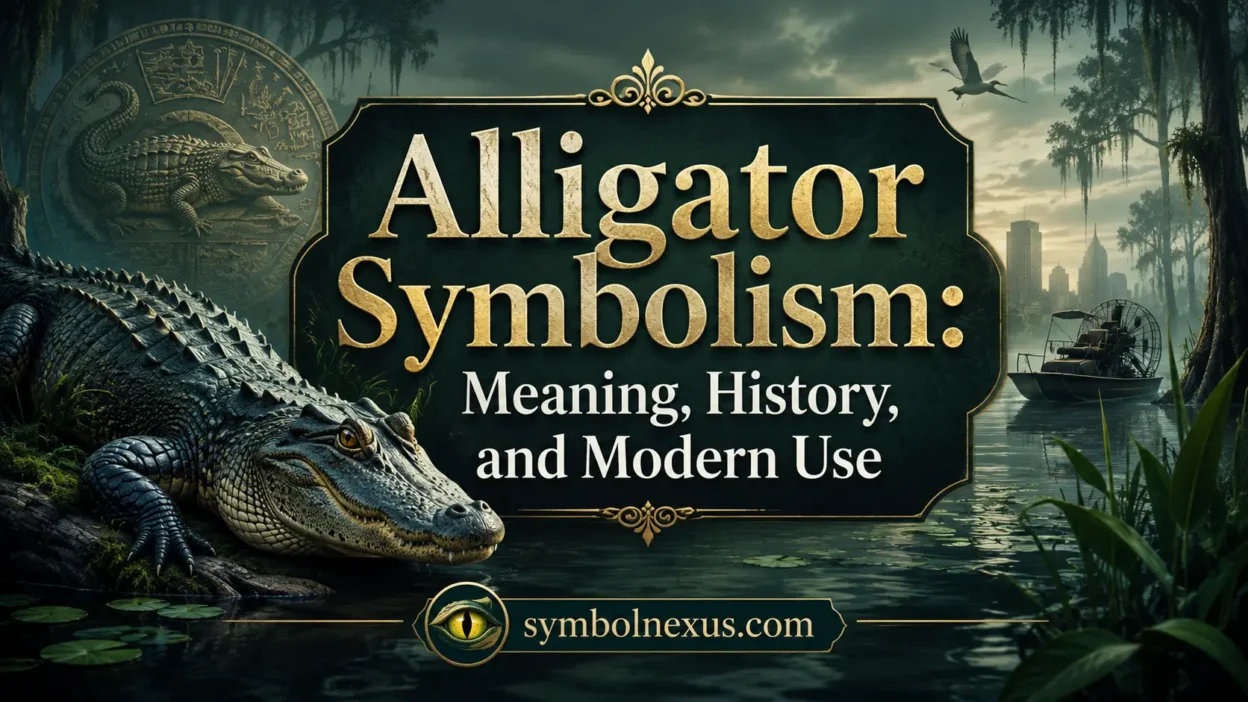
Alligator symbolism commonly centers on survival, patience, guarded strength, protection, and respect for boundaries. In the United States, these meanings are shaped by the animal’s real presence in Southern wetlands, its controlled hunting behavior, and its ability to remain almost invisible before acting.
People encounter alligators in wildlife photography, sports logos, regional art, tattoos, souvenirs, movies, and stories about the American South. The animal can inspire confidence and admiration, but it can also communicate danger, secrecy, aggression, or a warning not to come closer.
That tension is a major reason the alligator works so well as a symbol. It is neither simply heroic nor purely threatening. Its meaning changes according to posture, setting, cultural context, and the intention of the person using the image.
Quick Answer
Alligator symbolism most commonly represents survival, patience, protective strength, and firm personal boundaries in modern American culture. Historically, the animal has also been connected with Southern wetlands, Indigenous and regional traditions, danger, resourcefulness, and human adaptation to difficult environments.
TL;DR
- Alligators commonly symbolize survival, patience, strength, and protection.
- Their hidden posture suggests observation and carefully timed action.
- In the South, they represent wetlands and regional identity.
- Mothers guarding nests inspire meanings of fierce family protection.
- Tattoos often express toughness, independence, or personal boundaries.
- The animal can also warn of danger or concealed aggression.
What the Alligator Looks Like and Why It Matters
The American alligator has a dark, armored body, short legs, a muscular tail, and a wide, rounded snout. Its eyes and nostrils sit high on its head, allowing much of the body to remain underwater while the animal watches its surroundings.
These physical traits shape much of its modern meaning. The bony plates along its back resemble natural armor, so images of an alligator often suggest protection, toughness, and resistance to harm. Its heavy jaw represents physical force, while its low position in the water creates an impression of secrecy and restraint.
The animal’s appearance also produces a clear warning. An alligator does not need bright colors, raised fur, or constant movement to appear threatening. Its stillness alone can signal that danger is present, even when nothing is happening yet.
Core Alligator Meanings at a Glance
The alligator carries several related meanings rather than one fixed definition. Context determines whether the image feels protective, intimidating, regional, humorous, or personal.
| Context | Common Meaning in the USA | Typical Associations | Important Detail |
|---|---|---|---|
| Wildlife and nature | Survival and adaptation | Swamps, rivers, wetlands | Based on the animal’s real habitat |
| Tattoos | Strength and boundaries | Independence, endurance, warning | Meaning depends on the design |
| Family imagery | Protection | Motherhood, defense, loyalty | Inspired by nest-guarding behavior |
| Sports and identity | Pride and toughness | Competition, loyalty, Southern identity | Often energetic rather than threatening |
| Dreams and personal reflection | Hidden concerns or instincts | Caution, fear, patience | Not a scientific prediction |
| Dark art or storytelling | Danger and concealed aggression | Ambush, betrayal, hostile territory | Usually shaped by fictional portrayals |
The most common positive meanings are resilience, patience, protection, and self-control. Negative meanings usually involve danger, ruthlessness, secrecy, or aggression.
Quiet Strength Rather Than Constant Force
An alligator often represents power that does not need to be displayed continuously. It spends long periods appearing still, yet it remains alert and physically capable of acting quickly.
For this reason, the animal can symbolize a person who is calm but not weak. Such a person may conserve energy, avoid unnecessary conflict, and respond only when a situation truly requires action.
This differs from symbols of loud dominance. A roaring lion or charging bull displays strength openly. The alligator suggests controlled strength—the ability to remain composed without surrendering authority.
In personal art, this meaning may appeal to someone who values discipline, emotional restraint, or confidence that does not depend on public approval.
Patience, Observation, and Strategic Timing
Because alligators may wait quietly before moving, they have become natural symbols of patience and timing. The image can suggest watching a situation carefully instead of reacting to every disturbance.
In a positive sense, this represents preparation. A person waits until the facts are clear, chooses the right moment, and acts decisively. The emphasis is not on trickery but on avoiding wasted effort.
However, the same behavior can take on a darker meaning. In thrillers, crime stories, and cautionary imagery, a partly hidden alligator may represent a threat that has not yet revealed itself.
The difference lies in intention. Patient observation can show wisdom and self-control, while secretive waiting can suggest manipulation or concealed hostility.
Protection, Motherhood, and Family Loyalty
Alligators are sometimes treated as symbols of coldness because they are reptiles. Their parenting behavior complicates that stereotype.
Female alligators build nests, remain near them, respond to calls from hatchlings, and help young reach the water. This protective behavior gives the animal a credible connection with motherhood, family defense, and vigilance.
An alligator design showing a mother with young can therefore express a direct message: family members will be protected, and outsiders should respect that bond.
This meaning is especially suitable for tattoos or artwork created by parents. It communicates care without softness and affection without helplessness.
The symbolism is not about being aggressive toward everyone. It is about becoming formidable when something vulnerable is threatened.
Boundaries, Territory, and Self-Defense
An alligator near the edge of water can function like a visual boundary marker. Its presence tells the viewer that entering another creature’s space may have consequences.
As a personal symbol, it may represent the right to protect one’s privacy, home, emotional well-being, or family. It often appeals to people who have learned to set firmer limits after being ignored, pressured, or mistreated.
A closed-mouth alligator may suggest controlled authority. An open mouth, visible teeth, or raised body usually makes the message more confrontational.
This is why posture matters in visual design. The animal can say “I am secure and watchful,” or it can say “Do not test me.” Those are related messages, but they create very different emotional effects.
Survival and Adaptation in Difficult Environments
The American alligator lives in marshes, swamps, lakes, ponds, rivers, and other freshwater environments across much of the southeastern United States. Its ability to function in muddy, flooded, hot, and seasonally changing habitats supports its association with endurance.
Symbolically, the wetland becomes an uncertain environment where solid ground is not always visible. The alligator survives because it is suited to that world rather than because it can force the world to become easier.
That makes it a fitting image for adaptation. It can represent learning to operate within difficult circumstances, conserving resources, and using existing strengths instead of waiting for perfect conditions.
For someone recovering from hardship, the image may communicate: “I survived because I learned how to live in the conditions I faced.”
The Alligator’s Role in Wetland Life
The alligator is more than a predator. In the Everglades, it also changes the surrounding habitat by creating and maintaining depressions known as alligator holes.
These areas can hold water during dry periods, offering refuge to fish and other wildlife. Nests, trails, and holes created by alligators also affect plants and animals across the wetland ecosystem.
This ecological role adds another layer of meaning. The animal may symbolize influence that extends beyond obvious actions. Simply by building a place for itself, it can create conditions that help other life persist.
In environmental artwork, the alligator can therefore represent the interdependence of wetlands. Removing or harming one important species may affect many organisms that seem unrelated to it.
This meaning is less common in commercial imagery, but it is especially relevant in conservation, education, and Everglades restoration.
Indigenous and Seminole Cultural Contexts
Alligators have shared the southeastern landscape with Indigenous peoples for generations, but there is no single “Native American alligator meaning.” Tribal nations have distinct languages, histories, stories, and relationships with local animals.
In Florida, the animal has a particularly visible connection with Seminole life and public history. Alligator handling and wrestling became associated with tourism, exhibitions, economic survival, and the presentation of Seminole identity to outside audiences. The Seminole Tribe of Florida continues to recognize alligator wrestling among its living cultural traditions.
That history should not be reduced to the claim that the alligator simply means “warrior” or “courage” to all Seminole people. Its cultural role involves practical knowledge, environmental familiarity, tourism, livelihood, performance, adaptation, and Tribal self-representation.
Using Indigenous-inspired alligator imagery responsibly requires specificity. A person should identify the particular nation, artist, story, or object involved rather than attaching a broad spiritual definition to every design.
Colonial Naming and the Growth of an American Image
The English word alligator developed from the Spanish phrase el lagarto, meaning “the lizard.” English speakers gradually reshaped the sound into the modern word, which was in recorded use by the late sixteenth century.
As European settlement expanded through Florida and the broader Southeast, descriptions of the animal often emphasized its unfamiliar size, armored skin, teeth, and aquatic habits. Fear, fascination, hunting, and trade all influenced its developing image.
Over time, the alligator became closely tied to ideas of the swamp: heat, dark water, isolation, danger, and land that resisted easy control. American fiction and travel promotion later expanded that image.
The result was a distinctly regional symbol. For many Americans, an alligator does not merely represent a reptile. It evokes Florida, Louisiana, the Everglades, bayous, roadside attractions, airboats, and Southern wildlife.
What It Commonly Means in the United States
In the United States, the alligator has both local and national meanings. In Southern states, it can be a familiar part of the environment, a source of regional pride, and a reminder that wild nature exists close to homes and communities.
The American alligator is the official state reptile of Florida, Louisiana, and Mississippi. This official status strengthens its connection with state identity and local wildlife.
Sports culture has given the animal a more playful and competitive meaning. The University of Florida’s Gators identity and its mascots, Albert and Alberta, turn the reptile into a symbol of loyalty, school spirit, toughness, and energetic competition.
Tourism uses the image differently. A smiling cartoon gator on a shirt or souvenir may represent Florida vacations, humor, heat, or swamp adventure rather than danger.
These examples show how symbolism changes through presentation. The same animal may appear fierce on a team logo, friendly in a children’s design, or ecologically important in a national park exhibit.
A Conservation Comeback and the Meaning of Resilience
The American alligator’s modern image is also shaped by its recovery from severe population decline. Hunting, poaching, demand for hides, and habitat loss once placed major pressure on the species.
Federal and state protections helped populations recover, and the animal was removed from the endangered species list in 1987. It is now widely described as an important American conservation success, although habitat protection and responsible management remain necessary.
This history supports the alligator’s association with resilience. Its survival was not simply the result of natural toughness. Recovery depended on laws, habitat management, public cooperation, and changes in human behavior.
That distinction matters. The story does not prove that strong species can survive anything without help. Instead, it shows that decline can be reversed when people recognize damage and take coordinated action.
Cross-Cultural Crocodilian Meanings
Outside the United States, many famous symbolic traditions involve crocodiles or other crocodilians rather than true alligators. These animals may look similar in art, but they should not automatically be treated as interchangeable.
In ancient Egypt, the god Sobek was represented as a crocodile or a crocodile-headed man. He was connected with the Nile, strength, protection, fertility, and the dangerous life-giving force of water.
Those meanings can help explain the broader human response to large aquatic reptiles. People may fear such animals while also respecting their strength and their relationship with essential waterways.
However, calling Sobek an “alligator god” is inaccurate. Ancient Egyptian imagery refers to crocodiles. Modern designs that combine Sobek with an American alligator are creative reinterpretations, not faithful copies of the original tradition.
The Chinese alligator provides another reminder that the animal is not exclusively American, although most modern English-language symbolism focuses on the larger and more culturally visible American species.
Tattoos, Jewelry, Fashion, and Personal Style
An alligator tattoo often represents survival, toughness, patience, or the defense of personal boundaries. It may also express pride in Florida, Louisiana, Mississippi, or the broader Gulf Coast and Southeast.
Design details can change the message:
- A resting alligator suggests watchfulness and self-control.
- An open-jawed alligator communicates warning or confrontation.
- An alligator with hatchlings emphasizes family protection.
- A swamp background highlights regional identity and adaptation.
- Scars or damaged armor may represent survival after hardship.
- A cartoon gator creates a playful or nostalgic meaning.
Alligator teeth, scale patterns, leather textures, and silhouettes also appear in jewelry and fashion. These designs commonly communicate toughness, luxury, danger, or a rugged Southern style.
Ethical concerns may arise when real hides, teeth, or other animal materials are used. Buyers may prefer legally documented materials, vintage pieces with clear provenance, or designs made from metal, fabric, resin, or synthetic leather.
In home decor, the meaning depends on the room and style. A realistic alligator image may create a wild, dramatic atmosphere, while a brightly colored illustration can feel humorous or coastal.
Emotional and Psychological Interpretation
Psychologically, the alligator often represents instincts that remain beneath conscious awareness. This interpretation comes from the animal’s hidden position in water and its ability to appear suddenly, not from a clinical rule.
Someone drawn to the symbol may identify with emotional control, caution, independence, or the need for stronger defenses. The image can also appeal to people who prefer observing before speaking.
In dreams, an alligator may reflect fear of an unpredictable person, awareness of a tense environment, or concern that an ignored problem could become serious. It might also represent the dreamer’s own protective instincts or anger.
Dream context is more useful than a fixed dictionary meaning. A calm alligator at a distance creates a different message from one chasing the dreamer. Water conditions, location, emotions, and personal experiences all influence interpretation.
Dream imagery should not be treated as a prediction of betrayal, attack, or disaster. It is better understood as a prompt to examine current feelings and circumstances.
Positive and Negative Meanings
The alligator’s positive and negative meanings come from the same traits. Armor can suggest protection, but it can also suggest emotional hardness. Patience may represent wisdom, or it may appear calculating. Strength can defend others, or it can become intimidation.
Positive associations include:
- Resilience
- Protective parenting
- Patience
- Alertness
- Adaptability
- Confidence
- Environmental balance
- Regional pride
Negative associations include:
- Hidden danger
- Aggression
- Ruthlessness
- Territorial hostility
- Emotional distance
- Predatory behavior
- Fear of the unknown
Neither side is automatically correct. The intended meaning depends on the design, story, and setting.
A small smiling gator on a child’s shirt is unlikely to symbolize ruthlessness. A dark image showing only eyes above black water probably emphasizes hidden risk. Visual evidence should guide interpretation.
Common Misunderstandings and Misuse
One common mistake is treating alligators and crocodiles as the same animal. Alligators generally have broader, more rounded snouts and darker coloring, while crocodiles usually have narrower snouts and greater tolerance for saltwater.
A second mistake is assigning one universal spiritual meaning to every alligator image. Symbols do not function like fixed vocabulary words. A tattoo, Tribal artwork, sports mascot, conservation logo, and movie monster may use the same animal for different reasons.
People should also be cautious about invented Indigenous claims. Describing the alligator as a universal Native symbol of ancient wisdom, medicine, or spiritual awakening erases the differences among Tribal nations and may spread unsupported information.
Another distortion comes from entertainment. Horror movies and sensational news can make alligators seem like creatures that constantly hunt people. In reality, they are wild predators that require distance and respect, not fictional villains with human motives.
Responsible symbolism begins with accuracy. Respect the animal, distinguish cultural traditions, and avoid turning fear into false information.
FAQs
Is an alligator a positive symbol?
It can be positive when it represents resilience, protection, patience, or adaptability. The same image may become negative when it emphasizes predatory behavior, concealed danger, or uncontrolled aggression.
What does an alligator tattoo mean?
An alligator tattoo often means survival, toughness, self-control, regional pride, or strong personal boundaries. The pose, background, facial expression, and surrounding symbols determine the more specific message.
What does an alligator symbolize spiritually?
In modern personal spirituality, it may represent instinct, watchfulness, emotional protection, or the ability to survive difficult conditions. These are contemporary interpretations rather than one universal religious teaching.
What does seeing an alligator in a dream mean?
It may reflect caution, hidden tension, fear, anger, or a need to protect yourself. The dreamer’s emotions and current circumstances are more important than any fixed dream definition.
Does the alligator symbolize motherhood?
It can symbolize protective motherhood because female alligators guard nests and assist their young. Designs showing a mother and hatchlings often emphasize family loyalty and fierce defense.
Is the alligator connected with Florida symbolism?
Yes. The animal is strongly associated with Florida’s wetlands, tourism, wildlife, sports culture, and regional identity. It is also Florida’s official state reptile.
Are alligator and crocodile meanings the same?
They overlap because both are armored aquatic predators associated with strength and danger. However, historical traditions involving crocodiles—such as the worship of Sobek in ancient Egypt—should not automatically be relabeled as alligator traditions.
Conclusion
Alligator symbolism combines survival, patient observation, guarded strength, protection, and respect for boundaries. Its darker side includes concealed danger, aggression, emotional hardness, and the fear of entering territory that is not fully understood.
In the United States, the animal also carries a specifically Southern identity shaped by wetlands, Seminole history, conservation, sports, tourism, and everyday life near wild habitats.
The alligator remains meaningful because its image holds two truths at once: strength can be quiet, and stillness should never be mistaken for helplessness.