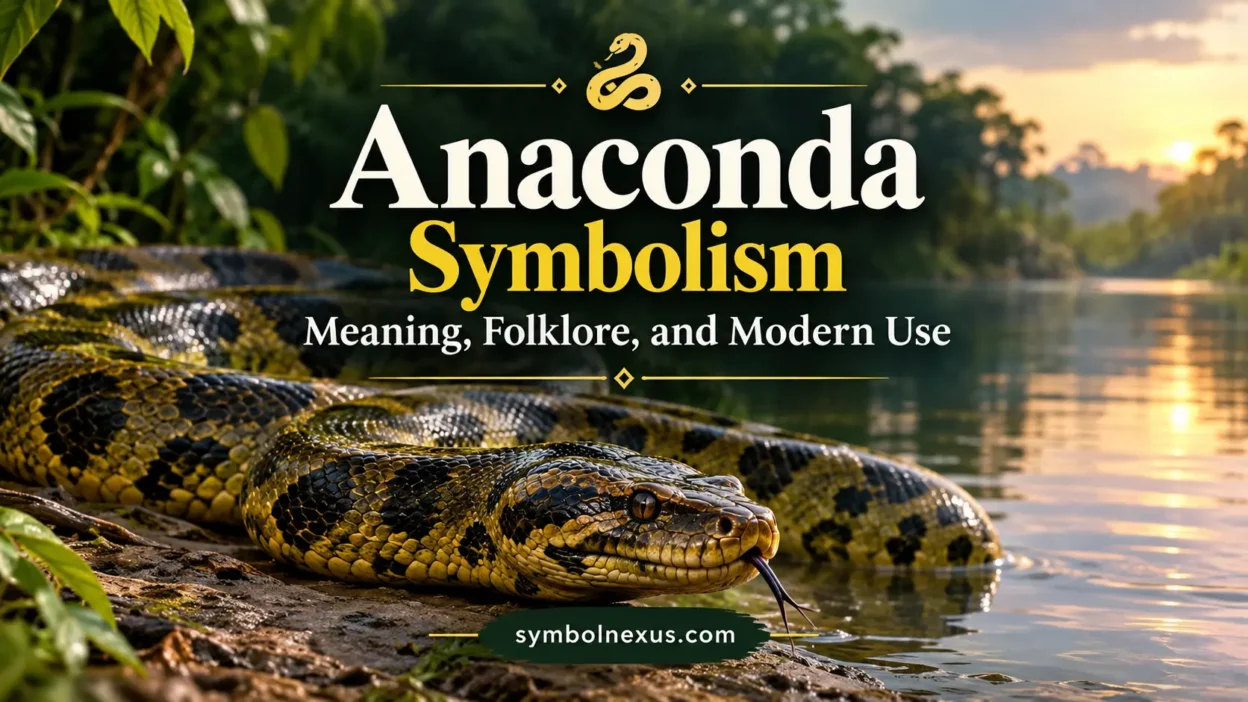
Anaconda symbolism often centers on strength, patience, survival, and the ability to overcome obstacles. As one of the world’s largest snakes, the anaconda has a commanding presence that makes it a natural subject for stories about power, danger, and the hidden forces of nature. Its meaning depends on the context, whether it appears in wildlife documentaries, South American folklore, dreams, artwork, or modern tattoo designs.
Anacondas are native to tropical South America, where they inhabit rivers, swamps, wetlands, and other areas with abundant water. Their size, camouflage, and ambush-hunting behavior have helped create an image of an animal that waits quietly before acting. These real characteristics often shape the symbolic meanings people associate with the snake.
In the United States, anacondas appear in nature programming, adventure films, fantasy stories, and discussions about dangerous wildlife. Some people admire their strength and adaptability, while others associate them with fear, hidden threats, or situations that feel difficult to escape.
Understanding anaconda symbolism requires separating the animal’s actual behavior from the meanings people assign to it. The result is a more grounded view of how this remarkable snake represents survival, restraint, uncertainty, and the complex relationship between humans and the natural world.
Quick Answer
Anaconda symbolism commonly represents strength, patience, survival, and hidden danger in modern American culture. In South American settings, the snake may also connect with local stories about powerful water-dwelling beings, although specific meanings vary across Indigenous communities, regional traditions, and individual narratives.
TL;DR
- Anacondas commonly symbolize physical strength, patience, survival, and concealed danger.
- Their ambush-hunting behavior inspires associations with timing and strategic restraint.
- South American folklore includes varied stories about giant serpents and powerful waters.
- American movies often portray anacondas as frightening predators or symbols of wilderness.
- Anaconda tattoos may represent resilience, confidence, protection, or personal transformation.
- Real anacondas are important predators, not supernatural creatures or deliberate human hunters.
What an Anaconda Represents as a Symbol
Anacondas are large, nonvenomous constrictor snakes associated with tropical South American wetlands. Their thick bodies, muscular strength, and ability to remain partly submerged make them visually distinctive. These features influence how people interpret the animal when it appears in art, stories, or personal symbolism.
The most common associations fall into several broad categories. Strength comes from the anaconda’s muscular body and ability to overpower substantial prey. Patience reflects its ambush-hunting strategy. Survival connects with its adaptation to aquatic habitats, while danger comes from its size and predatory abilities.
The anaconda can also represent something difficult to see or understand. Its camouflage allows it to blend into its surroundings, making it a fitting image for hidden circumstances, unspoken tensions, or risks that become apparent only when someone looks more carefully.
These interpretations are not universal cultural rules. A wildlife enthusiast may see an impressive example of adaptation, while a person who fears snakes may see a threat. The meaning emerges from the animal’s characteristics and the viewer’s experience.
Strength, Power, and Physical Authority
Strength is one of the clearest symbolic associations of the anaconda. Its heavy body and powerful muscles distinguish it from many smaller snakes, giving it an imposing appearance even when it is resting.
Anacondas kill prey through constriction rather than venom. They coil around their prey and exert pressure that prevents normal circulation and breathing. This behavior helps explain why people associate the snake with physical control, force, and the ability to hold onto something once engaged.
In symbolic artwork, an anaconda wrapped around a branch, rock, or another form may suggest authority, determination, or control over a difficult situation. A person who chooses the snake as a personal emblem might use it to express confidence, independence, or a refusal to be easily intimidated.
However, strength does not always imply aggression. The anaconda can remain still for long periods, and it does not need to display constant activity to survive. This contrast between visible power and quiet behavior adds another layer to its symbolism: genuine capability does not always require a dramatic display.
For modern readers, the anaconda can therefore represent controlled strength rather than force for its own sake.
Patience, Timing, and Strategic Action
Anacondas are ambush predators. Depending on the species, habitat, and circumstances, they may wait near water or remain partly concealed before striking at suitable prey. Their hunting strategy creates a natural connection with patience and timing.
Symbolically, the animal can represent the value of waiting until conditions are favorable instead of acting impulsively. In a personal context, this might mean preparing for a career change, observing a difficult situation before responding, or protecting time and resources until an opportunity appears.
The distinction between patience and passivity matters. An ambush predator is not simply inactive; its stillness is part of a strategy shaped by energy conservation and the availability of prey.
Anaconda imagery can communicate the same idea in a business illustration, a fictional character, or a personal emblem. The snake may stand for someone who watches carefully, evaluates circumstances, and acts decisively when the moment is right.
This interpretation is a modern metaphor based on animal behavior, not evidence that anacondas possess human-style plans or intentions.
Anaconda Symbolism in South American Folklore
The anaconda has a particularly important place in some Amazonian traditions, where enormous serpents appear in stories about rivers, lakes, creation, and the relationship between people and the natural environment.
One example is the tradition of the Cobra Grande, or Giant Snake, found in parts of the Brazilian Amazon. In some riverine communities, this immense serpent is associated with aquatic environments and is described as a guardian or mother of the waters. These stories connect the snake with forces that shape local landscapes and influence how people understand particular lakes and wetlands.
Other Amazonian narratives describe a great serpent traveling along rivers or serving as a vessel connected with the origins of communities. In these stories, the snake is not merely a dangerous animal. It can serve as an ancestral, creative, or cosmological figure.
These traditions should not be treated as one uniform Indigenous belief system. Amazonia includes many distinct peoples, languages, and oral histories, and stories vary between communities. Some narratives also describe beings that are understood as spiritual realities within their cultural setting rather than as ordinary zoological animals.
For readers in the United States, this context offers an important correction to the familiar image of the anaconda as nothing more than a giant predator. In some cultural traditions, the great serpent represents the relationship between water, life, place, and the forces people respect but cannot fully control.
What Anacondas Symbolize in American Culture
In the United States, anacondas are more commonly associated with wildlife, fear, physical power, and adventure than with established religious or ceremonial practices.
Nature documentaries introduce viewers to the animal’s real behavior and its role in tropical ecosystems. Adventure fiction, by contrast, often places anacondas in isolated settings where their size becomes a source of suspense. These different portrayals produce contrasting interpretations of the same creature.
An anaconda in a wildlife photograph might represent biodiversity, adaptation, or the importance of wetland conservation. The same snake in a thriller poster may represent a threat lurking beyond human control.
The animal can also function as a metaphor in everyday communication. Describing a situation as an anaconda-like threat might suggest something that grows more difficult to manage or gradually tightens its hold. Such uses are creative comparisons rather than established cultural traditions.
Unlike animals strongly associated with particular American holidays, the anaconda has no widely recognized national celebration or standard public ritual. Its symbolic role is more closely connected with entertainment, wildlife education, personal expression, and general snake imagery.
That distinction matters when interpreting anaconda designs in American culture. A modern emblem may reflect an individual’s ideas about strength or danger without carrying a specific inherited cultural meaning.
Anaconda Symbolism in Dreams
Some people interpret dreams about anacondas as images of pressure, fear, restraint, or personal strength. These interpretations are subjective, and there is no scientifically established dictionary that assigns a fixed meaning to every snake dream.
The circumstances of the dream can help a person explore what the image means to them.
- Seeing an anaconda in water: This may prompt reflection on uncertainty, concealed concerns, or feelings that are difficult to express.
- Watching an anaconda remain still: The scene may bring to mind patience, observation, or waiting before making an important decision.
- Being chased by an anaconda: A person might connect the experience with a stressful situation they would rather avoid.
- Seeing an anaconda shed its skin: The image may suggest change, renewal, or leaving an outdated identity behind.
- Observing an anaconda without fear: The dream might reflect curiosity about something that once seemed intimidating.
These are possible personal associations, not predictions or universal interpretations. A recent wildlife documentary, a frightening movie, or an ordinary concern about snakes can influence dream imagery.
Rather than assuming that a dream is a warning or supernatural message, consider the emotion it produced and whether that feeling connects with anything happening in everyday life.
The Emotional and Psychological Meaning of the Anaconda
Anaconda imagery can evoke two seemingly opposite reactions: admiration and apprehension. Its size may communicate capability and resilience, while its concealed movements can make it appear unpredictable.
This combination gives the animal a useful role in visual storytelling. A character represented by an anaconda might be formidable but reserved, difficult to understand, or capable of responding decisively when threatened.
The snake may also represent the tension between control and vulnerability. Its physical strength suggests the ability to hold or restrain, while its dependence on particular habitats reminds viewers that even a formidable predator exists within environmental limits.
For some people, the anaconda is an image of independence and confidence. For others, it evokes situations in which they feel trapped, overwhelmed, or unable to predict what will happen next.
Neither response is inherently more accurate. Personal associations are shaped by experience, cultural background, media exposure, and the context in which the image appears.
The most useful psychological interpretation therefore begins with the viewer’s actual reaction rather than an assumption that every anaconda represents the same emotion.
Anaconda Tattoos, Jewelry, and Modern Design
Anaconda imagery can make a striking personal emblem because the snake’s long, curved body lends itself to flowing compositions. Artists can depict it coiled around an arm, moving through water, or forming a circular design.
<row align=start gap={3}> <AsyncImage query=”black ink anaconda snake tattoo coiled detailed scales traditional tattoo flash art” aspectRatio=”3:4″ maxWidth=”132px”/> <box flex=”1″ gap={1}> **Strength and determination**
A muscular snake wrapped around a branch or coiled tightly can communicate endurance, confidence, and the ability to withstand pressure.</box> </row> <row align=start gap={3}> <AsyncImage query=”realistic green anaconda submerged in dark tropical water artistic wildlife illustration” aspectRatio=”3:4″ maxWidth=”132px”/> <box flex=”1″ gap={1}> **Mystery and adaptability**
An anaconda emerging from water can represent hidden potential, environmental awareness, or comfort in unfamiliar situations.</box> </row> <row align=start gap={3}> <AsyncImage query=”minimalist ouroboros style long snake circular black line art emblem” aspectRatio=”3:4″ maxWidth=”132px”/> <box flex=”1″ gap={1}> **Renewal and continuity**
A snake arranged in a circle may suggest cycles and renewal, although this design is more directly associated with the broader ouroboros tradition than with anacondas specifically.</box> </row>
In modern American tattoo culture, the intended meaning often matters more than a standardized symbolic definition. Someone may choose an anaconda because it represents personal resilience, while another person may simply appreciate reptile art or rainforest wildlife.
Jewelry, clothing, posters, and digital illustrations can use the same visual language. Dark water and muted green colors may emphasize camouflage and concealment, while brighter colors and an upright pose can make the animal appear assertive.
When a design draws on Amazonian stories, identifying the specific tradition behind it is more respectful than treating Indigenous imagery as a generic symbol of danger or exotic mystery.
Positive and Negative Anaconda Symbolism
The anaconda does not have one inherently positive or negative meaning. Its interpretation changes with the setting, the action shown, and the audience’s relationship with snakes.
| Context | Possible symbolic meaning | Why the association develops |
|---|---|---|
| Wildlife art | Adaptation and ecological importance | The snake is part of a specialized wetland ecosystem |
| Personal emblem | Strength and perseverance | Its muscular body suggests physical capability |
| Fiction and horror | Danger and fear | Its size and predatory behavior create suspense |
| Dream interpretation | Pressure or uncertainty | The image may reflect an individual’s emotional experience |
| Amazonian folklore | Water, guardianship, or creation | Specific traditions connect great serpents with aquatic environments |
| Tattoo design | Confidence, resilience, or individuality | The wearer chooses a meaning based on personal experience |
The negative associations largely arise from fear of predation, unfamiliarity, and dramatic media portrayals. Positive associations may come from admiration for the animal’s adaptations or from stories that treat great serpents as guardians or ancestral figures.
The table offers interpretive possibilities, not a universal code. The surrounding story and cultural context should guide any specific reading.
Common Misunderstandings About Anaconda Symbolism
One common misconception is that anacondas universally symbolize evil, deception, or betrayal. Those meanings are sometimes assigned to snakes in particular stories and religious contexts, but they do not apply to every serpent tradition or to anacondas specifically.
Another misunderstanding is the belief that every large serpent in South American folklore refers directly to a real anaconda. Folkloric beings may combine features of animals, supernatural powers, and culturally specific ideas about the natural world. They should not automatically be treated as descriptions of a known biological species.
Popular entertainment has also exaggerated the danger anacondas pose to people. Green anacondas are formidable predators, but documented attacks on humans are rare, and claims about habitual human hunting are not supported by ordinary observations of their behavior.
Finally, anaconda symbolism should not be confused with the meaning of every snake image. Cobras, rattlesnakes, pythons, and mythical serpents have their own biological characteristics and cultural histories. Similar body shapes do not guarantee identical symbolic meanings.
A more accurate interpretation distinguishes the living animal from fictional monsters, general snake symbolism, and the particular traditions in which great serpents appear.
Frequently Asked Questions
What does an anaconda symbolize spiritually?
Some people interpret the anaconda as a symbol of strength, patience, survival, or personal change. In certain Amazonian traditions, giant serpents have associations with water, creation, and guardianship, but these beliefs vary between communities.
Is anaconda symbolism positive or negative?
It can be either, depending on the context. The animal may represent resilience and strategic patience in personal artwork, or fear and danger in horror stories.
What does an anaconda tattoo mean?
An anaconda tattoo may express physical strength, determination, independence, or an appreciation for reptiles and wildlife. The design’s posture, setting, and personal significance help determine its intended meaning.
What does it mean to dream about an anaconda?
An anaconda dream may bring up feelings of pressure, uncertainty, fear, or confidence, depending on the dreamer’s experience. Dreams do not have scientifically verified universal meanings, so personal context matters more than fixed interpretations.
What does the anaconda represent in Amazonian folklore?
In some Amazonian traditions, enormous serpents are associated with rivers, lakes, creation, and the guardianship of aquatic environments. These stories differ among communities and should not be reduced to one universal Indigenous belief.
Does an anaconda symbolize transformation?
It can represent transformation as a modern personal interpretation, particularly when the snake appears in artwork about growth or changing circumstances. However, this association is not exclusive to anacondas and should not be presented as a universal historical meaning.
Are anacondas dangerous to humans in real life?
Anacondas are powerful constrictors that can injure people, but encounters and attacks are uncommon. They generally live in South American habitats and are not the human-hunting monsters often depicted in films.
Conclusion
Anaconda symbolism brings together strength, patience, survival, concealed danger, and the relationship between living creatures and their environments. Its meaning changes across contexts, from the predator depicted in American adventure films to the great serpent associated with water and creation in some Amazonian traditions.
For modern readers, anaconda symbolism can provide a way to explore resilience, restraint, uncertainty, or personal identity, provided those interpretations are not mistaken for universal cultural beliefs. The animal’s real biology and the specific traditions surrounding it offer a more accurate starting point than sensational portrayals.
The anaconda’s symbolism is most revealing when its physical characteristics, cultural setting, and intended message are considered together.