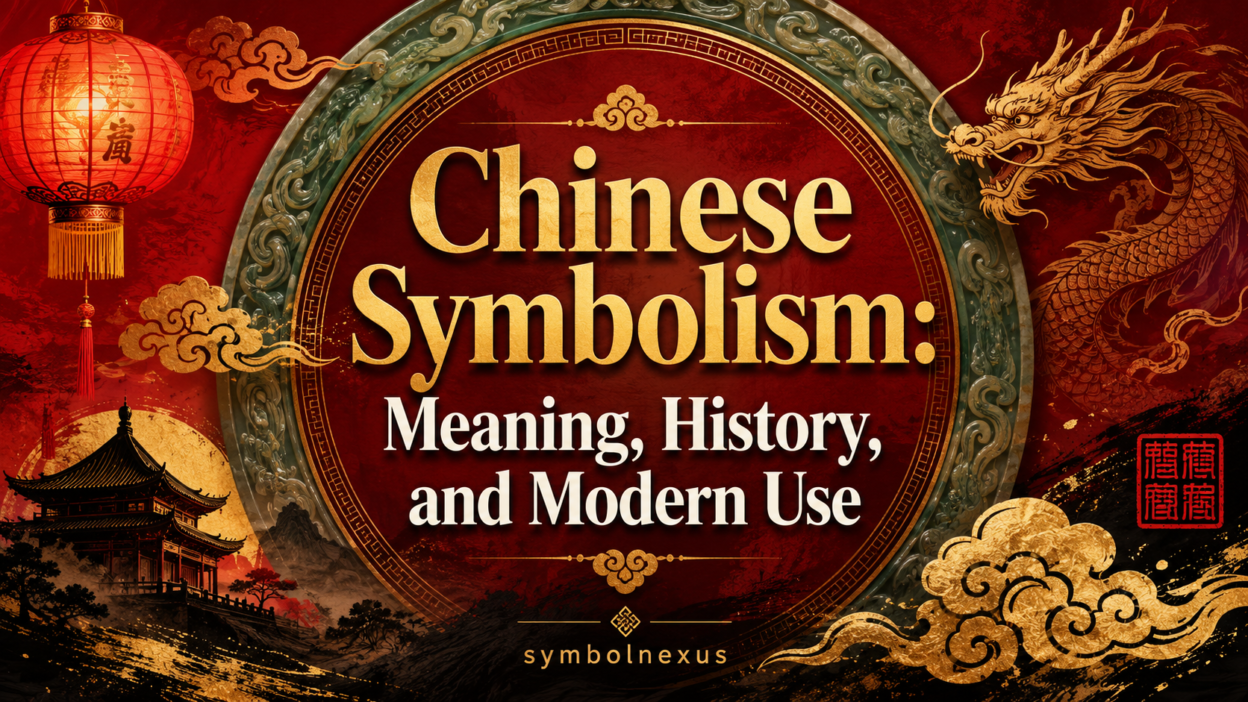
Chinese symbolism appears in paintings, architecture, clothing, ceramics, holiday decorations, family heirlooms, tattoos, jewelry, and everyday household objects. Rather than referring to one emblem with one fixed definition, it describes a broad visual language developed across different periods, regions, belief systems, and communities.
Many of its best-known motifs express wishes for good fortune, long life, family harmony, protection, prosperity, social advancement, or moral character. A dragon may communicate authority or beneficial natural forces. A peach can suggest longevity. A pair of fish may express abundance, marital harmony, or freedom, depending on the design surrounding it.
These meanings remain visible in the United States, particularly during Lunar New Year celebrations and within Chinese American communities. They also appear in fashion, interior design, public festivals, advertising, body art, and popular entertainment. Understanding the tradition requires more than matching an image with a definition. The same motif can change meaning according to its color, number, location, historical period, and relationship to other symbols.
Quick Answer
Chinese symbolism commonly represents good fortune, longevity, prosperity, harmony, protection, and family continuity in modern American culture. Historically, it also communicated religious ideas, imperial authority, moral virtues, social rank, seasonal change, and hopes for a favorable future.
TL;DR
- Auspicious designs often express luck, health, longevity, or prosperity.
- Animals gain meaning through mythology, behavior, status, and wordplay.
- Colors change meaning according to ceremony, period, and social context.
- Chinese American communities preserve and reinterpret traditional motifs.
- A symbol’s surroundings are as important as the symbol itself.
- Respectful interpretation avoids stereotypes and overly fixed definitions.
What Chinese Symbols Are Designed to Communicate
A large portion of traditional decorative imagery is auspicious. It does not simply describe the world as it is; it expresses what people hope life will become. A birthday object might wish someone longevity. Wedding decoration may communicate marital joy and fertility. New Year imagery can welcome prosperity, renewal, health, and protection.
This wish-making quality explains why many designs combine several motifs. A bat, peach, crane, pine tree, and longevity character may appear together because each contributes a related blessing. The full composition becomes a visual message rather than a random collection of attractive images.
Other symbols communicate moral or political ideas. Bamboo may represent integrity because it bends without breaking. Plum blossoms can suggest endurance because they bloom in cold weather. Imperial garments once used tightly regulated colors, animals, and cosmic emblems to identify rank and present the ruler as part of an ordered universe.
Ancient Foundations in Ritual, Nature, and Authority
Some of the oldest known symbolic objects from China come from late Neolithic and early Bronze Age burials. Jade disks, tubes, animal forms, and ceremonial objects were placed with the dead, although the exact meanings of many early forms remain uncertain. Modern explanations should therefore distinguish archaeological evidence from later interpretations.
During the Shang and Zhou periods, imagery on ritual bronzes and jade objects connected political power, ancestral rites, warfare, sacrifice, and the unseen world. Animals and composite creatures were not merely decorative. They helped define sacred objects used by elite families and ruling authorities.
Over later centuries, symbols became increasingly layered. Court traditions, popular customs, literature, folklore, religious practice, and commercial art all contributed new associations. Old forms were repeatedly copied, revived, and adapted, so a motif created in one setting could later acquire a different social or decorative purpose.
How Wordplay Turns Pictures into Messages
One of the most distinctive features of this symbolic language is the visual rebus: an image-based message built through similar-sounding words. A plant, fruit, animal, or household object may represent an idea because its Chinese name resembles another desirable word.
The bat is the best-known example. The word for bat, fu, sounds like a word associated with blessings or good fortune. As a result, bats that may appear frightening to American viewers can communicate happiness and luck in a Chinese design.
Five bats surrounding the character for longevity traditionally represent five major blessings, commonly associated with long life, health, wealth, virtue, and a peaceful or natural death. An upside-down good-fortune character may likewise suggest that fortune has “arrived,” because the expressions for inversion and arrival can sound alike in Chinese.
These visual puns make translation difficult. A viewer must recognize the depicted object, understand its pronunciation, identify the intended wordplay, and examine the other motifs in the composition.
Dragons, Phoenixes, Tigers, and Other Animals
The Chinese dragon usually differs from the fire-breathing monster familiar in European stories. It is commonly associated with authority, rain, water, agricultural well-being, transformation, and beneficial power. Dragons eventually became closely connected with emperors, although their earlier meanings were broader and are not fully understood.
The phoenix, often called fenghuang, can represent virtue, harmony, peace, and righteous rule. It was traditionally said to appear when society was governed well. When paired with a dragon, it may communicate balanced forces, imperial authority, or marital harmony, depending on the period and setting.
Tigers represent courage, military strength, and protection. Their images have appeared on children’s clothing, hats, shoes, charms, and domestic objects intended to repel harm. Cranes suggest longevity, refinement, high status, or transcendence, while fish commonly communicate abundance because the word for fish resembles the word for surplus.
These animals should not be reduced to personality labels. A dragon tattoo, zodiac dragon, imperial dragon robe, and temple dragon can carry related but significantly different meanings.
Flowers, Trees, and Fruits as Models for Human Life
Plants often symbolize admired human qualities because their physical characteristics suggest a moral or emotional lesson. Bamboo remains upright while remaining flexible, making it a common image of resilience, integrity, modesty, and adaptability.
The plum blossom opens during winter or at the approach of spring. It therefore represents endurance, renewal, and the ability to remain vital during hardship. Pine trees stay green through cold seasons and frequently appear as signs of longevity and steadfastness.
The lotus grows from muddy water while producing a clean flower. In Buddhist contexts, it expresses purity, spiritual development, and freedom from attachment. It can also appear in secular designs where its meaning depends on wordplay or its relationship with fish, birds, or children.
Peaches are strongly associated with long life and immortality, especially through stories involving supernatural peaches and immortal figures. Peonies frequently suggest wealth, honor, beauty, and elevated status. Together, floral and fruit motifs turn natural growth into a vocabulary for character, prosperity, and life’s changing seasons.
What Colors Mean — and Why Context Matters
Red is the color most widely recognized as auspicious. It is associated with celebration, vitality, happiness, prosperity, and life-generating forces. Red envelopes, banners, lanterns, clothing, and paper decorations become especially visible during weddings, birthdays, business openings, and Lunar New Year.
White has traditionally been connected with mourning and funerary observance, although it may also communicate simplicity, age, purity, or elegance in art and design. Treating white as universally negative would therefore be inaccurate.
Yellow gained special associations with the center, earth, status, and imperial authority. During parts of the imperial period, particular shades and garments were restricted according to rank. Bright yellow combined with five-clawed dragons carried a political meaning that ordinary yellow fabric does not automatically retain today.
Color should always be interpreted alongside the object’s purpose. A red wedding garment, red political poster, red restaurant logo, and red religious object do not communicate identical messages.
Numbers, Written Characters, and Repeated Forms
Numbers can gain favorable or unfavorable associations through pronunciation, philosophy, traditional cosmology, or modern popular custom. Eight is widely associated with prosperity because its pronunciation resembles words connected with becoming wealthy. Six can suggest smooth progress, while nine has historical links with longevity, completeness, and imperial authority.
Four is often avoided because its pronunciation resembles the word for death in several Chinese language varieties. This concern can affect apartment numbers, phone numbers, gifts, and business choices, although attitudes differ among individuals and regions.
Written characters function as visual symbols in their own right. The character fu expresses blessing or good fortune. Shou represents longevity. The doubled happiness character, often called “double happiness,” is strongly associated with marriage and appears on wedding invitations, banners, textiles, ceramics, and gifts.
Repetition intensifies meaning. Two figures may suggest partnership, five may refer to an established set of blessings, and a repeated border can turn a small motif into an encompassing wish.
Religious and Philosophical Layers
Chinese visual culture developed through interaction among ancestral practices, state ritual, Confucian ethics, Daoist traditions, Buddhism, local religion, and popular folklore. These systems often overlapped rather than existing as completely separate categories.
Confucian symbolism tends to emphasize ethical conduct, social responsibility, education, loyalty, family relationships, and the virtues expected of rulers and officials. Paintings of plants or historical figures may communicate moral character without being religious objects.
Daoist imagery includes immortals, cranes, peaches, mountains, sacred plants, constellations, alchemical objects, and symbols of long life or harmony with natural processes. Buddhist art introduced figures and emblems such as the lotus, wheel, endless knot, paired fish, vase, parasol, conch, and victory banner.
A motif may move between these settings. The lotus can convey Buddhist purity, seasonal beauty, reproductive hopes, or a wordplay-based blessing. Its religious meaning should not be assumed unless the surrounding imagery supports it.
Common Wishes Expressed Through Auspicious Designs
Many compositions can be understood as visual good wishes. Their purpose resembles the message inside a greeting card, but the message is constructed through animals, plants, characters, colors, and numbers.
| Context | Common Meaning | Typical Motifs | Important Note |
|---|---|---|---|
| New Year | Renewal and prosperity | Red, fish, bats, zodiac animals | Customs vary by family and region |
| Wedding | Marital joy and continuity | Double happiness, paired birds, dragon and phoenix | Pairings matter more than isolated images |
| Birthday | Longevity and health | Peaches, cranes, pine, shou character | Often associated with older adults |
| Home protection | Safety and stability | Tigers, guardian figures, door imagery | Some forms have religious significance |
| Career or study | Advancement and achievement | Carp, books, scholar objects, official emblems | Meanings may rely on stories or wordplay |
| Family life | Harmony and descendants | Children, pomegranates, paired figures | Historical fertility themes may feel dated today |
These designs reveal a practical side of symbolism. They help people express hopes that may be difficult to state directly: a secure household, respected children, a peaceful old age, or a favorable change in fortune.
Chinese Symbols in the United States
In the United States, these motifs carry both inherited meanings and Chinese American history. Early immigrant communities used festivals, temples, association buildings, shops, theaters, newspapers, and family celebrations to preserve cultural memory while adapting to American life. Chinatowns became commercial centers, community shelters, and visible expressions of identity during periods of discrimination and exclusion.
Lunar New Year celebrations are now among the most public settings for traditional imagery. Americans encounter red envelopes, lanterns, zodiac animals, lion dances, dragon dances, firecrackers, calligraphy, fish dishes, and banners bearing wishes for prosperity or good health. Chinese communities were celebrating the holiday in California before the American Civil War, and it later became part of public life in cities across the country.
These symbols can communicate cultural continuity as well as celebration. For Chinese Americans, a red envelope or family decoration may connect grandparents, children, language, migration history, and community belonging. For other Americans, the same object may first be encountered through a school activity, museum program, neighborhood parade, restaurant, or friendship with a Chinese family.
Tattoos, Jewelry, Fashion, and Interior Design
Modern personal style often removes symbols from their original ceremonial setting. Dragons, phoenixes, tigers, koi, lotus flowers, clouds, calligraphy, and zodiac animals now appear on tattoos, streetwear, luxury fashion, jewelry, wall art, and digital graphics.
A person may choose a dragon to represent ambition, confidence, heritage, or personal transformation rather than imperial authority. A lotus tattoo may express recovery after adversity, even when its owner does not practice Buddhism. A jade pendant may serve as a family keepsake, fashion accessory, protective object, or connection to ancestry.
The meaning becomes personal, but historical context still matters. Chinese characters should be checked by a fluent reader before permanent use. Traditional or simplified forms, stroke order, grammar, and calligraphic style can change how an inscription appears and whether it makes sense.
Jade also deserves special attention. It has been valued in China since ancient times and has carried associations with beauty, virtue, protection, ritual status, life, and death. Its significance is broader than the modern idea that every jade object is simply a good-luck charm.
Emotional Meaning and Cultural Identity
Symbols work emotionally because they compress family stories, social expectations, and personal hopes into recognizable forms. A longevity character in a grandparent’s home may express affection and respect. A dragon pendant may communicate confidence or cultural pride. A Lunar New Year banner can make a home feel connected to relatives living far away.
For immigrants and their descendants, symbolic objects may become portable forms of belonging. They can preserve language, recall a hometown, mark a family celebration, or create continuity between generations. Their value may come less from a fixed ancient definition than from the person who gave the object and the occasion it represents.
Symbols can also communicate aspiration. Images of abundance, advancement, harmony, and resilience provide a vocabulary for imagining a better future. This does not mean users believe a picture mechanically produces good luck. Often the symbol functions as an encouraging wish, family custom, cultural marker, or reminder of desired values.
Misunderstandings and Cultural Misuse
The most common mistake is assuming that every Chinese-looking design has one universal meaning. China contains many ethnic groups, language communities, regional customs, religious traditions, and historical periods. Practices also differ across Taiwan, Hong Kong, mainland China, Singapore, Malaysia, and Chinese diaspora communities.
Another mistake is interpreting motifs entirely through a Western lens. Bats may appear ominous to an American viewer but auspicious in a traditional design. Dragons may look dangerous but represent beneficial power. White may appear bridal in the United States while carrying mourning associations in many Chinese settings.
Cultural misuse occurs when sacred figures, funerary objects, religious texts, or characters are copied as decoration without understanding their function. Designs can also become stereotypes when commercial imagery reduces Chinese culture to red lanterns, fortune cookies, chopsticks, dragons, and exaggerated typefaces.
Respectful use begins with specificity. Identify the object’s date, community, language, purpose, and original setting before assigning a meaning.
How Meanings Continue to Change
Symbolic traditions survive because people adapt them. Court emblems once restricted by rank can later appear in theater costumes, souvenir art, fashion, and restaurant decoration. A protective tiger made for a child may become a museum object, contemporary illustration, or nostalgic design.
Migration also changes interpretation. In Chinese American communities, a festival symbol may represent cultural survival, public visibility, family memory, and resistance to exclusion in addition to its older auspicious meaning. Public arches, bilingual signs, lantern festivals, and neighborhood parades can signify both heritage and an American community’s claim to place.
Digital culture creates another layer. Zodiac animals circulate as profile images, memes, branded merchandise, filters, and annual social posts. These uses may simplify older traditions, but they also allow younger generations to reinterpret cultural material in contemporary language.
Evolution does not erase historical meaning. It adds new contexts to a visual vocabulary that has never remained completely static.
How to Interpret a Chinese Symbol Responsibly
Begin by identifying exactly what you are looking at. Is it an animal, plant, written character, religious figure, color pattern, or combination of several motifs? Then consider where it appears. A wedding invitation, temple carving, imperial robe, tattoo, New Year decoration, and burial object require different interpretive frameworks.
Look for pairings and numbers. One bat may indicate good fortune, while five bats can represent a defined group of blessings. A dragon alone differs from a dragon paired with a phoenix. Fish swimming among lotus flowers may communicate something more specific than either motif by itself.
Date and location also matter. Meanings recorded for Qing imperial art should not automatically be applied to every earlier object or every modern Chinese household. When the origin is uncertain, use cautious language such as “commonly associated with” rather than claiming that an image always means one thing.
The most accurate interpretation treats symbols as parts of a sentence. Individual motifs provide vocabulary, but their arrangement produces the complete message.
FAQs
Is Chinese symbolism mainly about good luck?
Good fortune is certainly one of its most visible themes, especially around household decoration, weddings, birthdays, and Lunar New Year. But it’s far from the whole picture — the same visual vocabulary carries religious teaching, mourning customs, political authority, moral instruction, and family identity, depending entirely on the setting a symbol appears in.
What does a Chinese dragon symbolize?
A Chinese dragon commonly represents beneficial power, authority, rain, water, transformation, and good fortune — a fundamentally different figure from the fire-breathing monster of European folklore. In imperial settings, specific dragon designs (like the five-clawed form) also identified the emperor or ruling household specifically, a political meaning that ordinary decorative dragons don’t automatically carry today.
What is the most important lucky symbol in Chinese culture?
There’s no single symbol that every community would rank first — the tradition is too regionally and historically varied for one universal answer. That said, the fu character, the color red, bats, fish, dragons, and certain auspicious number combinations are among the most widely recognized signs of blessing across different communities and eras.
What does Chinese symbolism mean in tattoos?
The meaning depends heavily on the specific image chosen and the wearer’s personal intent — a dragon might represent ambition or heritage, a lotus might mark recovery after hardship, independent of whether the wearer practices Buddhism. The one firm rule: any Chinese characters should be checked by a fluent reader before becoming permanent, since stroke order, grammar, and script style can all change what an inscription actually says.
Are Chinese symbols religious?
Some are explicitly tied to Buddhism, Daoism, temple ritual, specific deities, or ancestor remembrance, and those carry real devotional weight. Others are entirely secular — good-luck wishes, literary references, political emblems, family decorations, or visual puns — so a symbol’s religious status should never be assumed without looking at its context.
Why are bats considered lucky in Chinese art, when they look ominous to Western viewers?
It comes down to wordplay rather than the animal’s actual traits or behavior: the Chinese word for bat, fu, sounds like the word associated with blessings and good fortune. That pun turned an animal many Western viewers instinctively find unsettling into one of the most common auspicious motifs in traditional Chinese design.
Is it disrespectful to use Chinese symbols if you’re not Chinese?
Not automatically — using a symbol with accurate knowledge and appropriate context is different from trivializing it. The line gets crossed when sacred or funerary imagery is used purely as decoration without understanding its function, or when an entire culture gets flattened into a handful of stereotyped images like lanterns, fortune cookies, and exaggerated typefaces.
Why does the number four get avoided in Chinese culture?
The avoidance is based on pronunciation, not superstition about the number itself — in several Chinese language varieties, “four” sounds close to the word for death. That resemblance is real enough to influence apartment numbering, phone numbers, and gift-giving in many households, though how strictly individuals or regions observe it varies.
What’s the difference between how white is used in Chinese versus American culture?
In many traditional Chinese contexts, white is closely associated with mourning and funerary observance — nearly the opposite of its bridal, celebratory role in American wedding culture. That doesn’t make white a purely negative color in Chinese art, though; it can also represent simplicity, age, purity, or elegance depending on what it’s applied to.
Why do the same Chinese symbols sometimes mean different things?
Because a single motif’s meaning is built from its surroundings, not fixed to the image alone — the same lotus can signal Buddhist purity, seasonal beauty, a fertility wish, or a wordplay-based blessing depending on what it’s paired with. Reading a symbol accurately means treating it like one word in a sentence: color, number, companion motifs, and historical period all combine to produce the actual message.
Conclusion
Chinese symbolism resists a single tidy definition for a good reason: it was never built to be a fixed dictionary in the first place. It’s closer to a living vocabulary — one shaped over thousands of years by ritual bronze-casters, court painters, Buddhist monks, wedding planners, and immigrant families building new lives an ocean away from where these motifs began. A bat, a peach, a shade of red — none of them mean anything alone. They mean something in combination, in context, in the hands of the person using them.
That’s also why the tradition has never stopped changing without ever actually disappearing. An imperial dragon restricted to an emperor’s robe can become a tattoo chosen for personal confidence. A funerary jade object can become a family heirloom passed down for its beauty as much as its history. A festival once celebrated quietly by early immigrant communities facing exclusion can become a public parade drawing crowds who have never set foot in China. None of those shifts erase what came before — they simply add another sentence to a language still being spoken.
Reading that language well starts with a kind of humility: assume there’s more context you’re missing, look for what a symbol is paired with before deciding what it means, and let the specific setting — not a generic definition — do the final work of interpretation.