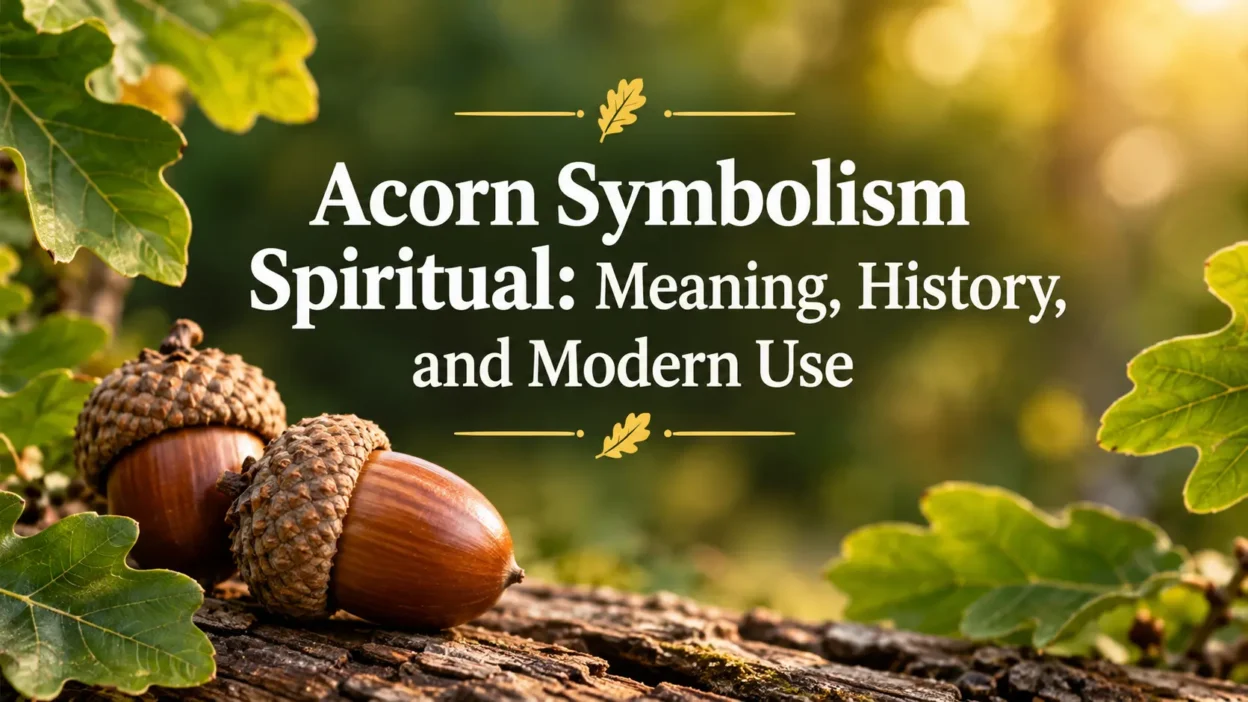
Acorns are small, familiar seeds, but their symbolic meaning often reaches far beyond their size. Acorn symbolism spiritual commonly centers on growth, potential, resilience, patience, and the idea that something substantial can develop from a modest beginning.
In the United States, acorns are especially easy to connect with oak trees, forests, autumn, wildlife, and seasonal change. Because an acorn eventually becomes an oak, it naturally suggests the possibility of future strength rather than immediate power.
People may encounter acorns in jewelry, tattoos, artwork, home decor, gardens, nature photography, and seasonal decorations. Their meaning can also become personal: an acorn may represent starting over, raising a family, building a career, recovering from difficulty, or trusting gradual progress.
Quick Answer
Acorn symbolism spiritual commonly represents growth, potential, resilience, and future strength in modern American culture, especially when an acorn is used to symbolize new beginnings or personal development. Historically, acorns have also been connected with fertility, abundance, protection, endurance, and the sacred importance of oak trees.
TL;DR
- Acorns commonly symbolize potential, patience, growth, and resilience.
- Their symbolism comes partly from the acorn-to-oak transformation.
- Oak trees held importance in several ancient European traditions.
- Americans often associate acorns with autumn, nature, strength, and renewal.
- Acorn tattoos can represent personal growth or a new beginning.
- Spiritual interpretations vary by culture, religion, and personal belief.
What Does an Acorn Symbolize Spiritually?
The most common spiritual interpretation of an acorn is potential.
An acorn does not resemble the enormous oak it can eventually produce. That contrast gives it a straightforward symbolic lesson: beginnings can look insignificant while containing the possibility of substantial change.
Acorns can therefore represent:
- Potential — something small can develop into something much larger.
- Growth — progress happens gradually rather than instantly.
- Resilience — oak trees can survive for generations under changing conditions.
- Patience — meaningful development takes time.
- Abundance — a single oak can eventually produce many acorns.
- Renewal — new trees can begin from fallen seeds.
- Strength — the mature oak gives the acorn an association with endurance.
- Legacy — planting or preserving an oak can connect one generation with another.
These meanings are symbolic rather than universal spiritual rules. An acorn does not have one fixed meaning across every religion or culture.
Why the Acorn Represents Potential
The physical life cycle of the acorn explains much of its symbolism.
An acorn begins as a relatively small seed. Under suitable conditions, it can germinate, develop roots, grow into a sapling, and eventually become an oak capable of producing acorns itself.
That process creates an unusually clear metaphor for human life.
A student may see an acorn as representing the beginning of an education. Someone starting a business might view it as a reminder that major achievements often begin with limited resources. A person rebuilding after hardship may see it as evidence that a new phase can emerge from an apparently ordinary beginning.
The important idea is not that every acorn becomes a giant oak. Nature is more complicated than that. Instead, the acorn symbolizes possibility: a beginning can contain a future that is not yet visible.
Ancient Roots and Early Acorn Symbolism
Acorn symbolism is closely connected with the long-standing importance of oak trees.
In parts of ancient Europe, oak trees were associated with sacred landscapes, strength, and divine or supernatural forces. Greco-Roman traditions connected oak trees with Zeus and Jupiter, while Celtic traditions have often been associated with reverence for oak-rich landscapes and sacred trees.
The Druids are frequently mentioned in discussions of oak symbolism, although modern popular descriptions can simplify or romanticize what is actually known about ancient Celtic religious practices. It is safer to say that oak trees held significant cultural importance in parts of ancient Europe rather than assuming every later claim about acorns reflects documented ancient belief.
The acorn inherited some of this significance because it was the seed of the respected oak.
Acorns in Greek and Roman Symbolism
Oak symbolism appears particularly clearly in classical Mediterranean traditions.
The oak was associated with Zeus in ancient Greek religion and with Jupiter in Roman religion. Sacred oak trees and prophetic traditions contributed to the tree’s association with divine authority.
The famous oracle at Dodona in ancient Greece was connected with a sacred oak. Ancient people interpreted signs associated with the sacred tree as part of religious divination.
The acorn itself was therefore more than a woodland object. As the seed of the oak, it could be understood within a larger symbolic system involving divine authority, endurance, and the natural world.
However, it is important not to claim that ancient Greeks or Romans had one standardized spiritual meaning for every acorn. Symbolism changed according to place, period, and context.
Acorn Symbolism in American Culture
In the United States, acorns usually carry a more natural and seasonal meaning than a formal religious one.
Americans commonly encounter them under oak trees in parks, backyards, neighborhoods, and forests. Children collect them, squirrels store them, and homeowners often see them scattered across lawns in autumn.
This familiarity gives acorns several recognizable associations:
| Context | Meaning in the USA | Common Associations | Notes |
|---|---|---|---|
| Autumn decor | Seasonal change | Leaves, harvest, woodland | Often decorative rather than religious |
| Jewelry | Growth and potential | Personal development | Meaning depends on the wearer |
| Tattoos | Resilience or beginnings | Oak trees, nature | Often highly personal |
| Gardening | Future growth | Planting and renewal | Can symbolize long-term investment |
| Home decor | Stability and nature | Woodland, rustic style | Often connected with oak imagery |
American symbolism also benefits from the oak’s place in national and local landscapes. Oak species are widespread across the country, and oak trees appear in parks, historic properties, streets, and natural areas.
For many Americans, then, an acorn symbolizes nature’s ability to produce something enduring from a small beginning rather than a specific religious doctrine.
Acorns and the Meaning of Strength
An acorn’s association with strength comes indirectly from the mature oak.
People rarely describe the acorn itself as physically powerful. Instead, they think about what it can become.
That distinction matters.
The symbolism says that strength can be developed rather than possessed immediately. A person does not need to begin life strong, wealthy, successful, or confident to eventually build those qualities.
This makes the acorn particularly useful as a symbol for perseverance. It can represent the early stage of a long process in which capability develops over time.
Acorn Symbolism for Growth and New Beginnings
An acorn can symbolize a new beginning without suggesting that the past has disappeared.
Planting an oak is inherently future-oriented. The action involves accepting that the most significant results may occur years or decades later.
For this reason, an acorn can represent:
- beginning a new career
- starting an educational journey
- building a relationship
- creating a family
- recovering after a difficult period
- establishing a new home
- beginning a creative project
- developing a long-term goal
The symbolism works because the acorn represents the beginning of a process, not its finished result.
Acorns, Abundance, and Fertility
Acorns can also symbolize abundance because mature oak trees can produce large quantities of them.
Historically, oak forests provided food and resources for humans and animals. In several European societies, acorns were important enough to have practical uses, including feeding livestock and, under certain circumstances, processing for human consumption.
This practical relationship with oak landscapes helps explain why abundance became part of their broader symbolism.
Fertility is a related interpretation. A seed naturally represents reproduction and continuation, while the oak’s ability to produce more acorns creates a visual cycle of one generation leading to another.
Still, fertility should be treated as a secondary symbolic association, not the universal meaning of every acorn.
The Emotional Meaning of an Acorn
Emotionally, acorns often communicate hope without immediate certainty.
A flower may symbolize something already visible and blooming. An acorn suggests something that has not happened yet.
That difference can make the symbol meaningful during uncertain periods.
Someone beginning again after a major life change might choose an acorn because it reflects an unfinished story. The future is not guaranteed, but there is something worth nurturing.
The acorn can therefore represent a quieter form of optimism: start small, protect what matters, and allow time to do its work.
What Acorns Can Mean in Dreams
Dream symbolism is highly personal, so an acorn in a dream does not have one scientifically established meaning.
Depending on the dreamer’s circumstances, an acorn might represent:
- an idea that is still developing
- a new responsibility
- a future opportunity
- personal growth
- family or inheritance
- patience
- concern about wasted potential
- a desire for stability
The surrounding details matter. An acorn being planted could suggest beginning something new, while finding many acorns might evoke abundance or opportunity. A damaged or empty acorn could instead reflect disappointment or uncertainty.
These interpretations are best treated as reflective possibilities rather than predictions.
Acorn Meaning in Tattoos and Personal Style
Acorn tattoos often carry a more personal meaning than traditional symbolism.
Someone may choose an acorn to represent surviving a difficult period, starting over, growing slowly, or remembering a person connected with an oak tree or woodland environment.
Common tattoo combinations include:
- acorn and oak leaves
- acorn and roots
- acorn with a tree
- multiple acorns
- acorn and autumn leaves
- acorn with initials or dates
- acorn incorporated into botanical artwork
An acorn tattoo can also communicate humility. Instead of displaying an enormous oak, the person chooses the small object that represents its beginning.
Acorns in Home Decor and Seasonal Design
Acorns have become common decorative elements in American autumn and woodland design.
They appear in wreaths, table arrangements, textiles, artwork, candles, centerpieces, and rustic interiors. In these settings, their symbolism is usually straightforward: autumn, nature, harvest, warmth, and the outdoors.
Some decorative uses carry additional meaning. An acorn placed in a home office might symbolize long-term growth, while one incorporated into a family-themed display could represent continuity across generations.
The design does not have to be spiritual to be symbolic. Objects can carry emotional associations even when they are used primarily for decoration.
Acorn Symbolism Across Cultures and Religions
Acorn meanings vary considerably across cultures.
In ancient Greek and Roman traditions, the oak had associations with divine authority and sacred spaces. In parts of Europe, oak trees became connected with strength, protection, sacred landscapes, and community traditions.
Christian symbolism sometimes uses oak imagery to represent endurance and strength, but the acorn does not have one universally established Christian meaning comparable to symbols such as the cross or fish.
In modern spiritual practices, people may interpret the acorn through themes such as manifestation, personal development, grounding, or connection with nature. These are contemporary spiritual interpretations rather than beliefs that should automatically be attributed to ancient traditions.
This distinction helps prevent modern spiritual ideas from being presented as ancient facts.
Common Misunderstandings About Acorn Symbolism
One common mistake is assuming that every acorn has a fixed spiritual message.
Symbolism depends on context. A squirrel carrying an acorn, an autumn decoration, a religious artwork, and a tattoo can all communicate different ideas.
Another misunderstanding is treating modern spiritual interpretations as historically universal. Ideas such as “the universe is sending you an acorn because you are destined for success” belong to contemporary personal spirituality, not a universally documented ancient tradition.
Acorns also should not automatically be interpreted as signs of good fortune. They can represent possibility, preparation, continuity, or nature without predicting an event.
The most reliable interpretation comes from asking why the acorn appears and what it means in that particular setting.
How Acorn Symbolism Has Changed Over Time
The meaning of the acorn has gradually shifted from practical and religious associations toward more personal and ecological ones.
In older societies, oak trees had practical importance as sources of food, materials, shelter, and landscape resources. Religious traditions could add sacred significance to particular trees and groves.
In modern America, most people encounter acorns in ordinary outdoor settings. Their symbolism is therefore more likely to involve personal growth, nature, seasonal change, environmental awareness, or family continuity.
The underlying idea of potential has remained remarkably useful because it comes directly from the relationship between seed and tree.
FAQ About Acorn Symbolism
What does an acorn symbolize spiritually?
An acorn commonly symbolizes potential, growth, patience, resilience, and future strength. Its symbolism comes largely from the fact that a small acorn can develop into a mature oak.
What does an acorn symbolize in the United States?
In the United States, acorns are commonly associated with autumn, nature, growth, strength, and new beginnings. Their meaning is generally cultural and personal rather than tied to one specific religious tradition.
Is an acorn a symbol of good luck?
An acorn can be used as a good-luck or prosperity symbol in some modern traditions, but this is not a universal historical meaning. Its broader symbolism is better described as potential, abundance, and future growth.
What does an acorn tattoo mean?
An acorn tattoo can represent personal growth, resilience, a new beginning, or the belief that small efforts can eventually produce major results. The specific meaning usually depends on the person’s life story.
What does an acorn symbolize in Christianity?
Acorns do not have one universally defined Christian meaning. Oak imagery may suggest strength, endurance, or longevity, while individual Christian artwork may assign additional meanings to the seed.
Does an acorn symbolize fertility?
Yes, an acorn can symbolize fertility because it is a seed capable of producing another tree and is associated with reproduction and abundance. However, fertility is one interpretation rather than its only or universal meaning.
What does finding an acorn symbolize?
Finding an acorn can personally represent opportunity, growth, preparation, or a new beginning. There is no universal spiritual rule that says finding one predicts a particular event.
Conclusion
The central idea behind acorn symbolism spiritual is potential: something small can contain the possibility of lasting growth. From ancient respect for oak trees to modern American associations with nature, autumn, resilience, and personal development, the acorn has remained useful because its physical life cycle provides an understandable metaphor.
Its symbolism does not require a supernatural explanation. An acorn can simply remind someone that meaningful progress often begins before the final result is visible. In that sense, the smallest seed can represent a future that still has room to grow.