
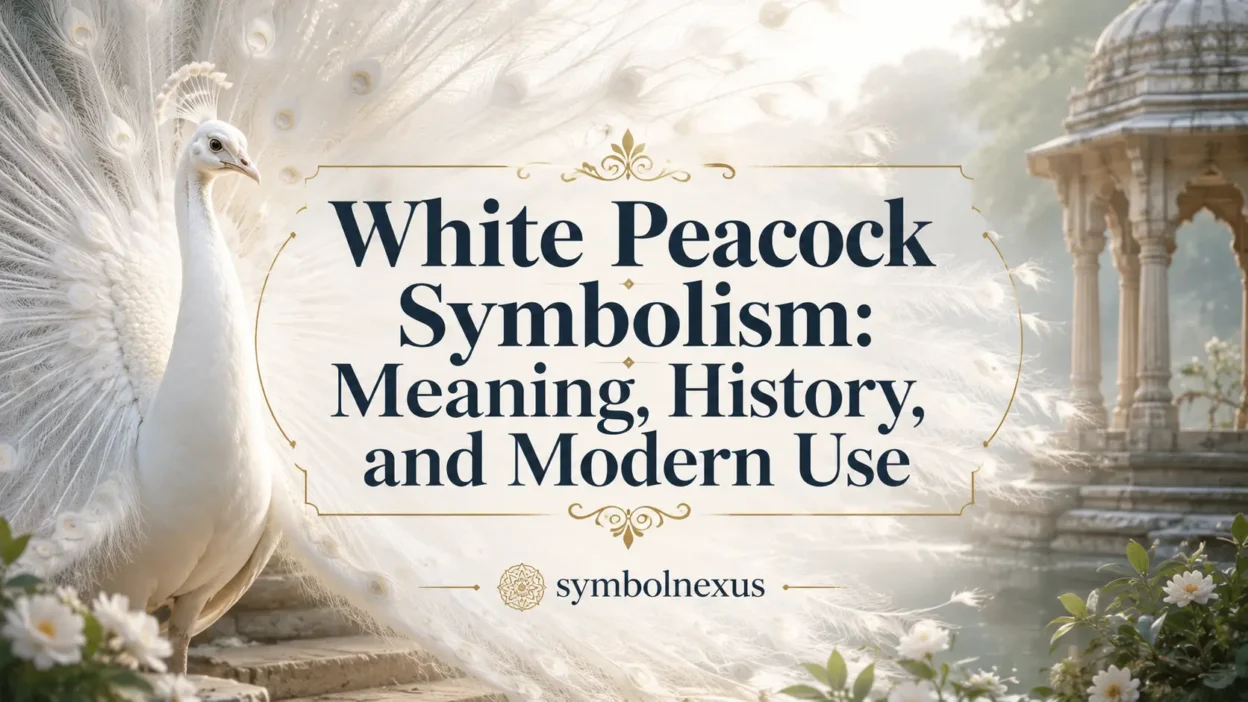
A white peacock looks almost unreal when it opens its fan: hundreds of pale feathers form a luminous circle while faint eye-shaped markings remain visible across the train. That appearance gives white peacock symbolism an unusual combination of purity, beauty, confidence, and transformation.
People encounter the bird in zoos, private gardens, wedding photography, artwork, tattoos, jewelry, fashion, and interior design. Because it resembles the familiar blue peacock while looking dramatically different, it often represents a person or experience that stands apart without losing its identity.
Its modern meaning, however, comes from several sources. The symbolism combines the long cultural history of peacocks with Western associations attached to the color white. Understanding that distinction prevents modern interpretations from being confused with ancient religious traditions.
Quick Answer
White peacock symbolism commonly represents purity, renewal, rare beauty, and confident self-expression in modern American culture. Historically, peacocks also signified immortality, divinity, royalty, and the transformation of harmful forces into wisdom across Mediterranean, Christian, Hindu, and Buddhist traditions.
TL;DR
- The bird represents purity, renewal, individuality, and visible grace.
- Most ancient meanings concern peacocks generally, not specifically white birds.
- Christian art connected peacocks with immortality and resurrection.
- Hindu traditions associate peacocks with deities, beauty, and protection.
- Buddhist imagery links them with wisdom and transformed negativity.
- Americans use the image in weddings, tattoos, decor, and fashion.
What a White Peacock Actually Is
The name “peacock” technically describes a male peafowl, while a female is called a peahen. In everyday speech, however, people frequently use “peacock” for the species as a whole.
Most completely white peafowl are color variants of the Indian peafowl, Pavo cristatus. They are not a separate species, nor are they usually albino. Their pale feathers generally result from leucism, a genetic condition that affects pigment deposition while leaving pigment in the eyes. True albinism also affects the eyes, commonly producing a pinkish or reddish appearance.
The male still develops the long ornamental train associated with an ordinary Indian peacock. When he raises it during courtship, the white feathers create a broad, lace-like fan. The famous “tail” is primarily formed from elongated upper tail coverts rather than the bird’s true tail feathers.
This biological detail matters symbolically. The bird has not become a different creature; it expresses a recognizable form through an uncommon appearance. For that reason, it can represent individuality without disconnection, change without lost identity, and distinction that does not require imitation.
Core Meanings at a Glance
| Context | Common Meaning in the United States | Related Associations | Important Note |
|---|---|---|---|
| Personal symbolism | Individuality and self-acceptance | Confidence, authenticity, visibility | Often chosen during major life changes |
| Spiritual imagery | Purification and renewal | Awakening, reflection, inner clarity | Usually a modern interpretation |
| Weddings | New beginnings and ceremonial beauty | Commitment, elegance, hope | White bridal symbolism is culturally specific |
| Christian-inspired art | Eternal life and resurrection | Paradise, incorruptibility, watchfulness | Based on older peacock imagery |
| Tattoos and jewelry | Rare identity and graceful confidence | Reinvention, dignity, independence | Meaning depends on accompanying details |
| Luxury decor | Refinement and visual abundance | Prestige, artistry, exclusivity | Can also imply display or excess |
No single interpretation applies in every setting. A wedding planner, tattoo wearer, Christian artist, and Buddhist practitioner may each understand the same bird differently.
Why White Plumage Changes the Peacock’s Message
A normally colored peacock communicates through intense blues, greens, bronze tones, and iridescent eyespots. Its visual identity depends partly on abundance of color. The pale form removes most of that color while preserving the elaborate shape.
That contrast changes the emotional effect. Instead of suggesting festive splendor alone, the white bird often appears quiet, ceremonial, dreamlike, or otherworldly. Its display remains dramatic, but the lack of bright color makes the drama feel more restrained.
In modern Western culture, white frequently carries associations with cleanliness, goodness, innocence, simplicity, and purity. These associations developed through religion, clothing, class customs, hygiene, and visual design rather than through one universal system. White has also represented mourning, death, or transition in certain times and cultures, so its meaning should never be treated as culturally fixed.
When these color associations are placed onto a peacock, they modify the bird’s older symbolism. Beauty becomes purified beauty. Pride becomes self-possession. Renewal becomes a clean beginning. Royal display becomes ceremonial elegance.
The resulting symbol contains a useful tension: it is visually extravagant but almost colorless. That tension explains why people use it to express confidence without loudness, beauty without conventional expectations, and visibility without apology.
Ancient Mediterranean and Early Christian Meaning
Peacocks already carried symbolic importance in the ancient Mediterranean world. In Greek and Roman imagery, the bird was associated with Hera, known to the Romans as Juno. Artists used it as one of the goddess’s recognizable attributes, connecting it with queenship, divine authority, marriage, and watchfulness.
The eye-shaped markings in the train encouraged associations with constant observation. Ancient viewers could imagine the feathers as numerous open eyes, making the bird a fitting companion for a powerful goddess.
The peacock later became an important image in early Christian art. By the fourth century, it appeared in Christian decorative objects, mosaics, lamps, tomb settings, and scenes associated with paradise.
Its Christian meaning depended partly on an ancient belief that peacock flesh did not decay after death. Although biologically incorrect, the belief made the bird an emblem of incorruptibility, eternal life, and resurrection. Peacocks placed near fountains, vines, cups, or trees could suggest the restored life of paradise.
These historical images did not consistently feature leucistic birds. Therefore, it is more accurate to say that modern pale-peacock imagery inherits Christian peacock symbolism and strengthens its themes through the Western association of white with purity and holiness.
Hindu Associations with Deities and Sacred Beauty
The Indian peafowl is native to South Asia and has a far older cultural presence there than it does in the United States. In Hindu art, its meaning is connected to specific deities, stories, regional customs, and devotional practices rather than to one general definition.
Kartikeya, also called Skanda or Murugan in different traditions, is commonly shown with a peacock as his vehicle. Museum objects from South Asia portray the god accompanied by the bird, linking it with divine power, courage, victory, and disciplined action.
The peacock feather is also strongly associated with Krishna, who is frequently depicted wearing one in his crown. Within Krishna imagery, the feather participates in a larger visual language of beauty, divine play, love, nature, and pastoral life.
These traditions primarily concern ordinary peacocks and their colorful feathers. Claims that a completely white bird has one fixed meaning across all Hindu communities are therefore too broad. A modern viewer may connect its pale plumage with purity or blessing, but that interpretation should not replace the particular stories, deities, and practices from which Hindu peacock imagery comes.
For American readers, the most respectful approach is to distinguish personal symbolism from religious iconography. Someone may view the bird as a sign of good fortune or divine beauty, but a depiction involving Kartikeya or Krishna carries a more specific cultural meaning.
Buddhist Meaning: Transforming Poison into Wisdom
Peacocks appear in several Buddhist artistic and literary traditions. One influential association comes from the old belief that peafowl could consume poisonous plants or animals without being harmed. Buddhist teachings transformed this natural legend into a moral metaphor: harmful conditions can become material for wisdom rather than causes of defeat.
In Tibetan Buddhist imagery, peacocks can represent the transformation of the mental poisons — such as ignorance, attachment, and hatred — into awakened understanding. Images of paired peacocks may communicate the ability to work with destructive emotions instead of merely suppressing them.
The bird is also connected with Mahamayuri, known in Japan as Kujaku Myōō, a Buddhist figure associated with protection from poison and other dangers. Japanese religious art sometimes shows this figure seated on a peacock, making the animal part of a precise sacred composition rather than a free-floating emblem.
A pale peacock can extend this theme in contemporary spiritual art. Its white plumage may suggest the cleared mind that follows honest confrontation with anger, fear, envy, or grief. However, “white peacock equals nirvana” is an oversimplification. Buddhist traditions are diverse, and their peacock imagery cannot be reduced to a single color-based formula.
The most grounded modern interpretation is transformation: difficult experience is not denied but processed into compassion, self-knowledge, or wiser action.
Royalty, Wealth, and Decorative Art
Peafowl have traveled far beyond their original range as ornamental birds and visual signs of wealth. Their size, elaborate trains, and demanding care made them suitable displays for courts, estates, gardens, and elite collections. The Smithsonian notes that peafowl became international symbols of wealth and power, while museum collections show the motif appearing across furniture, textiles, ceramics, clothing, and architectural decoration.
The bird’s connection with royalty does not come from color alone. A fully displayed male resembles a living ceremonial fan or jeweled screen. Its posture appears confident, and its train occupies considerable physical space. These features made it useful for communicating status, authority, and magnificence.
European and American designers embraced peacock imagery especially strongly during the late nineteenth and early twentieth centuries. Art Nouveau artists valued the curved body, flowing feathers, repeated eyespots, and ornamental silhouette. The motif came to signify beauty, exoticism, immortality, and cultivated luxury.
The white form gives this tradition a contemporary minimalist twist. It preserves the extravagant outline while replacing jewel tones with ivory, cream, silver, or pearl. In modern interiors, that combination can suggest quiet luxury: expensive-looking detail presented through a limited color palette.
Its shadow meaning is excess. When used without restraint, peacock imagery can communicate social display, elitism, or a desire to appear exceptional. Whether it feels elegant or ostentatious depends largely on context.
What It Commonly Means in the United States
In current American culture, this bird does not have one officially recognized meaning. Its symbolism is assembled from Christian art, South Asian traditions, Western color psychology, wedding customs, luxury design, wildlife fascination, and individual interpretation.
The most common positive meanings are:
- Purity after experience. Unlike innocence, which suggests not yet encountering difficulty, purification suggests emerging from difficulty with greater clarity.
- A fresh identity. Because the bird retains the peacock’s form while presenting an unexpected appearance, it can represent personal reinvention without rejection of the past.
- Visible individuality. The pale bird cannot easily disappear in a colorful setting. It therefore suits people who are learning to accept attention rather than shrink from it.
- Graceful confidence. Its display is unmistakable, yet its restricted palette can feel composed rather than aggressive.
- Rare beauty. Leucistic animals are visually uncommon, so the bird frequently represents singularity, unconventional attractiveness, and appreciation for natural variation.
- Spiritual transition. In memorial art, meditation spaces, or personal rituals, it may stand for moving from one state of life into another.
These are interpretive meanings, not scientific properties or universal beliefs. Their usefulness comes from the visual qualities people recognize in the animal and the stories they attach to it.
Wedding and Ceremonial Meaning
The bird fits naturally into American wedding imagery because it combines the peacock’s associations with beauty and display with the bridal associations of white.
White wedding clothing became fashionable through a complicated social history. Queen Victoria’s 1840 wedding helped popularize the white bridal gown, but the custom spread gradually and did not become ordinary for all brides immediately. In the United States, changing consumer culture and the growth of the wedding industry helped establish the white gown as a twentieth-century standard.
Today, a pale peacock at a wedding may represent:
- A new chapter shared by two people
- Loyalty expressed with dignity
- Ceremonial beauty and abundance
- Hope for a prosperous household
- The confidence to be fully seen by one’s partner
- Love that matures through change
The image works especially well in garden weddings, South Asian-inspired celebrations, ivory-and-gold decor, formal invitations, centerpieces, and bridal photography.
Cultural context remains important. Peacock feathers may have devotional meaning for Hindu families, while Christian couples may associate the bird with resurrection or eternal life. A decorative choice that appears merely elegant to one family may carry religious significance for another.
Tattoos, Jewelry, and Personal Identity
As a tattoo, the bird often represents a deliberately visible identity. A full fan takes up substantial space, making the design suitable for the back, shoulder, thigh, ribs, or upper arm. Smaller versions may focus on the head, crest, profile, or a single feather.
A pale or uncolored tattoo can symbolize starting over after a difficult period. It may mark recovery from grief, the end of a controlling relationship, a changed spiritual outlook, or the decision to live more openly.
Specific design elements adjust the meaning:
- An open train emphasizes confidence, presence, and self-expression.
- Folded feathers suggest restraint, privacy, or potential not yet revealed.
- A crown or gold detailing adds royalty, ambition, and self-respect.
- Flowers introduce growth, romance, remembrance, or seasonal renewal.
- A moon creates associations with intuition, cycles, and quiet reflection.
- A broken feather may represent beauty surviving loss.
- Two birds can symbolize partnership, mirrored identities, or devotion.
In jewelry, the motif tends to be more decorative but can still carry a personal message. Pearl, opal, crystal, silver, and white enamel reinforce ideas of luminosity and refinement. Someone may wear it as a reminder that standing out does not require becoming louder than everyone else.
The symbol may also appeal to people whose appearance or identity differs from social expectations. Its value in that setting comes from its visible variation: the bird remains complete, recognizable, and striking precisely because it does not look ordinary.
Home Decor, Fashion, and Digital Culture
Interior designers use pale peacock motifs where they want ornament without a heavily multicolored scheme. Common examples include sculptural centerpieces, wall art, embroidered cushions, lamps, mirrors, wedding backdrops, garden statues, and holiday displays.
In a home, the image can communicate hospitality, cultivated taste, protection of personal space, or celebration of beauty. A bird positioned near an entrance may function as a symbolic guardian. One displayed in a bedroom or dressing room may emphasize self-worth, elegance, or personal transformation.
Fashion uses the motif differently. A feather pattern on a formal gown suggests theatrical sophistication, while a small embroidered bird can appear whimsical or romantic. White-on-white beading allows designers to create visual complexity through texture rather than color.
Social media has strengthened associations with rarity and fantasy. Videos of a displaying pale peacock are often framed as almost supernatural encounters because the bird looks unlike the colorful form viewers expect. That reaction contributes to modern meanings of wonder, exceptionality, and dreamlike beauty.
Digital imagery can also distort the animal. Heavy editing, artificial intelligence, and mislabeled photographs sometimes produce birds with impossible feathers or present ordinary leucism as a newly discovered species. The actual animal is remarkable without invented claims.
Emotional and Psychological Meaning
The bird’s strongest emotional message is not simple innocence. It is composed visibility — the ability to be noticed while remaining calm, self-directed, and intact.
Someone drawn to the symbol may be working through a conflict between hiding and performing. The peacock is naturally associated with display, but the white form appears less visually noisy. It therefore offers a middle position: presence without chaos and confidence without constant competition.
It can also represent integration. Rather than erasing former experiences, a person reorganizes them into a clearer identity. This interpretation aligns with the peacock’s Buddhist association with transforming poison and the Christian association with life continuing beyond physical decay.
The bird may communicate several emotional needs:
- Permission to be different. Its unusual appearance presents variation as beautiful rather than defective.
- Recovery of dignity. Its upright posture and expansive fan can counter feelings of humiliation or invisibility.
- Release from comparison. The bird does not reproduce the familiar blue-and-green standard, yet it remains visually complete.
- Readiness for transition. Pale imagery often suits liminal events such as weddings, memorials, graduations, relocations, or identity changes.
- Balanced self-regard. Healthy pride recognizes worth without demanding superiority.
That last distinction is important because peacock symbolism has never been entirely positive.
Pride, Vanity, and the Symbol’s Shadow Side
The verb “peacock” can describe someone displaying appearance, wealth, or accomplishments to attract attention. This usage reflects the male bird’s courtship behavior and the human tendency to interpret its posture as self-conscious pride.
Christian art sometimes used the peacock in two opposing ways. It could represent immortality and paradise, yet its extravagant display could also warn against vanity and worldly pride. The same visual feature supported either meaning depending on the artwork’s moral context.
The pale form does not automatically remove this negative association. It may represent superiority disguised as purity, obsession with appearing spiritually advanced, or the performance of innocence. In fashion and luxury branding, it can imply exclusivity that separates the admired few from everyone else.
A balanced interpretation therefore asks what the display is doing. Is the bird expressing confidence, celebrating beauty, and occupying space honestly? Or is it being used to claim moral perfection, exceptional status, or attention at another person’s expense?
The distinction is not between being visible and being humble. It is between self-expression and self-importance.
Common Misunderstandings and Cultural Care
One frequent mistake is calling every white bird an albino. Most examples kept in parks and collections are leucistic, meaning their feathers lack normal coloration while their eyes retain pigment.
Another misunderstanding is treating it as an ancient universal emblem with one fixed spiritual definition. Historical evidence supports extensive peacock symbolism, but white-specific interpretations are often modern combinations of older bird imagery and newer color associations.
Claims that the animal always predicts marriage, wealth, pregnancy, death, or spiritual awakening should be understood as personal beliefs rather than established facts. Seeing one may feel meaningful, but the event does not provide a guaranteed forecast.
Religious imagery requires additional care. A peacock beside Kartikeya, in Krishna’s crown, beneath Mahamayuri, or in an early Christian paradise scene belongs to a specific tradition. Removing the image from that context and presenting it as generic “exotic spirituality” can erase its actual meaning.
Ethical use also includes respect for living birds. Peafowl are animals with habitat, dietary, social, and welfare needs — not decorative props. Their symbolism should not be used to excuse unsafe handling, stressful event displays, or careless private ownership.
FAQs
Is a white peacock a good symbol?
Yes — it is almost always interpreted positively in American art and personal symbolism. Common meanings include renewal, individuality, dignity, graceful confidence, and beauty that differs from conventional expectations. Negative readings exist but are the exception rather than the rule, usually tied to vanity rather than the bird itself.
What does a white peacock mean spiritually?
Spiritually, it’s most often read as a symbol of purification, personal transformation, or the conversion of painful experience into wisdom. That meaning is largely interpretive and modern rather than a teaching shared by any single religion — it draws its power from combining the peacock’s ancient symbolism with the Western meaning of the color white.
What does the white peacock mean in Christianity?
Christian peacock imagery traditionally represents immortality, resurrection, eternal life, and paradise, based on an old belief that peacock flesh resisted decay. A pale version can add modern associations with holiness or purity, though it’s worth noting that early Christian peacock art didn’t specifically depict white birds — that layer is a more recent addition.
What does a white peacock symbolize in a tattoo?
A white peacock tattoo commonly represents reinvention, self-acceptance, rare identity, and confidence rebuilt after hardship. The details matter: an open fan emphasizes visibility and pride, closed feathers suggest patience or privacy, and added elements like flowers or a moon can shift the meaning toward romance or reflection.
Does seeing a white peacock mean good luck?
Some people treat an encounter as fortunate, since peacocks have long been linked to prosperity, divine presence, and royalty across several cultures. There’s no single, universal omen system behind this belief, though — its significance comes down to the observer’s personal or cultural framework rather than any agreed-upon rule.
Is the white peacock associated with weddings?
Yes, strongly. In contemporary American weddings, it typically represents a fresh beginning, ceremonial beauty, lasting commitment, and a hopeful, abundant life together. It shows up most often in elegant garden weddings and ivory, pearl, or gold-themed decor, where its pale form complements bridal white without repeating it exactly.
Can a white peacock have a negative meaning?
It can, mainly through its association with vanity, social display, or excessive concern with appearance — the same shadow side that ordinary peacock symbolism has always carried. The negative reading tends to surface when the image is used to signal superiority or moral perfection rather than genuine self-expression.
Is a white peacock the same as an albino peacock?
Usually not. Most white peafowl are leucistic, a genetic condition that removes color from the feathers while leaving the eyes normally pigmented. True albinism affects the eyes as well, typically giving them a pink or reddish tint — so a white peacock with dark eyes is almost certainly leucistic, not albino.
What’s the difference between white peacock symbolism and regular peacock symbolism?
Regular, full-color peacock symbolism draws on vivid blue and green imagery tied to royalty, divinity, and festive splendor. White peacock symbolism keeps that same underlying shape and drama but filters it through the color white’s associations with purity and renewal — turning boldness into something quieter, more ceremonial, and more introspective.
What does it mean to dream about a white peacock?
There’s no universally agreed meaning for this in psychology or dream research, but many people interpret it personally as a sign of emerging clarity, an upcoming transformation, or a need to embrace a more visible, confident version of themselves. As with any dream symbol, the most reliable interpretation usually comes from what the image evokes for the individual dreamer.
Conclusion
A white peacock works as a symbol because it does something contradictory and does it well: it stays completely recognizable while looking like nothing you’ve seen before. That’s the whole story in miniature — an animal that changes its appearance without losing its identity, which is exactly why people reach for it when describing their own reinvention.
Trace its history and the same thread keeps surfacing. Ancient Mediterranean artists saw watchfulness and divine authority in its hundred eyes. Christian craftsmen saw a body that refused to decay. Hindu and Buddhist traditions saw divine beauty and poison turned into wisdom. None of those cultures were picturing a white bird specifically — but each one gave the peacock a reputation for carrying something extraordinary through difficult conditions, and the pale form simply makes that reputation visible at a glance.
That’s ultimately what the symbol offers a modern audience: proof that standing out and staying grounded aren’t opposites. Whether it appears on a wedding altar, a shoulder tattoo, or a mantelpiece, the message underneath the feathers is the same — you can be unmistakably seen without losing your composure, and unmistakably changed without losing yourself.


