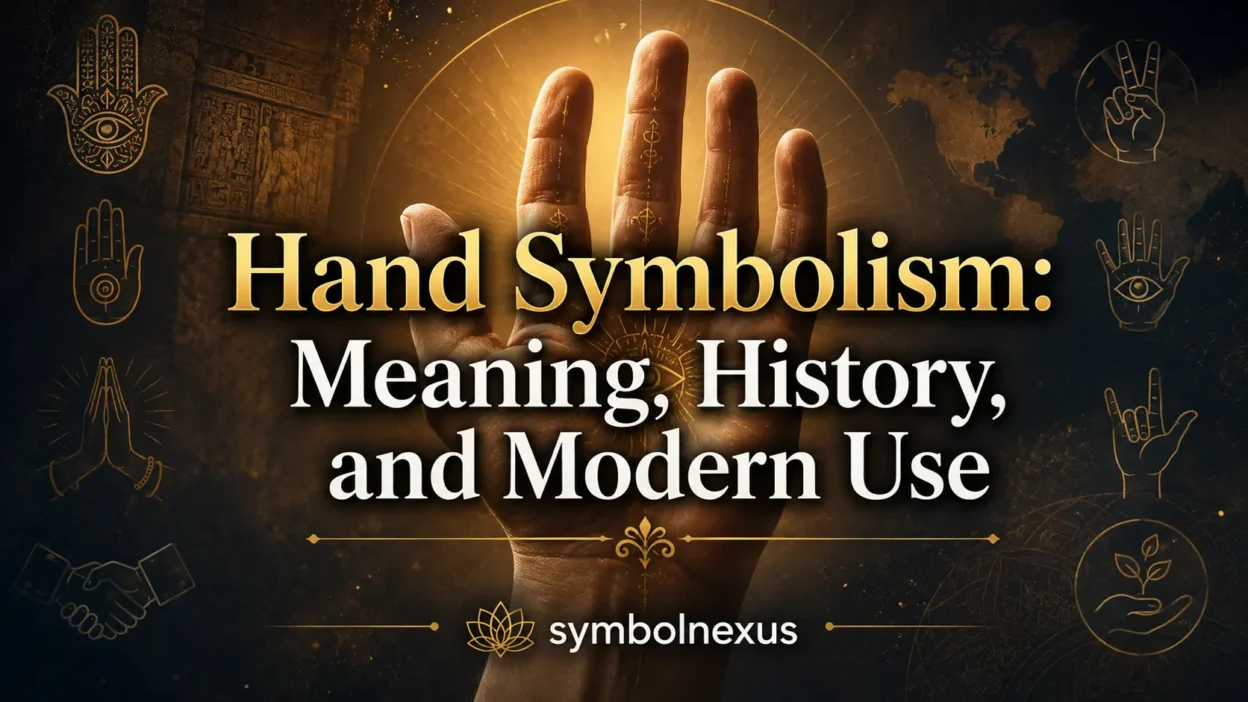
Hand symbolism centers on action, human connection, protection, skill, and personal identity. Unlike symbols based mainly on appearance, the hand gains meaning from what it does: it builds, touches, gives, receives, blesses, creates, warns, votes, protests, and communicates.
People encounter hand imagery almost everywhere in the United States. It appears in religious art, political posters, jewelry, tattoos, business logos, public memorials, emojis, safety signs, and children’s crafts. Even ordinary gestures such as a handshake, raised palm, clenched fist, or hand over the heart can communicate ideas without words.
The meaning changes with the position of the fingers, the direction of the palm, the surrounding objects, and the cultural setting. An open hand may welcome someone in one context and command them to stop in another. A fist may represent anger, resistance, strength, or solidarity. Understanding the surrounding context is therefore essential.
Quick Answer
Hand symbolism commonly represents action, ability, human connection, protection, and personal agency in modern American culture. Historically, hands have also represented divine authority, blessing, loyalty, labor, communication, and membership in a community.
TL;DR
- Hands symbolize action because they physically change the world.
- Open palms suggest honesty, welcome, peace, or surrender.
- Clasped hands often represent trust, agreement, or devotion.
- Raised fists communicate resistance, unity, and collective strength.
- Religious hand images may convey blessing, protection, or spiritual teaching.
- Modern hand symbols require cultural and situational context.
Why the Hand Works as a Symbol
The hand is closely connected to human intention. A person may think, feel, or believe something internally, but the hands often turn that intention into visible action. They write the letter, offer the gift, sign the agreement, strike the object, raise the banner, comfort the grieving person, or create the artwork.
This connection explains why the hand commonly represents agency — the ability to make choices and affect events. Expressions such as “take matters into your own hands,” “lend a hand,” and “hands-on experience” reinforce the idea that hands stand for practical involvement rather than passive thought.
The hand also represents identity. Fingerprints distinguish individuals, while scars, jewelry, nail styles, occupational calluses, and gestures can communicate personal history. In art and photography, hands may reveal age, work, emotion, social position, or relationships without showing a person’s face.
A third major meaning is connection. Hands allow people to greet, guide, protect, support, and comfort one another. Because touch can cross the boundary between two individuals, joined or reaching hands often represent cooperation, affection, reconciliation, or dependence.
At the same time, hands can threaten, restrain, reject, or dominate. The symbol is not automatically positive. Its meaning comes from the action being performed and the relationship between the people involved.
Common Hand Forms and Their Meanings
| Hand Form | Common Meaning in the USA | Typical Contexts | Important Note |
|---|---|---|---|
| Open palm | Honesty, welcome, peace, stopping | Logos, signs, greetings, art | Meaning depends on palm direction |
| Clasped hands | Trust, agreement, unity, loyalty | Weddings, charities, business imagery | Can also suggest prayer or pleading |
| Raised fist | Resistance, solidarity, strength | Protests, labor art, political posters | Meaning depends on the movement using it |
| Reaching hand | Help, longing, rescue, connection | Memorials, advertising, tattoos | May show giving or receiving |
| Praying hands | Faith, gratitude, remembrance | Religious art, tattoos, memorials | Not limited to one denomination |
| Handprint | Presence, identity, memory | Children’s art, activism, family keepsakes | Color and placement may change meaning |
These interpretations are familiar in American visual culture, but they are not fixed definitions. A hand symbol should be read together with its colors, words, location, historical background, and intended audience.
Prehistoric Handprints and the Earliest Human Marks
Handprints and hand stencils are among the oldest surviving forms of image-making. Ancient artists placed a hand against a rock surface and applied pigment around it, leaving a negative outline. Others pressed pigment-covered hands directly onto walls.
Examples have been discovered in Europe, Asia, Australia, Africa, and the Americas. Recent research has identified an Indonesian hand stencil reported to be at least 67,800 years old, while other Indonesian examples demonstrate that hand imagery remained part of rock-art traditions for thousands of years.
Their original meanings are unknown. Researchers cannot confidently say whether every print marked personal identity, participation in a ceremony, group membership, a sacred location, or a simple creative act. Different communities may also have used similar forms for unrelated reasons.
Still, a hand stencil has one unusual quality: it preserves the scale and outline of an actual human body. It is both an image and evidence of someone’s physical presence. Modern viewers often interpret it as an ancient statement resembling “I was here,” but that emotional response should not be confused with a proven archaeological explanation.
The enduring appeal of handprints comes partly from this directness. A painted animal represents something seen, while a handprint records the artist’s own contact with the surface.
Hands in Ancient Art, Authority, and Devotion
Ancient societies used hand positions to identify actions, relationships, and social roles. In early Mesopotamian votive sculpture, figures were often shown with their hands clasped at the chest or waist. The pose conveyed attentiveness and a continuing devotional presence before a deity.
Ancient Egyptian art used hands to show worship, offering, protection, and the transfer of life. During the reign of Akhenaten, the Aten was represented as a solar disk whose rays ended in small hands. Some of those hands held the ankh near the royal family, visually connecting sunlight, divine power, and life.
Clasped hands also became associated with promises and loyalty. In Greek and Roman art, two joined right hands could mark agreement, marriage, farewell, or mutual faith. Later European fede rings — named from a word associated with faith or trust — used clasped hands as signs of commitment and marital union.
The symbolic preference for the right hand appears in many older legal, political, and religious traditions. It could represent legitimacy, honor, proper order, or pledged truth. Modern Americans still raise the right hand when taking certain oaths, although contemporary culture generally treats left-handedness as an ordinary human variation rather than a negative sign.
Religious and Cross-Cultural Traditions
The hand appears in many religious systems, but similar-looking images should not be treated as interchangeable.
The Hamsa. The hamsa is a palm-shaped image used across parts of North Africa and the Middle East. It commonly functions as a protective amulet, especially against the evil eye, and appears in Jewish, Muslim, and regional cultural traditions.
The name relates to the number five and the five fingers. Depending on the community, it may be called the Hand of Fatima, Hand of Miriam, khamsa, or another regional name. It frequently appears on necklaces, wall hangings, household objects, and marriage documents.
In the United States, the hamsa may express religious identity, family heritage, protection, or general good fortune. Presenting it merely as a fashionable “good vibes” symbol can erase its cultural background, particularly when sellers invent unsupported meanings.
Christian imagery. In Christian art, an extended hand may represent blessing, healing, judgment, or divine intervention. Medieval artists sometimes depicted only the hand of God emerging from clouds because a full human figure was considered an inadequate representation of the divine.
Images of Christ and saints also use formal blessing gestures. Praying hands later became familiar symbols of devotion, humility, grief, gratitude, and remembrance. In modern American memorial art, the image may be used by people who identify with Christianity as well as by those who simply associate folded hands with prayer.
Hindu and Buddhist mudras. In Hindu and Buddhist art, a mudra is a meaningful position of one or both hands. Different mudras communicate specific teachings, states, or actions rather than one general idea.
For example, the raised palm of the abhaya mudra communicates reassurance and the removal of fear. In images of Shiva as Nataraja, different hands hold objects or perform gestures connected with destruction, refuge, protection, and spiritual release.
Removing a mudra from its religious and artistic context can lead to inaccurate interpretations. Finger placement, palm direction, associated objects, and the identity of the figure all matter.
What It Commonly Means in the United States
American culture uses the hand as a symbol of participation. Citizens raise their hands to vote in meetings, volunteer in classrooms, take oaths, and signal that they wish to speak. A hand placed over the heart communicates respect, sincerity, patriotism, or emotional attachment.
The handshake traditionally represents greeting, mutual recognition, or an agreement. Its exact origin remains uncertain, although forms of hand clasping have existed since antiquity. The popular claim that handshakes were invented specifically to prove that neither person carried a weapon is plausible as a theory, not an established historical fact.
Helping-hand imagery is especially common in nonprofit organizations, health services, charities, insurance companies, and community programs. It usually promises assistance, care, cooperation, or practical support. Multiple hands arranged in a circle may suggest diversity and teamwork, although the design can feel generic when no real community is represented.
The hand is also an occupational symbol. Images of farmers’ hands, construction workers’ hands, medical hands, and craftspeople’s hands emphasize effort, skill, service, and experience. American advertising often uses visibly worn hands to imply authenticity or honest labor.
Open Palms, Closed Fists, and Clasped Hands
A hand’s position can reverse its meaning.
An open palm facing outward may signal “stop,” nonaggression, honesty, or protection. In a religious image, the same shape may communicate blessing or reassurance. When raised during an oath, it signals public accountability.
An open hand facing upward often suggests offering, receiving, requesting, or surrendering control. Charitable imagery frequently shows one hand reaching down and another reaching up, creating a visual relationship between assistance and need.
A closed fist concentrates the fingers into one compact form. Because the pose resembles physical readiness, it may suggest anger, defense, determination, discipline, or force. When raised collectively, however, it more often communicates solidarity and organized resistance.
Clasped hands suggest that separate people or intentions have been joined. They may represent friendship, reconciliation, marriage, partnership, or a completed agreement. Hands clasped without a second person can instead suggest prayer, anxiety, patience, or pleading.
Artists also use partly opened or tense hands to create uncertainty. Curled fingers may imply hesitation, grief, restraint, fear, or an interrupted attempt to connect.
Work, Creativity, and Personal Agency
Hands symbolize work because they are the body’s primary instruments for making and altering objects. A hammer, pen, brush, needle, musical instrument, steering wheel, or surgical tool extends what the hand can accomplish.
In American labor imagery, large or roughened hands often represent workers as a collective force. They may communicate physical endurance, economic production, union strength, or pride in a trade. The same visual language can become romanticized when it celebrates labor while ignoring unsafe conditions or unequal compensation.
Creative professions use hand imagery differently. A hand holding a pencil may represent imagination made visible. A potter’s hands suggest patience and direct contact with material. A musician’s hands can stand for discipline, expression, and performance.
Hands also represent independence. To “make something by hand” implies personal involvement and variation rather than anonymous mass production. Labels such as handmade and handcrafted appeal to buyers because they suggest time, skill, and responsibility for the finished object.
A damaged, restrained, or missing hand can therefore symbolize lost control, interrupted work, punishment, dependence, or adaptation. In disability art, however, such imagery should not automatically be interpreted as helplessness. It may instead communicate resilience, altered technique, access needs, or rejection of narrow ideas about bodily ability.
Care, Touch, and Emotional Connection
Touch gives the hand much of its emotional meaning. Holding someone’s hand can communicate affection, reassurance, guidance, or presence during illness and grief. The action may be quiet, but it confirms that another person is not alone.
A parent’s hand holding a child’s often represents protection and trust. An older hand held by a younger one may suggest caregiving, continuity between generations, or the passage of time. Wedding photography uses joined hands to display rings and mutual commitment.
Reaching hands introduce more uncertainty. When they almost touch, they may symbolize longing, separation, missed connection, creation, or the desire for reconciliation. When one hand firmly catches another, the meaning shifts toward rescue and reliability.
Hands covering the face can represent grief, shame, fear, exhaustion, or privacy. A hand over the mouth may indicate shock, censorship, secrecy, or a voice being suppressed. Because these meanings involve vulnerability, context should determine whether the image communicates voluntary silence or forced silencing.
Protest, Identity, and Public Memory
Hand gestures are effective protest symbols because they can be performed by individuals and repeated by crowds. A single raised fist is visually simple; hundreds of raised fists transform individual commitment into collective presence.
In the United States, the raised fist has strong associations with labor organizing, civil rights, Black liberation, feminist activism, and later protest movements. Tommie Smith and John Carlos made the gesture internationally recognizable when they raised black-gloved fists during the medal ceremony at the 1968 Olympic Games. More recently, fist imagery has appeared extensively in Black Lives Matter protest art.
Another important contemporary image is the red handprint associated with awareness of Missing and Murdered Indigenous Women, girls, relatives, and Two-Spirit people. When placed over the mouth, it represents lives and voices silenced by violence and public neglect. The image appears in advocacy art, clothing, demonstrations, athletic events, and public memorials.
These symbols should not be treated as neutral design trends. Wearing or selling them without understanding the movements they represent can turn living issues into decoration. Responsible use requires attention to who created the symbol, who is affected, and whether the use supports or exploits the cause.
Why It Appears in Tattoos, Jewelry, and Decor
Hand tattoos allow people to combine anatomy with gesture. Praying hands may honor religious faith, a deceased relative, repentance, or gratitude. Two reaching hands may represent a relationship, spiritual creation, separation, or an important person who remains emotionally close.
A hamsa tattoo or pendant usually expresses protection, heritage, luck, or defense against harmful attention. An eye placed in the palm strengthens the protective association, but the design should not be described as belonging exclusively to one modern spiritual movement.
Skeleton-hand tattoos can represent mortality, endurance, fearlessness, or the closeness of life and death. A hand holding a flower may contrast human effort with natural growth. A handprint tattoo can preserve the size and shape of a child’s hand, memorialize a loved one, or mark family connection.
In home decor, open hands may serve as ring holders, wall sculptures, or protective objects. Hand-shaped chairs and surreal art use the body playfully, while palmistry-inspired prints often refer to fate, personality, or curiosity about the future.
Placement also matters. A hand image displayed near an entrance may imply welcome or protection. In a workspace, it may represent craft and productivity. In a memorial, the same form may communicate absence, touch, or a final connection.
Digital Gestures, Misunderstandings, and Misuse
Digital communication has expanded the number of hand symbols Americans use every day. Folded hands may communicate prayer, thanks, hope, apology, or a serious request. Raised hands often express celebration, while clapping hands signal approval. Pointing fingers direct attention but can also appear accusatory.
Hand emojis do not replace full body language. Tone, movement, facial expression, and physical distance disappear on a screen, making misunderstandings more likely. Skin-tone options also add questions of representation, identity, and appropriate use.
American Sign Language should not be reduced to a collection of symbolic gestures. It is a complete natural language with its own grammar, regional variation, and methods of word formation. Handshape is important, but facial expression, movement, location, and orientation also carry linguistic information.
Ordinary gestures can also acquire political or extremist associations. The “OK” sign, for example, remains a common signal of approval, yet it has also been used in trolling campaigns and by some white supremacists. Its presence alone does not prove hateful intent; surrounding behavior, location, accompanying symbols, and the person’s stated purpose must be considered.
Gestures may carry insulting meanings in other countries even when they seem harmless in the United States. Travelers, advertisers, photographers, and public figures should avoid assuming that a hand sign has one universal definition.
FAQs
What does an open hand symbolize?
An open hand commonly symbolizes honesty, welcome, peace, generosity, or willingness to receive. Direction changes the message significantly, though — a palm facing outward can mean stop, protection, or an oath being taken, while the same palm facing upward more often suggests offering or requesting something.
What does a hand tattoo usually mean?
The meaning depends heavily on the pose and any surrounding design elements rather than the hand shape alone. Common interpretations include personal agency, protection, religious faith, creative identity, family connection, mortality, or a visual attempt to reach toward someone emotionally important.
Is a hand a positive or negative symbol?
It genuinely depends on the action being shown, more than almost any other body-based symbol. A giving, healing, or joined hand tends to read as positive and connective, while a threatening fist, controlling grip, or hand covering someone’s mouth can just as easily signal aggression or suppression.
What do two hands reaching toward each other mean?
This usually symbolizes connection, longing, rescue, creation, or an attempt at reconciliation — the emotional weight often sits in whether the hands actually touch. A visible gap between the fingertips tends to emphasize separation or a relationship still working toward resolution, while contact suggests the connection has been made.
What does the right hand represent?
In many older Western and religious traditions, the right hand carried associations with honor, legitimate authority, blessing, and pledged truth — which is part of why oaths are still taken with the right hand raised today. Modern interpretation has largely dropped the old negative framing of the left hand, treating left-handedness as ordinary human variation rather than a meaningful symbol.
Are all hand gestures understood the same way worldwide?
No, and this is one of the more important cautions around hand symbolism. A gesture that reads as friendly or affirming in the United States — including common ones like the “OK” sign — can carry a completely different, sometimes insulting or unrelated meaning in another country, so context and location matter as much as the gesture itself.
What does the hamsa symbolize, and is it okay to wear one?
The hamsa is a palm-shaped protective symbol used across Jewish, Muslim, and regional North African and Middle Eastern traditions, most commonly associated with warding off the evil eye. Wearing one isn’t automatically disrespectful, but it’s worth knowing the tradition it comes from rather than treating it as a generic “good vibes” accessory — the difference is in the understanding, not the wearing itself.
Why is the raised fist such a recognizable protest symbol?
Its power comes from simplicity and repeatability — a single fist is an easy, unmistakable gesture, and when hundreds of people raise one together, individual commitment becomes visible collective presence. In the U.S., it carries strong historical ties to labor organizing, civil rights, and Black liberation movements, most famously the raised fists of Tommie Smith and John Carlos at the 1968 Olympics.
What does the red handprint over the mouth represent?
This is a specific, contemporary symbol connected to awareness of Missing and Murdered Indigenous Women, girls, relatives, and Two-Spirit people. Placed over the mouth, it represents lives and voices silenced by violence and public neglect — it’s a symbol tied to a real, ongoing crisis, not a generic design element, and it deserves to be used and understood with that context in mind.
Is American Sign Language just a set of symbolic hand gestures?
No — this is a common misconception worth correcting directly. ASL is a complete natural language with its own grammar, regional variation, and structure; handshape matters, but so do facial expression, movement, location, and orientation, all of which carry real linguistic information rather than functioning as isolated symbolic gestures.
Conclusion
The hand endures as a symbol because it’s the one part of the body built entirely around doing something to the world outside itself. Eyes see, and the heart feels, but the hand is where intention actually becomes visible — a thought turned into a signature, a grip, a gift, a raised fist, a held palm. That’s a harder trick for any other symbol to pull off, and it’s why hand imagery shows up in nearly every culture, era, and medium without ever really running out of new things to say.
That range is also exactly why context does so much of the interpretive work. The same five fingers can bless, protest, threaten, comfort, or silence, and the difference is never in the anatomy — it’s in the direction of the palm, who else is in the frame, and which history the gesture is standing inside of. A closed fist alone in a dark alley and a hundred closed fists raised together at a rally are not the same symbol wearing two outfits; they’re two entirely different sentences that happen to use the same word.
That’s the discipline worth carrying forward: before assigning a hand image any single meaning, ask what it’s actually doing, who it belongs to, and what it’s reaching toward or away from. The hand rarely lies about its intention — it just needs the rest of the picture to translate it correctly.


