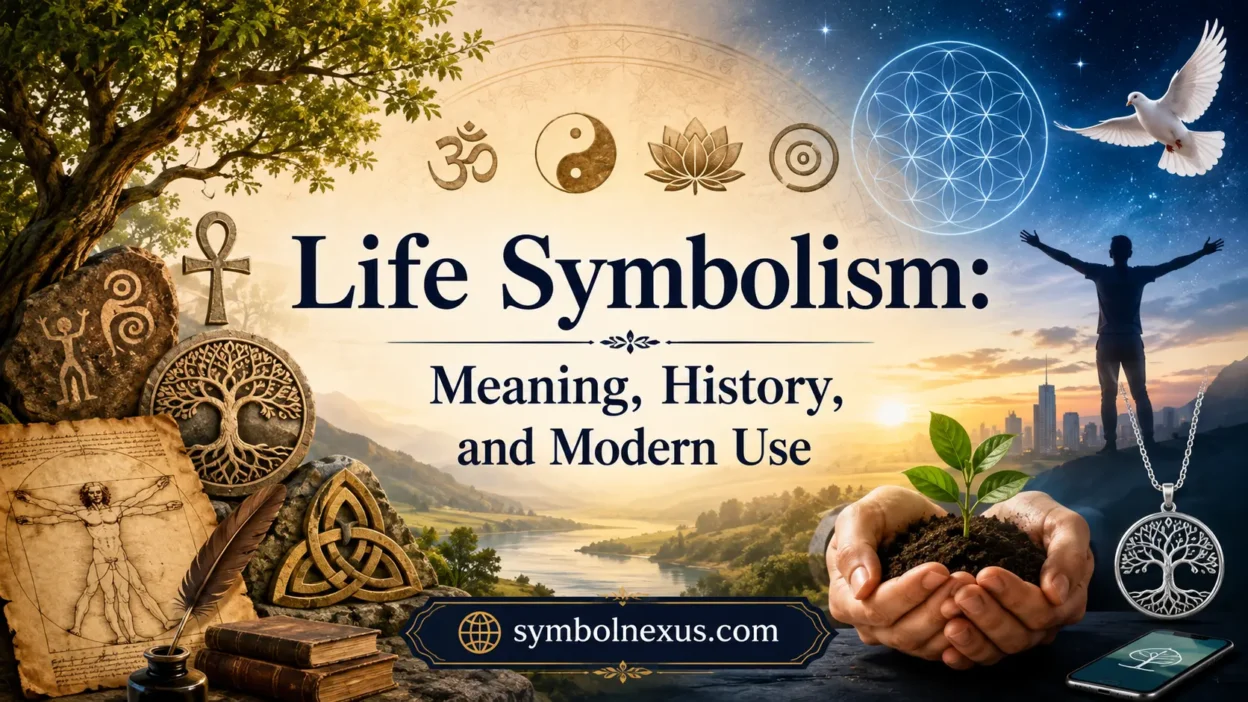
Life is an idea rather than a single object, so life symbolism appears through many different images: trees, seeds, water, sunlight, circles, flowers, breath, and ancient signs such as the ankh. What connects these symbols is their association with being alive, growing, changing, reproducing, surviving, and eventually dying.
People use symbols of life when ordinary language feels too limited. A tree planted after a loss can represent survival. A sprouting seed can mark a new beginning. A tattoo may express gratitude for being alive, recovery from hardship, family continuity, or acceptance of life’s temporary nature.
In the United States today, these meanings appear in tattoos, jewelry, memorials, family art, environmental design, religious imagery, public monuments, and digital graphics. Their meanings overlap, but they are not interchangeable.
Quick Answer
Life symbolism commonly represents growth, renewal, vitality, connection, and the continuing cycle of change in modern American culture. Historically, cultures have expressed these ideas through trees, water, flowers, circles, sunlight, and symbols such as the ancient Egyptian ankh.
TL;DR
- Life commonly symbolizes growth, renewal, connection, and continuing change.
- Trees and seeds represent development, ancestry, and future potential.
- The ancient Egyptian ankh directly represented life.
- Water and sunlight often suggest nourishment and vitality.
- Life symbols frequently include death as part of a larger cycle.
- Modern Americans use them in tattoos, memorials, jewelry, and design.
What Life Commonly Means in the United States
In American culture, life is most often represented as something active and developing rather than something fixed. Images of growing plants, open landscapes, flowing water, sunlight, and new leaves suggest movement toward the future.
Several related meanings appear repeatedly:
- Growth: becoming physically, emotionally, or spiritually different over time
- Renewal: beginning again after change or difficulty
- Vitality: health, movement, energy, and presence
- Connection: relationships between individuals, families, communities, and nature
- Potential: possibilities that have not yet developed
- Continuity: life continuing through generations or natural cycles
- Mortality: recognition that being alive also means being temporary
The meaning changes with context. A sapling at a wedding may suggest a shared future, while the same image at a memorial can represent continuity after death.
Why Life Has Many Symbols Instead of One
There is no universally recognized image that represents every meaning of life. Different societies developed symbols based on the natural processes, religious ideas, artistic traditions, and philosophical questions that mattered to them.
This is why a tree can represent life through visible growth, while water represents it through nourishment and movement. A circle emphasizes continuity. A seed emphasizes potential. The sun suggests vitality because living systems depend on its energy.
The following comparison shows how common images emphasize different parts of the idea:
| Symbol | Meaning in the USA | Common Associations | Important Note |
|---|---|---|---|
| Tree | Growth and continuity | Family, roots, resilience | Often connects past and future |
| Seed or sprout | New beginnings | Potential, youth, recovery | Focuses on early development |
| Water | Vitality and renewal | Cleansing, movement, birth | Meaning varies by religion |
| Circle | Continuity | Cycles, unity, wholeness | Can also suggest eternity |
| Sun | Energy and awakening | Warmth, hope, activity | Not always specifically a life symbol |
| Ankh | Life and continued existence | Egypt, antiquity, spirituality | Has a specific Egyptian origin |
Understanding the context matters more than looking for a rigid symbolic dictionary.
The Ankh and the Ancient Idea of Life
One of the clearest historical symbols of life is the ankh, an ancient Egyptian sign shaped somewhat like a cross with a loop at the top.
In Egyptian writing, the ankh was used for words meaning “life,” “live,” or “alive.” It also became a broader visual emblem of life and appears frequently in Egyptian religious and royal imagery.
Ancient Egyptian art sometimes shows deities holding the ankh, reinforcing ideas about divine life and continued existence. Its meaning could extend beyond ordinary biological survival to ideas connected with life granted or sustained by the gods.
Later uses changed. The looped form appeared in Christian-era Egypt as an alternative cross form, demonstrating how a familiar image could acquire new religious associations over time.
Today, Americans encounter the ankh in jewelry, tattoos, fashion, museum imagery, African diasporic cultural expression, and designs inspired by ancient Egypt. Modern wearers may associate it with life, heritage, spirituality, or personal identity, but those uses should not erase its specific Egyptian origin.
Trees, Roots, and the Tree of Life
Trees make intuitive symbols of life because they visibly perform many processes associated with living: they begin small, establish roots, grow upward, produce new leaves, reproduce, lose foliage, survive seasons, and eventually die.
Different parts of a tree can carry separate meanings:
Roots suggest ancestry, origins, stability, and belonging.
Trunks can represent strength, maturity, or the individual self.
Branches commonly suggest families, relationships, choices, or different paths.
Leaves and fruit can represent growth, descendants, abundance, or results.
The broader Tree of Life motif appears in numerous cultures and religious traditions, but these traditions should not be treated as versions of one universal ancient symbol. Similar tree imagery developed in different cultural settings with different theological and artistic meanings.
Trees also hold a strong place in American memorial culture. The Callery pear known as the Survivor Tree endured severe damage at the World Trade Center site after the September 11, 2001 attacks, was rehabilitated, and later returned to the memorial. It has become a public image of survival, resilience, recovery, and rebirth.
That example shows why living trees work especially well as memorial symbols: they continue changing after the event they commemorate.
Flowers, Seeds, and Images of Renewal
Plants often represent life at its beginning or during periods of renewal.
A seed contains visible potential without yet showing its final form. For that reason, seeds commonly suggest possibility, beginnings, children, ideas, faith in the future, or work whose results have not yet appeared.
A sprout takes the symbolism one stage further. Growth has begun, but the plant remains fragile. In modern design, a pair of green leaves emerging from soil often communicates health, sustainability, personal development, environmental responsibility, or a fresh start.
Flowers introduce another dimension: beauty that exists for a limited time. They can therefore represent both flourishing life and its temporary nature.
The ancient Egyptian blue and white water lilies commonly called lotuses carried strong associations with creation, rejuvenation, and rebirth. Their flowers close and reopen in connection with the daily cycle of light, which Egyptians linked symbolically with renewed creation.
Cherry blossoms offer another example of life joined with impermanence. Japanese traditions have long connected their brief flowering period with the transience of human existence. In Washington, D.C., trees originally given by Japan in 1912 became part of an American spring tradition where blooming also evokes friendship, renewal, and seasonal return.
Circles, Spirals, and the Cycle of Existence
Unlike a straight line, a circle has no obvious starting or ending point. That geometry makes it useful for representing continuity, return, recurring seasons, generations, and repeated patterns.
A circle may symbolize:
- the cycle from birth to death
- seasonal change
- wholeness
- unity
- continuity between generations
- eternity in religious settings
Spirals communicate a slightly different idea. They combine repetition with movement. A person can return to a similar position without being exactly where they started.
That makes the spiral particularly suitable for modern interpretations of personal development: grief may return, lessons may repeat, and families may follow familiar patterns, yet circumstances keep changing.
Neither shape carries one fixed meaning. Context determines whether a circle represents life, eternity, perfection, unity, protection, or something else entirely.
Water, Breath, and Other Signs of Living
Water symbolizes life partly because its connection with actual living organisms is direct. Humans, animals, and plants require it, so artistic associations with fertility, nourishment, birth, restoration, and survival developed naturally in many traditions.
Moving water adds the idea of change. Rivers flow forward, rain returns seasonally, and tides rise and fall. As a result, water can represent a life that continues while constantly changing form.
Religious uses add additional layers. Water may signify purification, spiritual renewal, ritual transition, blessing, or rebirth depending on the tradition.
Breath works similarly. Breathing is one of the most immediate signs of physical life, which gives breath symbolic associations with spirit, presence, consciousness, and the boundary between living and dying.
Modern phrases such as “a breath of life” or imagery showing someone taking a deep breath after hardship continue to draw on this basic connection.
Sunlight, Fire, and Vitality
Sun imagery usually emphasizes the energetic side of living.
Morning light can suggest awakening or a fresh beginning. Sunrise often marks the transition from darkness toward activity, which makes it a natural image for recovery and renewed opportunity.
The sun may also represent:
- warmth
- vitality
- clarity
- abundance
- seasonal growth
- hope after difficulty
Fire overlaps with these ideas but carries more tension. A controlled flame provides warmth and light; an uncontrolled fire destroys. For that reason, fire can symbolize both life force and transformation rather than life alone.
A candle makes the relationship especially clear. Its flame is active but fragile, so it can represent a living presence whose existence depends on continued protection. In memorial settings, extinguishing or lighting candles may communicate loss, remembrance, vigil, or continuing devotion.
Religious Meanings of Life Symbols
Religious traditions often connect life with questions that go beyond biological existence: Who creates life? What makes human existence meaningful? Does something continue after death? How should a person live?
In Jewish and Christian scripture, the Tree of Life appears in the Genesis creation narrative. Christian tradition also uses life imagery when discussing resurrection, eternal life, baptism, vines, fruit, bread, water, and light.
Ancient Egyptian religious art connected life with divine power, the afterlife, regeneration, and continued existence, helping explain the central role of the ankh and recurring rebirth imagery.
Buddhist traditions approach existence through concepts including birth, death, rebirth, impermanence, suffering, and liberation from the cycle of rebirth. Lotus imagery became important in Buddhist art, although its specific meaning depends on the figure, text, school, and artistic context.
Hindu traditions likewise contain multiple concepts of creation, preservation, rebirth, liberation, sacred plants, water, and cosmic order. There is no single image that summarizes the entire Hindu understanding of life.
Religious symbols should therefore be interpreted inside their own traditions instead of being blended into a generic spirituality.
Life and Death as Connected Ideas
Symbols of life frequently contain reminders of death.
At first that may seem contradictory, but mortality gives many life symbols their emotional force. A flower matters partly because it fades. A season becomes meaningful because it passes. A family tree includes ancestors who are no longer living.
This produces a recurring symbolic pattern:
birth → growth → maturity → decline → death → renewal
Nature makes that pattern visible through seeds, plants, seasons, animals, decomposition, and new growth.
Not every belief system interprets the sequence as literal rebirth. In secular American contexts, “renewal” may simply mean that communities continue, memories remain, descendants carry traditions forward, or ecosystems produce new life from what has died.
This distinction prevents symbolic language from being mistaken for a religious claim.
Emotional and Psychological Meaning
People often choose life-related symbols during periods when identity is changing.
After an illness, breakup, loss, relocation, addiction recovery, career change, or other major transition, images of growth may function as personal statements: the old situation ended, but the person continues developing.
A tree can communicate stability.
A sprout can communicate vulnerability combined with possibility.
A sunrise may express optimism.
A circle can reflect acceptance of change.
A family tree can reinforce belonging and continuity.
These meanings are psychological rather than magical. Wearing a symbol does not produce resilience or renewal. Instead, the object can serve as a reminder of values, experiences, relationships, or intentions that matter to the wearer.
That distinction makes symbolic interpretation more grounded.
Why Life Symbols Appear in Tattoos and Jewelry
Life symbols work especially well in tattoos because they can condense a complicated personal story into one image.
Tree tattoos may represent children, parents, ancestry, survival, or personal growth. Roots sometimes identify where someone came from, while branches point toward the life they are building.
Ankh tattoos often express life, continued existence, an interest in Egyptian imagery, or cultural identity. Because the sign has a specific historical background, its context deserves more care than a generic decorative icon.
Lotus tattoos commonly communicate renewal or perseverance in American tattoo culture, although interpretations drawn from Asian religious traditions should not be assumed to be interchangeable.
Small symbols are also common. Seeds, leaves, heartbeats, waves, suns, flowers, and circles can mark births, recoveries, anniversaries, or memories.
Jewelry works similarly but allows the wearer to remove, exchange, inherit, or pass down the object. This makes family jewelry particularly suited to ideas of continuity.
Modern American Design and Digital Culture
Commercial design tends to simplify symbolic ideas.
A green sprout may represent healthy living, environmental responsibility, organic products, gardening, or a new business. A heartbeat line can signal healthcare, fitness, survival, or emotional intensity. Sunrises often appear in wellness and recovery imagery.
Social media has accelerated this simplification. A symbol must often communicate in seconds, so familiar visual shortcuts become more common.
This creates useful shorthand, but also ambiguity. A leafy logo does not necessarily indicate literal environmental benefits, just as a heartbeat graphic does not always represent medical care.
Modern memorial design offers a more substantial use. Living plants, gardens, water, and seasonal change can place death beside continuing life. The Survivor Tree in New York is a particularly clear American example because the tree itself survived physical damage and continued growing.
The most effective modern uses generally work because the symbol’s physical behavior supports its message.
Common Misunderstandings and Cultural Misuse
The biggest mistake is assuming that every symbol has one universal definition.
A lotus does not mean exactly the same thing in ancient Egyptian art, Buddhist art, Hindu iconography, and an American tattoo studio. Similar images can develop distinct meanings in different societies.
The same caution applies to the Tree of Life. Contemporary jewelry and wall art often combine trees, circles, knot patterns, roots, and spiritual language under a single label. That modern design category should not automatically be presented as an unchanged symbol inherited from one ancient civilization.
Another problem is cultural flattening. Calling an ankh simply a “spiritual cross,” for example, loses its Egyptian linguistic and historical background. The sign represented life long before many of its later reinterpretations.
Personal meanings are valid, but they should be separated from documented historical meanings.
A person can say, “This symbol means rebirth to me,” without claiming, “This symbol has always meant rebirth everywhere.”
How Symbols of Life Changed Over Time
Early symbols often developed inside specific religious, political, funerary, or social systems. Their meanings depended on who used them and where they appeared.
Modern American culture operates differently. Museum collections, immigration, global media, tattoo culture, fashion, tourism, religious diversity, and digital communication place symbols from many traditions beside one another.
As a result, symbols acquire additional layers.
The ankh can remain an Egyptian symbol while also becoming jewelry.
A lotus can retain religious associations while appearing in wellness branding.
A family tree can function as genealogy, decoration, and identity art.
A cherry blossom can carry Japanese ideas about impermanence while also becoming part of Washington’s public spring culture.
Modern meanings do not automatically erase older ones. Usually, the symbol has accumulated several contexts that readers need to distinguish.
Frequently Asked Questions
What is the main symbol of life?
There is no single universal symbol of life. The tree is one of the most recognizable modern choices because growth, roots, branches, seasons, and reproduction naturally connect it with development and continuity.
What ancient symbol means life?
The ankh is one of the clearest examples. In ancient Egyptian writing, it represented words associated with being alive and became a widely used emblem of life.
What symbolizes new life and new beginnings?
Seeds, sprouts, eggs, newborn animals, spring flowers, sunrise, and fresh leaves commonly represent new life. They emphasize potential, emergence, or the beginning of a new stage rather than mature life.
What does a life symbol tattoo mean?
It depends on the image and wearer. Life-related tattoos commonly mark survival, birth, family, recovery, personal growth, mortality, gratitude, or a commitment to living differently.
Can a symbol represent both life and death?
Yes. Flowers, trees, seasons, circles, and water can represent life while also acknowledging decline or death. Their symbolism often centers on change rather than treating life and death as completely separate ideas.
Is the Tree of Life a religious symbol?
It can be. Tree-of-life imagery appears in several religious and cultural traditions, but those traditions do not all assign it identical meanings. Modern American versions also appear in secular family art, jewelry, tattoos, and home decor.
Does a lotus always symbolize rebirth?
No. Rebirth is an important interpretation in some contexts, including ancient Egyptian imagery, but lotus symbolism varies across religions and cultures. Its exact meaning should be identified from the tradition and artwork in which it appears.
Conclusion
Life symbolism centers on growth, vitality, renewal, connection, change, and the reality that living things do not remain unchanged forever. Trees, seeds, water, flowers, sunlight, circles, and the ankh communicate different parts of that larger idea.
What makes these images meaningful is usually something observable: roots hold a tree in place, seeds develop, flowers open and fade, water moves, sunlight returns, and living things grow older. Those physical processes allow people to turn abstract ideas about existence into images they can recognize.
The best interpretation therefore comes from considering both the symbol itself and its context. A personal meaning can be important while still respecting the historical and cultural tradition from which an image came.


