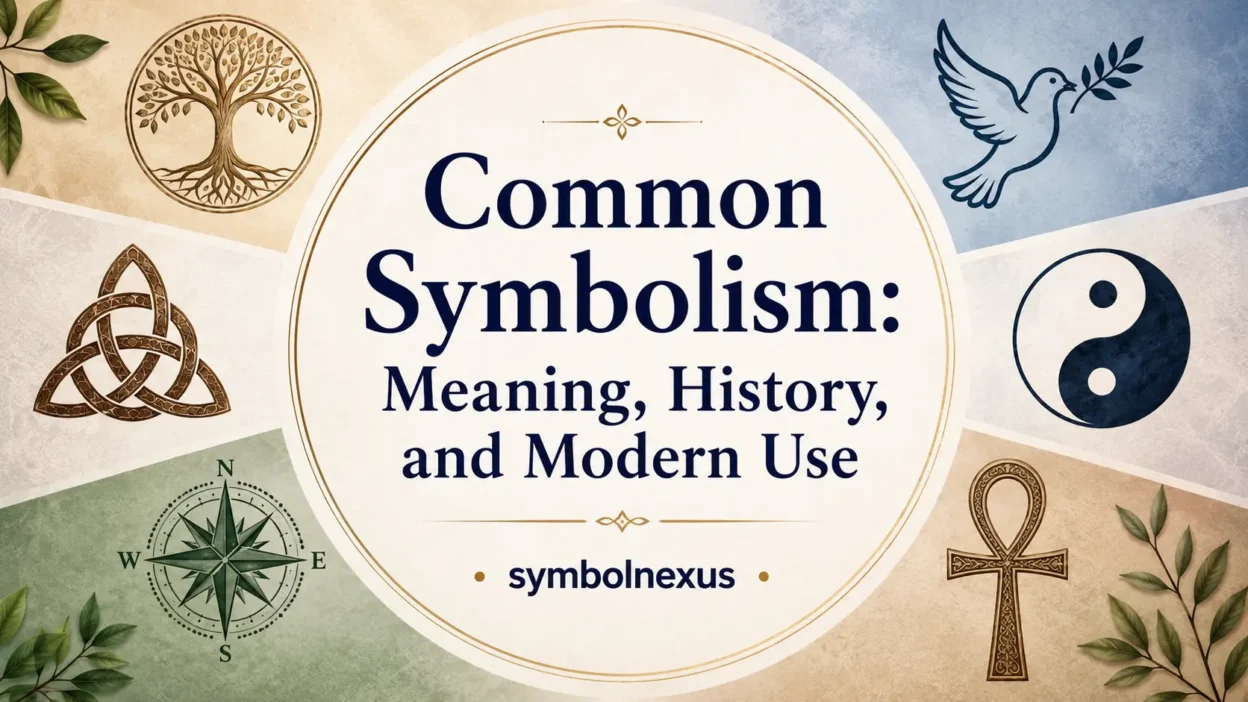
Common symbolism appears whenever an image, color, object, animal, or gesture communicates more than its literal form. A heart may express affection, a doorway can suggest transition, and a broken chain may represent freedom. These meanings are learned through religion, literature, public ceremonies, family traditions, advertising, and everyday social interaction.
Symbols help people communicate ideas that would otherwise require lengthy explanations. They can make a political message recognizable at a glance, give emotional weight to a memorial, or turn an ordinary piece of jewelry into a personal reminder.
Yet no symbol has a completely fixed definition. Its meaning depends on who uses it, where it appears, and what surrounds it. Understanding that context is the difference between thoughtful interpretation and simply assigning a memorized meaning.
Quick Answer
Common symbolism represents widely shared ideas through familiar images, objects, colors, animals, and gestures. In modern American culture, these symbols often communicate love, freedom, peace, danger, hope, identity, remembrance, or personal change, although their meanings can shift across historical and cultural settings.
TL;DR
- Hearts commonly express love, care, and emotional attachment.
- Eagles and flags often represent national identity and civic ideals.
- Doves, olive branches, and circular peace signs communicate peace.
- Colors gain meaning from context, tradition, and social convention.
- Animals often represent admired traits rather than literal behavior.
- Historical symbols can acquire new or controversial meanings.
How Familiar Symbols Create Meaning
A symbol is something visible or recognizable that represents an idea beyond itself. A physical object may symbolize an emotion, a social value, a religious belief, a political position, or an experience that cannot be seen directly.
The connection between a symbol and its meaning may come from resemblance. A sunrise resembles the beginning of a new day, so it can represent renewal. Other connections are established through convention. Red traffic lights mean stop because society has agreed on that function, not because red naturally contains the idea of stopping.
Repeated use strengthens recognition. When the same image appears in ceremonies, stories, monuments, classrooms, and public campaigns, people begin to associate it with a shared concept. National symbols are especially effective because they connect physical images with collective memories and ideals.
Why Context Changes Interpretation
A symbol rarely carries one universal meaning. The same image can communicate affection in one setting, danger in another, and political allegiance in a third.
Red may suggest romantic love on a Valentine’s Day card, injury in a medical scene, urgency on a warning label, or sacrifice in a national ceremony. A snake may represent danger, healing, rebirth, deception, fertility, or political unity depending on its culture and setting. Benjamin Franklin’s divided-snake image, for example, used the animal to argue for colonial cooperation rather than evil or temptation.
Interpretation therefore depends on four questions: What does the symbol traditionally mean? Who is using it? Where does it appear? What other images or words surround it? A tattoo, religious painting, protest sign, and corporate logo may use the same shape for entirely different purposes.
Widely Recognized Symbols at a Glance
| Symbol or motif | Common U.S. meaning | Other associations | Context to consider |
|---|---|---|---|
| Heart | Love and affection | Compassion, life, emotional pain | Color, condition, accompanying text |
| Eagle | Freedom and national identity | Strength, authority, vigilance | Government, military, spiritual, commercial |
| Dove | Peace and reconciliation | Innocence, faith, the Holy Spirit | Religious or civic setting |
| Circle | Unity and continuity | Wholeness, protection, eternity | Open, broken, enclosed, or repeated form |
| Skull | Death and danger | Mortality, rebellion, remembrance | Warning label, fashion, memorial, subculture |
| Rainbow | Hope and diversity | Covenant, inclusion, social identity | Religion, weather, activism, children’s design |
This table summarizes dominant American associations, not permanent definitions. Each symbol can take on a different meaning when its history, audience, or visual surroundings change.
Hearts, Rings, and Flowers in Love and Commitment
The heart is one of the clearest symbols of affection in the United States. It appears on greeting cards, jewelry, candy, clothing, digital reactions, and wedding decorations. Although it does not accurately reproduce the shape of a human heart, it functions as an emotional shorthand for love, care, attraction, and attachment.
The association developed gradually. Medieval European art and courtly-love traditions portrayed people giving or offering their hearts as signs of devotion. Heart imagery later became common on romantic objects and tokens exchanged not only by couples but also among relatives and friends.
Rings communicate continuity because their circular form has no visible beginning or end. Roses commonly suggest romance, while carnations have historically appeared in courtship and betrothal imagery. A wilted flower reverses the usual message, suggesting lost love, disappointment, age, or impermanence.
Doves, Olive Branches, and Peace Signs
The dove and olive branch are established signs of peace, reconciliation, and the end of conflict. Their meanings draw from religious narratives, classical traditions, and later civic art. In American monuments and public imagery, an extended olive branch often expresses a willingness to negotiate rather than fight.
The circular peace sign has a more recent and specific origin. British artist Gerald Holtom designed it in 1958 for the nuclear-disarmament movement, combining the semaphore positions for the letters N and D. It later expanded beyond that campaign and became a general international symbol of peace, protest, and opposition to war.
These symbols overlap but are not identical. A dove may carry religious meaning, an olive branch may imply diplomacy, and the circular sign often evokes modern activism.
Eagles, Flags, and Bells in American Civic Life
American public symbolism frequently uses images connected with independence, unity, sacrifice, and constitutional government. The Library of Congress identifies the U.S. flag, bald eagle, Liberty Bell, Statue of Liberty, national anthem, and Uncle Sam among the country’s major national symbols.
On the Great Seal, the eagle represents the nation, while the olive branch and arrows refer to the powers of peace and war. Thirteen arrows, shield stripes, and stars recall the original states, and the motto E Pluribus Unum emphasizes union.
The Statue of Liberty has become closely associated with freedom, democracy, equality, and immigration. The Liberty Bell also evolved beyond its original civic purpose, becoming a symbol used by abolitionists and later groups seeking expanded rights.
These images express ideals, but they can also invite debate about whether the nation has fulfilled them.
Light, Darkness, Roads, and Doors in Storytelling
Writers and filmmakers frequently use ordinary surroundings to express inner change. Light can suggest knowledge, safety, truth, spiritual presence, or sudden understanding. Darkness may indicate uncertainty, concealment, grief, fear, or moral confusion.
A road often represents a life direction because travelers must choose where to go. A crossroads intensifies that idea by presenting competing possibilities. Bridges connect separated places, making them useful symbols of reconciliation, communication, or movement between stages of life.
Doors and gates mark boundaries. An open door may suggest opportunity or welcome, while a locked door can communicate exclusion, secrecy, or restriction. Windows often represent partial access: a person can see another world without yet entering it.
These meanings become convincing when the story supports them. A door mentioned once may simply be a door. A door repeatedly opened, closed, guarded, or avoided is more likely to carry symbolic weight.
Animals as Symbols of Character and Identity
Animals are often used to represent human traits. Lions suggest courage or leadership, owls wisdom, foxes cleverness, butterflies transformation, dogs loyalty, and wolves independence or group belonging. These associations are simplified cultural patterns rather than scientific descriptions of animal behavior.
The eagle’s connection with height, strong vision, and flight supports its use as a symbol of authority and freedom. Butterflies are associated with transformation because their physical development visibly changes their form. Bears may communicate protection when shown with cubs but danger when depicted with claws exposed.
Animal meanings require particular care when connected to Indigenous cultures. Native nations have distinct histories, clan systems, stories, and relationships with animals. Treating all of these traditions as one generic system, or casually adopting sacred animal imagery, removes the symbol from the community that gives it meaning.
Colors as Emotional and Social Signals
Colors affect interpretation quickly, but their meanings are not universal. In contemporary American settings, red commonly suggests passion, danger, urgency, heat, or anger. Blue may imply calm, trust, sadness, authority, or distance. Green can represent nature, health, permission, money, envy, or environmental concern.
White often communicates cleanliness, simplicity, innocence, or peace, while black may suggest elegance, authority, mourning, secrecy, or rebellion. Gold is linked with achievement, prestige, wealth, or sacred importance. Purple can indicate luxury, spirituality, individuality, or ceremonial status.
Shade and placement matter. Pale blue feels different from electric blue, and a black formal suit communicates something different from a black warning banner. Color works with typography, material, shape, and setting rather than delivering an isolated message.
Cultural differences also matter. A color associated with celebration in one society may be used for grief or ritual observance in another.
Circles, Triangles, Spirals, and Broken Forms
Basic shapes communicate through their visual structure. A circle suggests unity, completion, cycles, protection, or continuity because its line returns to itself. Interlocking circles may represent partnership, shared identity, or overlapping communities.
Triangles can communicate stability when resting on a broad base. Pointed upward, they may suggest ascent, ambition, fire, or hierarchy. Inverted triangles can create a feeling of descent, receptivity, water, or instability, depending on the tradition using them.
Spirals imply movement while remaining connected to a center. They are often used for growth, repetition, inward reflection, or expanding awareness. A broken circle or snapped chain changes the message: the interruption can mean freedom, damage, incompleteness, resistance, or a cycle brought to an end.
Geometric symbolism is especially dependent on context because similar shapes appear in mathematics, religion, architecture, branding, and political movements.
Religious Symbols in a Pluralistic Culture
Religious symbols express belonging, belief, sacred history, and communal memory. Crosses, crescents, Stars of David, dharma wheels, lotus flowers, sacred words, candles, and ritual objects do not function as interchangeable decorations. Each belongs to particular teachings and practices.
In the United States, religious symbols may appear in houses of worship, jewelry, clothing, graves, public art, holiday displays, and personal tattoos. Some wearers use them as direct statements of faith. Others may use inherited symbols to maintain family or cultural connections even when they are not highly observant.
Interpretation should begin with the tradition itself rather than a generalized dictionary. A symbol’s orientation, color, inscription, or ceremonial placement may distinguish sacred usage from fashion, art, or political messaging.
Respectful use also requires recognizing that a symbol can carry obligations and meanings that outsiders may not immediately see.
Symbols of Death, Grief, and Remembrance
People use symbols to make loss visible and to preserve memory. Candles commonly represent life, prayer, presence, or remembrance. Extinguishing a flame can indicate death, while keeping one burning may express continuing memory.
Skulls remind viewers of mortality, but their tone changes by setting. On a hazardous-material label, a skull warns of poison. In fashion, it may suggest rebellion or toughness. In memorial art, it can encourage reflection on the brevity of life.
Broken columns, empty chairs, folded flags, black ribbons, and wilted flowers all communicate absence in different ways. An empty chair is effective because it shows the physical space once occupied by a person. A folded military flag connects private grief with public service and national ceremony.
Such symbols do not remove grief. They give communities a recognizable way to acknowledge it.
Tattoos and Jewelry as Personal Symbols
Tattoos and jewelry turn public images into personal statements. Someone may choose a butterfly after a major life change, a compass to represent direction, a tree for family continuity, or a memorial date to maintain a bond with someone who died.
Meaning can come from appearance, biography, or both. Two people may wear identical anchor tattoos, yet one associates it with stability while the other uses it to remember naval service. Initials, coordinates, birthstones, inherited rings, and religious pendants often have meanings that cannot be determined by appearance alone.
Because body art is long-lasting and publicly visible, historical research matters before choosing a design. Runes, numbers, crosses, and geometric marks may have religious, ethnic, military, criminal, or extremist associations that are not obvious to the wearer.
Personal intention matters, but it does not always erase a symbol’s public history.
Symbols in Homes, Fashion, and Digital Culture
Home decor often uses symbols to establish mood or identity. Trees can suggest family roots, suns warmth and optimism, moons rest or intuition, and protective signs safety. Seasonal decorations also rely on established associations, such as eggs for new life, evergreens for endurance, and harvest imagery for abundance.
Fashion allows people to display affiliation, irony, nostalgia, protest, or status. A symbol printed on a shirt may function as branding, cultural identification, political speech, or purely decorative design.
Digital communication has accelerated symbolic change. Hearts, flames, skulls, stars, check marks, and facial icons can express reactions that once required full sentences. Their meanings also evolve rapidly. A skull emoji, for instance, may represent literal death in one exchange but uncontrollable laughter in another.
Online communities frequently develop specialized meanings that differ from traditional interpretation, making audience awareness essential.
How Meaning Changes Across Cultures
Some symbols appear in many societies, but that does not mean they carry identical meanings. Water may represent life, purification, danger, rebirth, or the boundary between worlds. The moon may symbolize time, fertility, change, femininity, spiritual authority, or national identity.
The rainbow demonstrates this flexibility. It has appeared in religious stories, art, literature, political coalitions, popular entertainment, and movements for LGBTQ+ identity and equality. The modern Pride flag grew from activist design work surrounding San Francisco’s 1978 parade, but rainbow imagery had already been used in earlier literature and political movements to express hope, difference, and coalition.
Cross-cultural interpretation should therefore identify the specific community, period, and practice involved. Broad claims such as “this symbol always means” usually erase meaningful differences.
Controversies, Appropriation, and Distorted Meaning
Symbols can be borrowed, commercialized, politicized, or deliberately transformed. A design that once expressed religion or cultural identity may acquire a sharply different public meaning after being adopted by a violent movement.
The swastika is the clearest example. It existed for thousands of years in numerous cultures and remains sacred in Hinduism, Buddhism, Jainism, and other Asian traditions. Nazi adoption changed its dominant meaning in the United States and Europe, where it is now overwhelmingly recognized as a sign of Nazism, antisemitism, racial hatred, and mass murder.
Other symbols require similar contextual judgment. Some runes and numerical codes have ordinary historical or religious uses but have also been appropriated by extremist groups. A single mark should not automatically be treated as proof of intent; accompanying language, placement, repetition, and group affiliation must be considered.
How to Interpret a Symbol Accurately
Begin with the immediate setting. Identify where the symbol appears, who created it, and what purpose the object serves. A rose in a wedding invitation probably carries a different meaning from a rose placed on a grave.
Next, look for repetition and contrast. A recurring bird, color, season, or object is more likely to be intentional. Changes may also matter. A healthy tree that later loses its leaves can reflect a shift in the story or character.
Then examine relevant history. Determine whether the symbol belongs to a religious tradition, political movement, national institution, artistic convention, or cultural community. Avoid combining unrelated traditions merely because their symbols look similar.
Finally, separate evidence from personal reaction. Readers may form individual associations, but a strong interpretation explains how the surrounding details support the conclusion.
Frequently Asked Questions
What are the most common symbolic meanings?
The most widely recognized meanings include love, peace, freedom, danger, hope, death, renewal, loyalty, wisdom, and transformation, expressed through familiar vehicles like hearts, doves, chains, warning colors, light, skulls, trees, and changing seasons. What makes these meanings feel universal is really just how often they recur across religion, storytelling, and public life — not that every culture arrived at the same image independently.
Can one symbol have both positive and negative meanings?
Yes, and fire is one of the clearest examples — the same flame can represent warmth, purification, passion, destruction, or punishment depending on context. What flips the meaning is usually a small set of factors: whether the fire is controlled or spreading, welcomed or feared, and whether it appears in a domestic, religious, political, or narrative setting.
What do common symbols mean in tattoos?
Tattoo symbols typically blend a widely recognized public meaning with the wearer’s private history, which is why identical designs can mean genuinely different things to different people. An anchor might represent stability to one person and naval service to another; the shared image is really just a starting point for a more specific personal story.
Are symbolic meanings universal?
Very few are, despite how often they’re presented that way. Human experiences like birth, danger, death, family bonds, and seasonal change are close to universal, but the specific images and traditions societies use to represent those experiences vary considerably — which is exactly why context does so much of the interpretive work.
How is religious symbolism different from ordinary symbolism?
Religious symbols operate inside a full system of belief, ritual, scripture, and community practice, which typically gives them a more specific and bounded meaning than their visual appearance alone would suggest. A cross, a lotus, or a Star of David isn’t simply decorative shorthand — its meaning is anchored to the teachings and practices of the tradition it comes from, not open to casual reinterpretation.
How can I tell whether a symbol is offensive?
Start by researching its historical and current use, particularly in the country or community where it will actually appear, since meaning can shift sharply across borders and eras. Pay close attention to whether the symbol belongs to a marginalized community, has been adopted by an extremist movement, or is being pulled out of a sacred context and used as casual decoration — any of those should prompt real caution.
Why do the same symbols sometimes mean opposite things in different cultures?
Because symbolic meaning is built through convention and repeated cultural use rather than any inherent property of the image itself — there’s nothing about a color or shape that fixes its meaning in advance. White signals purity at an American wedding but mourning in some other traditions; red means danger on a warning label but luck and prosperity in Chinese custom. The image travels, but its meaning has to be relearned in each new context.
Can a symbol’s meaning really change because of how it was used historically?
Yes, dramatically so — the swastika is the starkest example, having been sacred across Hinduism, Buddhism, and Jainism for thousands of years before Nazi appropriation overwrote its dominant meaning throughout the U.S. and Europe. This shows that historical use isn’t just background trivia; it can actively determine what a symbol communicates today, sometimes regardless of a wearer’s personal intent.
How do I know if a symbol is being used sincerely versus ironically or as branding?
Look at the surrounding context rather than the symbol alone — the setting, the accompanying text or imagery, and the apparent purpose of the object it appears on all signal intent. A skull on a hazardous-material label, a skull on a fashion T-shirt, and a skull in memorial art are visually similar but functionally unrelated, and the difference is almost always legible from what surrounds the image, not the image itself.
Why shouldn’t Indigenous animal or spiritual symbols be treated the same as general symbolism?
Because those symbols are tied to specific nations, clan systems, oral traditions, and living communities rather than existing as generic cultural shorthand available for anyone to reinterpret. Treating a sacred animal symbol from one specific tradition as though it belongs to “Native American culture” broadly erases real differences between distinct nations and can strip meaning away from the community it actually belongs to.
Conclusion
Every symbol in this article does the same basic trick: it lets a physical thing — a color, a shape, an animal, a gesture — carry an idea too large or too private to say outright. That trick only works because of repetition. A heart means love because millions of cards, rings, and gestures kept saying so; a raised olive branch means peace because centuries of art and diplomacy kept pointing at the same idea. Meaning isn’t hidden inside the object. It’s built by everyone who has used it before you.
That’s precisely why the same symbol can split so cleanly into opposite readings depending on where it lands. A skull warns of poison on one label and celebrates rebellion on one T-shirt. A swastika represents thousands of years of sacred tradition in one context and, after a single twentieth-century regime, represents something almost unrecognizably different in another. The object never changed. The history attached to it did — and that history is doing most of the real communicating.
Reading a symbol well, then, isn’t about memorizing a dictionary of fixed meanings. It’s about asking who’s using it, where, and what surrounds it — and staying willing to find out that the answer might not be the one you expected.