
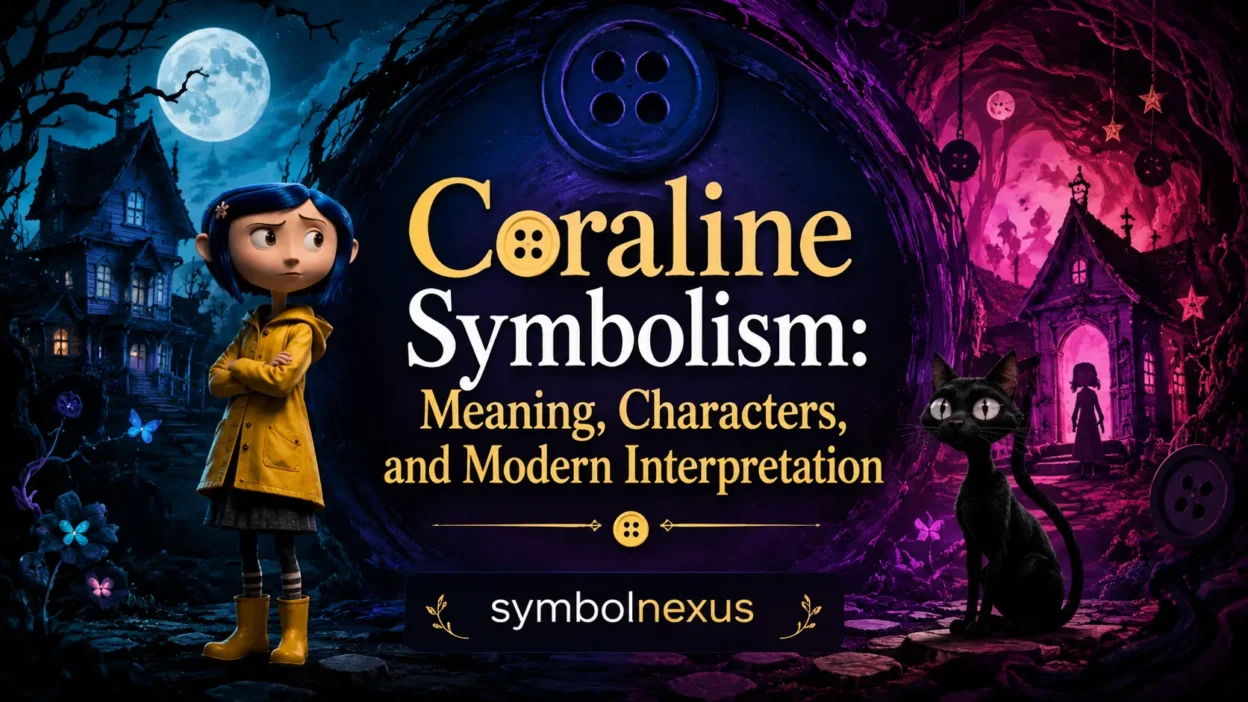
Coraline symbolism centers on the conflict between authentic love and controlling attention. Through button eyes, secret doors, mirrored families, trapped children, and a world designed around one girl’s desires, the story explores temptation, personal identity, emotional manipulation, and the courage required to reject a comforting lie.
Neil Gaiman’s novella was published in 2002, while Henry Selick’s stop-motion adaptation arrived in 2009 as LAIKA’s first feature film. The movie preserves the book’s central struggle but adds visual symbols, characters, and settings that make Coraline’s emotional journey especially vivid.
Many of the story’s objects have become recognizable far beyond the original book. Buttons, blue hair, black cats, unusual keys, handmade dolls, and yellow raincoats now appear in fan art, clothing, tattoos, Halloween costumes, and online culture. Yet these images make the most sense when understood as parts of a larger warning about attention, choice, and personal freedom.
Quick Answer
Coraline symbolism most commonly represents the danger of surrendering freedom in exchange for attention, comfort, or a seemingly perfect life. Its broader meanings include courage in the presence of fear, the preservation of identity, distrust of manipulative affection, and a growing appreciation for imperfect but genuine family relationships.
TL;DR
- Button eyes represent obedience and the loss of personal identity.
- The Other World turns desire into a method of control.
- The small door marks a dangerous emotional threshold.
- Coraline’s courage depends on acting while still afraid.
- The cat represents independence, instinct, and clear judgment.
- The real world becomes valuable because it permits freedom.
What Coraline Symbolizes at Its Core
At its center, Coraline is a story about learning to distinguish genuine care from possession. Coraline initially wants more excitement, better food, greater attention, and parents who organize their lives around her. The Other Mother supplies all of these things, but only because they make Coraline easier to capture.
The story does not argue that children should accept neglect or stop asking adults for attention. Coraline’s frustration with her busy parents is understandable. The danger begins when another figure studies that frustration and uses it to manufacture an irresistible offer.
The contrast creates several connected meanings:
| Symbol or Context | Primary Meaning | Emotional Association | Important Distinction |
|---|---|---|---|
| Button eyes | Lost identity and obedience | Unease, helplessness | Attention becomes conditional |
| Small door | Crossing a forbidden boundary | Curiosity, anticipation | Discovery carries consequences |
| Other World | Seductive fantasy | Delight followed by fear | Perfection conceals control |
| Other Mother | Possessive affection | Comfort, guilt, terror | Love is confused with ownership |
| Black cat | Independence and intuition | Caution, confidence | Guidance without domination |
| Seeing stone | Perception beyond appearances | Focus, hope | Truth requires active searching |
These meanings develop gradually. Coraline does not immediately recognize the Other World as dangerous because manipulation is most effective when it resembles generosity.
The Fairy-Tale and Gothic Roots of the Story
Coraline belongs to a long tradition of children entering unfamiliar worlds where ordinary rules no longer protect them. Its secret passage recalls the threshold journeys of fairy tales and portal fantasies, while its false parent and endangered child connect it to stories involving witches, replacements, enchanted food, and deceptive homes.
Gaiman has discussed Lucy Clifford’s Victorian story “The New Mother” as an influence. That tale also uses the fear of a frightening replacement mother, placing Coraline within an older tradition of stories about children being separated from dependable family structures. Critics have also compared Coraline’s journey to Alice’s Adventures in Wonderland, although Coraline enters a more openly predatory environment.
The story also uses the Gothic idea of the uncanny: something ordinary becomes frightening because it is almost familiar but not quite right. The Other Mother resembles Coraline’s mother. The Other World resembles her home. The neighbors, furniture, meals, and bedrooms all look recognizable, but each has been altered.
This resemblance is more disturbing than a completely alien world would be. Coraline is not simply threatened by a monster. She is threatened by a false version of home.
The Small Door and Tunnel as a Dangerous Threshold
The small door represents curiosity, transition, and the decision to enter a situation that cannot be fully understood in advance. At first, it appears useless because a brick wall stands behind it. When the wall disappears, the familiar room gains access to an impossible space.
Symbolically, the door separates dissatisfaction from temptation. Coraline does not cross it because she intends to abandon her family. She crosses because she is bored, lonely, and curious. Those ordinary feelings make the danger believable.
The tunnel intensifies this meaning. It is not an instant magical portal but a narrow passage that Coraline must crawl through. Moving on her hands and knees places her in a vulnerable physical position, while the tunnel’s shifting character suggests that the boundary between worlds is controlled by something else.
The passage can also be read as a transition between stages of awareness. Coraline first travels through it as an explorer. Later, she uses it as an escape route. By the end, she understands that a doorway can offer possibility without guaranteeing safety.
The Other World and the Danger of Perfect Wish Fulfillment
The Other World is built from Coraline’s complaints. Her real parents are distracted, so the other parents focus entirely on her. Her meals feel dull, so the Other Mother serves elaborate food. Her neighbors seem eccentric and disappointing, so their counterparts become spectacular performers.
This environment symbolizes wish fulfillment without boundaries. Everything responds to Coraline, but nothing possesses an independent life. The world exists to flatter, entertain, and contain her.
Its artificial perfection is important. A healthy home includes disagreement, boredom, waiting, compromise, and other people’s needs. The Other World removes those frustrations, but it also removes freedom. Coraline can have anything except the right to leave unchanged.
The message is not simply that people should be satisfied with whatever they have. Instead, the story warns that a fantasy becomes dangerous when it eliminates another person’s ability to say no.
Button Eyes: Obedience, Blindness, and Loss of Self
Button eyes are the story’s most recognizable symbol. Eyes normally allow people to perceive their surroundings and reveal emotion to others. Replacing them with identical black buttons removes both functions.
The buttons therefore suggest blindness in several senses. The Other World’s inhabitants cannot see independently, reveal authentic feelings, or look back at Coraline as complete individuals. They appear attentive, but their expressions are manufactured.
The Other Mother’s demand that Coraline accept buttons is also a demand for consent. She wants Coraline to participate in her own transformation. Once Coraline agrees, the Other Mother can present captivity as a chosen arrangement rather than an act of violence.
Sewing the buttons into place would destroy Coraline’s physical vision, but the greater loss would be her independent point of view. She would stop being a person who observes, judges, and disagrees. She would become another object in the Other Mother’s collection.
Buttons are ordinary household items, which makes them especially effective as horror imagery. They represent domestic control disguised as harmless craft.
The Other Mother as Possessive and Manipulative Love
The Other Mother symbolizes affection that demands ownership. She does not merely want Coraline to visit or appreciate her. She wants permanent access to Coraline’s body, attention, and identity.
Her behavior follows a recognizable pattern. She studies Coraline’s disappointments, offers intense approval, creates pleasurable experiences, and then introduces a permanent condition. When Coraline refuses, warmth becomes punishment.
This change reveals that the earlier kindness was never unconditional. The Other Mother’s affection depends on submission.
Gaiman has described the character as a predator rooted partly in childhood fears of abandonment and replacement. That origin helps explain why she is frightening even before her appearance becomes monstrous. She threatens the security of the family bond by suggesting that parents and children might be exchanged.
As her disguise collapses, she becomes thinner, sharper, and more spiderlike. The transformation externalizes what was always present beneath the welcoming performance: appetite, calculation, and control.
The Doll as Surveillance Disguised as Companionship
The Coraline doll plays a major role in the film, although it is not used in the same way in the original novella. It resembles Coraline but has button eyes, making it an early model of what the Other Mother wants her to become.
At first, the doll appears to be a personalized gift. Because it looks like Coraline, it seems comforting and special. Its real purpose, however, is observation. It allows the Other Mother to study Coraline’s environment and learn what she lacks.
The doll therefore symbolizes surveillance hidden inside intimacy. Its resemblance creates trust, while its silent presence collects information.
It also raises a question about imitation. A handmade copy may reproduce Coraline’s clothes and hair, but it cannot reproduce her judgment, memories, or will. The difference between Coraline and the doll is the difference between a living identity and an image that can be positioned by someone else.
Mirrors and the Ghost Children
Mirrors normally reflect visible reality, but in Coraline they are used to confuse, imprison, and manipulate. The Other Mother shows Coraline images intended to make her believe that her real parents rejected her. The mirror becomes a tool for producing emotional doubt rather than revealing truth.
Coraline is also confined behind a mirror, where she meets the spirits of children previously taken by the Other Mother. Their presence exposes the history hidden behind the beautiful Other World.
The ghost children represent the final consequence of surrendering identity. Their names, appearances, and periods of life have become uncertain. What remains is a fragmented memory of being tempted, altered, and discarded.
By helping them, Coraline moves beyond her original goal of recovering her parents. She recognizes that the Other Mother’s behavior is not a private family dispute but a repeated pattern of victimization. Her rescue mission becomes an act of solidarity with people she never knew.
The Seeing Stone and the Work of Recognizing Truth
Miss Spink and Miss Forcible give Coraline a stone with a hole through its center. In the Other World, looking through that opening helps her locate the hidden souls of the ghost children.
The stone symbolizes focused perception. Coraline cannot find the truth by staring at the entire dazzling environment. She must narrow her attention and look past the surface designed to distract her.
Its effectiveness also depends on Coraline’s action. The object does not rescue anyone by itself. She must remember it, interpret what it reveals, and continue searching while the Other Mother tries to frighten her.
The stone’s plain appearance contrasts with the elaborate attractions of the Other World. A small, imperfect object from the real world proves more useful than the Other Mother’s spectacles. This reinforces the idea that truth may appear modest while deception works hard to impress.
The Black Cat as Independence and Intuition
The cat can move between the real and Other Worlds without losing its identity. Unlike the duplicated people around Coraline, it has no false counterpart.
That independence makes the cat a symbolic contrast to the Other Mother. She classifies, copies, names, and controls. The cat refuses ownership and behaves according to its own judgment.
It also represents instinct. The cat recognizes the Other World’s danger before Coraline fully understands it, but it does not remove her responsibility to choose. It offers information, criticism, and occasional help without demanding obedience.
Its ability to speak only in the Other World suggests that danger makes certain truths easier to hear. Coraline may dismiss the cat as an ordinary animal at home, but beyond the door its warnings become impossible to ignore.
The cat’s loyalty is freely given rather than forced. That makes its companionship a healthier form of care than the Other Mother’s constant attention.
Food, Gardens, and Performances as Bait
The Other Mother does not begin with chains or threats. She begins with a meal. Food symbolizes nurture, domestic care, and belonging, which makes it an ideal instrument for winning Coraline’s trust.
Yet the meals are performances rather than evidence of a sustainable relationship. They are designed around immediate pleasure. Like the rest of the Other World, they conceal the cost until Coraline is emotionally invested.
The film’s garden performs a similar function. It blooms into an image centered on Coraline, converting nature into a personalized advertisement. Rather than growing for its own sake, the garden exists to tell Coraline that she is the center of everything.
The theatrical versions of her neighbors also appeal to her desire for excitement and recognition. Their performances are grander than anything in the real world, but the performers themselves lack freedom.
Together, the meals, garden, music, and shows symbolize attention as spectacle. They look like generosity, but every attraction is part of the same trap.
Color and Space in the Film Adaptation
The film uses visual contrast to shape the audience’s emotional response. Coraline’s real environment initially appears muted, rainy, and physically restricted. The Other World introduces warmer colors, movement, elaborate lighting, and a stronger sense of depth.
Selick explained that the real-world scenes were intentionally given a more limited palette and shallower visual space to express Coraline’s loneliness. The fuller use of color and stereoscopic depth in the Other World was designed to draw viewers inward just as Coraline is drawn toward it.
This creates a deliberate reversal. Brightness initially signals pleasure, while grayness appears disappointing. As the story progresses, the colorful world decays and the ordinary world gains warmth.
Color therefore does not operate as a simple good-versus-evil code. Its meaning changes with Coraline’s understanding. Beauty becomes suspicious when it is used to conceal control, while subdued reality becomes valuable when it allows genuine relationships to grow.
Webs, Needles, and the Severed Hand
The Other Mother’s later spiderlike appearance makes the structure of her world clearer. Like a spider, she creates an attractive environment, waits for movement within it, and closes off escape once the victim is caught.
Sewing imagery strengthens this association. Needles and thread can represent creativity, repair, and domestic skill, but the Other Mother turns them into instruments of forced alteration. She does not sew clothing for Coraline; she intends to sew Coraline into a permanent role.
The severed hand continues to pursue Coraline after the apparent escape. It symbolizes the persistence of coercive control. Leaving the controlling figure does not automatically remove every mechanism that figure created.
The hand is also frightening because it acts without a face or voice. Reduced to grasping fingers, the Other Mother’s purpose becomes unmistakable: to seize, retrieve, and possess.
Courage, Identity, and a More Mature View of Family
Coraline begins the story as curious and capable, but her bravery develops when curiosity gains consequences. She returns to the Other World after discovering its danger because her parents and the ghost children remain trapped.
Her courage does not depend on becoming fearless. She plans while frightened, bargains while vulnerable, and continues even when she knows the Other Mother is stronger. The story treats bravery as a decision rather than a personality type.
Coraline also learns that independence is not the same as isolation. She succeeds by combining her intelligence with help from the cat, the seeing stone, warnings from neighbors, and information from the ghost children.
Her view of family changes as well. She does not conclude that her real parents are flawless. They remain busy, occasionally impatient, and unable to turn everyday life into continuous entertainment. What changes is Coraline’s ability to recognize the difference between imperfect love and possessive imitation.
Real love leaves room for separation. The Other Mother’s version does not.
How Americans Interpret and Use the Story Today
In the United States, Coraline is commonly understood as a dark coming-of-age story, a family horror film, and a warning about offers that appear perfectly tailored to personal dissatisfaction.
Adult viewers often connect the Other Mother with emotionally manipulative relationships, controlling parenting, deceptive online attention, or affection that becomes hostile when boundaries are asserted. Younger viewers may focus more directly on courage, curiosity, and learning to value home.
The story’s visual language is now widely used in personal style. Button motifs may express an interest in Gothic fantasy, alternative animation, childhood nostalgia, or resistance to conformity. Tattoos frequently combine buttons, the key, the cat, the door, the seeing stone, or Coraline’s raincoat.
Its continued popularity is visible in theatrical revivals as well. The film’s 2024 anniversary rerelease earned more than $50 million worldwide, demonstrating substantial interest from both returning viewers and a younger audience encountering it in theaters.
Common Misunderstandings and Overreaching Fan Theories
One common misunderstanding is that Coraline’s real parents are presented as villains. They are distracted and emotionally unavailable at important moments, but the story distinguishes those flaws from the Other Mother’s deliberate predation.
Another mistake is treating the story as a warning against curiosity. Coraline’s curiosity exposes her to danger, but it also gives her the knowledge and resourcefulness needed to defeat it. The problem is not exploration itself; it is failing to examine the price attached to an attractive offer.
Online theories sometimes assign a fixed secret meaning to every color, insect, piece of furniture, or background detail. The film contains intentional visual patterns, but not every object has a confirmed one-to-one symbolic definition.
Claims that the entire story is exclusively about addiction, a specific mental disorder, or one hidden supernatural event should therefore be treated as interpretive theories. The story supports multiple readings, but its central conflict remains clear without requiring a single coded explanation.
Frequently Asked Questions
What do the buttons symbolize in Coraline?
The buttons represent lost vision, restricted identity, and obedience to the Other Mother — accepting them means surrendering the ability to see, judge, and exist as an independent person. What makes them especially unsettling is how ordinary they are; the story turns a harmless household object into a symbol of total domestic control specifically because buttons don’t look like a threat.
What does the Other Mother symbolize?
She symbolizes affection used as a mechanism of control rather than a source of genuine care. Her kindness reads as real at first specifically because it is generous in the moment — the danger only becomes visible once Coraline tries to say no, which is exactly when the story reveals that her warmth was conditional all along.
What does the small door represent?
The door represents curiosity and the crossing of an emotional threshold — it connects Coraline’s ordinary boredom and loneliness to a fantasy that appears to solve every problem at once. Its danger lies precisely in how mundane the feelings that lead her there are; the story is clear that wanting more attention isn’t the mistake, failing to examine what an offer actually costs is.
Is Coraline mainly about appreciating your parents?
That’s part of it, but it undersells the story’s real argument. Coraline does come to value her imperfect, distracted parents more by the end, but the deeper lesson is learning to distinguish ordinary parental shortcomings from deliberate manipulation and possession — a distinction that matters well beyond the parent-child relationship the story uses to illustrate it.
What does a Coraline tattoo usually mean?
It can represent courage, individuality, Gothic creative sensibility, childhood nostalgia, or having survived a controlling relationship or situation, depending heavily on which specific image is chosen. A button motif tends to lean toward themes of identity and control, while the cat or the key often signal independence or the idea of finding one’s own way through danger.
Is the Other World imaginary?
Within the story, it functions as a genuine supernatural space rather than a dream Coraline simply wakes up from — the danger and its consequences are treated as real. That said, it clearly does double duty as a psychological mirror too, built directly from Coraline’s actual wishes, fears, and loneliness, which is part of why it feels so specifically tailored to her rather than a generic fantasy realm.
Why does the real world look duller than the Other World?
The visual contrast is deliberate and does real narrative work — it mirrors Coraline’s own early dissatisfaction and makes the false world’s appeal legible to the audience, not just to her. As she comes to understand the danger, the film reverses that palette: the colorful world grows sickly and decayed while ordinary reality gains warmth, letting the visuals track her emotional realization in real time.
Is the Other Mother meant to represent a specific type of real-world relationship?
Not one single type exclusively — Gaiman has spoken about her partly as a childhood fear of a replacement or abandoning parent, but audiences widely read her as a stand-in for any relationship where affection is used to control rather than support. Adult viewers commonly connect her to manipulative partners, overly controlling parenting, or the pattern where warmth turns hostile the moment a boundary gets asserted.
Why do the ghost children matter to the story’s meaning?
They shift Coraline’s mission from a personal rescue into something closer to solidarity — she stops fighting only for her own parents and starts fighting because she now understands the Other Mother’s pattern has hurt other children before her. Their fragmented names and memories are also the clearest visual proof in the film of what surrendering your identity actually costs, beyond just the button eyes as a warning image.
What’s the difference between Coraline’s curiosity and recklessness in the story?
The story is careful not to punish curiosity itself — Coraline’s exploration is what eventually gives her the knowledge and resourcefulness to defeat the Other Mother. What separates her early curiosity from recklessness is whether she examines the cost of what’s being offered; the story’s real caution is against accepting an appealing offer without asking what it actually demands in return, not against wanting more or exploring the unknown.
Conclusion
Coraline works as horror because it never asks the audience to imagine an unrecognizable threat. Every dangerous thing in the Other World is built from something ordinary and good — a mother’s attention, a warm meal, a garden in bloom, a doll that looks like you. The story’s real insight is that manipulation doesn’t usually arrive looking like a monster. It arrives looking like exactly what you already wanted, offered by someone who has clearly been paying close attention.
That’s why the story’s central test isn’t whether Coraline can resist an obvious villain — it’s whether she can keep looking past a generosity that feels this good. Every symbol in the story does the same job from a different angle: buttons ask what you’d trade for constant attention, the seeing stone asks whether you’re willing to look past a beautiful surface, and the cat asks what loyalty looks like when nobody’s demanding it. None of them work as a warning against wanting things. They work as a warning against refusing to ask what a perfect answer might cost.
That’s the version of the story worth carrying past the ending: real love, like the real world Coraline returns to, is allowed to be dull, busy, and imperfect — because unlike the Other Mother’s version, it never needs to take away your ability to leave.