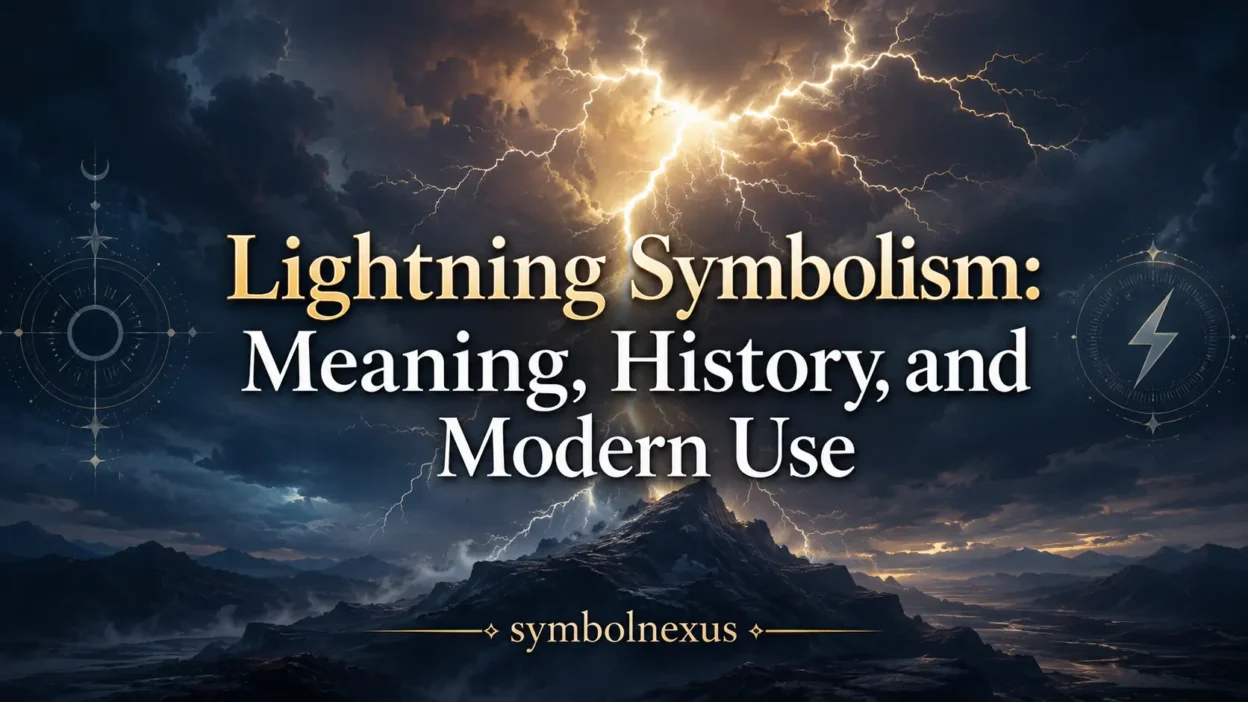
Lightning appears for only a moment, yet it can illuminate an entire landscape. That combination of brilliance, speed, danger, and unpredictability has made lightning symbolism especially useful for expressing sudden change, extraordinary force, inspiration, authority, and warning.
People encounter the image in many forms. It appears in religious art, ancient mythology, electrical hazard signs, superhero costumes, tattoos, jewelry, sports branding, music culture, and digital charging icons. A single bolt may suggest energy and confidence, while a violent storm can communicate fear, conflict, or forces beyond human control.
Its meaning depends heavily on context. A bolt on a battery icon indicates power. A bolt in a tattoo may represent survival or personal transformation. In an ancient sculpture, it may identify a storm deity. Understanding those differences prevents a complex symbol from being reduced to one vague definition.
Quick Answer
Lightning symbolism commonly represents sudden change, energy, speed, revelation, and forces that cannot be easily controlled. Historically, lightning was also associated with divine authority, judgment, protection, rain, warfare, and the life-giving yet destructive character of storms.
TL;DR
- Lightning represents energy, speed, revelation, and sudden change.
- Ancient cultures connected it with storm gods and divine authority.
- Americans often associate the bolt with electricity and personal power.
- Tattoos may express survival, intensity, independence, or transformation.
- Lightning can signify both creative force and serious danger.
- Double bolt designs require careful historical and political context.
What the Lightning Symbol Looks Like
Natural lightning branches irregularly across the sky. It may spread through clouds, strike the ground, or produce several visible channels at once. The familiar symbol, however, is usually a clean zigzag with sharp angles and a pointed end.
That simplified design is easier to recognize from a distance. Its downward movement suggests a force arriving suddenly from above, while its angular shape creates a sense of speed and impact.
A lightning image may appear as:
- A single sharp bolt
- Several branching flashes
- A bolt inside a warning triangle
- A bolt paired with clouds or rain
- A bolt striking an object
- A stylized emblem on clothing or jewelry
These forms are related, but they do not always communicate the same message. A storm scene emphasizes nature, while a geometric bolt usually emphasizes electricity, motion, or identity.
Core Meanings at a Glance
| Context | Common U.S. Meaning | Typical Associations | Important Note |
|---|---|---|---|
| Nature | Uncontrollable force | Storms, danger, awe | Can be destructive or life-giving |
| Personal symbolism | Sudden transformation | Courage, survival, awakening | Meaning depends on the wearer |
| Technology | Electrical energy | Charging, voltage, power | Often functional rather than spiritual |
| Religion and mythology | Divine authority | Judgment, protection, revelation | Interpretation varies by tradition |
| Popular culture | Speed and exceptional ability | Heroes, music, rebellion | Often designed for immediate visual impact |
| Warning signs | Electrical danger | High voltage, injury risk | Intended as a literal safety message |
Why Lightning Became a Sign of Divine Authority
Before modern meteorology, lightning seemed to arrive directly from the sky without warning. It produced light, sound, fire, injury, and destruction within seconds. Communities therefore interpreted it as evidence that the heavens could act upon the human world.
Its position in the sky also shaped its meaning. Many religious systems imagined the upper world as the domain of gods, ancestors, spirits, or cosmic rulers. A bolt descending from that realm could be understood as a weapon, command, warning, blessing, or visible display of authority.
Lightning was rarely viewed as purely destructive. Storms also brought rain, renewed vegetation, and supported agriculture. This created a lasting symbolic tension: the same force could nourish a community or devastate it.
That dual role explains why storm deities were often portrayed as warriors and providers at the same time. Their lightning expressed the ability to defend order, punish enemies, release rain, and govern powers humans could not control.
Zeus and the Thunderbolt in Greek and Roman Tradition
In ancient Greek religion, Zeus ruled the sky and was closely associated with thunder, lightning, rain, law, and divine authority. The thunderbolt became one of his defining attributes in sculpture, pottery, coins, and other forms of art. Roman culture later connected the same weapon with Jupiter.
The bolt did more than identify a weather god. It represented the authority to enforce order. In myth, Zeus used it against threats, oath-breakers, rebellious figures, and beings that challenged the rule of the Olympian gods.
As a result, Greco-Roman lightning could symbolize:
- Supreme authority
- Justice and punishment
- Victory over disorder
- Protection of political or cosmic order
- A decision that could not be reversed
This imagery still influences American entertainment and design. A character holding lightning may be understood as commanding exceptional power even when viewers know little about ancient Greek religion.
Thor, Thunder, and Protective Strength
In Norse tradition, thunder was associated with Thor, a widely recognized deity known for strength, protection, and conflict with destructive beings. His hammer, Mjölnir, was connected with thunder and functioned in stories as both a weapon and an instrument of blessing. Archaeological evidence shows that hammer-shaped pendants were worn in the Viking Age.
Thor’s symbolism differs slightly from the distant authority represented by Zeus. Thor often appears as an active defender who confronts threats directly. Lightning and thunder therefore became connected with physical courage, protective force, endurance, and resistance against chaos.
Modern American audiences frequently encounter this imagery through movies, comics, games, tattoos, and jewelry. These portrayals often emphasize strength and heroism, though historical Norse meanings were tied to a wider religious and social setting.
A lightning design inspired by Thor may communicate resilience or protection, but it should not automatically be treated as an accurate representation of every pre-Christian Scandinavian belief.
Indra, the Vajra, and Life-Giving Storms
In early South Asian religious tradition, Indra was associated with storms, rain, battle, and the thunderbolt known as the vajra. Stories describe him defeating forces that restrained water, allowing rain and rivers to support life.
The vajra later developed additional meanings in Buddhist traditions. It could represent firmness, clarity, spiritual power, or insight capable of cutting through ignorance. In Buddhist art, Vajrapani—the “holder of the thunderbolt”—became associated with protective strength and the penetrating clarity of awakened thought.
This history demonstrates how a storm weapon can evolve into a philosophical and ritual object. Its force is not limited to physical destruction. It can also represent an idea so clear and decisive that confusion cannot withstand it.
Modern decorative versions of the vajra should not be treated as interchangeable with an ordinary Western lightning icon. It belongs to living religious traditions with specific artistic, ritual, and philosophical meanings.
Raijin and Lightning in Japanese Culture
Japanese art and folklore connect thunder and lightning with Raijin, a fierce supernatural figure commonly shown among clouds and surrounded by drums. His appearance turns the sound and violence of a storm into a recognizable personality.
Raijin can appear threatening, protective, disruptive, or connected with needed rain. His frightening face does not make him equivalent to a Western demon. Japanese religious imagery often gives formidable appearances to figures whose roles include guarding, warning, or controlling dangerous natural forces.
Historical representations of Raijin appear in sculpture, painting, architecture, and decorative art. He is frequently paired with Fūjin, the wind deity, creating a visual expression of storm conditions rather than a simple battle between good and evil.
In modern American tattoo and design culture, Raijin-inspired art may represent fearlessness, controlled aggression, or respect for nature. Responsible use requires recognizing its Japanese cultural and religious background rather than treating it as a generic monster image.
Lightning in Indigenous North American Traditions
There is no single Indigenous interpretation of lightning. Native nations have distinct languages, ceremonies, stories, and artistic systems, so broad claims about a universal “Native American meaning” are inaccurate.
In some traditions, lightning is connected with powerful sky beings, rain, wind, healing, warfare, protection, or the upper world. Thunderbird traditions are especially important in several communities, including nations of the Pacific Northwest and other regions, but the details differ.
Among some Northwest Coast peoples, Thunderbird is described as producing thunder through the movement of its wings and lightning through its eyes or supernatural weapons. Thunderbird imagery may also be connected with family histories, ceremonial rights, or community identity—not merely with personal strength.
The National Weather Service also records a Navajo association between lightning, healing practices, rain, wind, and crop growth. That example should be understood as culturally specific rather than applied to every Indigenous nation.
Using a plain lightning bolt is generally different from copying a recognizable sacred figure, crest, mask, or ceremonial design. People considering Indigenous-inspired artwork should identify the specific tradition and avoid reproducing restricted imagery without context or permission.
Biblical and Christian Interpretations
In biblical writing, lightning often appears alongside storms, clouds, fire, earthquakes, or thunder. These images emphasize the difference between human limitation and divine authority.
Depending on the passage, lightning may suggest:
- The presence of God
- Judgment or warning
- Majesty and sovereignty
- Sudden revelation
- The speed or visibility of divine action
- Human fear before forces beyond control
The symbolism is therefore broader than anger. Lightning can mark a moment when ordinary experience is interrupted and people become aware of a greater authority.
In Christian art and preaching, the image may still be used to communicate judgment, but it can also represent truth arriving suddenly, a dramatic conversion, or the unexpected clarity of spiritual understanding. These modern interpretations are often metaphorical rather than direct claims about a specific biblical passage.
What Lightning Commonly Means in the United States
In everyday American culture, lightning most often communicates energy, speed, danger, or sudden impact. These meanings are reinforced by electrical signs, weather reports, sports uniforms, entertainment, technology, and advertising.
A bolt on an appliance warns of voltage. On a phone screen, it usually means charging. On an athletic logo, it suggests quick movement and competitive force. In a comic-book costume, it may signal superhuman speed or electrical ability.
The Flash is a well-known example. The character’s lightning emblem, speed-based identity, and connection with electrical energy helped strengthen the association between the bolt and extraordinary velocity in American popular culture.
Americans also use lightning metaphorically. A “bolt of inspiration” describes an idea that arrives without gradual preparation. Being “struck” by a realization suggests immediate recognition. In these expressions, lightning represents speed of thought rather than violence.
Emotional and Psychological Meaning
Lightning appeals to people because it combines opposing emotional signals. It is beautiful but unsafe, brief but unforgettable, illuminating but followed by darkness.
As a personal emblem, it may communicate:
- Decisiveness: Acting without hesitation
- Intensity: Experiencing emotions strongly
- Independence: Refusing to be easily controlled
- Awakening: Recognizing something suddenly
- Resilience: Surviving an abrupt crisis
- Restlessness: Seeking movement and stimulation
- Unpredictability: Rejecting fixed expectations
The image can also represent anxiety. Someone who associates storms with danger may read a bolt as tension, instability, or an approaching crisis.
Psychological meaning is not universal. The same design may feel energizing to one person and threatening to another. Its interpretation depends on color, setting, accompanying images, and personal experience.
Why Lightning Appears in Tattoos and Jewelry
Lightning works well in body art because its shape remains recognizable at many sizes. It can form a small wrist tattoo, a narrow design along a finger or arm, or part of a larger storm scene.
Common tattoo interpretations include personal transformation, fast recovery, survival, rebellion, inspiration, anger, confidence, or a life-changing event. A person may choose a bolt after overcoming an illness, leaving a difficult relationship, changing careers, or experiencing an insight that altered their direction.
Placement can modify the message. A discreet design may serve as a private reminder, while a large visible bolt can function as a bold identity statement. Clouds may emphasize struggle, rain may suggest renewal, and fire may increase the sense of danger.
Lightning jewelry often communicates energy more casually. Earrings, pendants, and rings use the shape as a stylish sign of confidence, youthfulness, movement, or playful defiance.
No single tattoo definition applies to every wearer. Personal meaning should take priority unless the design reproduces a culturally or politically specific emblem.
Lightning in Technology, Branding, and Digital Culture
The bolt became closely connected with electricity as electrical systems entered homes, factories, transportation, and public infrastructure. Today, a lightning symbol can communicate power before a viewer reads any accompanying words.
In technology, it commonly indicates:
- Battery charging
- Electrical connections
- Fast charging
- High-voltage components
- Energy consumption
- Performance or boosted speed
Branding uses the same visual logic. Sharp angles create movement, while the narrow shape fits easily into logos, buttons, app icons, and merchandise. Companies may use it to suggest quick service, strong performance, innovation, or disruption.
The symbol’s clarity is also why it appears on electrical safety labels. A bolt inside a warning shape is not a metaphor for motivation; it indicates a potentially dangerous electrical condition.
On social media, the lightning emoji can emphasize excitement, talent, energy, urgency, or a dramatic announcement. It may also act as visual punctuation, giving a post a faster and more aggressive tone.
Positive and Negative Meanings
Lightning cannot be classified as entirely positive or negative. Its central meaning is concentrated force, and that force may create, reveal, protect, or destroy.
Positive associations
- Inspiration
- Personal awakening
- Courage
- Energy
- Speed
- Renewal through rain
- Protection
- Clear thinking
- Decisive action
Negative associations
- Destruction
- Anger
- Punishment
- Instability
- Fear
- Conflict
- Electrical danger
- Sudden loss
- Uncontrolled behavior
Color affects interpretation. A bright yellow bolt often feels energetic or playful. White or blue may suggest electricity, technology, or supernatural force. Red can imply aggression, urgency, or danger. Black creates a heavier, more rebellious appearance.
Surrounding imagery matters equally. A bolt emerging from a dark cloud usually feels threatening, while a clean bolt beside a battery reads as functional and neutral.
Misunderstandings and Controversial Uses
One common mistake is assuming that every lightning image has a spiritual meaning. Many bolts are simply electrical indicators, decorative graphics, or signs of speed.
Another error is treating storm traditions as interchangeable. Zeus’s thunderbolt, Thor’s hammer, the vajra, Raijin, and Thunderbird traditions developed within different cultures. Combining them without explanation can erase their distinct religious and historical roles.
A separate concern involves the paired, rune-like bolts used by Nazi Germany’s SS and later adopted by neo-Nazi and white supremacist groups. These usually appear as two matching angular forms with flattened ends. They should not be confused automatically with every single lightning bolt, superhero emblem, charging icon, or weather image. Context, shape, pairing, accompanying numbers, and surrounding symbols all matter.
This distinction is important in tattoos and branding. A designer may intend to communicate electricity but unintentionally create an emblem resembling the SS form. Reviewing the complete design before publication can prevent harmful associations.
How Its Meaning Evolved
Lightning first gained symbolic force through direct human experience of storms. It arrived from the sky, created fire, shook buildings, damaged trees, and brought rain. Mythological systems translated those observations into stories about divine weapons, cosmic conflict, fertility, protection, and judgment.
Religious art then gave lightning recognizable forms that could identify particular deities or sacred forces. The natural flash became a visual attribute that viewers could read instantly.
Industrialization produced another major shift. As electricity became part of modern life, the bolt moved from mythology into engineering, public safety, transportation, appliances, and commercial design. It no longer referred only to a storm; it represented electrical power itself.
American entertainment added speed, heroism, rebellion, and exceptional ability. Digital technology then made the bolt an everyday icon for charging and performance.
These meanings now coexist. A single image may carry ancient associations with heavenly authority while functioning as a modern symbol of technology, identity, or personal change.
FAQs
Is lightning a positive symbol?
Lightning can be positive when it represents inspiration, energy, courage, awakening, or necessary change. It becomes negative when the context emphasizes destruction, punishment, danger, anger, or instability.
What does a lightning bolt tattoo mean?
A lightning bolt tattoo commonly represents sudden transformation, strength, speed, rebellion, survival, or a life-changing realization. Its exact meaning depends on the wearer, the design style, and any surrounding symbols.
What does lightning symbolize in Christianity?
Christian interpretations often connect lightning with divine presence, authority, judgment, revelation, and the suddenness of spiritual events. It does not carry one fixed biblical meaning in every passage.
Does lightning symbolize power?
Yes. Lightning represents concentrated power because it appears suddenly, produces intense light and heat, and can alter its surroundings instantly. In modern design, that power may be physical, electrical, emotional, creative, or supernatural.
Is a lightning bolt an offensive symbol?
A basic single bolt is widely used for weather, electricity, speed, and popular culture and is not inherently offensive. Paired rune-like bolts resembling the Nazi SS emblem carry a very different historical meaning and must be evaluated carefully.
What does lightning mean spiritually?
Spiritually, lightning may suggest revelation, divine authority, judgment, awakening, or the sudden removal of confusion. The interpretation depends on the religion or cultural tradition involved rather than on a universal spiritual definition.
Conclusion
Lightning represents a force that arrives quickly and leaves a lasting effect. It can express energy, inspiration, revelation, speed, divine authority, environmental danger, or an abrupt change that divides life into a before and an after.
The meaning becomes clearer when the design’s cultural source and practical setting are considered. Ancient thunderbolts, religious storm figures, electrical warnings, superhero emblems, and personal tattoos may share a visual form without sharing the same message.
Ultimately, lightning symbolism reflects humanity’s effort to understand concentrated force—something capable of illuminating, frightening, renewing, and transforming the world within a single moment.


