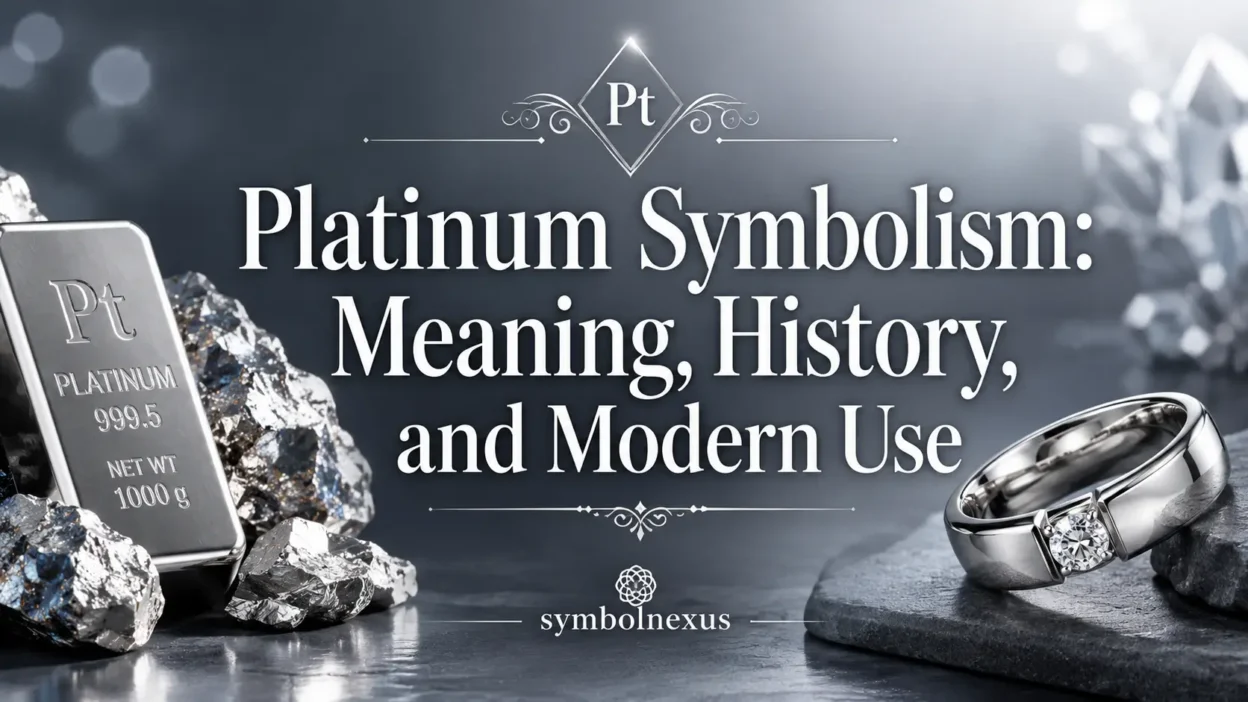
Platinum symbolism centers on endurance, rarity, lasting commitment, and exceptional achievement. Its naturally white appearance, resistance to tarnish, and limited supply have helped the metal become associated with relationships, accomplishments, and objects intended to retain their value over time.
In the United States, people most often encounter platinum in engagement rings, wedding bands, luxury goods, music awards, membership levels, credit cards, and premium product categories. In each setting, the word suggests something above the ordinary — not simply expensive, but selective, durable, and difficult to attain.
That reputation developed gradually. Indigenous metalworkers in South America used native platinum long before Europeans understood it. Later, advances in science and jewelry-making transformed a once-dismissed material into a metal connected with modern technology, refined design, and social distinction.
Quick Answer
Platinum symbolism commonly represents lasting commitment, rarity, resilience, refined prestige, and top-level achievement in modern American culture. Historically, its meaning grew from its unusual physical properties, early South American metalworking, and its later use in elite jewelry, science, and industry.
TL;DR
- Platinum represents endurance, rarity, and long-term commitment.
- Its white color suggests clarity, restraint, and modern refinement.
- Indigenous South Americans worked platinum before European colonization.
- American culture uses “platinum” to mark exceptional achievement.
- Jewelry connects the metal with dependable, lasting relationships.
- Status marketing can exaggerate its exclusivity or value.
What Platinum Is and Why Its Properties Matter
Platinum is a dense, silver-white precious metal identified by the chemical symbol Pt and atomic number 78. It is malleable, resistant to corrosion, and slow to react with many substances. Unlike metals that readily oxidize or tarnish, platinum usually keeps its natural white appearance without requiring a plated surface.
Those physical characteristics provide the foundation for its symbolic meanings. A material that resists deterioration naturally lends itself to ideas of permanence, steadiness, and survival. Its rarity contributes associations with distinction and exclusivity, while its weight gives platinum objects a noticeable sense of substance.
The metal is not completely indestructible. Platinum jewelry can develop scratches and a soft surface texture called a patina. Symbolically, however, this gradual change may strengthen its association with endurance: the piece shows evidence of use while retaining the metal itself.
Platinum is also more than a decorative material. Its resistance to chemical attack, stable electrical properties, and performance at high temperatures make it useful in laboratory equipment, electronics, industrial catalysts, and vehicle emission-control systems.
What Platinum Commonly Means in the United States
In contemporary American culture, platinum usually communicates one or more of the following ideas:
| Context | Meaning in the USA | Common Associations | Important Note |
|---|---|---|---|
| Wedding jewelry | Lasting commitment | Marriage, loyalty, permanence | Meaning comes partly from durability |
| Luxury goods | Selective prestige | Quality, expense, exclusivity | Higher price does not guarantee better design |
| Music awards | Major achievement | Popular success, career milestones | Based on formal certification |
| Membership tiers | Premium access | Benefits, priority, status | Often a marketing category |
| Modern design | Restraint and precision | Clean lines, cool tones, minimalism | Usually less ornate than gold imagery |
| Personal symbolism | Resilience | Strength, stability, self-worth | Interpretation depends on the wearer |
Platinum rarely carries only one meaning. A wedding band may represent both commitment and financial investment. A platinum-colored logo may suggest modern technology as well as exclusivity. Context determines which association is strongest.
Indigenous South American Origins
Platinum was not first given value by European scientists or luxury jewelers. Archaeological evidence shows that Indigenous metalworkers in parts of present-day Ecuador and Colombia recognized and worked native platinum before the Spanish conquest. They used specialized techniques to combine small platinum particles with gold and produce ornaments despite platinum’s extremely high melting temperature.
This early history changes the common story that platinum was simply “discovered” by Europeans. European observers documented and classified the metal within their own scientific systems, but Indigenous communities had already developed practical knowledge of the material.
The exact symbolic interpretations attached to every early object are not always recoverable. It would therefore be misleading to assign a single spiritual meaning to all Indigenous platinum work. What the surviving material does demonstrate is technical sophistication, aesthetic intention, and recognition that the unusual white metal could serve as a valued component of ornament.
In this context, platinum can represent cultural knowledge and innovation rather than luxury alone.
Why Europeans Initially Dismissed the Metal
Spanish colonizers encountered platinum while extracting gold in South America. They called it platina, meaning “little silver,” and often treated it as an unwanted substance mixed with more familiar precious metals. Some accounts describe it as a nuisance that interfered with gold recovery.
Platinum’s high melting point made it difficult to process with the furnaces and techniques available to many early European metalworkers. Its resistance to ordinary methods initially appeared to be a disadvantage.
Over time, that same resistance was reinterpreted. Once scientists and craftspeople learned how to refine and shape platinum more effectively, difficulty became evidence of rarity, technical mastery, and advanced workmanship.
This reversal is central to the metal’s history. Platinum moved from being considered an obstruction to becoming a marker of refinement. Symbolically, that evolution supports associations with underestimated worth, delayed recognition, and value that becomes visible only through knowledge and effort.
How Platinum Became a Modern Luxury Metal
Developments in refining, high-temperature equipment, and jewelry fabrication allowed platinum to enter European and American luxury markets more fully during the nineteenth and early twentieth centuries.
Edwardian jewelers used platinum to create delicate settings for diamonds, pearls, ribbons, floral garlands, and lace-like patterns. Because the metal could hold stones securely in relatively fine structures, it allowed jewelers to reduce the visual heaviness of the mounting. The result emphasized light, gemstones, and intricate craftsmanship.
Art Deco designers later adapted platinum to sharper geometry. During the 1920s and 1930s, it appeared in bracelets, brooches, pendants, and rings featuring diamonds, emeralds, sapphires, onyx, and other contrasting materials. American jewelers in New York helped make diamond-and-platinum designs part of the period’s image of urban sophistication.
These styles linked platinum with technological progress as much as inherited wealth. Gold could suggest warmth, tradition, and ceremony. Platinum’s cooler appearance suited an age fascinated by machines, streamlined forms, tall buildings, cinema, and modern city life.
Platinum in Engagement Rings and Wedding Bands
Wedding jewelry is one of the clearest settings in which platinum represents permanence. Couples often choose it for rings intended to be worn daily and retained for decades.
Several qualities contribute to that meaning. Platinum is naturally white, resistant to tarnish, and suitable for holding gemstones. It also tends to be used in high-purity jewelry alloys. In the United States, platinum markings are regulated according to the metal content of the piece; common quality marks include forms such as 950Pt, 900Pt, and 850Pt.
Symbolically, a platinum wedding ring may communicate:
- Commitment that is intended to endure
- Loyalty that does not depend on appearances
- Emotional steadiness during change
- A relationship treated as rare and valuable
- A preference for understated rather than conspicuous luxury
The interpretation is cultural rather than automatic. A platinum ring does not make a marriage stronger, and another metal does not make a commitment less sincere. The symbolism comes from what the couple chooses to associate with the material.
The Meaning of Platinum’s White Color
Platinum’s natural color falls between bright silver-white and soft gray. In design, this cooler tone often conveys clarity, control, precision, and restraint.
White metals are frequently paired with diamonds because they do not add a strong yellow or reddish reflection around a colorless stone. This visual neutrality helps the gemstone remain the focus. Historically, that quality contributed to the popularity of platinum in Edwardian and Art Deco jewelry.
Outside jewelry, platinum tones appear in interiors, electronics, vehicles, cosmetics packaging, and fashion. They can suggest:
- Clean modern surfaces
- Technical accuracy
- Quiet confidence
- Professional seriousness
- Futuristic or space-age design
- Luxury without decorative excess
Platinum white should not automatically be interpreted as innocence or spiritual purity. Those meanings are more firmly associated with white as a general color. When applied specifically to platinum, whiteness usually emphasizes natural integrity, consistency, and sophisticated restraint.
Endurance, Resilience, and Survival
Platinum’s resistance to corrosion makes endurance one of its most convincing symbolic associations. It can represent a person, relationship, or institution that remains stable despite pressure.
This does not require the image of something untouched by hardship. Platinum jewelry changes with use, and industrial platinum operates in demanding conditions. Its symbolic strength lies in continued function rather than perfect appearance.
For that reason, someone may use platinum to mark:
- Recovery after a difficult period
- A relationship that survived conflict
- A long professional career
- Steady personal discipline
- Confidence earned through experience
- The preservation of identity under pressure
Platinum differs subtly from symbols of aggressive strength. Iron may evoke force, weapons, or physical power. Steel often suggests construction and toughness. Platinum more often communicates controlled endurance — a form of strength that remains composed.
Rarity and Selective Prestige
Platinum-group elements are among the rarer metallic resources, and much of their recorded production has been concentrated in a limited number of countries, especially South Africa and Russia. Recycling from jewelry, electronics, and vehicle catalytic converters also contributes to supply.
Rarity helps platinum signify distinction. In marketing, a platinum label often identifies a category positioned above gold or silver. Airlines, hotels, financial services, retailers, and subscription programs use the word to imply increased privileges or restricted access.
This status meaning is not purely about money. It also appeals to the desire to feel recognized, prioritized, or admitted into a smaller group.
However, “platinum” may be only a brand name. A platinum membership does not necessarily contain the metal or represent an objective standard. Its meaning depends on the benefits, requirements, and credibility behind the label.
Achievement in American Music and Popular Culture
The Recording Industry Association of America uses platinum certification to recognize major commercial success in recorded music. Within American popular culture, “going platinum” has therefore become a familiar expression for reaching a high level of sales and streaming performance.
This usage expanded the metal’s symbolism beyond jewelry and inherited wealth. Platinum became connected with measurable achievement, public recognition, and entry into an elite professional group.
A platinum record may symbolize:
- A career breakthrough
- Broad audience acceptance
- Commercial influence
- Creative work reaching a major milestone
- Recognition that can be publicly verified
The phrase is sometimes used loosely outside music. Businesses may describe a product as platinum-level, athletes may refer to platinum performance, and online communities may create unofficial platinum ranks. In these cases, the word borrows authority from established award systems even when no universal standard exists.
Premium Cards, Memberships, and Status Tiers
American companies frequently use platinum as the name of an upper-level service tier. One influential example is the American Express Platinum Card, introduced in the United States and Canada in 1984 and associated with premium travel and lifestyle benefits.
Over time, the pattern spread across many industries. Consumers now encounter platinum insurance plans, loyalty memberships, warranties, seating packages, gaming ranks, and customer-support levels.
Here, platinum represents access rather than physical possession. The customer is being offered — or sold — the idea of priority treatment.
Psychologically, these labels work because they combine three associations:
- Rarity — Not everyone belongs to the tier.
- Recognition — The holder appears to have earned or purchased distinction.
- Advantage — The tier promises benefits unavailable at lower levels.
The symbolism can be effective even when the actual object is plastic, digital, or entirely intangible.
Emotional and Psychological Meaning
Platinum usually communicates controlled confidence. It is less visually warm than gold and less familiar than silver, so it may appeal to people who prefer distinction without bright display.
Emotionally, the metal can suggest:
- Dependability
- Mature commitment
- Self-possession
- High personal standards
- Independence from passing trends
- Appreciation for substance over ornament
Its weight may also affect perception. A platinum ring often feels substantial in the hand, reinforcing ideas of seriousness and material presence. This physical experience can make the object seem more consequential.
Still, emotional responses vary. Some people find platinum elegant and calm; others consider it cold, formal, or impersonal. A person attracted to warm colors and traditional decoration may connect more strongly with yellow or rose gold.
Platinum in Minimalist and Contemporary Design
Modern designers often use platinum or platinum-like tones where they want an object to look precise, clean, and technologically advanced.
In jewelry, simple platinum bands may symbolize confidence without embellishment. The wearer does not need a large gemstone or elaborate pattern for the piece to feel intentional. This makes the metal suitable for minimalist wedding rings, unisex designs, geometric jewelry, and understated heirlooms.
In interiors and consumer products, “platinum” may describe brushed gray appliances, metallic fabrics, vehicle finishes, hardware, or electronic devices. These applications usually evoke modernity rather than historical ceremony.
The symbolism works best when the finish appears controlled and well made. When used carelessly, platinum coloring can resemble ordinary gray plastic or imitation chrome. Material quality and design execution determine whether the effect feels refined.
Cross-Cultural and Ceremonial Associations
Platinum does not have one universal meaning shared by every culture. Its associations depend on local history, technology, trade, and social customs.
In northwestern South America, its early importance is connected with Indigenous metalworking knowledge and ornament. In European and American jewelry history, it became associated with technical progress, elite craftsmanship, and diamond settings.
British royal tradition has also helped popularize the expression Platinum Jubilee for a seventieth anniversary of a monarch’s reign. Queen Elizabeth II’s Platinum Jubilee in 2022 made the term especially visible in international media and commemorative culture.
In this ceremonial context, platinum represents extraordinary longevity. Few reigns, institutions, or relationships last long enough to reach such a milestone, so the metal’s rarity becomes a metaphor for duration.
Unlike gold and silver, platinum does not have an extensive fixed role in ancient European religious texts or common biblical imagery. Contemporary spiritual interpretations usually derive from the metal’s endurance, natural whiteness, and rarity rather than from a longstanding religious doctrine.
Platinum in Tattoos, Fashion, and Personal Identity
A platinum-themed tattoo is usually conceptual rather than material. Tattoo ink does not need to contain platinum for the design to carry the metal’s associations.
Possible motifs include:
- The chemical symbol Pt
- The atomic number 78
- A platinum record plaque
- A pale metallic ring
- Geometric gray-and-white patterns
- A date marking a long commitment
- A symbol of recovery or achievement
In such designs, platinum may represent survival, exceptional standards, or a milestone the wearer worked to reach.
Fashion uses the word more broadly. Platinum-blonde hair, silver-gray textiles, metallic makeup, and cool-toned accessories can communicate glamour, transformation, visibility, or futuristic style. These meanings come mainly from color and cultural imagery rather than from the physical metal.
Because platinum is associated with premium categories, the term may also become part of an identity statement. A person may use it to present themselves as polished, selective, ambitious, or unwilling to accept ordinary standards.
More Than Luxury: Science and Industrial Use
Platinum’s practical uses prevent its symbolism from being limited to display and status. The metal is employed in catalysts, laboratory vessels, electrical contacts, refining processes, electronics, and other specialized applications. Its properties are valuable precisely because it can remain stable under conditions that would damage less resistant materials.
This industrial role adds meanings of competence, transformation, and controlled performance. A catalyst helps a reaction proceed without being consumed in the same way as the reacting materials. Metaphorically, platinum can therefore suggest a person or idea that enables change while remaining steady.
That interpretation should be presented as a modern metaphor, not an ancient tradition. It is derived from scientific function.
The contrast between jewelry and industry also gives platinum an unusual cultural identity. It can appear in an engagement ring, an emissions-control system, laboratory equipment, and advanced electronics. Few luxury symbols have such a strong connection to practical technology.
Common Misunderstandings and Misuse
One common mistake is assuming that platinum always costs more than gold. Market prices change, and a finished item’s cost also depends on weight, purity, craftsmanship, brand, gemstones, and retail conditions. The symbolic hierarchy used in loyalty programs does not guarantee a permanent hierarchy in commodity prices.
Another misunderstanding is treating every white metal as platinum. White gold was developed partly to imitate platinum’s appearance, while silver, palladium, steel, and plated base metals may also look similar. Hallmarks and accurate product descriptions matter when identifying jewelry.
Marketing can also misuse the term by attaching “platinum” to an ordinary product without offering meaningful differences in quality. In these cases, the word functions as an aspiration rather than evidence.
Finally, rarity should not erase the human and environmental realities of mining. Platinum production is geographically concentrated, and its extraction requires significant industrial activity. Its image of clean, effortless luxury can hide the complex supply chain behind the finished object.
How Platinum’s Meaning Has Evolved
Platinum’s cultural meaning changed as people learned to understand and work with it.
For Indigenous South American metalworkers, it was a distinctive natural material incorporated into skilled ornament production. Spanish colonizers later regarded it as an inconvenient companion to gold. European researchers then treated it as a scientific puzzle, while improved technology made it useful in laboratories and high-end jewelry.
During the Edwardian and Art Deco periods, platinum became a visual language of refinement and modernity. American music certification later turned it into a public measure of extraordinary success. Credit cards, loyalty programs, and product tiers expanded the term into an everyday label for premium access.
Its modern meanings are therefore layered:
- Material meaning: resistant, dense, naturally white
- Historical meaning: difficult to understand and master
- Romantic meaning: lasting commitment
- Social meaning: exclusivity and prestige
- Professional meaning: recognized achievement
- Design meaning: precision and restrained modernity
- Personal meaning: resilience and high standards
The symbol has moved from physical rarity to a broader language of exceptional value.
FAQs
Is platinum a positive symbol?
Yes — platinum is almost always interpreted positively. It represents endurance, achievement, rarity, and dependable commitment across nearly every context where it appears. Negative associations are rare and usually surface only when the label is used to signal excessive status, emotional coldness, or manufactured exclusivity rather than genuine substance.
What does platinum symbolize in love and relationships?
In romantic settings, platinum represents a bond intended to last through time and change. Its resistance to tarnish and its frequent use in wedding jewelry make it a natural metaphor for loyalty, stability, and serious, long-term commitment — the kind of relationship built to withstand pressure rather than simply look good on the surface.
What does a platinum ring symbolize?
A platinum ring can symbolize marriage, a lasting partnership, personal success, or understated luxury, depending on context. As a wedding band it usually points to permanence and loyalty; as an heirloom, it can represent continuity across generations; and as a personal reward, it can mark an achievement the wearer worked hard to reach.
Does platinum have a spiritual or religious meaning?
Platinum has no single, widely established spiritual meaning across major religious traditions, unlike gold or silver. Most modern spiritual interpretations are personal or contemporary rather than doctrinal — commonly linking the metal to clarity, resilience, protection through stability, or the refinement of character under pressure.
What does platinum symbolize in a tattoo?
In tattoo art, platinum commonly represents exceptional achievement, survival, personal standards, or an enduring bond. Popular motifs include the letters “Pt,” the atomic number 78, a platinum record plaque, or a simple silver-gray band — each used to visually anchor an idea of resilience or milestone recognition.
Why does platinum represent success and achievement?
Its rarity and prestige made platinum a natural label for top-tier categories long before the music industry adopted it. American music certification then reinforced and popularized that association, using “platinum” awards to mark major, publicly verifiable commercial milestones — which is why the word now signals success far beyond the jewelry case.
Is platinum more symbolic than gold?
Neither metal is inherently “more” symbolic — they simply carry different weight. Gold has older, broader associations with wealth, sunlight, royalty, and sacred objects across many cultures. Platinum, by contrast, more often represents modern prestige, resilience, technical precision, and restrained luxury — a newer, cooler-toned counterpart to gold’s warmth.
Why is platinum associated with rarity if gold is also rare?
Platinum is significantly rarer than gold in terms of annual mining output, and its production is far more geographically concentrated, largely in South Africa and Russia. That tighter supply, combined with its difficult extraction and refining history, gives platinum a symbolic edge in rarity even though gold has a longer cultural legacy.
Does the color of platinum change its meaning?
Yes, in subtle ways. Platinum’s naturally cool, silver-white tone tends to suggest clarity, restraint, and modern precision, whereas gold’s warmth leans toward tradition and ceremony. Choosing platinum over a warmer metal often reflects a preference for understated confidence rather than overt display.
Is “platinum” in credit cards or memberships the same as the real metal?
Not necessarily. In most loyalty programs, credit card tiers, and membership levels, “platinum” is a brand name borrowed for its prestige associations rather than a reference to the physical metal. The symbolism of rarity and priority still applies, but the meaning comes from marketing psychology, not metallurgy.
Conclusion
Platinum’s real power as a symbol has little to do with price and everything to do with persistence. It represents value that survives — a metal that resists tarnish the way a strong relationship resists conflict, and a status marker that stays credible because it’s backed by genuine rarity rather than appearance alone.
That meaning didn’t arrive overnight. Platinum moved from a discarded byproduct of colonial gold mining, to a scientific curiosity, to the defining metal of Edwardian and Art Deco jewelry, to a modern shorthand for achievement in music, finance, and hospitality. Each era added a new layer without erasing the last, which is why platinum today can mean commitment, mastery, resilience, and prestige all at once — depending entirely on where it shows up.
What ties every one of those meanings together is a simple idea: platinum stands for things built to last and hard enough to earn. Whether it’s set into a wedding band, stamped on a record plaque, or printed on a membership card, the metal asks to be judged the same way it was forged — by what survives the pressure, not by what merely looks impressive under it.