Butterflies have a special place in Christian symbolism because their transformation from caterpillars into winged insects offers a beautiful illustration of spiritual renewal, resurrection, and the promise of new life. Their journey from one stage of existence to another provides a visual way to understand the Christian belief that death is not necessarily the end but can be followed by a new and eternal life.
Butterfly symbolism in Christianity is especially connected to the resurrection of Jesus Christ, the transformation of believers through faith, and the hope of eternal life. Although butterflies are not specifically identified as religious symbols in the Bible, Christian traditions have used their life cycle as a metaphor for spiritual change and the resurrection.
The butterfly’s delicate wings, emergence from a chrysalis, and ability to transform its entire form make it a meaningful image in Christian paintings, church decorations, jewelry, funeral arrangements, and religious artwork. Its symbolism reminds believers that spiritual growth often involves leaving an old way of life behind and embracing something new.
Quick Answer
In Christianity, butterflies commonly symbolize resurrection, spiritual transformation, new life, and eternal hope. Their movement from caterpillar to chrysalis to butterfly is often used as a metaphor for Jesus Christ’s resurrection and the believer’s transformation through faith, although the butterfly itself is not a specific biblical symbol.
TL;DR
- Butterflies symbolize resurrection and the promise of eternal life.
- Their transformation represents spiritual growth and renewal through faith.
- The butterfly’s emergence from a chrysalis illustrates new life.
- They are commonly associated with Jesus Christ’s resurrection.
- White butterflies can represent purity, peace, and spiritual hope.
- Butterflies in Christian art often communicate salvation and transformation.
1. What Does a Butterfly Symbolize in Christianity?
Monarch butterfly feeding on white flowers
In Christian symbolism, a butterfly primarily represents resurrection, transformation, and the promise of life beyond death. Its natural life cycle provides an image that helps explain one of Christianity’s central beliefs: that life can emerge after an experience that appears to be an ending.
The butterfly develops through three major stages before reaching adulthood: caterpillar, chrysalis, and butterfly. Christian interpretations often connect these stages with the human spiritual journey.
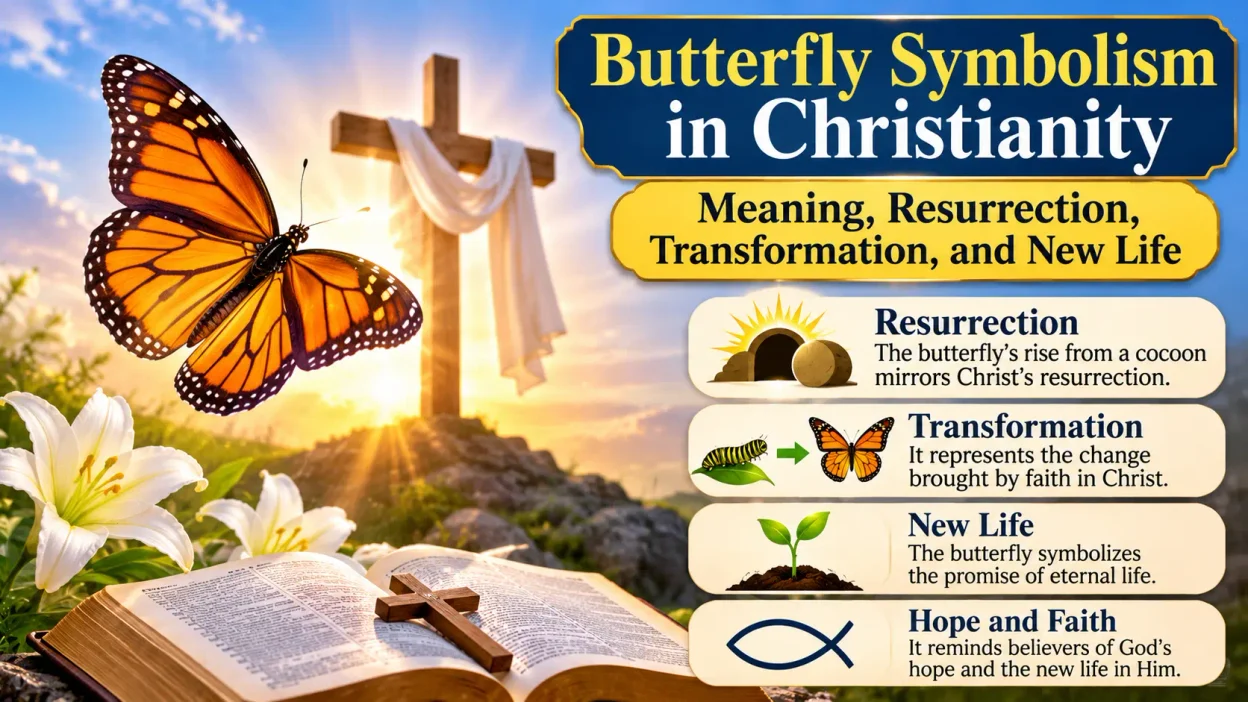
The caterpillar represents earthly life, the chrysalis represents death or a period of transition, and the butterfly represents resurrection and the beginning of a transformed existence.
The most common Christian meanings include:
- Resurrection: The butterfly represents the victory of life over death through Jesus Christ.
- Transformation: It symbolizes becoming spiritually renewed through faith.
- New life: Its emergence represents a fresh beginning and a changed existence.
- Eternal hope: It reminds believers of the Christian promise of life beyond physical death.
- Salvation: It can represent leaving behind sin and embracing a life guided by Christ.
- Spiritual freedom: Its wings can symbolize freedom from the limitations of an earthly existence.
These interpretations make butterflies meaningful images of Christian hope, particularly during Easter and other celebrations of renewal.
2. Butterfly Symbolism and the Resurrection of Jesus Christ
1 Corinthians 15:21 Artwork | Bible Art
One of the strongest associations between butterflies and Christianity is the resurrection of Jesus Christ.
According to Christian belief, Jesus was crucified, died, and rose from the dead on the third day. His resurrection represents victory over sin and death and provides the foundation of Christian hope.
The butterfly offers a visual metaphor for this central event.
A caterpillar appears to undergo a complete change when it enters the chrysalis stage. When the adult butterfly emerges, it has a different form and a new way of moving through the world. Christian artists and writers have used this transformation to illustrate the idea of resurrection and a life changed by divine power.
The symbolism can be understood in three ways:
The caterpillar: Represents earthly existence and the limitations of human life.
The chrysalis: Represents death, waiting, and the transition between two stages of existence.
The butterfly: Represents resurrection, renewed life, and the hope of eternity.
There is an important distinction between the metaphor and Christian doctrine. The butterfly’s biological life cycle does not prove resurrection. Instead, it provides a natural illustration that helps communicate the Christian belief in life beyond death.
For this reason, butterflies frequently appear in Easter-themed artwork, religious illustrations, and Christian messages about resurrection.
3. The Butterfly as a Symbol of Spiritual Transformation
Monarch Butterfly newly emerged from Chrysalis
Spiritual transformation is another important meaning of butterflies in Christianity. The insect’s metamorphosis illustrates how a person’s life can change through faith, repentance, and a growing relationship with God.
Before becoming a butterfly, the insect lives as a caterpillar. It eventually enters the chrysalis stage, where its body undergoes an extraordinary transformation. When it emerges, it has a completely different appearance and can fly.
Christians often compare this process with the spiritual journey of someone who accepts Christ and begins living according to Christian teachings.
The connection can be understood through three ideas:
- Leaving the old life: The caterpillar represents a person’s former way of living, including habits and attitudes that conflict with Christian values.
- Spiritual development: The chrysalis represents a period of inner change, reflection, repentance, and growth.
- Living differently: The butterfly represents a renewed life shaped by faith, love, forgiveness, and obedience to God.
This interpretation connects naturally with Romans 12:2, which encourages believers to be transformed through the renewal of their minds. The verse emphasizes that Christian transformation involves changing how people think and live, not simply changing their outward appearance. Bible Gateway+1
The butterfly therefore represents the possibility of becoming a different person through spiritual renewal.
4. Biblical Verses That Connect With Butterfly Symbolism
Although the Bible does not specifically mention butterflies, several passages describe themes that Christians associate with their transformation.
These verses provide a biblical foundation for interpreting the butterfly as a symbol of renewal, resurrection, and new life.
2 Corinthians 5:17 — Becoming a New Creation
This verse teaches that anyone who belongs to Christ becomes a new creation. The old life passes away, and a new life begins.
It connects with the butterfly because the insect’s transformation provides a visual illustration of leaving one form behind and emerging in another.
Romans 12:2 — Transformation Through a Renewed Mind
Romans 12:2 encourages Christians not to conform to worldly patterns but to experience transformation through the renewal of their minds.
The butterfly represents this process of spiritual development, in which faith gradually changes a person’s priorities, attitudes, and behavior.
1 Corinthians 15:52 — The Resurrection of the Dead
This passage describes the resurrection of believers and the transformation that takes place when the dead are raised imperishable.
It is especially relevant to butterfly symbolism because Christian interpretations often connect the insect’s emergence with the promise of resurrection and eternal life. The United Methodist Church+1
John 11:25 — Jesus as the Resurrection and the Life
In John 11:25, Jesus identifies himself as the resurrection and the life. This teaching is central to Christian hope and provides context for understanding why butterflies are used in Easter imagery.
Isaiah 43:19 — God Makes a New Way
Isaiah 43:19 describes God doing a new thing and creating a way in the wilderness.
Although the passage does not mention butterflies, its message of renewal and new possibilities fits the flower-and-nature imagery often used to illustrate spiritual hope.
Together, these passages explain why Christians find the butterfly such an appropriate illustration of faith and transformation.
5. The Three Stages of a Butterfly’s Life and Their Christian Meaning
Butterfly Life Cycle (Free Google Slides and More)
The butterfly’s life cycle is one of the main reasons it has become a Christian symbol. Its transformation offers a simple way to explain ideas that can otherwise be difficult to visualize.
Although Christian interpretations often focus on three main stages, the complete biological life cycle includes four stages: egg, larva, pupa, and adult butterfly.
| Butterfly stage | Christian symbolic interpretation | Main idea |
|---|---|---|
| Egg | Beginning of life and creation | God’s gift of life |
| Caterpillar | Earthly human existence | Life before spiritual renewal |
| Chrysalis | Death, waiting, or transition | Change and transformation |
| Adult butterfly | Resurrection and eternal life | Renewed existence |
The Egg: The Beginning of Life
The egg represents the beginning of existence and the potential for growth. In a Christian interpretation, it can illustrate the idea that every life begins with purpose and possibility.
The Caterpillar: Life on Earth
The caterpillar represents earthly existence, with its struggles, limitations, and opportunities for spiritual development.
It can also symbolize the period when a person is learning about faith and discovering a relationship with God.
The Chrysalis: Death and Transformation
The chrysalis is perhaps the most emotionally significant stage in Christian butterfly symbolism.
During this period, the caterpillar undergoes extensive physical changes. Its appearance becomes hidden from view, and the process represents a transition from one form of life to another.
Christians often compare this stage with death, burial, and the mystery of resurrection.
Technically, a butterfly develops inside a chrysalis rather than a silk cocoon, although the two terms are sometimes used interchangeably in everyday descriptions.
The Adult Butterfly: Resurrection and New Life
When the butterfly emerges, it represents the completion of transformation.
In Christian symbolism, this final stage illustrates resurrection, spiritual freedom, and the promise of eternal life through Jesus Christ.
The Diocese of Lansing has also used these stages to explain the connection between the butterfly’s life cycle and the life, death, and resurrection of Christ. Going Deeper Baptismal Promises.docx+1
6. Butterflies as Symbols of Eternal Life and Hope
Eternal life is one of the most meaningful associations between butterflies and Christian faith.
Christianity teaches that those who believe in Jesus Christ have the promise of eternal life. This belief gives the butterfly a special meaning because its transformation can illustrate the possibility of existence beyond physical death.
The butterfly’s emergence from the chrysalis represents hope after a period of darkness.
For Christians, this symbolism can communicate several ideas:
- Death does not have the final word.
- God’s promises provide hope beyond earthly suffering.
- Believers can look forward to eternal life.
- Spiritual transformation continues through faith.
- God’s love offers comfort during difficult experiences.
The butterfly is particularly meaningful to people who have experienced the death of a loved one. Seeing one may remind them of Christian teachings about resurrection and the hope of being reunited with loved ones through Christ.
However, the appearance of a butterfly should not automatically be interpreted as a message from God or proof that a deceased person is communicating. Its significance is best understood as a personal reminder of Christian hope rather than a guaranteed supernatural sign.
7. The Butterfly in Christian Art and Church History
Johan Maelwael | Mijn Gelderland
Butterflies have appeared in Christian artistic traditions as representations of resurrection, the soul, and spiritual transformation.
Their meaning became particularly useful to artists because natural imagery could communicate religious ideas without requiring lengthy explanations.
In some Renaissance artworks, butterflies appear near or in the hands of the Christ Child. These images connect the insect with the future death and resurrection of Jesus.
Christian art also uses butterflies in:
- Religious paintings.
- Easter decorations.
- Stained-glass designs.
- Church memorial artwork.
- Baptismal illustrations.
- Funeral monuments.
The butterfly’s symbolism also has connections with earlier Greek and Roman imagery. The Greek word psyche was associated with both the soul and the butterfly, and ancient funerary art sometimes depicted butterflies in connection with the soul.
Christian interpretations later adapted some of these associations to express resurrection and eternal life. However, butterflies were not among the earliest or most universally used Christian symbols, and medieval Christian imagery often represented the soul in other ways. Abdruck-Digital+2
This historical development demonstrates how Christian artists used familiar elements of nature to communicate religious beliefs.
8. Butterfly Symbolism During Easter
Easter is one of the occasions when butterfly symbolism becomes especially meaningful.
The holiday celebrates the resurrection of Jesus Christ, which is the foundation of Christian hope. Butterflies fit naturally into Easter decorations because their life cycle illustrates the movement from an apparently lifeless stage into a new form of life.
During Easter, butterflies may appear in:
- Church decorations.
- Children’s religious activities.
- Easter greeting cards.
- Christian educational materials.
- Religious illustrations and banners.
- Spring-themed floral arrangements.
The butterfly’s emergence can help children understand the concept of resurrection through an example from nature.
For adults, it can serve as a reminder that the Christian message of Easter is not simply about the end of suffering but about victory over death through Christ.
The butterfly is therefore a meaningful supporting symbol for Easter, although the cross and empty tomb remain much more central to Christian teaching.
9. The Spiritual Meaning of Different Butterfly Colors in Christianity
Colores de las mariposas: significado de cada tono
Butterfly colors can add additional layers of meaning to Christian interpretations. However, these color associations are largely drawn from general Christian color traditions and contemporary spiritual interpretations rather than specific biblical teachings about butterflies.
White Butterfly: Purity and Peace
A white butterfly is commonly associated with purity, innocence, peace, and spiritual hope.
Its appearance can remind Christians of forgiveness, God’s grace, and the desire to live with a sincere heart.
Yellow Butterfly: Joy and Hope
Yellow butterflies are often interpreted as symbols of happiness, optimism, and hope.
In a Christian context, their bright coloring can remind believers of God’s goodness and the joy that comes through faith.
Blue Butterfly: Peace and Faith
Blue butterflies can symbolize calmness, trust, and spiritual reflection.
Their color is sometimes connected with heavenly imagery and the importance of maintaining faith during uncertainty.
Black Butterfly: Mourning and Transformation
Black butterflies are sometimes associated with grief, endings, and reflection.
A Christian interpretation may connect them with mortality, the experience of loss, and the hope of resurrection. However, black butterflies are not inherently signs of death or bad luck.
Orange Butterfly: Energy and Renewal
Orange butterflies are often associated with warmth, encouragement, and positive change.
They can represent the joy of a renewed spiritual life and the motivation to continue growing in faith.
Purple Butterfly: Spiritual Reflection and Devotion
Purple is traditionally used in several Christian settings to communicate penitence, preparation, and reflection, particularly during Advent and Lent.
A purple butterfly may therefore be interpreted as a symbol of spiritual contemplation and personal renewal.
These meanings are interpretive rather than fixed rules. A butterfly’s color does not determine a particular spiritual message.
10. Butterflies as Symbols of Salvation and Freedom From Sin
Another Christian interpretation of the butterfly is its connection with salvation and freedom from sin.
In Christian teaching, salvation means being delivered from sin through the grace of God and the work of Jesus Christ. Believers are encouraged to leave behind destructive behavior and develop a life guided by love, humility, forgiveness, and obedience.
The butterfly provides a visual illustration of this change.
Just as a caterpillar develops into a butterfly, a person can experience a significant spiritual change through faith. The transformation is not merely external. It involves a renewed relationship with God and a different understanding of how to live.
This symbolism can be understood through three ideas:
Leaving sin behind: The old stage represents a life that needs spiritual renewal.
Receiving God’s grace: The transformation represents the opportunity for forgiveness and a restored relationship with God.
Living in freedom: The butterfly’s wings represent the freedom and hope associated with a life guided by faith.
This interpretation connects with Galatians 5:1, which teaches that Christ has set believers free. The butterfly’s flight can therefore serve as an image of spiritual freedom rather than a literal representation of salvation.
11. Butterfly Symbolism in Christian Funerals and Mourning
Butterflies are frequently used in Christian memorial designs because they communicate hope, transformation, and the promise of resurrection.
When a family loses someone they love, the butterfly can provide a comforting visual reminder of Christian teachings about eternal life.
Its symbolism is especially meaningful in situations involving grief because it offers an image of transformation rather than permanent destruction.
Common uses include:
- Butterfly-shaped memorial ornaments.
- Funeral flowers and sympathy cards.
- Engraved headstones.
- Memorial jewelry.
- Church remembrance displays.
- Christian funeral programs.
A butterfly may also be included in a memorial gift to represent the belief that physical death does not erase the hope Christians have through Jesus Christ.
For some families, a butterfly also becomes a personal reminder of someone they have lost. Its appearance may bring back memories of that person and offer emotional comfort.
Christian funeral symbolism ultimately points beyond the butterfly itself. The central source of hope remains the resurrection of Jesus and the promise of eternal life.
12. The Butterfly as a Symbol of God’s Creation
Butterflies can also represent the beauty, creativity, and complexity of God’s creation.
Christian belief teaches that the natural world is part of God’s creation and can encourage people to appreciate the life around them.
The butterfly is an especially interesting example because its development involves an extraordinary biological process. Its ability to change from a crawling caterpillar into a flying insect can inspire wonder about the complexity of nature.
For Christians, observing a butterfly may encourage reflection on:
- God’s creativity and wisdom.
- The beauty of the natural world.
- The importance of caring for living creatures.
- The relationship between creation and faith.
- The possibility of finding spiritual lessons in everyday experiences.
This interpretation does not mean every butterfly has a hidden religious message. Rather, it reflects the Christian practice of appreciating nature as part of God’s creation.
The butterfly can serve as a reminder that even small creatures can encourage meaningful reflection on life, growth, and the natural world.
13. What Does It Mean When You See a Butterfly? A Christian Interpretation
Seeing a butterfly can have personal significance for Christians, especially when it appears during a period of uncertainty, grief, or spiritual growth.
Rather than treating every sighting as a supernatural message, Christians may use the experience as an opportunity to reflect on biblical themes.
Some common interpretations include:
Seeing a butterfly during a difficult time: It may remind you to remain hopeful and trust in God’s presence during challenges.
Seeing a butterfly after losing someone: It may bring comfort by reminding you of resurrection and the Christian promise of eternal life.
Seeing a butterfly during personal change: It may encourage you to continue developing your faith and leave behind unhealthy habits.
Seeing a butterfly near a church: It may reinforce associations with resurrection, spiritual renewal, and the beauty of creation.
Seeing a butterfly repeatedly: It may become a personal reminder to reflect on faith, gratitude, and the changes taking place in your life.
There is no biblical teaching that says seeing a butterfly repeatedly predicts a particular event. Its meaning should not be confused with a guaranteed sign, prophecy, or message from a deceased loved one.
For many Christians, its greatest significance is the opportunity it provides to remember God’s promises.
14. How Butterfly Symbolism Compares With Other Christian Symbols
Butterflies share several meanings with other familiar Christian symbols, particularly those associated with resurrection, hope, purity, and spiritual life.
However, each symbol communicates a different aspect of Christian belief.
| Christian symbol | Main meaning | Connection with the butterfly |
|---|---|---|
| Cross | Sacrifice and salvation | Represents the foundation of Christian hope |
| Empty tomb | Resurrection of Jesus | Connects with new life after death |
| Dove | Holy Spirit and peace | Shares themes of spiritual renewal |
| White lily | Purity and resurrection | Represents new life and hope |
| Phoenix | Renewal through rebirth | Shares the theme of emerging from an apparent ending |
| Butterfly | Transformation and resurrection | Illustrates spiritual change and eternal hope |
The butterfly is particularly useful because it connects a familiar natural process with an important Christian belief.
The cross and empty tomb communicate the central events of Christianity, while the butterfly provides a visual analogy that makes the concept of transformation easier to understand.
15. Modern Christian Uses of Butterfly Symbolism
Butterfly Image in Stained Glass
Butterfly Cross Pendant | Religious Jewelry | CharmWorks
11
Today, butterflies appear in many forms of Christian expression. Their association with resurrection and spiritual transformation makes them popular in religious gifts, church decorations, and personal accessories.
Christian jewelry: Butterfly pendants, bracelets, and necklaces are sometimes combined with crosses to represent faith, transformation, and hope.
Church decorations: Butterfly designs may appear in stained-glass windows, Easter displays, banners, and religious artwork.
Bible study materials: Christian teachers sometimes use butterfly life-cycle illustrations to explain spiritual growth and resurrection to children.
Memorial gifts: Butterfly ornaments and engraved keepsakes can provide comfort to people remembering deceased family members.
Christian tattoos: Some believers choose butterfly tattoos to represent a renewed relationship with God, freedom from past mistakes, or a personal journey of faith.
Home decor: Butterfly artwork with Bible verses can serve as a daily reminder of spiritual renewal and God’s promises.
The butterfly’s continued use in Christian design demonstrates how a natural image can communicate important religious ideas in a simple and recognizable way.
Frequently Asked Questions About Butterfly Symbolism in Christianity
1. What does a butterfly symbolize in the Bible?
The Bible does not specifically mention butterflies. However, Christians use the butterfly’s transformation as an illustration of biblical teachings about resurrection, spiritual renewal, and becoming a new creation, particularly in 2 Corinthians 5:17.
2. Does a butterfly represent Jesus Christ?
A butterfly can symbolize Jesus Christ’s resurrection because its emergence from a chrysalis illustrates the idea of life following an apparently lifeless stage. It is a symbolic representation rather than a direct biblical identification of Jesus with a butterfly.
3. What does a butterfly symbolize spiritually in Christianity?
Spiritually, a butterfly represents transformation, salvation, forgiveness, freedom from sin, and renewed faith. It reminds believers that a relationship with God can bring meaningful changes to their lives.
4. Does seeing a butterfly mean someone who died is visiting you?
Some people interpret butterflies as reminders of deceased loved ones, but Christianity does not establish that a butterfly represents a visit from someone who has died. Christians may instead view it as a comforting reminder of resurrection and eternal life.
5. What does a white butterfly mean in Christianity?
A white butterfly commonly represents purity, peace, innocence, and spiritual hope. Its white coloring can also complement Christian themes of forgiveness, grace, and a renewed relationship with God.
6. Why is the butterfly associated with Easter?
The butterfly is associated with Easter because its transformation provides a visual illustration of resurrection. Its emergence from the chrysalis represents new life, making it a meaningful supporting symbol for celebrating Jesus Christ’s victory over death.
7. What Bible verse best represents butterfly symbolism?
Second Corinthians 5:17 is one of the most appropriate verses because it describes becoming a new creation through Christ. Romans 12:2 is another useful passage because it discusses transformation through the renewal of the mind.
Conclusion
Butterfly symbolism in Christianity is primarily connected with resurrection, spiritual transformation, new life, and eternal hope. Its journey from caterpillar to chrysalis to adult butterfly provides a meaningful illustration of the Christian belief that life can be transformed through faith and that death does not have the final word.
Although butterflies are not specifically mentioned in the Bible, their natural transformation connects with important biblical teachings about becoming a new creation, renewing the mind, and receiving eternal life through Jesus Christ.
From Easter celebrations and Christian artwork to funeral traditions and personal jewelry, butterflies continue to communicate messages of hope and renewal. Ultimately, the butterfly reminds Christians that spiritual growth involves leaving the old behind, embracing God’s grace, and trusting in the promise of new life through Christ.
Research note: The distinction between biblical teaching and later Christian butterfly symbolism is important. The butterfly is a traditional Christian illustration of resurrection, not a creature explicitly identified as a religious symbol in Scripture. The United Methodist Church+3