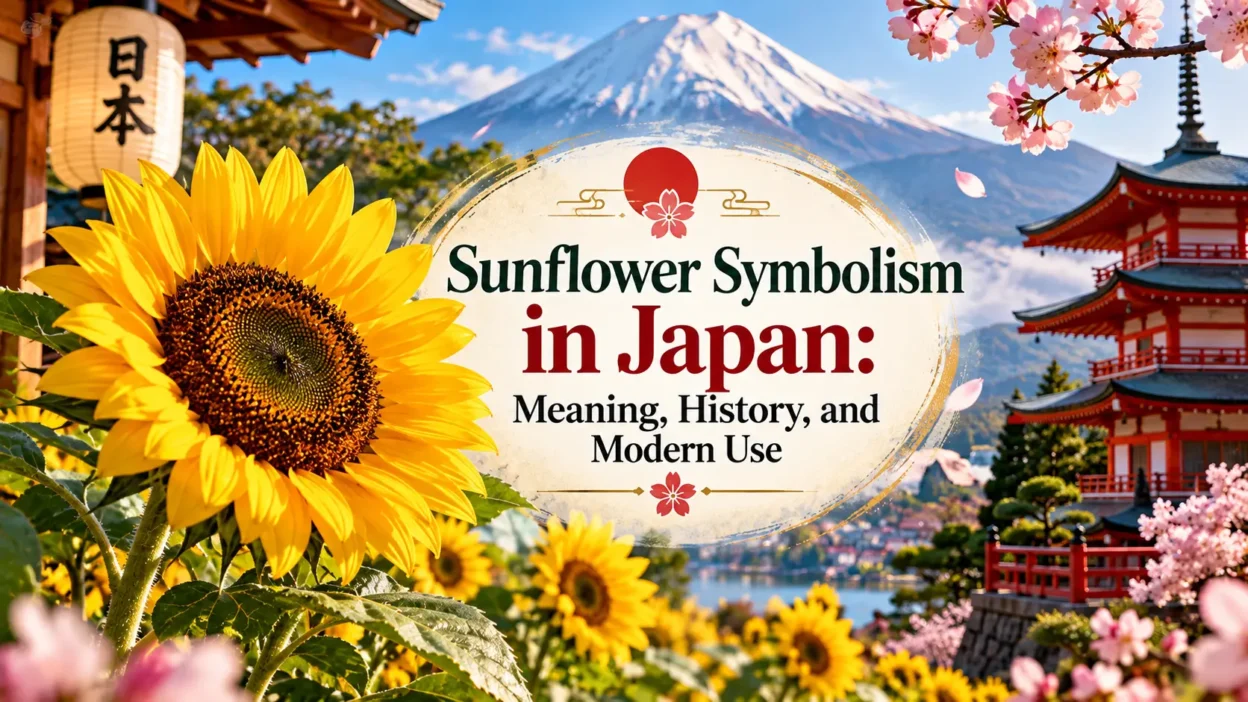
The sunflower symbolism Japan is closely connected with admiration, devotion, summer, and the image of turning toward light. In Japanese flower language, the sunflower (himawari, ひまわり) is often associated with feelings such as admiration and having one’s attention fixed on someone, while its bright appearance has also made it strongly associated with the Japanese summer landscape.
Unlike some flowers that have centuries-old roots in Japanese culture, the sunflower itself is a relatively late arrival. Historical records show that it was introduced to Japan during the Edo period, yet it gradually became familiar enough to acquire Japanese names, literary associations, flower-language meanings, and a strong place in modern seasonal imagery.
Today, large sunflower fields, summer festivals, gardens, photographs, gifts, illustrations, and popular media all contribute to the flower’s recognizable image in Japan. Its symbolism is generally bright and affectionate rather than solemn or religious.
Quick Answer
Sunflower symbolism in Japan commonly represents admiration, devotion, and focused affection, especially through the traditional flower-language idea of “having eyes only for you.” It is also strongly associated with summer, brightness, and an orientation toward the sun, while its historical meaning in Japan developed after the flower was introduced during the Edo period.
TL;DR
- Sunflowers commonly symbolize admiration and devoted affection in Japanese flower language.
- The flower arrived in Japan during the Edo period.
- Himawari became associated with turning toward the sun.
- Summer sunflower fields are a major modern Japanese image.
- Sunflowers usually carry positive rather than mournful associations.
- Some detailed flower-number meanings are modern and should be treated cautiously.
What Does the Sunflower Represent in Japanese Culture?
The sunflower’s main symbolic associations in Japan are admiration, devotion, affection, brightness, and summer.
Japanese flower language, known as hanakotoba (花言葉), gives the sunflower meanings connected to its appearance and behavior. Popular explanations associate himawari with admiration, yearning, passion, and the idea of looking toward one particular person. The image makes intuitive sense: a tall yellow flower facing the sun can suggest someone directing their attention toward a loved one.
This does not mean every Japanese person automatically interprets a sunflower in exactly the same way. Flower meanings vary by source, generation, situation, color, and context. A sunflower growing in a neighborhood garden may simply mean summer, while one used in a romantic gift can suggest affection or admiration.
That distinction matters because hanakotoba is better understood as a cultural tradition of flower associations than as a fixed symbolic dictionary.
Why Is the Sunflower Called Himawari?
The Japanese word himawari is commonly written as 向日葵. The name is closely connected with the flower’s relationship to the sun.
Historical Japanese sources show that several names were used for the sunflower before himawari became established. The National Diet Library records the plant in Japanese botanical works from the Edo period, including an illustration from 1666. Another historical source notes names such as jōgiku, ten-gaika, and geiyōka before himawari became widespread.
The name reflects the visual impression that the flower turns toward the sun. That association became an important part of its symbolic identity.
There is an interesting botanical qualification, however. Young sunflower plants can exhibit heliotropic movement, following the sun during the day. Mature flower heads generally settle facing east rather than continuously following the sun. So the popular image of a sunflower endlessly turning after the sun is more complicated than it first appears.
How the Sunflower Arrived in Japan
The sunflower is not native to Japan. It originated in North America and spread internationally after contact between the Americas and Europe.
Japanese historical records place its introduction in the Edo period (1603–1868). The National Diet Library notes that sunflowers appear to have reached Japan around the middle of the 17th century. A sunflower illustration appeared in Kinmō Zui in 1666, making it one of the early recorded visual representations of the plant in Japan.
At first, the flower was not necessarily considered beautiful by Japanese gardening standards. The National Diet Library notes that early observers regarded it as relatively large and crude, and it did not immediately become a favorite ornamental plant.
This is an important part of the story. The sunflower’s modern Japanese image was developed over time rather than inherited from an ancient Japanese religious tradition.
Sunflower Symbolism in the Edo Period
The Edo period was a particularly important era for Japanese horticulture. Gardening became increasingly sophisticated, and imported plants entered Japanese gardens and botanical literature. The spread of commercial plant cultivation and flower appreciation helped create a culture in which plants could be studied, collected, illustrated, and selectively cultivated.
The sunflower entered this environment as an unfamiliar foreign plant.
Its early history also shows why it is misleading to describe every modern sunflower association as an ancient Japanese belief. Some meanings developed after the plant became familiar in Japan, while others reflect the visual qualities of the flower itself.
Over time, the sunflower became easier to recognize as himawari, and its connection with the sun became central to its Japanese identity.
What Does Himawari Mean in Japanese Flower Language?
In popular Japanese hanakotoba, the sunflower is commonly associated with:
| Context | Meaning in Japan | Common Association | Notes |
|---|---|---|---|
| General flower language | Admiration | Respect and affection | One of the most commonly cited meanings |
| Romantic symbolism | Devotion | Focused affection | Often connected with “I only have eyes for you” |
| Summer imagery | Brightness | Warm weather and energy | Strong seasonal association |
| Sun-facing imagery | Yearning | Looking toward someone or something | Derived partly from the flower’s appearance |
| Gifts and personal expression | Affection | Positive feelings | Meaning depends on the relationship and setting |
Popular Japanese flower-language sources connect the sunflower with admiration and the expression “I only have eyes for you.” Some also give it meanings related to passion or yearning.
The important point is that these meanings should not be treated as an ancient religious code. They belong to the broader cultural practice of assigning symbolic meanings to flowers.
Why Does the Sunflower Symbolize Devotion?
The connection between sunflowers and devotion comes largely from their visual relationship with sunlight.
A sunflower appears to orient itself toward the sun. That makes it an easy metaphor for someone who consistently directs attention toward another person.
From that visual idea come associations such as:
- admiration
- loyalty
- affection
- yearning
- romantic attention
- steadfast interest
The phrase “I only have eyes for you” is especially compatible with this imagery. The flower seems to have one visual destination: the sun.
This symbolism can work romantically, but it does not have to be romantic. A sunflower can also express admiration for a friend, appreciation for someone’s character, or affection within a family.
Sunflowers and Summer in Japan
If one image captures the modern Japanese sunflower, it is the summer sunflower field.
Sunflowers bloom during the warmer months, and large fields create a distinctly seasonal landscape. Japanese sunflower destinations and festivals have helped strengthen the association between himawari and summer.
This seasonal connection gives the flower meanings beyond romance. It can suggest:
- warm weather
- childhood summer memories
- outdoor life
- brightness
- vitality
- holidays
- countryside landscapes
- seasonal celebration
In this sense, a sunflower in Japan can function much like other seasonal flowers: its appearance immediately helps establish a time of year.
Large sunflower fields are now photographed and visited as summer attractions, reinforcing the flower’s place in contemporary Japanese visual culture.
The Emotional Meaning of Sunflowers in Japan
The emotional symbolism of the sunflower is generally outward-looking and positive.
Its tall stem, yellow petals, and large central disk create a visually energetic flower. Unlike flowers commonly associated with funerals or remembrance, sunflowers are usually connected with cheerful occasions, summer, affection, and optimism.
Emotionally, a sunflower may communicate:
Admiration:
“I appreciate and look up to you.”
Devotion:
“My attention remains directed toward you.”
Affection:
“You bring warmth and happiness into my life.”
Optimism:
“The image of facing toward light suggests a positive outlook.”
Vitality:
Its strong summer presence can suggest energy and life.
These are symbolic interpretations, not claims that the flower causes a particular emotional response. Individual reactions naturally differ.
Sunflower Symbolism in Japanese Romance
The sunflower can have a romantic meaning because of its traditional association with focused attention.
Giving a sunflower can therefore suggest admiration or strong affection, particularly when the recipient already understands flower symbolism.
The romantic message is somewhat different from the symbolism of a red rose. A rose can communicate established romantic passion, while the sunflower’s visual language often feels brighter, more open, and more youthful.
This makes himawari suitable for situations where someone wants to express affection without relying on the darker or more formal associations sometimes attached to traditional romantic flowers.
Still, the meaning of a gift depends heavily on context. The same bouquet could communicate romantic affection between partners or simple appreciation between friends.
What Does a Sunflower Mean in Japanese Art and Popular Culture?
The sunflower’s bright visual identity makes it especially useful in contemporary Japanese illustration, photography, advertising, merchandise, and entertainment.
Its yellow color creates an immediate summer impression, while the large flower head is easy to recognize even in simplified artwork.
The word himawari itself also appears frequently in Japanese names and popular culture. The name has been used for fictional characters, music, television, organizations, and other cultural references, demonstrating how familiar the sunflower image has become in modern Japan.
This does not mean every appearance carries a deliberate symbolic message. Sometimes himawari is simply being used because the flower evokes warmth, youth, summer, or visual brightness.
Sunflower Symbolism in Gifts, Weddings, and Celebrations
Sunflowers can work well in celebratory settings because their symbolism tends to be positive.
In Japanese-inspired floral arrangements, a sunflower may suggest admiration, happiness, or affection. Its strong yellow color can also create a cheerful contrast with softer flowers.
For weddings, the sunflower can communicate ideas such as:
- happiness
- devotion
- admiration
- warmth
- a bright future
However, these meanings should not be presented as universal Japanese wedding rules. Japanese wedding traditions are diverse, and flower choices depend on personal taste, venue, season, family preferences, and contemporary fashion.
The sunflower is better understood as a modern positive floral symbol than as a mandatory traditional wedding emblem.
Does the Sunflower Have Religious Meaning in Japan?
There is no strong basis for describing the sunflower as a central traditional religious symbol in Japan.
Japan has extensive religious and cultural symbolism involving plants, flowers, trees, seasons, and natural imagery. But the sunflower arrived relatively recently compared with many plants deeply embedded in Japanese religious traditions.
Its connection with the sun can sometimes lead people to assume that it represents sun worship in Japan. That conclusion goes too far.
The Japanese sunflower’s association with sunlight is primarily connected with its botanical appearance, name, seasonal character, and flower-language tradition. Its symbolism should not automatically be converted into a Shinto or Buddhist doctrine.
How Japanese Sunflower Symbolism Differs From Western Meaning
Sunflowers have positive meanings in many cultures, but the details differ.
In the United States, the sunflower is commonly associated with happiness, optimism, summer, friendship, warmth, and rural or garden imagery. It can also carry agricultural associations because sunflowers are grown commercially for seeds and oil.
Japanese flower language adds a more explicitly relational dimension through meanings such as admiration and focused affection.
The two traditions overlap around brightness and positivity, but the Japanese hanakotoba tradition gives special attention to the flower’s apparent orientation toward the sun.
This is one reason sunflower symbolism in Japan can feel slightly more personal or romantic than the general American association with cheerful summer imagery.
Common Misunderstandings About Japanese Sunflower Symbolism
Several claims about sunflower meaning are repeated online without enough qualification.
“Sunflowers are an ancient Japanese symbol.”
Not exactly. The plant was introduced to Japan during the Edo period, so its history there is relatively recent compared with native or long-established flowers.
“Every sunflower always means loyalty.”
Flower meanings are not fixed rules. Hanakotoba associations vary among sources and contexts.
“Sunflowers literally follow the sun all day.”
Young plants can show heliotropic movement, but mature sunflower heads generally face east. The familiar image is therefore based on a real botanical behavior but oversimplifies it.
“Every number of sunflowers has an official Japanese meaning.”
Number-based flower meanings are widely circulated online, but many detailed lists are not equivalent to established historical Japanese tradition. Treat highly specific numerical claims cautiously.
How Sunflower Meaning Has Changed Over Time
The sunflower’s Japanese story illustrates how symbolism can develop after a plant enters a new culture.
During the Edo period, it was an unfamiliar imported plant documented in botanical and horticultural works. Over subsequent centuries, it became familiar as himawari and acquired associations based on its appearance, seasonal flowering, and cultural use.
Modern Japan has added another layer through tourism, photography, festivals, gardens, media, and social culture.
The result is a symbol with several overlapping meanings rather than one fixed definition. A sunflower can represent romantic admiration in a bouquet, summer in a photograph, childhood memories in an illustration, or simply a favorite flower in a garden.
That flexibility is part of its modern appeal.
How Sunflower Symbolism Is Used Today
Today, himawari appears in many ordinary settings rather than only formal symbolic contexts.
You may see sunflowers in:
- summer festival photography
- flower fields and parks
- home gardens
- bouquets
- greeting cards
- clothing designs
- jewelry
- tattoos
- illustrations
- advertising
- social media posts
- children’s products
- seasonal decorations
A tattoo of a sunflower, for example, might represent optimism or personal growth for one person and admiration or a meaningful relationship for another.
Modern Japanese symbolism is therefore best understood through context. The flower itself provides a recognizable set of associations, but the person using it determines the specific message.
Sunflower Symbolism in Japan vs. the United States
For an American reader, the easiest way to understand the Japanese interpretation is to compare the two cultural contexts.
In the United States, sunflowers often communicate cheerfulness, friendliness, warmth, and connection with summer or the countryside.
In Japan, those associations exist as well, but hanakotoba adds the idea of admiration directed toward a particular person.
That distinction can matter when interpreting Japanese artwork, gifts, tattoos, or flower arrangements. A sunflower may look like a simple cheerful flower while carrying an additional relational meaning.
Neither interpretation is more “correct.” They developed within different cultural environments.
FAQ: Japanese Sunflower Symbolism
What does a sunflower symbolize in Japan?
A sunflower commonly symbolizes admiration, affection, and focused devotion in Japanese flower language. It is also strongly associated with summer, brightness, and turning toward the sun.
What does himawari mean in Japanese?
Himawari (ひまわり) is the common Japanese word for sunflower. Its written form, 向日葵, is closely connected with the image of a flower oriented toward the sun.
Does a sunflower symbolize love in Japan?
Yes, it can. Japanese flower-language traditions associate sunflowers with admiration, yearning, and the idea of having eyes for one person, making them suitable for affectionate or romantic messages.
Is the sunflower an ancient Japanese flower?
No. Sunflowers were introduced to Japan during the Edo period, with records and illustrations appearing by the 17th century. Their cultural symbolism in Japan developed after their introduction.
What does a sunflower tattoo mean in Japanese culture?
A sunflower tattoo can suggest admiration, affection, optimism, or summer, but there is no single official Japanese tattoo meaning. The personal story behind the tattoo usually determines its most important symbolism.
Are sunflowers religious symbols in Japan?
Generally, no. Although sunflowers are connected visually with the sun, they are not a central traditional Shinto or Buddhist religious symbol. Their modern Japanese associations are more strongly connected with flower language, seasonality, and visual culture.
Why are sunflowers associated with summer in Japan?
Sunflowers bloom prominently during the Japanese summer and are featured in fields, gardens, photographs, and seasonal events. Their bright yellow flowers have consequently become a recognizable part of contemporary summer imagery.
Conclusion
The sunflower symbolism in Japan combines a relatively modern botanical history with a familiar and emotionally appealing image. Its Japanese flower-language associations include admiration, affection, yearning, and focused devotion, while its bright appearance has made it one of the recognizable visual symbols of summer.
The flower’s history also provides an important reminder: not every Japanese sunflower meaning comes from an ancient tradition. The plant arrived during the Edo period and gradually developed its place in Japanese language, horticulture, seasonal culture, and popular imagery.
Today, himawari can represent a person you admire, a feeling of affection, a summer landscape, or simply the cheerful beauty of the season. Its meaning depends on context, but its central image remains straightforward: a bright flower associated with looking toward the light.