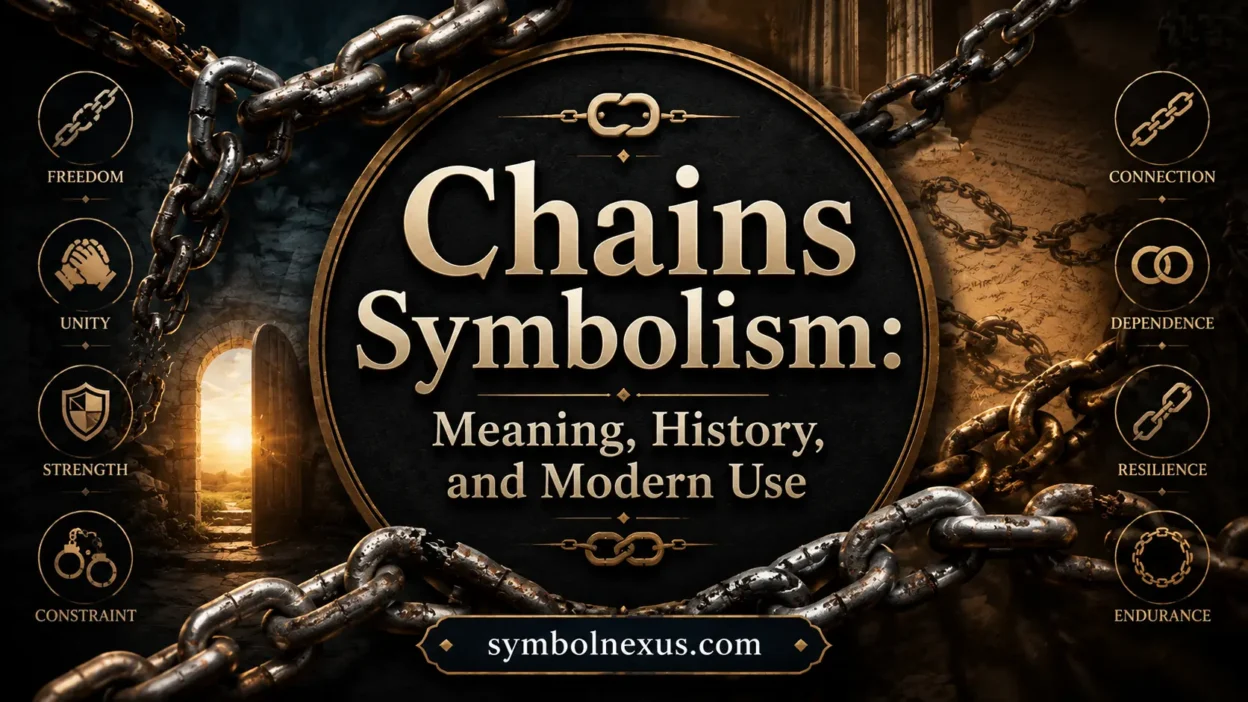
Chains can hold something together, secure something valuable, or prevent someone from moving freely. That contradiction is the foundation of chains symbolism. The same linked structure can suggest connection and strength in one setting, then captivity and oppression in another.
In the United States, chains carry especially serious historical associations because shackles and restraints are closely tied to slavery, imprisonment, and forced labor. Broken chains reverse that image and commonly represent emancipation, independence, recovery, and release from oppression.
At the same time, chains appear everywhere from necklaces and tattoos to fences, monuments, music, fashion, and political art. Their meaning depends heavily on whether the chain is intact, broken, worn voluntarily, or being used to restrain someone.
Quick Answer
Chains symbolism commonly represents restriction, captivity, obligation, or strong connection in modern American culture. Broken chains usually reverse those meanings, representing freedom, emancipation, independence, and escape from forces that once held someone back.
TL;DR
Intact chains often symbolize restraint, obligation, connection, or strength.
Broken chains commonly represent freedom, emancipation, and personal release.
American history gives chains strong associations with slavery and oppression.
Linked chains can also represent loyalty, unity, and interdependence.
Gold chains may communicate success, status, identity, and cultural pride.
Context determines whether a chain feels protective, supportive, or restrictive.
What Chains Are and Why Their Structure Shapes the Symbol
A chain consists of separate links joined so that each one depends on the next. That physical construction makes the object unusually useful as a symbol.
A single metal ring has limited strength and reach. Connect many rings, however, and they create something capable of pulling, securing, supporting, enclosing, or restraining. As a result, chains naturally suggest interdependence: individual parts become more effective when joined.
The same design also explains the symbol’s darker side. A chain placed around a gate protects property. A chain worn around the neck may be decorative. A chain attached to a person’s body removes freedom. The object itself is neither positive nor negative; its purpose changes the interpretation.
Breaking one link can also disable the entire structure. That physical fact helps explain why broken-chain imagery communicates release so clearly. The viewer does not need an elaborate explanation to understand that something which once confined or controlled has lost its power.
Chains have also been used for adornment for thousands of years. Surviving Hellenistic jewelry includes sophisticated loop-in-loop gold chains from around 300 BCE, while Roman and later Byzantine examples show the long history of linked metalwork as personal ornament.
The Core Meanings of Chains
No single definition covers every appearance of a chain. Its meaning changes according to its condition, placement, material, and cultural setting.
Context Common Meaning in the USA Typical Association Key Detail
Intact restraining chain Captivity, control Prison, oppression Freedom is limited
Broken chain Liberation, recovery Emancipation, independence Restraint has ended
Interlocking links Unity, loyalty Family, teamwork, relationships Separate parts stay connected
Heavy steel chain Strength, endurance Labor, toughness, protection Strength comes from linked parts
Gold chain Success, status, identity Jewelry, hip-hop, fashion Meaning depends on wearer and style
Chain barrier Boundary, exclusion Gates, fences, restricted spaces Access is controlled
These meanings can overlap. Someone may choose a chain tattoo, for example, because an intact link represents an unbreakable family bond. Another person might use nearly the same image to express emotional confinement.
The condition of the chain usually provides the strongest clue.
Restraint, Captivity, and Loss of Freedom
The most serious meaning of a chain comes from its literal use as a restraint.
Chains and shackles have historically been used to control prisoners, enslaved people, captives, and forced laborers. Because the object physically limits movement, it became a straightforward image for loss of liberty.
In modern language, the metaphor continues even when no metal chain is present. People describe being “chained” to debt, addiction, an unhealthy relationship, a demanding job, or expectations they cannot escape.
This symbolic extension works because all of those situations involve some form of restricted choice.
Chains may therefore represent:
physical imprisonment
abusive control
political oppression
economic dependence
unwanted obligations
addiction or compulsive behavior
emotional entrapment
The meaning is not necessarily permanent. In personal art and tattoos, an intact chain may represent the difficult period before someone became free. When shown snapping or falling away, the emphasis shifts toward survival and change.
Why Broken Chains Symbolize Freedom
Few symbolic changes are as direct as turning an intact chain into a broken one.
The original chain represents a force that restricts movement. Once a link snaps, that force can no longer perform its function. Broken chains therefore communicate freedom gained by ending restraint, rather than freedom that has always existed.
That difference matters.
A soaring bird may suggest natural independence. An open road may suggest possibility. A broken chain specifically implies that there was once something to escape.
In the United States, this image has particularly strong associations with emancipation. Broken chains appeared in nineteenth-century representations of formerly enslaved people, including post-Civil War art where discarded restraints identified the transition from enslavement toward freedom.
The same visual language now appears in recovery art, activist graphics, tattoos, memorial imagery, and personal transformation stories.
A person may use broken chains to represent leaving an abusive environment, ending an addiction, overcoming restrictive expectations, becoming financially independent, or reclaiming control over personal decisions.
The image works because the viewer sees both the former restriction and its defeat.
Connection, Loyalty, and the Bonds Between People
Chains are not always about imprisonment.
Because one link physically joins another, chains can symbolize relationships that remain connected under pressure. In this interpretation, the chain does not trap anyone. Instead, it represents a bond.
That bond may involve family, friendship, marriage, community, teamwork, ancestry, or membership in a group.
The familiar phrase “a chain is only as strong as its weakest link” adds another layer. It treats a group as an interconnected system in which every member affects the whole. The image can therefore communicate both solidarity and responsibility.
Couples or relatives sometimes use linked-chain jewelry or tattoos to express this idea. Two connected links may stand for two individuals. A longer chain can represent generations, family members, or a community.
Whether this symbolism feels comforting or restrictive depends on how the bond is portrayed.
A loose decorative chain suggests chosen connection. Tight chains around the wrists or body suggest control. The same basic object can therefore distinguish between belonging and possession.
Strength, Endurance, and the Meaning of the Link
Industrial chains are expected to survive tension, weight, repeated movement, and hard use. That practical strength has given them another common symbolic association: endurance.
A thick chain in a tattoo, logo, gym design, or piece of masculine jewelry may suggest toughness and resistance to pressure.
The symbolism comes from structure rather than simply from metal. Each link transfers force to the next one. Strength depends on continuity.
For that reason, chains can represent:
Resilience. The ability to withstand pressure without breaking.
Dependability. Each link must continue doing its job.
Collective strength. Many connected parts accomplish what one could not.
Protection. Chains secure gates, equipment, valuables, and boundaries.
There is still an important distinction between strength and restriction. A chain wrapped tightly around a person communicates something very different from a chain being lifted, pulled, or used as protective equipment.
Visual context determines which quality dominates.
Chains in American History and Public Symbolism
American interpretations of chains cannot be separated from the country’s history of slavery.
Metal restraints were real instruments of captivity, making chains and shackles enduring visual references to enslavement. After emancipation, broken restraints became a recognizable way of representing the destruction of legal bondage.
One of the country’s best-known examples is easy to miss.
At the feet of the Statue of Liberty are broken shackles and chains. They form part of the statue’s symbolism of liberation from servitude and oppression, while the statue’s raised foot suggests forward movement. The monument’s intellectual origins were also connected with the abolitionist beliefs of Édouard de Laboulaye, who regarded the abolition of slavery in the United States as an important achievement.
This history gives broken-chain imagery particular weight in American public life.
It can represent emancipation in a specifically historical setting, but artists and political movements have also adapted it to other campaigns against oppression.
That flexibility requires care. A broken chain used in a Civil War memorial does not automatically carry exactly the same meaning as one used in a contemporary political poster. The basic concept of liberation may remain, while the historical claim behind it changes.
Religious Meaning of Chains
Chains appear in religious language largely because bondage and freedom are familiar moral metaphors.
In Christianity, one important example comes from the account of the apostle Peter’s imprisonment in the Book of Acts. Peter is bound in prison before being miraculously released, allowing falling or broken chains to become an image of deliverance from captivity. Christian teaching has continued to use chains metaphorically for habits, fear, sin, persecution, or other conditions believed to prevent spiritual freedom.
Chains can also carry a nearly opposite religious meaning when the focus is on a bond rather than imprisonment. A chain of believers, generations, or teachings can suggest continuity and shared faith.
It is important not to treat chains as a universal religious symbol with one fixed definition. They do not function like the Christian cross or another established sacred emblem.
Instead, religious interpretations usually come from the chain’s ordinary functions: binding, connecting, restraining, and being broken.
Similar metaphors occur across cultures because those physical experiences are widely understandable, but individual traditions should be interpreted within their own historical setting rather than combined into a single supposed ancient meaning.
Gold Chains, Jewelry, Status, and Hip-Hop Culture
A chain worn voluntarily around the neck produces an entirely different impression from a chain used as a restraint.
Jewelry can transform the chain from an object of control into an object of display.
Gold especially carries longstanding associations with wealth, rarity, prestige, and social position. Ancient societies used elaborate linked jewelry centuries before modern fashion, showing that chains have long occupied both practical and decorative roles.
In American culture, gold chains gained another highly visible identity through hip-hop.
From the 1980s onward, prominent chains, pendants, and customized jewelry became important parts of hip-hop style. Museums now treat such pieces as material evidence of the genre’s cultural history rather than simply as luxury accessories; exhibitions have traced hip-hop jewelry from the 1980s into contemporary music and fashion.
Within that setting, a chain can communicate several things at once: financial success, self-presentation, neighborhood or group identity, artistic persona, craftsmanship, and the achievement of visibility in industries where Black artists historically encountered barriers.
Customized pendants add another level. A chain carrying a name, logo, neighborhood reference, religious symbol, or record-label emblem becomes an identity statement rather than a generic display of wealth.
The meaning comes from both the chain and what the wearer chooses to place on it.
What Chain Tattoos Commonly Mean
Chain tattoos are especially dependent on design.
An artist can change the message simply by breaking one link, adding a lock, wrapping the chain around a body part, or connecting it to another symbol.
An unbroken chain may represent endurance, loyalty, commitment, or a connection that the wearer does not want to lose.
A broken chain most often suggests freedom. Someone may choose it after recovering from addiction, leaving a controlling relationship, rejecting an old identity, or surviving a difficult period.
A chain around the wrist or ankle can create a stronger association with captivity because those placements resemble historical restraints. For that reason, such designs can carry heavier emotional implications than a decorative chain around the shoulder or neck.
A chain with a lock may symbolize commitment, secrecy, emotional protection, or restriction.
A chain connected to a heart can imply lasting love, but it can also portray love as possessive or emotionally confining.
A chain connected to an anchor, cross, skull, or other image takes much of its final meaning from that second symbol.
There is no standardized tattoo dictionary that determines what every chain means. Personal history usually matters more than a generic interpretation found online.
Emotional and Psychological Meaning
Chains provide a convenient visual language for experiences that are otherwise difficult to show.
A person who feels trapped by responsibilities may imagine chains even though no physical restraint exists. Someone recovering from a destructive pattern may picture those chains falling away.
Psychologically, chain imagery often revolves around agency: the ability to make choices and act on them.
An intact restrictive chain can communicate helplessness, frustration, fear, dependency, guilt, or obligation.
Breaking it can communicate relief, self-determination, boundary-setting, recovery, or a new identity.
Chains representing relationships introduce a more complicated emotional question: Is the connection chosen?
A voluntary bond can feel reassuring. People often want relationships that are dependable and difficult to break. An imposed bond feels entirely different.
This is why chain imagery works so well in stories about family expectations, controlling relationships, social roles, and personal independence. It visualizes the boundary between commitment and confinement.
How Chains Function in Art, Stories, and Popular Culture
Writers and artists frequently use chains because the object makes an invisible condition visible.
A character does not need to be literally imprisoned for chain imagery to suggest that the past controls them. Ghost stories, moral allegories, fantasy, comics, album art, and political posters have all used chains this way.
One familiar literary example is Jacob Marley in A Christmas Carol. The chain he carries represents a burden created through his own actions. Here the chain does not primarily symbolize government imprisonment or slavery. It represents accumulated moral consequences.
Popular culture also uses snapping chains as a visual shortcut for transformation. A superhero tearing chains apart instantly communicates extraordinary strength and resistance to domination. Political posters use the same action to represent revolution or independence.
Fashion complicates the symbol further. Chain belts, necklace chains, wallet chains, and decorative metal links may carry little connection to historical restraint. Depending on the style, they can signal luxury, streetwear, punk aesthetics, industrial toughness, rebellion, or simply visual preference.
Digital culture has made the image even more flexible. Broken-chain illustrations appear in posts about quitting jobs, leaving relationships, recovering from addiction, challenging social expectations, or gaining personal independence.
The basic visual grammar remains remarkably stable: an intact restraint limits; a broken restraint releases.
Controversies, Misuse, and the Symbol’s Changing Meaning
Because chains have been connected to real human captivity, they are not always a neutral decorative motif.
Images involving shackled wrists, ankles, enslaved bodies, or racial stereotypes can evoke the history of slavery whether or not the creator intended that reference. Using such imagery purely for shock, fashion, or humor can therefore seem insensitive when its historical associations are obvious.
Political imagery creates another problem.
Almost any movement can portray itself as “breaking chains.” The symbol tells viewers that liberation is occurring, but the image alone does not prove that a political cause actually produces freedom. Competing movements can use identical visual language while advocating very different ideas.
The symbol can also become confusing when people assign rigid meanings to ordinary chain jewelry. Wearing a chain does not automatically communicate oppression, gang affiliation, dominance, spiritual bondage, or any other hidden message. Jewelry frequently reflects fashion or personal taste.
A useful interpretation considers four questions:
Is the chain intact or broken?
Is it restraining something or simply connecting things?
Is the person wearing it voluntarily?
What other symbols appear beside it?
Those details explain why the meaning of chains has expanded without losing its original logic. Their symbolism still grows from what chains physically do: they connect, secure, bear weight, restrict movement, and break.
FAQs About Chain Symbolism
Are chains a positive or negative symbol?
They can be either. Restrictive chains commonly represent captivity, oppression, or unwanted obligations, while linked chains may represent loyalty, strength, protection, and dependable relationships.
What does a broken chain symbolize?
A broken chain usually symbolizes liberation from something that previously limited freedom. Depending on the context, it can refer to emancipation, independence, recovery, escaping abuse, overcoming addiction, or rejecting restrictive expectations.
What do chains symbolize in tattoos?
Chain tattoos can represent commitment, endurance, family bonds, restriction, or struggle. Broken-chain tattoos more often emphasize release, survival, independence, or the end of a difficult period.
What do chains symbolize in Christianity?
Christian imagery can use chains to represent imprisonment, persecution, sinful habits, fear, or other forms of bondage. The account of Peter being released from prison also gives broken or falling chains an association with deliverance.
Why are chains associated with slavery in the United States?
Chains and shackles were physically used to restrain enslaved people, so they became direct images of bondage. After emancipation, broken restraints were used in American art and monuments to communicate the ending of slavery and the pursuit of freedom.
What does a gold chain symbolize?
Gold chains can suggest wealth, achievement, prestige, personal identity, or fashion. In American hip-hop culture, prominent gold and jeweled chains have also become important forms of artistic self-presentation and cultural expression.
Can chains symbolize love and relationships?
Yes. Interlocking links can represent loyalty, commitment, family ties, and relationships designed to endure pressure. When a chain appears tight, locked, or restrictive, however, the same image may suggest possessiveness or an unhealthy bond.
Conclusion
Chains symbolism is built around a simple contradiction. Chains join individual pieces into something stronger, yet the same structure can restrict movement and remove freedom. That is why they can represent loyalty, unity, endurance, protection, captivity, oppression, or obligation without those meanings being arbitrary.
Broken chains change the message most clearly. In American history, they carry an especially important connection to emancipation and the rejection of slavery, while modern tattoos, art, recovery imagery, and political graphics extend the idea toward personal and social liberation.
The best way to interpret a chain is therefore not to ask for one universal definition. Look at what the chain is doing. A chain that connects tells a different story from one that restrains, and a chain that has finally broken tells another story altogether.