
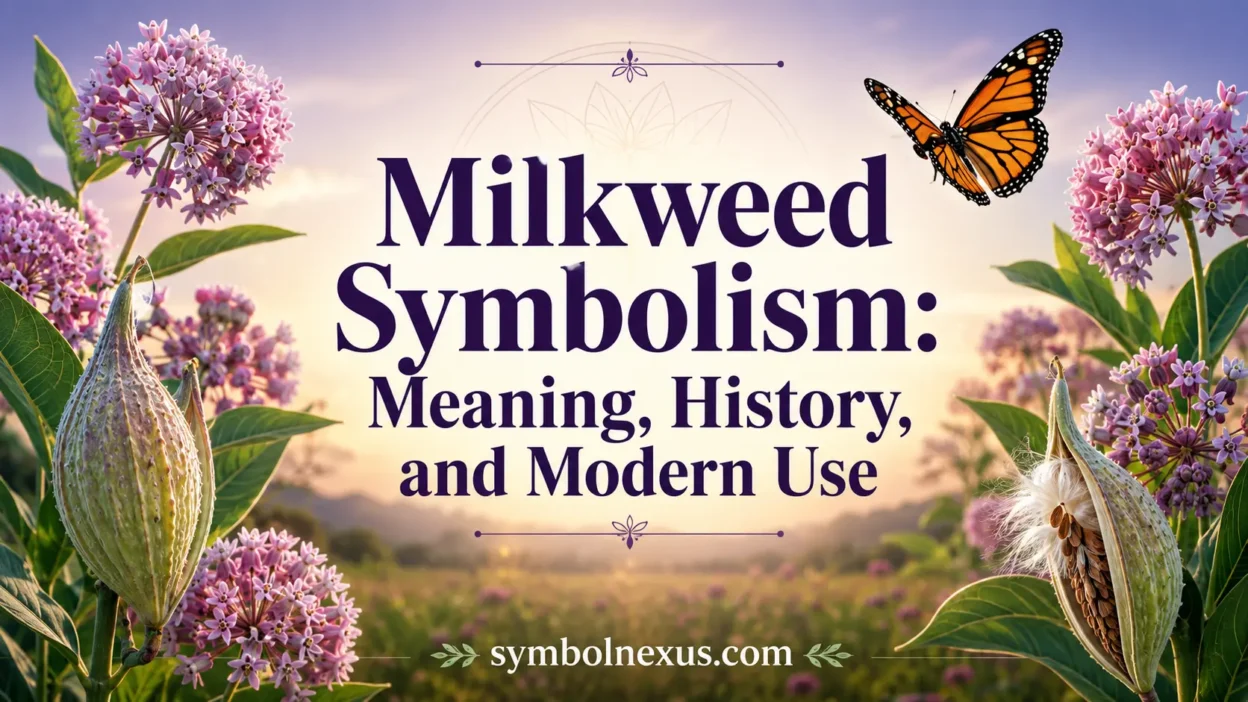
Milkweed is easy to overlook until its flowers open, its seedpods split, or a monarch butterfly lands on its leaves. Yet milkweed symbolism has become increasingly meaningful in the United States because the plant connects several recognizable ideas: transformation, resilience, protection, migration, ecological responsibility, and the quiet support that allows new life to develop.
Unlike roses, lilies, or laurel, milkweed does not have one ancient, universally agreed symbolic language. Much of its modern meaning comes from what the plant actually does. It survives in exposed landscapes, protects itself chemically, releases seeds into the wind, and provides the essential larval food source for monarch butterflies. Female monarchs lay eggs on milkweeds, and their caterpillars depend on these plants for food.
Its American story also extends beyond butterflies. Different Indigenous communities made practical use of milkweed, and Americans collected its silky floss during World War II for life-preserving equipment. Those layers make milkweed less a symbol of ornamental beauty than of usefulness, interdependence, endurance, and survival.
Quick Answer
Milkweed symbolism commonly represents transformation, resilience, nurturing, protection, and support for life in modern American culture, largely because of the plant’s close relationship with monarch butterflies. Historically, its medicinal associations, Indigenous uses, wartime importance, and wind-carried seeds have also connected it with healing, resourcefulness, survival, and movement.
TL;DR
- Milkweed commonly represents transformation because it sustains developing monarch caterpillars.
- Its persistence makes it a natural symbol of resilience.
- Toxic sap gives it associations with protection and healthy boundaries.
- Windborne seeds can suggest release, travel, and new beginnings.
- Americans increasingly associate milkweed with pollinator conservation and ecological care.
- Historical uses add themes of healing, usefulness, and survival.
What Milkweed Looks Like and Why Its Biology Matters
Milkweed is not a single species but a group of flowering plants in the genus Asclepias. More than 100 milkweed species are native to the United States, ranging from familiar common milkweed to swamp milkweed, butterfly weed, and species adapted to deserts and other specialized habitats.
Many species produce clusters of small, complex flowers in shades of pink, purple, white, orange, or green. When a stem or leaf is damaged, many milkweeds release the milky latex that inspired the common name.
Later in the season, their pods mature and split. Flat seeds escape attached to silky fibers that catch air currents and carry them away from the parent plant.
Each feature contributes naturally to symbolic interpretation. The flowers attract life, the leaves sustain caterpillars, the sap defends the plant, and the airborne seeds suggest movement beyond familiar ground.
Milkweed’s meanings therefore tend to arise from observable biology rather than from an invented symbolic code.
What Milkweed Commonly Symbolizes in the United States
In contemporary American symbolism, milkweed is most closely associated with transformation, resilience, nurturing, conservation, protection, and renewal.
| Context | Meaning in the USA | Common Association | Why It Fits |
|---|---|---|---|
| Monarch habitat | Transformation | Butterfly life cycle | Caterpillars rely on milkweed |
| Native garden | Stewardship | Pollinator conservation | Planting creates wildlife habitat |
| Persistent wild plant | Resilience | Endurance | Many species survive difficult sites |
| Milky defensive sap | Protection | Boundaries | Chemical defenses discourage feeding |
| Floating seeds | Release and renewal | Travel, possibility | Seeds disperse to new locations |
| Historical use | Resourcefulness | Survival and service | Fiber and floss had practical value |
No single interpretation applies in every setting. A milkweed tattoo may emphasize personal change, while a milkweed patch in a school garden is more likely to represent environmental stewardship.
The strongest interpretations come from context rather than from treating every part of the plant as carrying a fixed message.
Transformation and the Monarch Connection
Transformation is probably milkweed’s most recognizable modern symbolic meaning because Americans commonly encounter the plant through monarch conservation.
A monarch begins life as an egg deposited on milkweed. After hatching, the caterpillar eats milkweed leaves as it grows through its larval stages before eventually forming a chrysalis and becoming a butterfly. Milkweed is therefore present near the beginning of one of nature’s most familiar examples of metamorphosis.
Symbolically, this makes milkweed different from the butterfly itself.
A butterfly can represent the completed transformation. Milkweed can represent what makes transformation possible: nourishment, preparation, patience, and the environment needed for change.
That distinction gives the plant particular relevance during periods of education, recovery, parenthood, career change, or personal development. The message is not simply “change.” It is that meaningful change often requires support before it becomes visible.
Nurturing, Support, and Interdependence
Milkweed also represents nurturing because its relationship with monarchs demonstrates biological dependence.
Monarch caterpillars cannot simply replace milkweed leaves with an unrelated garden plant. Milkweeds are their essential larval host plants. Adult monarchs use many flowers for nectar, but the caterpillar stage depends specifically on milkweed and closely related host plants.
That ecological relationship gives milkweed an appealing symbolic role as the support behind another creature’s growth.
For some people, it can represent:
- caregiving without seeking attention
- parents supporting children
- teachers helping students develop
- communities creating conditions for others to thrive
- reciprocal relationships between species
- responsibility toward vulnerable life
This meaning avoids romanticizing dependence. Ecologically, monarchs need milkweed; milkweed is also part of a broader community of insects and pollinators. The relationship demonstrates interconnectedness rather than self-sacrifice.
Resilience and Persistence
Milkweed often grows where ornamental plants would look out of place: along roadsides, prairie edges, meadows, pastures, open fields, wetlands, and disturbed ground. Different species occupy very different habitats, and many are adapted to recurring environmental stress.
That persistence naturally lends the plant to symbolism involving resilience.
Resilience here does not mean remaining unchanged. Milkweed dies back, regrows, spreads underground in some species, produces seeds, and responds to seasonal conditions. It survives through adaptation.
As a personal symbol, milkweed can therefore suggest:
Endurance without rigidity. Surviving difficulty may require changing how one grows.
Recovery after disruption. A landscape that appears empty can produce new shoots later.
Strength outside cultivated spaces. Value does not depend on looking polished or ornamental.
That final idea is particularly appropriate for a plant burdened with the word weed even though native milkweeds are important wildflowers.
Protection, Toxicity, and Personal Boundaries
Milkweed has another side: it defends itself.
Many species contain cardenolides, defensive compounds that can make the plants toxic when consumed improperly. Monarch caterpillars have evolved a specialized relationship with milkweed and can retain some of these compounds, helping make monarchs unpalatable to many predators.
This biology supports a symbolic association with protection.
In personal or artistic symbolism, milkweed can represent the idea that something gentle, attractive, or nurturing can also maintain boundaries. Support does not require defenselessness.
A milkweed image may therefore communicate:
- self-protection
- guarded vulnerability
- maintaining limits
- strength concealed beneath softness
- protecting what is still developing
This interpretation is more grounded than simply calling milkweed a “protective plant.” Its symbolism comes from a real defensive strategy.
The plant’s toxicity should also be treated literally when appropriate. Symbolism does not make milkweed safe to eat, and preparation practices associated with particular edible species should not be generalized casually.
Windborne Seeds: Release, Movement, and New Beginnings
A mature milkweed pod changes the visual character of the plant completely.
The pod splits open, revealing overlapping brown seeds attached to fine white fibers. A breeze can lift those fibers and scatter the seeds across the landscape.
It is easy to see why this stage inspires associations with release, travel, freedom, transition, and beginning again somewhere new.
A seed leaving the parent plant does not know where it will land. Symbolically, that uncertainty can represent accepting movement without controlling every outcome.
Milkweed seed imagery can be particularly appropriate for:
- graduation
- relocation
- leaving home
- recovery after loss
- ending one stage of life
- choosing a new direction
It shares some visual symbolism with dandelion seeds, but the milkweed carries an additional ecological connection to monarch migration and habitat.
Milkweed in American History: Survival and Resourcefulness
Milkweed acquired an unusual place in American history during World War II.
When conventional supplies of kapok fiber became difficult to obtain, Americans collected milkweed pods so their buoyant floss could be used as filling for military life preservers. Schoolchildren, youth organizations, and communities participated in collection campaigns. The National Park Service records that enormous quantities of milkweed floss were needed and that children gathered pods from roadsides, fields, and other open spaces.
This history adds a distinctly American layer to the plant’s symbolism.
Milkweed could represent:
Resourcefulness. A plant often dismissed as a weed became strategically useful.
Collective effort. Individual children gathering pods contributed to a national project.
Protection and survival. The lightweight floss became part of life-preserving equipment.
Recognizing overlooked value. Something ordinary in a field could become useful under extraordinary circumstances.
This is one reason milkweed symbolism should not be reduced entirely to monarch butterflies. The plant has its own human history.
Indigenous Uses and the Importance of Cultural Accuracy
Long before modern pollinator gardens, Native peoples across parts of North America had detailed knowledge of milkweed species.
Documented uses varied among communities and included fibers for cordage and textiles as well as carefully prepared food and medicinal applications. The U.S. Forest Service notes that Native Americans harvested milkweed fibers and that different tribes used parts of butterfly milkweed for practical purposes.
Those records can support broad themes such as utility, knowledge of place, continuity, and human relationships with native plants.
They should not, however, be turned into a claim that “Native Americans believed milkweed symbolized” one universal concept.
There is no single Native American culture, religion, or symbolic vocabulary. Nations have distinct languages, histories, environments, and traditions. Practical use also does not automatically prove ceremonial or spiritual symbolism.
A culturally responsible interpretation recognizes documented relationships without inventing a pan-Indigenous legend.
Why the Name Asclepias Adds a Healing Association
Milkweed’s botanical name adds another historical layer.
The genus Asclepias is associated by botanical tradition with Asclepius, the Greek figure connected with medicine and healing. Modern horticultural references continue to explain the genus name through that healing association.
This can make healing a reasonable secondary symbolic interpretation, especially when milkweed appears in botanical art, herbal history, or designs that intentionally reference the scientific name.
There is an important distinction, however.
The naming connection does not mean milkweed functioned as a universal sacred emblem of Asclepius in ancient Greece. Nor does a historical medicinal use prove that the plant is safe for modern self-treatment.
For symbolism, the strongest interpretation is simply that milkweed’s botanical identity preserves a linguistic connection with medicine and healing.
Milkweed as a Modern American Conservation Symbol
Perhaps the biggest change in milkweed’s meaning has occurred in recent decades.
For many Americans, seeing milkweed now immediately suggests monarch butterflies and pollinator protection. Garden programs, schools, parks, conservation organizations, and homeowners deliberately plant native milkweeds to create breeding habitat.
That shift has transformed the image of the plant. Something once frequently regarded primarily as roadside vegetation or an agricultural nuisance can now communicate ecological stewardship.
The U.S. Fish and Wildlife Service emphasizes that the United States has more than 100 native milkweed species and challenges the assumption that native milkweeds are simply invasive “weeds.”
As a contemporary symbol, a milkweed planting can therefore function almost like a small public statement:
Wildlife belongs here.
The symbolism is expressed through action rather than decoration.
Gardens, Schools, and Community Spaces
Milkweed’s modern meaning becomes especially visible in gardens.
A patch of native milkweed beside coneflowers, asters, goldenrods, or other nectar plants often signals that the gardener is thinking beyond appearance. The landscape is being designed as habitat.
Schools use milkweed gardens to teach life cycles, migration, pollination, native plants, and the relationships between organisms. Community gardens and park plantings can serve similar purposes.
In these settings, milkweed can symbolize:
- environmental education
- responsibility toward local ecosystems
- coexistence with wildlife
- patience with seasonal change
- restoration of habitat
It also challenges conventional ideas about what a beautiful yard should look like. A chewed leaf is not necessarily a gardening failure when the intended purpose of the plant is to feed a caterpillar.
That reversal gives milkweed a modern symbolic message about valuing ecological function as well as visual perfection.
Milkweed in Tattoos and Personal Art
Milkweed is less conventional in tattoos than roses, lotuses, or butterflies, which can make it appealing to someone seeking a quieter botanical symbol.
The chosen stage of the plant changes the meaning.
Milkweed with a monarch usually emphasizes transformation, migration, interconnectedness, or conservation.
An unopened pod can suggest potential, preparation, or something not yet released.
An open pod with drifting seeds fits themes of letting go, travel, independence, or new beginnings.
Flowers and leaves alone may represent native landscapes, resilience, or attachment to a particular region.
Milkweed roots and stems can emphasize persistence and survival rather than visual delicacy.
For memorial art, floating seeds may also suggest continuation after absence. That interpretation is personal rather than a standardized mourning tradition, so it should be understood as modern visual symbolism.
Emotional and Psychological Meaning
Milkweed’s strongest emotional message may be the coexistence of vulnerability and strength.
A monarch egg or caterpillar appears delicate, yet it develops on a chemically defended plant. The seed fibers look almost weightless, yet they help carry the next generation outward. The flowers appear intricate and fragile, while many milkweed species endure exposed conditions.
Those contrasts make milkweed useful when representing complicated emotional states.
Someone might identify with milkweed after:
- rebuilding life following disruption
- learning to set boundaries
- supporting another person’s development
- adapting to a major transition
- finding value after feeling overlooked
- reconnecting with nature during recovery
The plant does not need to symbolize triumph in a dramatic sense. Its imagery is better suited to sustained growth, necessary support, and survival through ordinary processes.
Milkweed, Monarch Migration, and Cross-Cultural Meaning
Milkweed and monarch symbolism overlap, but they should not be treated as identical.
In parts of central Mexico, monarch butterflies have longstanding cultural associations involving ancestors, the dead, and the seasonal arrival of migrating butterflies near Día de Muertos. Smithsonian Folklife describes traditions among Purépecha and Mazahua communities connecting monarchs with returning ancestors.
That meaning belongs primarily to the monarch butterfly and its migration, not automatically to every milkweed plant.
Still, milkweed forms part of the monarch’s continental life cycle. In the United States, this ecological connection can make a milkweed-and-monarch design evoke migration, borders, continuity between generations, or connections across North America.
The distinction matters. It allows people to appreciate the cultural meaning of monarchs without falsely claiming that milkweed itself carries an ancient Mexican or Indigenous symbolism that has not been established.
How Milkweed’s Meaning Has Changed
Milkweed provides a good example of symbolic meaning evolving with social context.
For Indigenous communities, individual species had practical roles shaped by local ecological knowledge.
In later American agricultural landscapes, milkweed was often viewed through the language of weeds and unwanted growth.
During World War II, its floss turned an overlooked wild plant into a valuable home-front resource.
In the modern conservation era, its dependence relationship with monarchs has placed milkweed at the center of native gardening campaigns and habitat restoration.
The symbolism consequently moved through several overlapping ideas:
useful native plant → unwanted weed → wartime resource → monarch host plant → conservation emblem
None completely replaces the others.
That changing reputation reinforces one of milkweed’s most interesting symbolic lessons: cultural value depends partly on what people notice. A plant considered useless in one context may prove essential in another.
Common Misunderstandings About Milkweed Symbolism
Several claims about milkweed deserve caution.
“Milkweed has one ancient spiritual meaning”
It does not have a single documented symbolic tradition shared across cultures. Modern meanings such as transformation and resilience are largely interpretations based on the plant’s ecology and association with monarchs.
“All milkweed is invasive”
No. More than 100 species are native to the United States, although individual species differ greatly in growth habit and appropriate geographic range.
“Any milkweed is good for monarchs”
That is also too simple. Conservation organizations generally recommend regionally appropriate native species. Non-native tropical milkweed can create ecological and monarch-health concerns in parts of the United States because it may persist through seasons when native milkweeds normally die back.
“Milkweed symbolizes healing, so it is medicinally safe”
Symbolism and medical safety are unrelated. Historical uses should not be treated as modern health instructions.
“The monarch’s cultural meaning automatically belongs to milkweed”
The two are closely connected ecologically, but their cultural histories are not interchangeable.
Frequently Asked Questions
Is milkweed a positive symbol?
Milkweed is usually interpreted positively in modern American symbolism, especially through ideas of resilience, transformation, nurturing, conservation, and renewal. Its toxicity can add a more complex meaning involving protection and boundaries rather than negativity.
What does milkweed symbolize in a tattoo?
A milkweed tattoo can represent transformation, resilience, caregiving, ecological connection, or moving into a new stage of life. Adding monarchs emphasizes metamorphosis and migration, while drifting seeds emphasize release and new beginnings.
Does milkweed symbolize healing?
Healing can be a secondary association because the botanical name Asclepias is traditionally linked with Asclepius and the history of medicine. It is best understood as a historical or botanical association, not evidence that the plant should be used as a modern remedy.
What do milkweed seeds symbolize?
Milkweed seeds commonly lend themselves to interpretations of freedom, transition, dispersal, possibility, and starting somewhere new. Their meaning comes from the visual act of leaving an opened pod and traveling on the wind.
What does milkweed symbolize spiritually?
There is no single established spiritual meaning. In personal spiritual practice, people may use milkweed to represent transformation, interdependence, protection, surrender, or life’s dependence on supportive relationships.
Is milkweed associated with monarch butterflies?
Yes. Milkweeds are essential host plants for monarch larvae, which is why the plant has become strongly associated with monarch conservation in the United States. Adult monarchs also visit flowers for nectar, although they use many flowering species.
Can milkweed symbolize remembrance?
It can in modern personal symbolism, especially when open seedpods and drifting seeds are used to express continuation, departure, or carrying someone’s influence forward. That is an individual artistic interpretation rather than a universal historical mourning custom.
Conclusion
Milkweed symbolism is strongest when it remains connected to the plant’s real characteristics. It sustains developing monarchs, survives in demanding landscapes, protects itself chemically, releases its seeds to the wind, and has served people in ways ranging from traditional fiber use to American wartime life-preserver production.
In modern U.S. culture, those qualities make milkweed an especially fitting symbol of transformation, resilience, caregiving, protection, ecological responsibility, and renewal. Its story also reminds us that symbolic value does not always belong to the most glamorous object in the landscape.
Sometimes meaning grows from recognizing that what looks ordinary, unruly, or expendable may be exactly what another life depends on.


