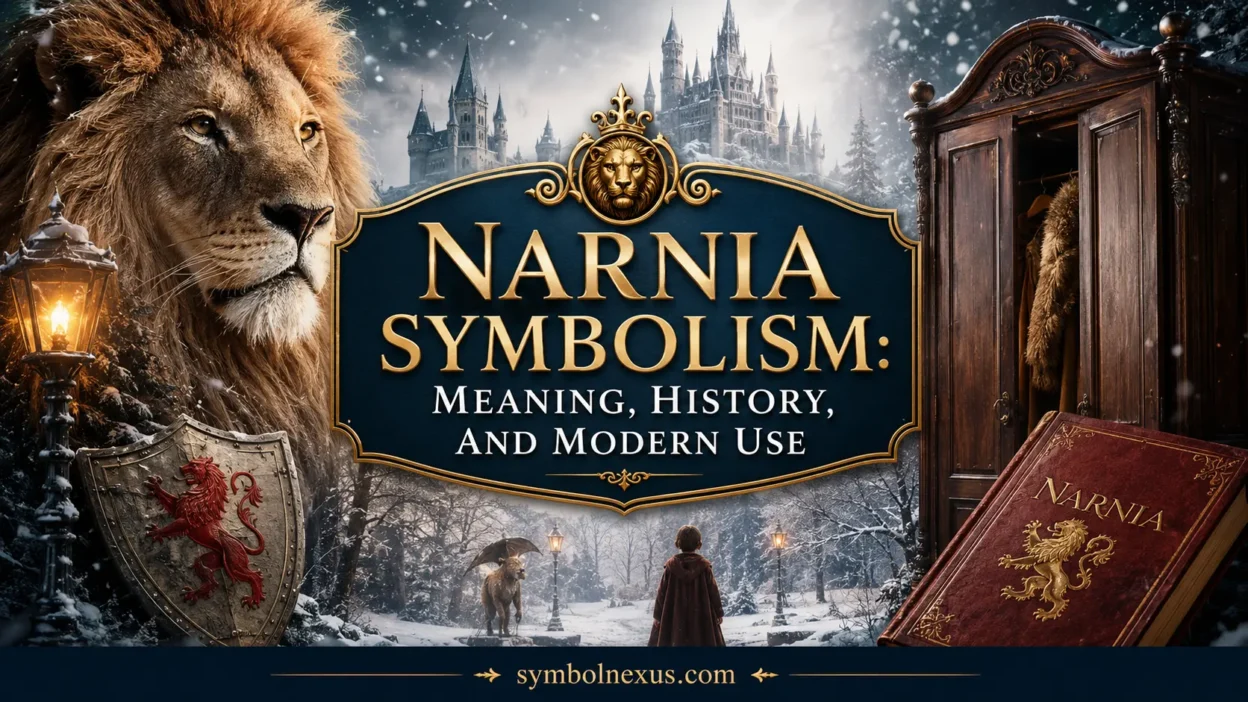
Narnia symbolism centers on moral choice, redemption, temptation, rightful authority, spiritual awakening, and the recovery of a world damaged by fear and false rule. C. S. Lewis built these ideas into a fantasy landscape filled with talking animals, mythical creatures, ruined castles, enchanted food, endless winter, and doorways between worlds.
The seven Chronicles of Narnia novels were published between 1950 and 1956, beginning with The Lion, the Witch and the Wardrobe. Although the stories work as children’s adventures, Lewis drew on Christianity, classical mythology, medieval literature, fairy tales, and his experience of wartime Britain.
That combination explains why readers can approach Narnia differently. A Christian reader may recognize theological ideas immediately, while another reader may focus on courage, betrayal, growing up, imagination, tyranny, friendship, or the longing for a world made right.
Quick Answer
Narnia symbolism most commonly represents redemption, moral choice, hope, sacrifice, and the struggle between rightful order and corrupt power. Its Christian framework is especially visible through Aslan, but Lewis also combined biblical ideas with mythology, medieval imagination, fairy tale, wartime experience, and universal themes of temptation, courage, loss, and renewal.
TL;DR
- Aslan represents divine authority, sacrifice, restoration, and Christian redemption.
- The White Witch represents false rule, fear, sterility, and domination.
- The wardrobe symbolizes passage from ordinary perception into a larger reality.
- Edmund’s temptation explores appetite, selfishness, betrayal, and eventual forgiveness.
- Winter turning to spring represents liberation, renewal, and restored natural order.
- Narnia mixes Christian theology with mythology rather than functioning as simple allegory.
What Narnia Represents as a Whole
Narnia is more than an imaginary country. Across the series, it becomes a testing ground where characters discover what they actually value when comfort, status, fear, loyalty, and truth come into conflict.
Again and again, Lewis contrasts appearance with reality. People who seem weak may prove brave. Respectable authorities may be corrupt. Attractive offers may conceal slavery. Creatures dismissed as foolish may understand more than rulers. Characters frequently have to decide whether to trust what is true even when circumstances make that truth difficult to see.
Narnia therefore often symbolizes a world in which moral realities become visible. Pride can turn a boy into a dragon. Tyranny can freeze a country. Creation can arrive through music. Deception can literally place someone in chains.
This is one reason the stories remain emotionally accessible even for readers who do not share Lewis’s religious beliefs. Fear, temptation, guilt, forgiveness, loyalty, and longing for home work on both theological and psychological levels.
Why Narnia Is Not a Simple Christian Allegory
Calling Narnia a Christian allegory is convenient, but it can also be misleading.
Lewis himself distinguished the books from straightforward allegory. In a 1962 letter, he described the Narnian stories as closer to a “supposal”: imagine that a world such as Narnia existed and needed redemption, then ask what Christ’s presence in that world might be like.
That distinction matters.
In strict allegory, one character or object may consistently stand for another specific thing. Lewis was doing something looser and more imaginative. Aslan’s relationship to Christ is central, but that does not mean every sword, tree, animal, meal, or geographical feature has a secret biblical equivalent.
Readers can therefore interpret symbols without turning Narnia into a puzzle with only one correct answer.
Some patterns are strongly supported by the books and Lewis’s comments. Others are reasonable literary interpretations. Keeping those categories separate produces a more accurate reading.
Aslan: Christ, Kingship, and Moral Authority
No figure carries more symbolic weight than Aslan.
The great lion is Narnia’s creator and highest authority. His story involves sacrifice, death, return to life, judgment, forgiveness, creation, and the restoration of corrupted things. Lewis’s own explanation connects Aslan directly with his imaginative question about how Christ might appear in another world.
The choice of a lion also carries familiar associations: royalty, courage, strength, danger, and majesty.
Yet Aslan is not simply a tame emblem of goodness. Characters love him, but they also find him overwhelming. Lewis uses that tension to distinguish goodness from mere pleasantness. Moral authority may comfort, but it can also demand honesty, courage, repentance, or change.
Aslan also represents a form of kingship opposite to tyranny. He possesses greater power than the White Witch, yet he does not control others through constant coercion. He guides, commands, warns, forgives, and sometimes allows characters to make painful choices.
The contrast suggests that legitimate authority protects freedom and restores order rather than reducing everyone else to obedient possessions.
The White Witch and Endless Winter
The White Witch represents power cut off from legitimate authority.
She calls herself Narnia’s queen, but her rule depends on fear, surveillance, punishment, deception, and magical force. Creatures who resist her can be turned to stone. Edmund is drawn into her service through promises rather than genuine loyalty.
Her endless winter reinforces that meaning.
Winter itself is not inherently evil in Narnia. The problem is that the Witch has stopped the seasons. Nothing progresses. Growth is suspended. Celebration disappears. The natural cycle has been replaced by artificial permanence.
Symbolically, that makes her winter a picture of sterility and political stagnation. Life continues, but it cannot fully flourish.
When the snow begins melting as Aslan returns, the change is political, natural, emotional, and spiritual at the same time. Rivers move again. Plants emerge. Creatures regain hope. The Witch’s apparent permanence turns out to be temporary.
Spring therefore means more than warmer weather. It represents restored order.
The Wardrobe as a Symbol of Passage
The wardrobe is one of the most recognizable objects in modern fantasy because it turns something completely ordinary into a threshold.
Lucy does not enter Narnia through a golden gate or magical palace. She walks through coats stored inside a piece of household furniture.
That contrast matters.
The wardrobe suggests that extraordinary reality may lie behind familiar appearances. Childhood curiosity makes Lucy willing to keep exploring after a more practical person might turn around.
Psychologically, the wardrobe can represent imagination: the ability to move beyond the limits of ordinary perception.
It can also represent transition. The children cross from safety into danger, from dependence toward responsibility, and eventually from one understanding of themselves into another.
Importantly, the wardrobe is not an escape hatch that removes consequences. Narnia demands action. The children enter fantasy only to encounter moral responsibilities as serious as anything in their ordinary world.
The Lamp-Post and the Boundary Between Worlds
The lamp-post standing in a snowy forest looks strange because it belongs to London, not a mythical wilderness.
Its origin is explained in The Magician’s Nephew, where material from our world becomes part of newly created Narnia. This gives the lamp-post a literal place in the world’s history rather than making it merely decorative.
Symbolically, it works especially well as a marker of threshold and memory.
For Lucy, it stands near the path back to the wardrobe. It becomes a recognizable point between two realities: the human world she understands and the Narnian world she is beginning to discover.
Light also makes it a natural symbol of orientation. The lamp does not remove the surrounding darkness or tell Lucy everything she needs to know. It simply provides enough light to recognize where she is.
That makes the lamp-post a fitting image for partial knowledge: guidance without complete certainty.
Turkish Delight, Edmund, and the Psychology of Temptation
Edmund’s Turkish delight is memorable because his temptation begins with something small.
The White Witch does not initially ask him to become a traitor. She feeds him, flatters him, encourages resentment toward his siblings, and makes future rewards appear possible.
The enchanted candy therefore represents desire detached from judgment.
Edmund keeps wanting more even though consuming more does not satisfy him. That pattern makes the scene psychologically recognizable. Temptation works by narrowing attention until the desired object seems more important than consequences.
The wartime setting adds another layer. Food rationing began in Britain in 1940, with sugar among the early rationed foods; confectionery was also restricted during the period surrounding the novel’s composition and publication. A luxurious sweet would therefore have carried associations of scarcity that many original British readers understood.
That historical context strengthens the scene, although it does not prove Lewis selected Turkish delight solely because of rationing.
Most importantly, Edmund’s story does not end with temptation. His betrayal becomes the starting point for remorse, rescue, forgiveness, and changed behavior.
The Stone Table, Sacrifice, and Redemption
The Stone Table scene is one of the clearest places where Christian patterns enter the narrative.
Edmund’s betrayal places him under the Witch’s claim. Aslan offers himself instead. He is humiliated and killed before returning to life after the Witch misunderstands the deeper law governing sacrifice.
The sequence echoes Christian ideas about substitution, crucifixion, resurrection, justice, mercy, and redemption.
Yet its emotional meaning extends beyond doctrine.
Edmund cannot simply erase what he has done. Someone else bears the cost of rescuing him. Forgiveness in this world is therefore not presented as pretending harm never occurred.
The broken Stone Table also marks a transition. The Witch understands rules as instruments for claiming victims. Aslan understands a deeper order in which voluntary self-sacrifice defeats the logic on which her power depends.
Lewis turns resurrection into the reversal of apparently final defeat.
Creation, Music, and the Beginning of Narnia
The Magician’s Nephew expands the symbolic structure by showing Narnia’s creation.
Aslan sings the world into existence. Light, landscape, vegetation, animals, and speech emerge as the new creation develops.
Music is especially important because creation is presented as harmonious rather than mechanical. The world begins with relationship, pattern, beauty, and response.
The scene draws naturally on biblical creation themes while also fitting older traditions in which music represents cosmic harmony.
Lewis also places corruption close to creation. Jadis enters the newborn world almost immediately, while Digory must make a moral choice involving a desirable fruit.
Creation is therefore not portrayed as a simple movement from nothing to perfection. Freedom enters the story alongside the possibility of misuse.
That pattern establishes one of the series’ central ideas: having freedom matters because choices matter.
Children, Kingship, and Moral Growth
Narnia repeatedly gives children responsibilities that adults in the ordinary world would rarely give them.
Peter must lead. Lucy must trust what she has seen when others doubt her. Edmund must confront his betrayal. Eustace must face what selfishness has made him. Jill must remember instructions despite distraction and discomfort.
The symbolism of childhood here is not innocence alone.
Children represent moral formation. Their personalities are still changing, and Narnia makes that change visible.
Even kingship is treated more as responsibility than privilege. Good rulers protect others, keep promises, listen, accept correction, and resist the temptation to use power merely because they possess it.
Lewis therefore connects growing up with becoming capable of responsibility rather than simply becoming older.
This also explains why memory matters so much. Characters often fail when they forget what they have learned, deny what they once recognized, or allow social pressure to redefine reality for them.
Mythology, Fauns, Centaurs, and Medieval Imagination
Narnia is unmistakably Christian in important ways, but its population comes from a much broader imaginative tradition.
Fauns, centaurs, dryads, dwarfs, giants, talking beasts, sea creatures, classical gods, Father Christmas, and figures from European folklore occupy the same world.
Lewis did not treat these traditions as automatically incompatible.
Instead, he placed pagan and mythological imagery inside a larger moral universe governed by Aslan. Classical creatures become inhabitants of creation rather than rival theological systems.
This mixture helps explain Narnia’s unusual atmosphere. It can feel biblical, medieval, classical, northern European, and fairy-tale-like within the same chapter.
Scholar Michael Ward has also argued that Lewis structured the seven books around imagery associated with the seven planets of medieval cosmology. The theory has received serious scholarly attention, though it remains an interpretive thesis rather than an explicit structural plan Lewis publicly announced for the series.
The larger point is clear even without accepting every detail of that theory: Lewis’s symbolic imagination reached well beyond one source tradition.
War, Displacement, and the Return of Spring
The opening of The Lion, the Witch and the Wardrobe places the Pevensie children in the countryside because they have been sent away from London during World War II.
That detail was rooted in a recognizable British reality. Children were evacuated from cities threatened by German bombing, and Lewis himself hosted young evacuees during the war.
This context gives Narnia’s danger an additional emotional layer.
The Pevensies begin as displaced children. They have already left home because forces beyond their control have made ordinary life unsafe. They then enter another country living under fear and authoritarian rule.
It would be too simplistic to claim that the White Witch simply represents Hitler or that Narnia directly represents wartime Europe. Lewis did not establish that one-to-one equation.
Still, an original audience familiar with evacuation, shortages, military danger, and uncertainty would have understood the emotional force of a world waiting for liberation.
The arrival of spring therefore carries a particularly understandable promise: abnormal conditions will not last forever.
What the Major Narnian Symbols Mean Today
Modern American readers encounter these images through novels, films, classrooms, religious discussions, fan communities, art, costumes, and personal designs. Their meanings overlap, but each emphasizes a different part of the larger story.
| Symbol | Common Modern Meaning | Key Association | Important Nuance |
|---|---|---|---|
| Aslan | Redemption and rightful authority | Christ, courage, sacrifice | More than a simple allegorical stand-in |
| White Witch | Tyranny and false authority | Fear, control, stagnation | Not officially a symbol for one historical dictator |
| Wardrobe | Discovery and transition | Imagination, threshold, another reality | Entry into Narnia brings responsibility |
| Lamp-post | Guidance and connection | Light, memory, boundary | Its origin is explained within Narnian history |
| Turkish delight | Temptation and appetite | Desire, manipulation, betrayal | Wartime scarcity adds historical resonance |
| Spring | Restoration and hope | Freedom, life, renewal | Its meaning depends on the Witch’s unnatural winter |
These symbols are also popular because they can retain meaning outside explicitly religious settings.
A wardrobe can represent entering a more imaginative life. A lamp-post in snow immediately evokes wonder and discovery. Aslan can signal courage or faith. The thawing of winter can stand for recovery after a restrictive period.
The stories therefore support both theological and secular emotional readings without requiring those readings to be identical.
Controversies, Misreadings, and Changing Interpretations
Modern readings of Narnia also include substantial criticism.
One recurring issue concerns Calormen. Its visual and cultural features draw heavily on generalized Middle Eastern and Asian imagery, while its political and religious institutions are often presented negatively. Critics have argued that this contrast can reproduce stereotypes about Eastern cultures; defenders point to sympathetic Calormene characters and argue that Lewis’s primary contrast is moral and political rather than racial. The debate remains part of serious discussion of the books.
Susan Pevensie’s absence from the final reunion in The Last Battle has produced another long-running argument. Some readers see her treatment as criticism of femininity, sexuality, or growing up, while others interpret her situation as a temporary loss of belief rather than a final condemnation. Scholars and Lewis readers continue to disagree about how the passage should be understood.
There are also less controversial but common interpretive mistakes. Not every character is a direct biblical substitute. The White Witch is not conclusively Hitler. Turkish delight does not have one officially stated symbolic definition.
A responsible reading separates what Lewis clearly established from what later readers reasonably infer.
That distinction makes the books more interesting, not less. Symbols often work precisely because a concrete story can support several related meanings without becoming infinitely interpretable.
Why Narnia Still Matters in 2026
Narnia remains culturally active rather than existing only as a mid-20th-century children’s series.
The 75th anniversary of The Lion, the Witch and the Wardrobe was marked in 2025, and HarperCollins reported that the broader series had surpassed 115 million copies worldwide and appeared in dozens of languages.
A new screen era is also approaching. As of August 2026, Netflix has officially announced Greta Gerwig’s Narnia: The Magician’s Nephew for a theatrical release beginning in February 2027, followed by its Netflix debut in April 2027. The decision places Narnia’s creation story—and symbols such as Aslan’s song, the birth of the world, Jadis, temptation, and the origins of the wardrobe—back at the center of popular discussion.
Its durability comes partly from the flexibility Lewis built into the series. Children can encounter talking animals and dangerous adventures. Adults can notice theology, political authority, medieval cosmology, wartime displacement, grief, mortality, and moral psychology.
The symbols grow with the reader because the story operates at more than one level.
Frequently Asked Questions
Is Narnia a Christian allegory?
Narnia contains extensive Christian imagery, but Lewis did not describe the series as a straightforward allegory. He preferred the idea of a “supposal”: imagining what Christ’s incarnation and redemptive work might look like in another world.
What does Aslan symbolize in Narnia?
Aslan represents divine authority, creation, sacrifice, forgiveness, judgment, resurrection, and rightful kingship. His connection with Christ is unusually strong because Lewis himself explained Aslan within an explicitly Christian imaginative framework.
What does the White Witch symbolize?
The White Witch commonly represents tyranny, false authority, temptation, fear, and a form of power that prevents natural growth. Her endless winter reinforces the idea of a society trapped under an unnatural and sterile order.
What does the wardrobe symbolize?
The wardrobe symbolizes a threshold between ordinary experience and a reality larger than expected. It can also represent imagination, discovery, childhood openness, and the transition from passive observation to moral responsibility.
Why is Turkish delight symbolic?
Turkish delight represents temptation because Edmund’s desire for it helps the Witch manipulate his judgment and loyalty. Its sweetness offers immediate pleasure, while his growing appetite illustrates how desire can become less satisfying as it gains control.
Does Narnia include pagan symbolism?
Yes, but “pagan” does not mean anti-Christian in the structure of the stories. Lewis freely incorporated fauns, centaurs, dryads, classical imagery, medieval cosmology, and European folklore into a world ultimately ordered around Aslan.
Is Narnia’s symbolism only meaningful to Christians?
No. Christian theology explains many of the series’ strongest patterns, but themes such as courage, temptation, authoritarian power, forgiveness, grief, responsibility, imagination, and renewal can be understood without religious belief. Knowing Lewis’s Christian framework simply provides additional context for why many of those patterns appear.
Conclusion
At its center, Narnia symbolism is about discovering that choices have consequences and that appearances do not always reveal what is ultimately real. Aslan, the Witch’s winter, Edmund’s enchanted food, the wardrobe, the lamp-post, the Stone Table, and the return of spring all develop different parts of that idea.
Lewis combined Christianity with fairy tale, mythology, medieval thought, childhood adventure, and experiences recognizable to a generation shaped by war. Some elements now invite criticism as well as admiration, especially when modern readers consider race, gender, cultural representation, and authority.
That complexity is part of Narnia’s continuing relevance. Its symbols do not merely decorate an imaginary world; they turn invisible questions about loyalty, freedom, temptation, sacrifice, truth, and hope into things readers can see happening in a snowy wood.