
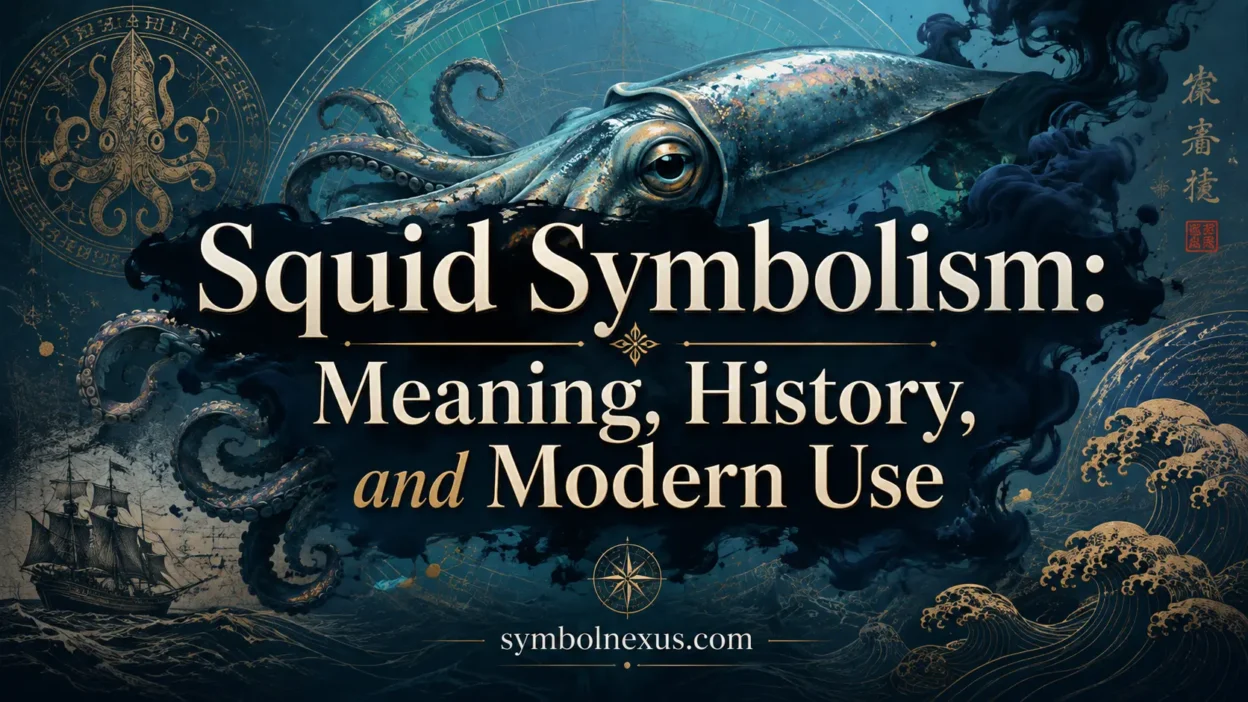
Squid symbolism is most often connected with adaptability, self-protection, mystery, quick movement, and the ability to respond intelligently to changing conditions. These meanings come less from one ancient symbolic tradition and more from the squid’s unusual real-world behavior: changing appearance, releasing ink, moving rapidly through water, and living in parts of the ocean humans rarely see.
Squid also occupy an interesting place between science and imagination. An ordinary squid can suggest flexibility or defense, while the enormous giant squid has inspired ideas about hidden forces, fear of the unknown, and the unexplored ocean.
In modern American culture, squid imagery appears in tattoos, marine art, entertainment, clothing, games, sports branding, and ocean-themed design. Its meaning changes considerably depending on whether the image shows a graceful squid, an ink cloud, spreading tentacles, or a gigantic creature rising from dark water.
Quick Answer
Squid symbolism commonly represents adaptability, self-protection, mystery, and fast responses to change in modern American interpretation. Historically, large squid also became associated with dangerous seas and the unknown because rare encounters with giant cephalopods helped inspire stories about enormous tentacled sea creatures.
TL;DR
- Squid commonly represent adaptability, defense, mystery, and swift action.
- Color changes suggest adjustment, communication, and changing identity.
- Squid ink commonly represents protection, concealment, and strategic retreat.
- Giant squid imagery emphasizes hidden strength and fear of the unknown.
- Modern tattoos often emphasize resilience, independence, or personal transformation.
- Squid should not automatically be given octopus or kraken meanings.
What Makes the Squid Symbolically Distinctive?
Squid belong to the cephalopod group of mollusks, alongside octopuses, cuttlefish, and nautiluses. A typical squid has a streamlined mantle, eight arms, two longer feeding tentacles, prominent eyes, and a siphon used in movement.
Those physical traits strongly influence how people interpret the animal.
Its many limbs create an impression of reach and coordination. Its streamlined body suggests movement rather than stillness. Its large eyes can make it appear alert or watchful, while its unfamiliar body shape makes it seem less predictable than familiar land animals.
For symbolic interpretation, however, biology matters more than appearance alone. Squid can rapidly alter aspects of their coloration, use ink defensively, and escape through powerful jet propulsion. Such abilities make adaptation and strategic defense more natural interpretations than abstract ideas imposed without any connection to the animal itself.
The Core Meanings Associated With Squid
Several meanings occur repeatedly in contemporary art, tattoos, personal symbolism, and discussions of marine imagery.
| Context | Common Meaning in the USA | Association | Interpretation |
|---|---|---|---|
| Changing color | Adaptability | Adjustment, responsiveness | Changing with circumstances |
| Ink defense | Protection | Boundaries, escape | Knowing when to withdraw |
| Deep ocean | Mystery | Unknown territory | What remains unexplored |
| Rapid movement | Decisiveness | Speed, reaction | Acting when conditions change |
| Giant squid | Hidden strength | Scale, uncertainty | Something formidable beneath the surface |
| Tentacles | Reach or complexity | Many responsibilities | Handling interconnected demands |
These are interpretations rather than fixed definitions. A squid tattoo chosen after surviving a difficult period, for example, can mean resilience without implying that every squid image has the same message.
Context determines whether the creature feels elegant, defensive, strange, threatening, humorous, or scientific.
Adaptability and the Ability to Change
Adaptability is probably the strongest positive meaning attached to squid imagery.
Many cephalopods possess pigment-containing structures called chromatophores. By changing their visible coloration and patterns, they can camouflage themselves and communicate in ways that may relate to courtship, warnings, or interactions with other animals.
Symbolically, this biological flexibility can represent someone who adjusts without losing the capacity to act.
A squid image may therefore appeal to a person who has moved into an unfamiliar environment, rebuilt life after disruption, learned to handle changing responsibilities, developed different sides of their personality, or become better at reading difficult situations.
There is an important distinction between adaptability and dishonesty. Changing behavior according to circumstances does not necessarily mean pretending to be someone else. In positive interpretations, the squid represents responsiveness rather than deception.
Ink as a Symbol of Protection and Boundaries
The squid’s ink defense creates another particularly recognizable meaning.
When threatened, many squid can release ink that interferes with a predator while the animal moves away. Symbolically, the important idea is not aggression but creating enough separation to escape danger.
That can make squid ink a useful image for boundaries.
Someone might interpret it as protection without confrontation (not every threat needs to be fought directly), strategic withdrawal (leaving a harmful situation can require more judgment than remaining in it), privacy (a person does not need to reveal every thought, plan, or emotion), or confusion as defense (some artwork uses dark ink clouds to represent uncertainty or deliberate concealment).
The symbolism can become negative when concealment means avoiding accountability or deliberately obscuring the truth. As with many animal symbols, the same survival characteristic can support several readings.
Speed, Movement, and Decisive Action
Squid do not merely hide from problems. They can move rapidly through the water using jet propulsion, forcing water from the mantle through a siphon. Some squid can even propel themselves above the ocean surface for brief gliding movements.
That behavior gives the squid a more active symbolic quality than creatures primarily associated with patience or stillness.
In personal imagery, it can stand for quick thinking, acting under pressure, escaping limiting circumstances, changing direction, or committing to a decision once the moment arrives.
This interpretation works particularly well in artwork that shows the squid moving rather than floating. Lines trailing behind the body, extended tentacles, or an ink cloud can turn the animal into a symbol of momentum.
Why Giant Squid Represent the Unknown
The symbolism changes dramatically when the squid becomes enormous.
Giant squid inhabit deep water and historically were rarely encountered alive. Their size, unusual anatomy, and limited visibility gave people plenty of room to imagine what might exist below the surface.
For centuries, much human knowledge of very large squid came from damaged specimens, animals found at the surface, or bodies washed ashore. Scientific evidence gradually replaced exaggerated ideas about ship-destroying monsters, but the enormous creatures retained their cultural connection with the unknown.
This makes the giant squid particularly effective as an image of hidden power, fear that cannot yet be explained, the unexplored mind, the enormous scale of nature, or something important existing beneath an ordinary surface.
The meaning does not have to be negative. The unknown can provoke curiosity as easily as fear.
That combination — real animal, limited visibility, extraordinary size — is one reason the giant squid remains so effective in fantasy and marine imagery.
Ancient Observations Came Before Modern Mythmaking
It is easy to exaggerate the antiquity of squid meanings.
There was no single ancient system in which squid universally represented one spiritual concept. Ancient writers did, however, know that unusually large cephalopods existed. Aristotle and later Pliny wrote about large squid-like animals, showing that human awareness of them predates modern marine science by many centuries.
Early observations did not always separate natural history from speculation as clearly as modern science does.
When strange marine bodies appeared along coastlines, damaged or decomposed remains could look dramatically different from living animals. That uncertainty contributed to stories about bizarre beings inhabiting distant waters.
The historical significance of the squid therefore comes partly from uncertainty itself. People occasionally encountered enough evidence to know that extraordinary animals existed without having enough information to understand them fully.
The Kraken Connection and Sea-Monster Imagery
No discussion of giant squid imagery is complete without the kraken, but the two should not be treated as identical.
The kraken comes from Scandinavian maritime tradition and developed into the image of an enormous sea creature capable of threatening ships. Later illustrations and popular storytelling frequently gave it squid-like or octopus-like features. Real giant cephalopods have often been suggested as one source behind such stories.
Over time, literature made the connection even stronger.
Nineteenth- and twentieth-century stories increasingly presented enormous tentacled animals as inhabitants of dangerous depths. Jules Verne’s Twenty Thousand Leagues Under the Seas became especially influential in shaping later visual ideas about encounters between people, ships, and colossal cephalopods. The boundaries between squid, octopus, kraken, and invented sea monster became increasingly loose in popular imagination.
That history explains why tentacled marine creatures can symbolize uncontrolled natural force even when the actual animals pose nothing like the threat shown in fiction.
From Sea Monster to Scientific Wonder
Modern science significantly changed how people view squid.
Rather than eliminating their mysterious reputation, scientific discovery often made them more interesting. Researchers have documented specialized camouflage, unusual communication displays, jet propulsion, deep-sea adaptations, and other traits that sound almost fictional despite being biological.
Giant species remain particularly compelling because direct observation has arrived surprisingly late.
In March 2025, researchers recorded the first confirmed footage of a living colossal squid in its natural environment. The animal was a juvenile filmed about 600 meters below the surface near the South Sandwich Islands.
That discovery illustrates why the symbolic connection between squid and mystery persists.
Humans live in an age of satellites, submarines, remote cameras, and advanced oceanography, yet remarkably large marine animals can remain scarcely observed.
Today the mystery is less about believing in monsters and more about recognizing how much of the ocean remains unfamiliar to us.
Squid Meaning in Modern American Culture
There is no nationally standardized American meaning for a squid.
Instead, Americans generally encounter squid through several overlapping cultural channels: aquariums, nature programs, seafood, fantasy entertainment, tattoos, video games, marine conservation, sports imagery, science education, and internet culture.
These contexts encourage different interpretations.
A naturalistic aquarium image may communicate curiosity and appreciation for marine life. A giant squid gripping a ship suggests danger or overwhelming force. A colorful tattoo can emphasize transformation. A minimalist squid drawing may communicate intelligence, individuality, or fascination with the ocean. A dark silhouette disappearing into deep water tends to emphasize secrecy and the unknown.
Tentacled sea-monster imagery also appears in American sports branding. The Seattle Kraken, for example, uses imagery connected with maritime folklore and a mysterious creature below the water, illustrating how old sea-monster ideas can be turned into modern messages of intensity and strength. The kraken itself, however, is legendary rather than simply another name for a squid.
Cross-Cultural Interpretations Need Care
Squid and other cephalopods appear in the stories, art, and maritime traditions of many societies, but those traditions should not be merged into one generic “ancient meaning.”
European sea-monster traditions developed differently from East Asian marine imagery. Pacific cultures have their own stories involving large tentacled creatures. In some cases, the animal in a traditional story is specifically an octopus rather than a squid.
That distinction matters.
Modern symbolism websites sometimes take a story about an octopus, kraken, or unspecified sea monster and present it as evidence of an ancient universal squid meaning. That approach erases important differences between animals and cultures.
A more accurate interpretation recognizes a broad shared theme: people living near oceans have often used extraordinary marine creatures to express danger, wonder, uncertainty, abundance, or the power of the sea.
The exact meaning depends on the particular tradition.
Emotional and Psychological Interpretations
On a personal level, squid imagery often works because the animal combines visibility and concealment.
It can be vivid one moment and difficult to see the next. It can move forward quickly but also create cover when threatened. Its limbs extend outward while its main body remains compact.
Those qualities lend themselves to psychological interpretation.
Someone who identifies with a squid may value flexibility but also privacy. Another person may see the animal as representing a complicated mind managing many different obligations at once.
Dark ocean imagery adds another layer.
A squid emerging from darkness can represent facing something previously avoided. A squid disappearing into it may represent withdrawal, introspection, or emotional privacy.
These interpretations are strongest when treated as metaphors rather than claims that squid possess human emotional meanings.
What a Squid Tattoo Can Mean
Squid tattoos are especially flexible because the artist controls size, movement, color, surroundings, and expression.
A colorful squid may represent change, creativity, or adaptability. A black-ink squid can emphasize protection, privacy, and surviving difficult circumstances. A giant squid can represent strength that remains unseen until necessary. A squid wrapped around another object may suggest interconnected responsibilities, attachment, or control. A squid moving upward can symbolize escape or personal progress.
Deep-sea compositions often emphasize independence and comfort with uncertainty.
The tattoo’s personal story ultimately matters more than a dictionary-style definition. Two people can choose nearly identical designs for completely different reasons.
People considering a squid tattoo should also decide whether they actually want a squid, an octopus, or a kraken. Those animals are frequently drawn in similar ways, yet they create different cultural associations.
Squid in Art, Fashion, and Digital Culture
Modern designers are drawn to squid because the body creates naturally dramatic shapes.
Tentacles provide movement across clothing, posters, album art, skateboard graphics, game characters, and illustrations. The silhouette remains recognizable even when highly stylized.
Color-changing biology also gives artists permission to use unusual palettes without abandoning the animal’s natural identity.
Deep blues and blacks emphasize mystery. Bright reds, oranges, and purples suggest intensity or transformation. White or translucent designs can feel strange, fragile, or otherworldly.
Scientific illustration often takes the opposite approach, emphasizing anatomical precision and curiosity rather than menace.
This range helps explain why squid imagery works equally well in horror art and educational design.
Does Squid Game Change the Meaning?
For many Americans, the word “squid” now also brings to mind the South Korean series Squid Game.
That cultural association should not be confused with traditional animal meaning.
The series takes its name from a Korean children’s game played on a squid-shaped court. Within the story, childhood competition is transformed into a violent contest involving debt, inequality, desperation, survival, and moral choice.
As a result, a symbol directly referencing the television series may communicate competition, survival, money, social pressure, or the show’s characters rather than anything about the marine animal.
Context makes the distinction clear.
A realistic squid tattoo swimming through ocean water and a design based on Squid Game belong to very different symbolic systems despite sharing the same word.
Common Misunderstandings About the Squid
The biggest mistake is assigning the creature a single universal meaning.
Several other misunderstandings are also common.
Squid and octopuses are not interchangeable. Squid generally have eight arms plus two specialized tentacles, while octopuses have eight arms. Their behavior and cultural representation also differ.
The kraken is not scientifically a giant squid. It is a legendary creature whose later appearance may have been influenced by encounters with large cephalopods.
Squid do not have one established spiritual meaning. Contemporary spiritual interpretations are generally personal or modern rather than part of a universal historical tradition.
Ink does not automatically mean deception. Biologically, it is primarily connected with defense and escape, making protection an equally plausible symbolic reading.
A giant squid does not have to represent evil. It can symbolize curiosity, hidden strength, scientific discovery, or unexplored nature just as easily as fear.
Recognizing these distinctions produces a more useful interpretation than forcing every image into a fixed spiritual definition.
How the Meaning Has Evolved
The changing reputation of squid reflects a broader shift in how humans understand the ocean.
When enormous marine animals were poorly documented, unfamiliar bodies and rare sightings could support stories about monsters.
As scientific classification improved, some creatures once associated with frightening legends became identifiable animals.
Photography, underwater cameras, remotely operated vehicles, aquariums, and nature documentaries pushed the squid further from fantasy and closer to public understanding.
Yet science did not remove its symbolic appeal.
Instead, the dominant image expanded from monster in unknown waters to remarkably adapted animal inhabiting environments humans still struggle to observe.
Fear became curiosity. Mystery remained.
That transition explains much of the squid’s modern appeal: it represents something strange enough to inspire imagination but real enough to remind us that nature does not require mythology to be extraordinary.
Frequently Asked Questions
Is a squid a positive or negative symbol? It can genuinely be either, though modern personal interpretations lean positive more often than not. Adaptability, protection, independence, and quick thinking are the favorable readings, while secrecy, entanglement, or an overwhelming sense of threat can pull the same imagery toward darker territory — context and design details usually decide which way it lands.
What does a squid tattoo symbolize? A squid tattoo commonly represents adaptability, resilience, privacy, transformation, or the ability to escape a difficult situation, with color and pose doing most of the interpretive work. Giant-squid designs specifically shift the emphasis toward hidden strength, mystery, and confronting something previously unknown or unseen.
What does squid ink symbolize? Squid ink most naturally represents defense, boundaries, concealment, or a strategic retreat rather than aggression — the biological function is escape, not attack. In darker artwork, the same ink cloud can also suggest confusion, secrecy, or something being deliberately obscured, depending on the surrounding imagery.
Does a squid have a biblical meaning? No — there’s no standard biblical tradition that establishes the squid as a specific religious symbol. Modern Christian interpretations may assign the animal personal meaning, but that should be understood as an individual reading rather than something rooted in scripture itself.
What does a giant squid symbolize? A giant squid often represents hidden strength, the unexplored, fear of unseen forces, and the sheer scale of the natural world — themes reinforced by how rarely humans have actually observed one alive. Modern scientific discoveries have added a more curious layer to that symbolism too, turning the giant squid into an emblem of how much of the deep ocean remains genuinely unknown even today.
Are squid and octopus meanings the same? No, and they shouldn’t be treated as interchangeable despite both being unusual-looking cephalopods with camouflage abilities. They’re anatomically distinct (squid have eight arms plus two specialized tentacles; octopuses have eight arms only) and carry different cultural histories, so a traditional story specifically about an octopus shouldn’t be repurposed as squid symbolism.
Is the kraken just another name for a giant squid? Not exactly — the kraken is a legendary creature from Scandinavian maritime tradition, while giant and colossal squid are real, documented animals. Real cephalopod encounters likely influenced kraken folklore over time, and the two have become visually blended in popular culture, but scientifically they’re not the same thing, and treating them as synonyms erases that distinction.
Does Squid Game change what a squid symbolizes? For anyone referencing the show specifically, yes — that symbolism points toward competition, survival, debt, inequality, and moral choice rather than anything about the actual marine animal. The show borrows its name from a Korean children’s game played on a squid-shaped court, but a design referencing Squid Game and a naturalistic squid tattoo belong to entirely separate symbolic systems that just happen to share a word.
Why did squid become associated with sea monsters in the first place? Largely because of a gap between rare, incomplete evidence and human imagination — ancient writers like Aristotle and Pliny recorded large squid-like animals, and later sightings often involved damaged specimens, surface remains, or storm-washed bodies rather than living, intact animals. That incomplete picture left plenty of room for exaggeration, and centuries of literature, including Jules Verne’s work, cemented the tentacled sea monster as a recognizable cultural image well before modern marine science caught up.
Has modern science made squid less mysterious or more interesting? More interesting, if anything — scientific documentation of squid camouflage, jet propulsion, and deep-sea adaptation reads almost as strange as the old monster stories, just grounded in verified biology instead of speculation. The 2025 footage of a living colossal squid in its natural habitat is a good example: even now, with satellites and remote submersibles, genuinely large marine animals can go almost entirely unobserved, which keeps the sense of mystery alive without needing any mythology to sustain it.
Conclusion
Squid symbolism holds up because it was never really invented — it was noticed. Every meaning in this article traces back to something the animal actually does: it changes color, so it became a symbol of adaptability. It releases ink to escape rather than fight, so it became a symbol of boundaries rather than aggression. It lives in water too deep and dark for most of human history to properly observe, so it became a symbol of the unknown almost by default, long before anyone decided to make it one on purpose.
That’s also why the squid’s reputation shifted without ever really changing shape. The same set of facts — strange body, rare sightings, incomplete evidence — first produced sea monsters and kraken folklore, and later, once cameras and submersibles caught up, produced scientific fascination instead. Fear and curiosity turned out to be two readings of the exact same gap in human knowledge, not opposite conclusions about the animal itself.
That’s the most honest way to carry the symbol forward: not as a fixed spiritual meaning waiting to be decoded, but as a reminder that adaptability, boundaries, and comfort with the unexplained are all survival strategies worth admiring — in an animal, or in a person navigating change of their own.