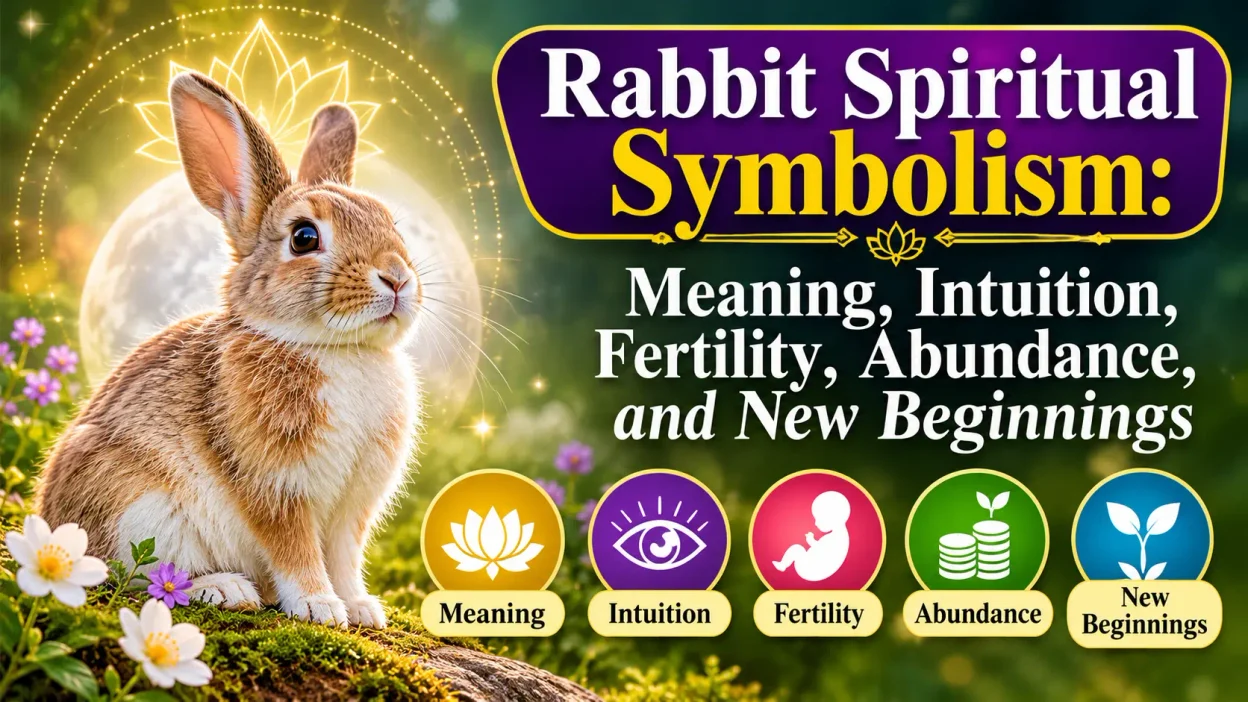
Rabbits have fascinated people for centuries because of their gentle appearance, quick movements, alert nature, and remarkable ability to reproduce. Found in forests, grasslands, fields, and gardens, these small mammals have become powerful symbols in folklore, mythology, literature, and spiritual traditions. Their ability to survive through awareness and adaptability gives them a deeper symbolic meaning that extends beyond their familiar association with spring and fertility.
Rabbit spiritual symbolism is commonly connected to intuition, abundance, fertility, sensitivity, protection, and new beginnings. A rabbit’s alert behavior can represent the importance of trusting your instincts, while its reproductive ability makes it a traditional symbol of growth, creativity, and prosperity. Its gentle appearance also suggests compassion, innocence, and emotional awareness.
Whether you encounter a rabbit in nature, see one repeatedly, dream about it, or feel personally connected to this animal, its symbolism can encourage you to recognize opportunities, protect your peace, and remain open to personal transformation. Although meanings vary between cultures and individuals, the rabbit often represents the balance between gentleness and survival.
What Does a Rabbit Symbolize Spiritually?
Spiritually, a rabbit commonly symbolizes fertility, abundance, intuition, sensitivity, adaptability, and new beginnings. Its connection with reproduction and seasonal renewal has made it an enduring symbol of life’s ability to grow and continue.
Here are some of the most common spiritual meanings associated with rabbits:
- Fertility: Rabbits represent reproduction, family growth, creativity, and the beginning of new possibilities.
- Abundance: Their ability to reproduce quickly makes them symbols of prosperity, productivity, and expansion.
- Intuition: Their sharp awareness and quick reactions symbolize listening to your instincts.
- New beginnings: Their association with spring represents renewal, fresh opportunities, and personal transformation.
- Protection: Their cautious behavior highlights the importance of safety and healthy boundaries.
- Gentleness: Their soft appearance suggests kindness, compassion, and emotional sensitivity.
- Good fortune: Rabbits are associated with luck in several cultural traditions and popular beliefs.
- Adaptability: Their ability to survive in different environments represents flexibility and resilience.
These meanings are symbolic interpretations rather than universal spiritual rules. A rabbit’s significance depends on the cultural tradition, personal beliefs, and circumstances in which it appears.
1. Rabbit Symbolism of Fertility and Abundance
One of the oldest and most recognizable meanings of rabbit symbolism is fertility. Rabbits are known for their reproductive ability, making them natural symbols of new life, family growth, and abundance.
Spiritually, fertility can represent much more than physical reproduction. It may also refer to creativity, productive ideas, emotional development, and the ability to build something meaningful.
Physical Fertility and Family
In traditional symbolism, rabbits often represent reproduction, motherhood, family, and the continuation of life. Their association with spring and new growth strengthens these connections.
Creativity and New Ideas
A rabbit may also symbolize the development of creative potential. It can encourage you to explore your talents, start new projects, and give attention to ideas that have the potential to grow.
Abundance and Prosperity
In modern spiritual interpretations, rabbits are sometimes connected with financial prosperity and material abundance. Their symbolism may remind you to recognize opportunities and use your resources wisely.
However, seeing a rabbit does not guarantee wealth or success. Its meaning is better understood as encouragement to remain productive and open to possibilities.
2. Rabbit Spiritual Meaning and Intuition
Rabbits are highly alert animals. Their long ears help them detect sounds, and their quick reactions allow them to respond to potential danger.
These natural characteristics make rabbits powerful symbols of intuition and awareness.
Spiritually, rabbit symbolism may encourage you to:
- Listen to your inner feelings before making important decisions.
- Pay attention to subtle changes in your surroundings.
- Recognize situations that make you uncomfortable.
- Avoid ignoring warning signs in relationships.
- Balance emotional awareness with practical judgment.
The rabbit’s message is not to become fearful of everything around you. Instead, it encourages thoughtful awareness and the confidence to respond when something requires attention.
3. Rabbit Symbolism of New Beginnings and Renewal
Rabbits are strongly associated with spring, a season that represents the return of life, warmer weather, and fresh growth after winter.
This connection makes them symbols of new beginnings and personal renewal.
Seeing a rabbit may inspire you to consider whether it is time to:
- Begin a new project or personal goal.
- Release habits that no longer support you.
- Explore a different direction in life.
- Develop healthier relationships.
- Welcome opportunities for personal growth.
The rabbit reminds us that transformation can happen gradually. A fresh beginning does not require changing everything at once; small decisions can create meaningful progress over time.
4. Rabbit Symbolism of Gentleness and Compassion
Rabbits are often associated with softness, innocence, and peaceful behavior. Their appearance has helped establish them as symbols of gentleness and kindness in stories, artwork, and popular culture.
Spiritually, this symbolism encourages people to approach themselves and others with compassion.
A rabbit may represent the importance of:
- Treating others with patience and understanding.
- Showing affection through thoughtful actions.
- Recognizing emotional vulnerability.
- Practicing self-compassion.
- Remaining kind without sacrificing personal boundaries.
Its message is that gentleness does not mean weakness. A person can be compassionate while remaining confident, independent, and emotionally strong.
5. Rabbit Symbolism of Protection and Safety
Although rabbits appear delicate, they are skilled at recognizing danger and finding ways to protect themselves.
Their natural behavior can symbolize self-preservation, caution, and the importance of creating a secure environment.
In modern spiritual interpretations, a rabbit may remind you to protect your emotional well-being and pay attention to the people and situations around you.
This symbolism can encourage you to:
- Establish healthy personal boundaries.
- Avoid unnecessary conflict.
- Recognize relationships that create emotional stress.
- Give yourself time before making important commitments.
- Protect your peace without isolating yourself from others.
The rabbit represents a balance between remaining open to life and knowing when to protect yourself.
6. Rabbit Symbolism in Love and Relationships
In love and relationships, rabbits commonly symbolize tenderness, affection, fertility, emotional sensitivity, and family life.
Their gentle appearance and association with reproduction make them popular symbols of romance and nurturing connections.
| Relationship Theme | Possible Meaning |
|---|---|
| Tenderness | Showing love through gentle actions |
| Fertility | Family growth and the possibility of new life |
| Affection | Emotional closeness and sincere care |
| Loyalty | Building trust and long-term connection |
| Innocence | Approaching relationships with sincerity |
| Sensitivity | Understanding and respecting emotions |
| New romance | Welcoming a fresh emotional experience |
Rabbit Symbolism for Singles
For someone who is single, rabbit symbolism may represent emotional openness, self-love, and the possibility of a new relationship.
It can encourage you to remain receptive to meaningful connections without rushing into something that does not feel right.
Rabbit Symbolism for Couples
For couples, rabbits may represent affection, nurturing, family growth, and shared goals.
Their symbolism can serve as a reminder that healthy relationships develop through patience, communication, and mutual care.
7. Rabbit Symbolism and Personal Growth
Rabbits can also represent the importance of developing confidence while respecting your individual pace.
Their cautious nature provides a useful metaphor for people who prefer to observe a situation before taking action.
Spiritually, rabbit symbolism may encourage you to:
- Recognize your strengths.
- Develop confidence gradually.
- Stop comparing your progress with others.
- Become more adaptable when circumstances change.
- Learn from past experiences.
- Take opportunities when the timing feels appropriate.
The rabbit reminds us that personal growth does not always require dramatic action. Sometimes it begins with small, thoughtful decisions.
8. Different Rabbit Colors and Their Spiritual Meanings
The color of a rabbit can influence its symbolic interpretation, especially in dreams, artwork, and modern spiritual traditions.
These associations are subjective and are not universal cultural meanings.
| Rabbit Color | Spiritual Symbolism |
|---|---|
| White rabbit | Purity, peace, innocence, and new beginnings |
| Black rabbit | Mystery, transformation, protection, and the unknown |
| Brown rabbit | Grounding, stability, simplicity, and connection with nature |
| Gray rabbit | Balance, patience, neutrality, and emotional maturity |
| Golden rabbit | Prosperity, confidence, and abundance |
| White and brown rabbit | Balance, harmony, and adaptability |
White Rabbit Spiritual Meaning
A white rabbit is commonly associated with purity, peace, innocence, and spiritual clarity. It may represent a desire for a fresh beginning or a more peaceful period in life.
In literature and popular culture, white rabbits can also symbolize curiosity and the beginning of an unexpected journey.
Black Rabbit Spiritual Meaning
A black rabbit may symbolize mystery, transformation, protection, and unfamiliar experiences. Its appearance does not automatically represent bad luck or negative energy.
It can serve as a reminder to explore uncertainty with awareness rather than fear.
Brown Rabbit Spiritual Meaning
A brown rabbit is often associated with grounding, stability, and a connection with the natural world.
Its earthy color may inspire reflection on practical decisions, security, and building a strong foundation.
Gray Rabbit Spiritual Meaning
A gray rabbit may represent balance, patience, neutrality, and the ability to understand different perspectives.
It can encourage thoughtful decision-making when a situation does not have an obvious answer.
9. Rabbit Symbolism in Dreams
Dreaming about a rabbit may reflect emotional sensitivity, hopes, fears, relationships, or the desire for a new beginning.
Dream interpretations are subjective, so the meaning depends on the dream’s details and your personal experiences.
| Rabbit Dream | Possible Interpretation |
|---|---|
| Seeing a white rabbit | Peace, innocence, or emotional clarity |
| Seeing a black rabbit | Mystery, uncertainty, or transformation |
| Seeing a brown rabbit | Stability, grounding, or security |
| A rabbit running away | Avoidance, fear, or emotional distance |
| Holding a rabbit | Affection, responsibility, or a desire for comfort |
| Feeding a rabbit | Nurturing relationships and personal growth |
| A baby rabbit | New beginnings, vulnerability, or potential |
| A group of rabbits | Community, family, fertility, or abundance |
| A rabbit jumping | Progress, freedom, or excitement |
| An injured rabbit | Emotional vulnerability or concern |
| A dead rabbit | An ending, disappointment, or fear of loss |
The emotions you experience during the dream can provide useful context. For example, a peaceful encounter may reflect comfort, while a frightening one may connect with anxiety or vulnerability.
A rabbit dream should not be treated as a prediction of future events.
10. What Does It Mean When You See a Rabbit?
Seeing a rabbit unexpectedly can feel meaningful, particularly when it happens during a quiet or memorable moment.
In modern spiritual interpretations, a rabbit sighting may represent opportunity, intuition, renewal, or good fortune.
Seeing a Rabbit in Your Garden
A rabbit in your garden may inspire thoughts about growth, abundance, and your connection with nature. It may also simply indicate that your garden provides suitable food or shelter.
Seeing a Rabbit Cross Your Path
A rabbit crossing your path may serve as a personal reminder to remain alert, welcome opportunities, and approach changes thoughtfully.
Seeing a Rabbit at Night
Rabbits are generally most active around dawn and dusk, although they can also be active at night. A nighttime sighting may inspire symbolic interpretations involving intuition, mystery, and awareness.
Seeing Rabbits Repeatedly
Repeated encounters may feel personally significant. You might interpret them as reminders to practice patience, trust your instincts, or pay attention to new possibilities.
However, repeated sightings are not scientific evidence of a supernatural message. They may also reflect the presence of rabbits in your local environment or the fact that you have become more attentive to them.
11. Baby Rabbit Spiritual Symbolism
Baby rabbits, commonly called kits, are powerful symbols of innocence, vulnerability, potential, and new beginnings.
Their small size and dependence on their mother make them natural symbols of nurturing and protection.
A baby rabbit may represent:
- Innocence: A fresh and uncomplicated perspective.
- New opportunities: The beginning of something with potential to grow.
- Vulnerability: The need for care, patience, and protection.
- Nurturing: Supporting yourself or someone who depends on you.
- Family: Emotional connection and the development of close relationships.
- Personal growth: A new stage that requires time and attention.
In dreams, a baby rabbit may symbolize a new responsibility, developing relationship, or creative idea that needs care.
12. Rabbit Symbolism in Different Cultures and Traditions
Rabbits appear in mythology, folklore, and spiritual storytelling across different parts of the world. Their meanings vary, so it is important to understand each cultural context separately.
Chinese Culture and the Rabbit Zodiac
The Rabbit is the fourth animal in the Chinese zodiac. It is traditionally associated with gentleness, elegance, sensitivity, diplomacy, and good fortune.
People born in Rabbit years are culturally associated with qualities such as kindness, careful judgment, and a preference for harmony.
The Rabbit also has an important connection with the Moon in Chinese mythology. The Jade Rabbit is commonly depicted preparing the elixir of life or grinding medicinal ingredients, depending on the version of the story.
Japanese Folklore and the Moon Rabbit
In Japanese folklore, the Moon Rabbit is a familiar figure associated with the moon and the preparation of rice cakes.
One popular story tells of a rabbit whose kindness and willingness to sacrifice itself lead to its image being placed on the moon.
This story connects the rabbit with generosity, compassion, and selflessness.
European Folklore
In various European traditions, rabbits and hares have been associated with fertility, spring, abundance, and good fortune.
Their reproductive behavior and seasonal associations helped establish them as symbols of new life and renewal.
The tradition of the Easter Bunny developed from European folklore and later became a popular part of Easter celebrations in several countries.
Indigenous North American Traditions
Rabbits and hares appear in stories and traditions among some Indigenous nations of North America. Their roles differ significantly between communities.
For example, Nanabozho, also known by related names such as Nanabush, is an important figure in Anishinaabe storytelling. Rabbit and hare characters also appear in other Indigenous storytelling traditions, but their meanings and roles should be understood within their specific cultural contexts.
It would be inaccurate to claim that all Native American nations share one universal rabbit symbol or spiritual interpretation.
African Folklore
Rabbit and hare characters appear in several African storytelling traditions, where they are sometimes portrayed as clever, resourceful, and quick-thinking figures.
In some traditions, the hare is known for using intelligence and strategy to overcome stronger opponents. These stories often explore wisdom, social behavior, consequences, and the value of clever thinking.
Specific stories differ between communities and should not be treated as one unified African belief.
13. Rabbit as a Spirit Animal
In contemporary spiritual language, a rabbit spirit animal is often associated with intuition, sensitivity, adaptability, fertility, and gentleness.
For someone who feels personally connected to rabbits, the animal may represent qualities they want to develop or recognize in themselves.
Common Rabbit Spirit Animal Traits
- Sensitive: You may be attentive to emotions and changes in your surroundings.
- Intuitive: You value observation and listening to your instincts.
- Gentle: You prefer kindness and peaceful communication.
- Adaptable: You can adjust when circumstances change.
- Creative: You enjoy exploring new ideas and possibilities.
- Protective: You understand the importance of emotional safety and boundaries.
- Resourceful: You look for practical ways to handle challenges.
These are modern symbolic interpretations, not scientifically established personality traits.
Rabbit as a Personal Animal Guide
Some people use rabbit symbolism as a personal source of inspiration or guidance.
It may encourage you to trust your instincts, protect your emotional well-being, and approach new opportunities with patience.
The term spirit animal also has specific cultural significance in some Indigenous contexts. It is important not to assume that contemporary personal interpretations are equivalent to Indigenous spiritual traditions.
14. Rabbit Symbolism and Good Luck
Rabbits are associated with good luck in several cultural traditions and popular beliefs.
The custom of carrying a rabbit’s foot as a lucky charm is particularly familiar in some Western traditions. In Chinese culture, the zodiac Rabbit is also associated with favorable qualities such as gentleness, harmony, and good fortune.
In modern spiritual interpretations, rabbits may symbolize:
- Positive opportunities.
- Prosperity and abundance.
- Personal growth.
- Fresh beginnings.
- Hope during uncertain times.
- Confidence in making important decisions.
However, there is no scientific evidence that rabbits bring good luck or guarantee future success. Their symbolism is best understood as an expression of cultural belief and personal meaning.
15. What Can a Rabbit Teach You Spiritually?
The natural behavior of rabbits offers several lessons that can be applied to everyday life.
Trust your awareness: Pay attention to your surroundings and recognize when a situation requires caution.
Protect your boundaries: Create a safe environment where you can develop without unnecessary pressure.
Value gentleness: Kindness and compassion can exist alongside confidence and strength.
Welcome new beginnings: Stay open to opportunities that encourage positive change.
Practice patience: Allow yourself to grow at a pace that feels sustainable.
Stay adaptable: Be willing to adjust when life takes an unexpected direction.
Recognize abundance: Appreciate the opportunities, relationships, and resources already present in your life.
The rabbit’s deeper message is that sensitivity does not have to be a weakness. Awareness, adaptability, and gentle determination can help you move through difficult situations.
Frequently Asked Questions About Rabbit Spiritual Symbolism
1. What does a rabbit symbolize spiritually?
A rabbit commonly symbolizes fertility, abundance, intuition, gentleness, protection, adaptability, and new beginnings. Its connection with spring and reproduction makes it a traditional symbol of growth and renewal.
2. Is seeing a rabbit a good spiritual sign?
In modern spiritual interpretations, seeing a rabbit may be viewed as a positive reminder of opportunity, hope, and personal growth. However, there is no scientific evidence that a rabbit sighting predicts future events.
3. What does a white rabbit symbolize spiritually?
A white rabbit commonly represents purity, peace, innocence, emotional clarity, and fresh beginnings. Its meaning can also be influenced by cultural stories and personal experiences.
4. What does a black rabbit symbolize spiritually?
A black rabbit may symbolize mystery, transformation, protection, and unfamiliar experiences. It should not automatically be interpreted as a negative omen.
5. What does it mean when a rabbit crosses your path?
A rabbit crossing your path may serve as a personal reminder to remain aware, welcome opportunities, and approach change thoughtfully. It may also simply be a natural wildlife encounter.
6. What does a rabbit symbolize in love?
In love, rabbits commonly represent affection, tenderness, fertility, emotional sensitivity, and family growth. They may also symbolize the beginning of a new relationship or a renewed connection.
7. What does a baby rabbit symbolize spiritually?
A baby rabbit often represents innocence, vulnerability, new beginnings, nurturing, and potential. It may symbolize something new in your life that requires patience and attention.
8. What does dreaming about a rabbit mean?
Dreaming about a rabbit may reflect emotional sensitivity, hope, personal growth, fertility, or a desire for a fresh beginning. The interpretation depends on the dream’s details and your feelings.
9. Are rabbits symbols of good luck?
Yes, rabbits are associated with good luck in several cultural traditions and popular beliefs. The Western lucky rabbit’s foot custom and the Chinese zodiac Rabbit are familiar examples.
10. What is the difference between rabbit and hare symbolism?
Rabbit and hare symbolism often overlaps, particularly around fertility, alertness, and renewal. However, specific cultural stories may distinguish between them. Hares are often portrayed as clever tricksters in folklore, while rabbits are frequently associated with gentleness and fertility.
11. What is the main spiritual message of a rabbit?
The main spiritual message of a rabbit is to trust your awareness, protect your emotional well-being, welcome new beginnings, and balance gentleness with courage. It reminds us that strength can come from sensitivity and adaptability.
Conclusion: The Deeper Meaning of Rabbit Spiritual Symbolism
Rabbit spiritual symbolism brings together fertility, abundance, intuition, gentleness, protection, and new beginnings. Its connection with spring and reproduction makes it a powerful symbol of renewal, while its alert behavior represents awareness and the importance of trusting your instincts.
In relationships, rabbits can symbolize tenderness, affection, and family growth. In dreams, they may reflect emotional sensitivity, vulnerability, or the desire for positive change. Across cultural traditions, rabbits appear in stories connected with good fortune, cleverness, the moon, and the continuation of life.
Ultimately, the rabbit offers a meaningful reminder that gentleness and strength can exist together. By remaining aware, protecting what matters, and staying open to new possibilities, you can move through life’s changes with patience, confidence, and a willingness to grow.