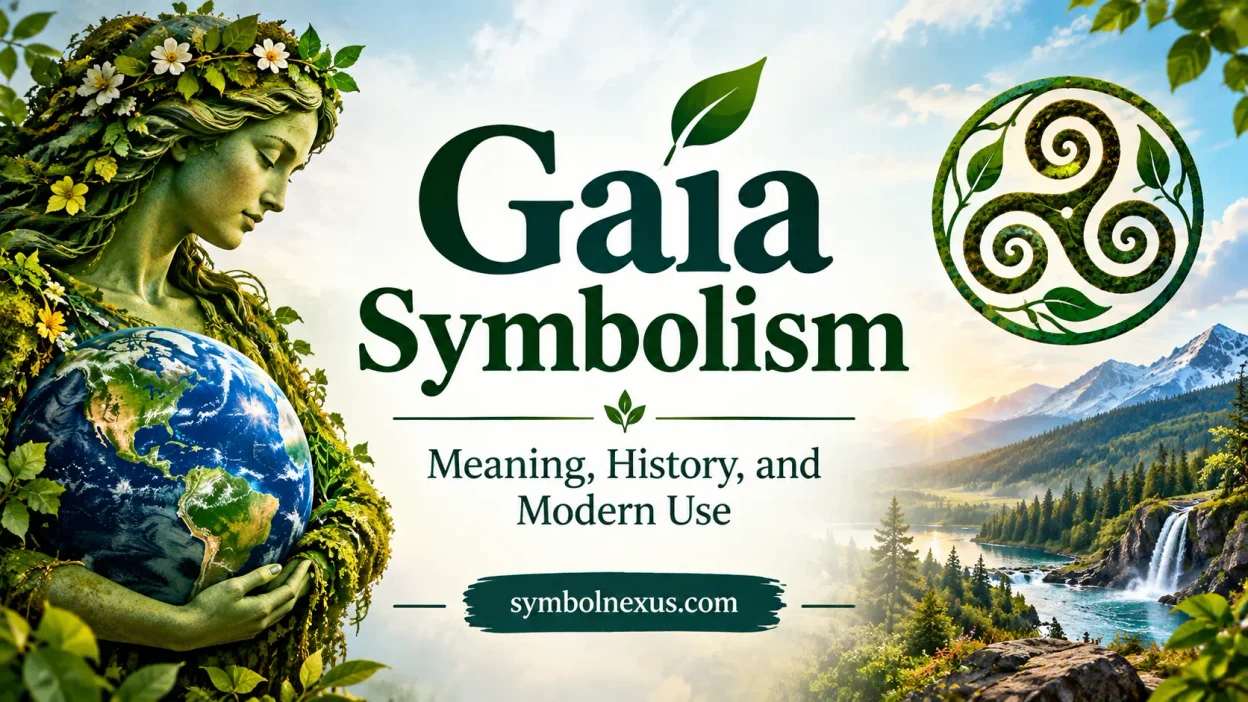
Gaia symbolism connects the Earth with life, fertility, natural balance, and the relationship between humans and the living world. In ancient Greek mythology, Gaia was the primordial goddess who personified the Earth itself. Today, Gaia symbolism appears in environmental movements, spiritual practices, art, jewelry, and conversations about humanity’s responsibility to the planet.
The name Gaia often suggests more than soil, forests, oceans, and mountains. It can represent the idea that the natural world supports countless interconnected forms of life. For some people, Gaia is a goddess worthy of reverence; for others, she is a poetic image of Earth as a living system.
These interpretations overlap, but they are not identical. Understanding Gaia requires looking at her ancient mythological origins, her place in modern environmental thought, and the different ways people use her image to express care for the planet.
Quick Answer
Gaia symbolism commonly represents Earth, nature, fertility, interconnected life, and environmental responsibility in modern American culture. In ancient Greek mythology, Gaia was the primordial Earth goddess and a mother figure associated with the origins of gods, giants, and other beings.
TL;DR
- Gaia represents Earth as the source and support of life.
- Ancient Greek mythology describes Gaia as a primordial goddess.
- Modern Americans associate Gaia with ecology and planetary responsibility.
- Gaia imagery can express fertility, resilience, nurture, and renewal.
- Spiritual interpretations vary and are not shared by everyone.
- Modern science does not require belief in Gaia as a goddess.
Who Is Gaia in Greek Mythology?
Gaia, also spelled Gaea, is the primordial goddess who personifies Earth in ancient Greek mythology. Unlike a deity associated with one particular natural feature, Gaia represents the ground and world on which life exists. She is not simply a goddess of forests or agriculture; her identity encompasses the Earth itself.
In the creation account presented in Hesiod’s Theogony, Gaia emerges after Chaos and becomes one of the earliest fundamental beings in the cosmos. She gives rise to Uranus, the sky, as well as other primordial figures. Her union with Uranus produces the Titans, including Cronus, and other children who help shape the mythological world.
Gaia therefore symbolizes origin and continuity. She is both a place where life develops and a maternal figure who produces generations of divine beings. Her mythological role connects the physical world with ancestry, creation, and the relationships among different forms of existence.
Her stories also include conflict. Gaia does not always represent peaceful harmony: she acts to protect or support her children and becomes involved in struggles among the gods. This complexity matters because the ancient goddess was not merely a decorative symbol of a beautiful planet. She belonged to a world of creation, power, family obligations, and cosmic change.
The Core Meanings of Gaia Symbolism
Gaia can carry several related meanings, depending on the setting and the person interpreting her. Most modern uses draw from her identity as Earth itself, while others emphasize her role as a mother, creator, or figure of natural balance.
Earth and life: Gaia represents the planet as the physical foundation of human and nonhuman life. Her symbolism can include oceans, soil, forests, wildlife, and the atmosphere.
Motherhood and nourishment: As a maternal figure in Greek mythology, Gaia is associated with birth, care, fertility, and the conditions that allow life to grow.
Interconnection: Gaia can represent the idea that living beings depend on one another and on natural systems. People use this meaning when discussing food webs, habitats, water cycles, and ecological relationships.
Renewal and resilience: Plants regrow, landscapes change, and ecosystems can recover under suitable conditions. Gaia imagery may express hope in nature’s capacity for renewal, although recovery is not guaranteed after every environmental disturbance.
Responsibility and limits: The Earth provides resources, but those resources are not infinite in every practical sense. Gaia can symbolize the need to respect environmental limits rather than treating nature as an inexhaustible supply.
These meanings often appear together. An image of Gaia holding a globe, for example, may communicate both the planet’s ability to sustain life and the responsibility humans have toward it.
Ancient Roots and Early Symbolism
Gaia’s origins belong to ancient Greek religious and literary traditions, where natural features and cosmic forces could be understood through divine personalities. The Earth was not an abstract backdrop to human life. It was the ground people cultivated, the place where they buried their dead, and the foundation on which communities depended.
In Greek mythology, Gaia’s importance extends beyond her identity as a mother. She belongs to the earliest generation of cosmic beings and participates in the succession of divine powers. Her relationships with Uranus, Cronus, and Zeus connect her with major transitions in the mythological order.
Ancient Greek stories also associated the Earth with fertility and the ability to produce life. Agricultural communities depended on soil, seasonal rain, and successful harvests, so the Earth could carry religious significance as well as practical importance. However, it would be inaccurate to assume that every Greek community worshipped Gaia in the same way or assigned her an identical role.
Gaia was honored in particular religious and ritual contexts, but she did not function as a single universal symbol with one fixed interpretation. Her significance developed through different stories, local practices, and changing understandings of the gods.
Her ancient meaning is therefore best understood through her role as a primordial Earth figure, not through every modern idea associated with environmentalism.
Gaia as Mother Earth
One of the most recognizable meanings of Gaia is Mother Earth. This association comes naturally from Greek mythology, where Gaia produces important divine beings and represents the world that sustains life.
The mother image communicates nourishment, shelter, and continuity between generations. In everyday language, people may call the Earth a mother because it provides food, water, materials, and the conditions necessary for human survival. The phrase can express gratitude for nature without requiring belief in a literal goddess.
The symbolism also has a more complicated side. A mother figure can protect and nourish, but the natural world does not always behave gently. Storms, droughts, earthquakes, disease, and other hazards remind people that the Earth is not a human caregiver who guarantees safety.
This contrast helps explain why Gaia can represent both comfort and vulnerability. She may evoke a fertile garden or a green landscape, but she can also remind viewers that human life depends on natural systems that people cannot fully control.
In modern American art and writing, Mother Earth imagery often appears in environmental education, conservation campaigns, and spiritual illustrations. It offers a familiar way to express the connection between the planet and the lives it supports.
Gaia Symbolism in Modern American Culture
In the United States, Gaia is especially visible in environmental conversations, nature-centered spirituality, wellness communities, and visual art. Her image can provide a personal or memorable way to discuss ecological responsibility.
An illustration of a woman whose hair becomes a forest, for instance, may present Gaia as the embodiment of nature. A globe surrounded by leaves can express similar ideas without depicting a goddess directly. Both images turn a large, complicated subject into something viewers can recognize emotionally.
Environmental groups and individual creators may use Gaia-related imagery to encourage conservation, habitat protection, reduced waste, and greater awareness of climate change. In these contexts, Gaia often represents the interconnected systems that make life possible.
Her meaning is not universal across American society. Some people understand Gaia in a religious or spiritual sense, while others see her as a mythological character or a metaphor for the environment. Many people care deeply about protecting nature without identifying with Gaia symbolism at all.
The important distinction is between using Gaia as a cultural image and treating her as a figure of personal faith. Both are legitimate interpretations, but neither should be assumed from the symbol alone.
Gaia and the Modern Environmental Movement
Gaia’s connection with environmental thinking became especially prominent in the modern era, partly because the name was adopted in scientific and philosophical discussions of Earth systems.
In the 1970s, scientist James Lovelock developed the Gaia hypothesis, with biologist Lynn Margulis contributing to its development. In broad terms, the hypothesis proposed that living organisms and their physical environment interact in ways that can influence conditions on Earth. It encouraged researchers to consider relationships among life, the atmosphere, oceans, and other planetary processes.
The scientific hypothesis is not the same thing as the ancient Greek belief in a goddess. It does not require the claim that Earth has human-like intentions, feelings, or consciousness. Scientific discussions of Earth-system regulation focus on processes, feedback, and interactions that can be investigated with evidence.
In everyday environmental language, however, the name Gaia can carry a more poetic meaning. It may encourage people to think of Earth as an interconnected whole rather than a collection of unrelated resources.
That image can be useful, but it should not replace scientific explanation. Ecosystems can be disrupted, species can disappear, and environmental damage can persist for generations. The planet’s capacity to sustain life does not mean every ecosystem will automatically restore itself or that human choices have no lasting consequences.
Gaia, Nature, and the Meaning of Interconnection
Gaia often symbolizes the connections among organisms and the physical systems around them. A forest, for example, includes plants, fungi, animals, microorganisms, soil, moisture, and changing weather conditions. Each part affects others, even when those relationships are not immediately visible.
The same principle applies to oceans, wetlands, grasslands, and urban environments. Pollinators affect plant reproduction; plants influence habitats and soil; waterways connect landscapes; and human activity can alter all of these relationships.
Gaia imagery makes this interdependence easier to picture. A figure holding the Earth, a body formed from roots, or a planet surrounded by living creatures can suggest that the natural world is made up of connected processes.
The symbolism can also challenge the idea that humans stand entirely outside nature. People depend on clean water, fertile soil, stable ecosystems, and other environmental conditions. Housing, food production, transportation, and industry all interact with the physical world.
Still, interconnection should not be confused with perfect harmony. Nature includes competition, predation, disease, and extinction as well as cooperation and growth. Gaia symbolism is most useful when it encourages attention to relationships without pretending that every natural process is peaceful or beneficial.
Spiritual and Religious Interpretations of Gaia
Some modern spiritual traditions treat Gaia as a goddess or as a sacred expression of the Earth. In these settings, she may represent reverence for nature, gratitude for life, seasonal change, and a sense of belonging within the natural world.
People who follow contemporary Pagan or Earth-centered spiritual practices may include Gaia in personal rituals, prayers, meditation, or seasonal observances. The details vary considerably. Some understand her as a distinct deity; others use her name as one expression of a broader sacred relationship with the planet.
Other people appreciate Gaia as a metaphor without adopting any religious belief. They may use the name in poetry, environmental education, or personal reflection because it makes the relationship between humans and Earth feel concrete.
These approaches should not be collapsed into one category. Ancient Greek religion, contemporary Pagan practice, ecological philosophy, and secular environmentalism have different histories and purposes. Their use of Gaia may overlap, but the underlying beliefs are not identical.
It is also important not to describe Gaia as a universal figure shared in exactly the same form by all cultures. Many societies have their own traditions concerning Earth, land, creation, and fertility, and those traditions deserve to be understood on their own terms.
Gaia Symbolism Across Cultures
The specific figure of Gaia belongs to Greek mythology, but the broader idea of Earth as a source of life appears in many cultural and religious traditions. Similarities can help readers understand why Earth imagery is widely recognizable, but they do not prove that the traditions are interchangeable.
In Roman tradition, Terra Mater, or Mother Earth, was a personification of the Earth with associations that overlap with Gaia’s. The two figures are related through the wider history of Greco-Roman religion, although their stories and religious contexts are not exactly the same.
In Hindu traditions, Bhumi Devi is associated with the Earth and can be understood as a divine figure connected with land, nourishment, and sustaining life. Her significance belongs to Hindu religious traditions and should not be reduced to a simple equivalent of Gaia.
In many Indigenous traditions around the world, relationships with land involve specific histories, responsibilities, communities, and sacred teachings. Some people use expressions such as “Mother Earth,” but there is no single Indigenous belief system. Meanings differ among nations and cultures, and outsiders should avoid treating them as interchangeable environmental metaphors.
These comparisons show that people have developed many ways to express the importance of the Earth. Gaia symbolism remains specifically Greek in origin, even when modern audiences connect it with broader ideas of planetary care.
The Emotional and Psychological Meaning of Gaia
Gaia imagery can communicate belonging, stability, gratitude, and concern. For people who feel overwhelmed by modern life, an image of Earth surrounded by plants or stars may serve as a reminder that human experience is part of a larger natural world.
The motherly aspect can suggest safety and nourishment. The planet itself can also represent home: a shared place where different communities, species, and generations live under the same broad environmental conditions.
Gaia may also express grief or anxiety. Images of a damaged Earth, a wilted goddess, or a figure surrounded by smoke can communicate concern about pollution, habitat loss, and climate change. These images turn abstract problems into a recognizable emotional story.
For some people, Gaia symbolism supports a sense of responsibility. If the Earth is understood as a living whole or a sacred home, environmental care can feel like a moral obligation rather than a purely practical task.
However, no symbol produces the same emotional response in everyone. A person may find Gaia comforting, another may see the imagery as sentimental, and someone else may interpret it primarily as mythology. The surrounding context matters more than any supposed universal psychological effect.
Gaia in Tattoos, Jewelry, and Personal Style
Gaia imagery is used in tattoos and jewelry by people who want to express a connection with nature, environmental concern, spirituality, or personal identity. The design often determines which meaning comes forward.
A face surrounded by leaves may emphasize Mother Earth and nourishment. A globe held in two hands may suggest stewardship or responsibility. Roots extending from a human figure can symbolize connection to place, family, ancestry, or the natural world.
Some designs combine Gaia with moons, flowers, animals, or the four classical elements. These additions can introduce themes such as seasonal change, fertility, balance, or the relationship between the body and the environment. Their meaning depends on the wearer’s intentions rather than a fixed symbolic code.
Jewelry may feature a goddess silhouette, a small globe, a tree, or a leaf motif. Such pieces can serve as reminders of a personal belief, a commitment to conservation, or a meaningful relationship with a particular landscape.
Before choosing a design, it helps to decide whether the intended message is mythological, spiritual, environmental, or personal. Gaia imagery can accommodate all four, but a specific design may communicate one more clearly than the others.
Gaia in Art, Literature, and Popular Media
Artists and writers use Gaia to give the Earth a recognizable presence. Instead of depicting the planet as an object viewed from space, they may portray it as a person, a body, or a figure whose appearance changes with the condition of the natural world.
In literature, Gaia can function as a mother figure, a creator, a source of conflict, or a representation of ecological interdependence. A story that presents the Earth as injured may use Gaia imagery to explore environmental destruction. A story that depicts her as a creator may focus on fertility, origins, or the relationship between generations.
In fantasy and popular media, Gaia may appear as a goddess, an ancient force, or the personification of a planet. These portrayals often adapt mythology for contemporary storytelling, so they should not automatically be treated as accurate accounts of ancient Greek beliefs.
Digital art and social media have also made Earth-goddess imagery easy to share and reinterpret. Artists may combine classical references with modern environmental themes, contemporary fashion, or speculative ideas about the future.
The symbol works well in visual storytelling because it joins a large subject, the planet, with a familiar human form. That connection can make environmental issues feel more immediate without requiring every viewer to share the same religious or philosophical beliefs.
Positive and Negative Meanings of Gaia
Gaia is generally associated with life-supporting and constructive ideas, but her symbolism can also communicate vulnerability, conflict, or the consequences of human behavior.
| Context | Common Meaning | Possible Interpretation |
|---|---|---|
| Nature and gardening | Fertility and growth | Respect for the conditions that support life |
| Environmental advocacy | Interconnection and responsibility | A reminder to protect ecosystems |
| Spiritual practice | Sacred Earth and belonging | Reverence for the natural world |
| Mythological art | Creation and divine ancestry | The origins and order of the cosmos |
| Images of a damaged Earth | Vulnerability and loss | Concern about environmental harm |
A positive interpretation often focuses on nourishment, renewal, and the possibility of living more responsibly. A negative or cautionary interpretation may emphasize environmental damage, human arrogance, or the limits of the planet’s resources.
Gaia’s role in Greek mythology also prevents an overly simple reading. Her stories include disputes and acts of retaliation, not just peaceful nurturing. Depending on the narrative, she can represent the source of life and an active force within conflicts over power.
The meaning therefore depends on how Gaia is presented. A green, flourishing figure communicates something different from a wounded Earth or a goddess involved in a mythological struggle.
Common Misunderstandings About Gaia Symbolism
One common misunderstanding is that Gaia simply means “Mother Earth.” That phrase captures an important modern association, but it leaves out Gaia’s role as a primordial deity in Greek creation stories and her involvement in conflicts among the gods.
Another mistake is to treat the Gaia hypothesis as scientific proof that Earth is conscious. The hypothesis concerns interactions between living organisms and their environment; it does not establish that the planet has a mind, intentions, or emotions.
Gaia is also sometimes described as a universal goddess found in every culture. This confuses a specific Greek figure with broader similarities among Earth-centered traditions. Other cultures have their own deities, teachings, and relationships with land, and those should not be renamed Gaia simply because they share some themes.
A final misunderstanding is that Gaia symbolism always implies a particular political position. Environmental care is a common association, but people may use Gaia imagery for mythology, art, spirituality, personal identity, or aesthetic reasons. The symbol alone does not establish a person’s political views.
Understanding these distinctions makes it easier to interpret Gaia without turning a flexible symbol into a single fixed claim.
How to Interpret Gaia Imagery in Everyday Life
When you encounter Gaia in an artwork, tattoo, book, or online image, begin by looking at the details rather than assuming the meaning. Notice whether the figure appears youthful or aged, healthy or injured, surrounded by plants or set against an industrial landscape.
The setting offers useful clues. A goddess holding crops may emphasize fertility and nourishment, while a figure protecting a globe may suggest environmental responsibility. A dramatic scene involving other Greek gods may refer more directly to mythology than to modern ecological ideas.
Consider the creator’s purpose as well. An environmental campaign may use Gaia to encourage conservation, while a spiritual artist may intend to express reverence for a goddess. A fantasy story might use the name simply because it suggests an ancient power associated with Earth.
Personal meaning also matters. Someone who grew up near a forest or coastline may associate Gaia with a particular landscape, while another person may connect her with family, spirituality, or environmental activism.
A reliable interpretation brings together three things: the image itself, the context in which it appears, and the meaning intended by the person using it. That approach allows for multiple readings without treating every interpretation as equally supported by the historical record.
Frequently Asked Questions
What does Gaia symbolize spiritually?
Gaia commonly symbolizes the sacredness of Earth, the interdependence of life, nourishment, and a sense of belonging to the natural world. In some contemporary spiritual practices, she is worshipped as a goddess; in others, her name serves as a metaphor for reverence for the planet.
What does Gaia represent in Greek mythology?
In Greek mythology, Gaia personifies Earth and is one of the primordial beings in the creation of the cosmos. She is a mother of major divine figures, including the Titans, and plays an active role in stories about divine ancestry and struggles for power.
Is Gaia the same as Mother Earth?
Gaia is one specific figure associated with the Mother Earth idea, but the terms are not identical in every context. “Mother Earth” is a broader expression used in different cultural, spiritual, and environmental settings, while Gaia originates in Greek mythology.
What does a Gaia tattoo mean?
A Gaia tattoo often represents love for nature, environmental responsibility, spiritual beliefs, fertility, or the connection between human life and Earth. Its precise meaning depends on the design and the wearer’s personal intentions.
Is Gaia a real goddess or a scientific concept?
Gaia is a goddess in ancient Greek mythology and a figure of worship for some modern spiritual practitioners. The Gaia hypothesis is a separate scientific framework for examining interactions among life and Earth’s physical systems; it does not require belief in a goddess.
Is Gaia symbolism always positive?
No. Although Gaia often represents nourishment, fertility, and renewal, she can also symbolize vulnerability, ecological damage, conflict, and the limits of human control. Her role in Greek mythology includes both creation and confrontation.
How is Gaia different from other Earth goddesses?
Gaia is specifically rooted in Greek mythology, where she is a primordial personification of Earth and a mother of divine beings. Other cultures have their own Earth deities and sacred traditions, which may share broad themes but have distinct histories and meanings.
Conclusion
Gaia symbolism brings together the Earth, the origins of life, motherhood, interconnection, and responsibility toward the natural world. Its roots lie in ancient Greek mythology, but modern audiences also use Gaia to express environmental concern, spiritual belonging, and the idea that human life depends on a wider planetary system.
The symbol can be religious, artistic, ecological, or personal. Its meaning becomes clearer when readers distinguish the ancient goddess from modern scientific ideas and from the different Earth-centered traditions found across cultures.
Ultimately, Gaia offers a way to picture the relationship between people and the planet: not as a promise that nature will always protect us, but as a reminder that life depends on conditions worth understanding and caring for.
Add a Stronger Search-Focused IntroductionUse Gaia Symbolism More Naturally Throughout