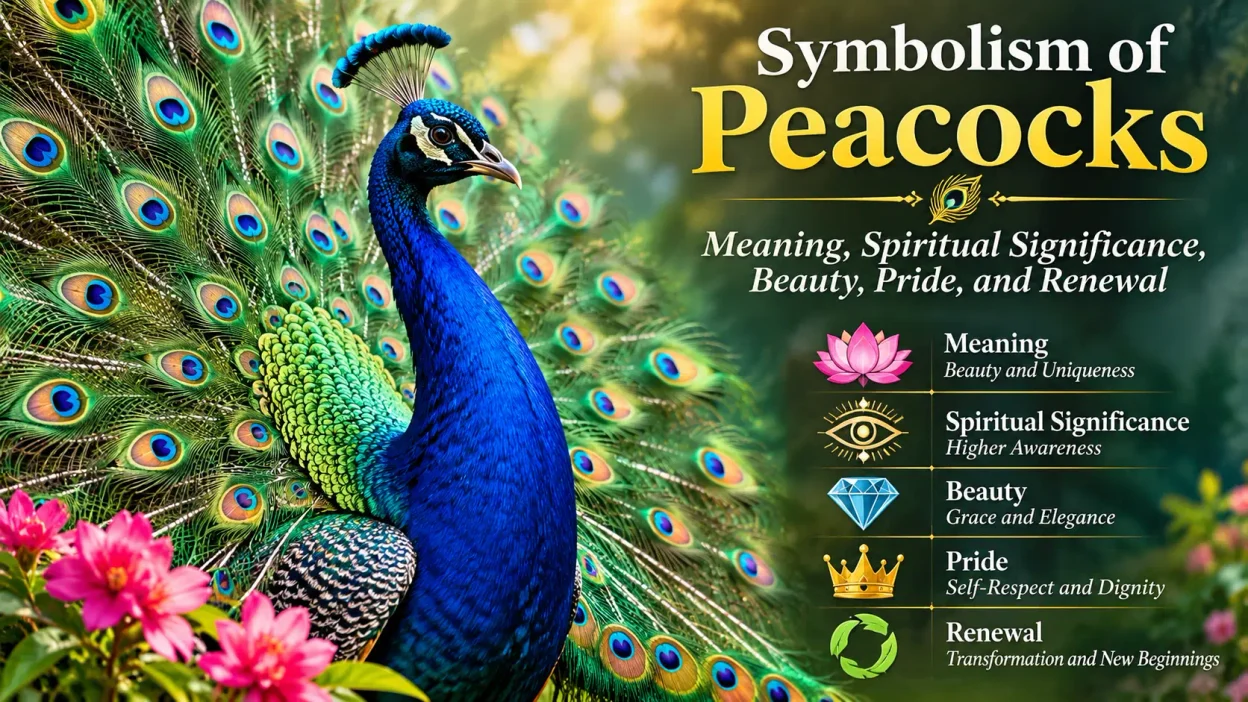
The symbolism of peacocks is closely connected to beauty, confidence, pride, spirituality, renewal, and immortality. Known for their brilliant feathers and spectacular displays, peacocks have fascinated people for centuries. Their colorful appearance has made them powerful symbols in mythology, religion, art, literature, and cultural traditions around the world.
A peacock spreading its magnificent tail can represent self-expression, confidence, and the courage to be seen. Its colorful feathers may suggest creativity, individuality, and the beauty of life. In some spiritual traditions, the peacock is also associated with protection, wisdom, resurrection, and the victory of good over evil.
However, peacock symbolism is not limited to positive meanings. Depending on the context, the bird can also represent vanity, arrogance, excessive pride, or a concern with outward appearances.
Whether you encounter a peacock in a dream, see one in nature, admire its feathers, or explore its appearance in religious artwork, understanding its symbolism reveals why this remarkable bird holds such a lasting place in human imagination.
What Do Peacocks Symbolize?
Peacocks commonly symbolize beauty, confidence, pride, renewal, spirituality, protection, and immortality. Their impressive feathers and seasonal molting have inspired associations with transformation, while their elaborate courtship displays have made them symbols of self-expression and attraction.
Here are the most common symbolic meanings associated with peacocks:
| Symbolic Meaning | Significance |
|---|---|
| Beauty | Elegance, attractiveness, and artistic expression |
| Confidence | Self-assurance and willingness to stand out |
| Pride | Personal dignity, achievement, and self-worth |
| Vanity | Excessive concern with appearance or admiration |
| Renewal | Transformation and fresh beginnings |
| Immortality | Eternal life and spiritual continuity |
| Protection | Awareness and the ability to recognize danger |
| Spirituality | Wisdom, sacred beauty, and divine connection |
| Abundance | Prosperity, good fortune, and richness |
| Creativity | Individuality, color, and self-expression |
| Integrity | Inner strength and personal values |
| Resurrection | Rebirth and victory over difficult circumstances |
These meanings vary across cultures and traditions. A peacock may represent divine beauty in one religious context and excessive pride in a moral or literary setting.
1. Beauty and Elegance
One of the most recognizable meanings of peacock symbolism is beauty. The male peafowl’s colorful plumage, elaborate tail feathers, and distinctive courtship display make it one of the most visually striking birds.
Its appearance has inspired artists, writers, designers, and spiritual traditions for generations.
Symbolically, the peacock can represent:
- Natural beauty and elegance.
- Appreciation of art and creativity.
- Grace and individuality.
- The ability to recognize beauty in everyday life.
- Confidence in one’s unique qualities.
The peacock also reminds us that beauty can take many forms. Its colorful feathers encourage appreciation of individuality rather than comparison with others.
2. Confidence and Self-Expression
A peacock spreading its feathers is often interpreted as a symbol of confidence and self-expression.
The bird’s display is a natural part of courtship behavior, but its dramatic appearance has inspired human associations with standing out and showing one’s abilities.
Spiritually, peacock symbolism may encourage you to:
- Express your personality honestly.
- Recognize your strengths.
- Stop hiding your talents.
- Take pride in your achievements.
- Become comfortable with being noticed.
The peacock’s message is not necessarily about seeking attention. It can represent the confidence to be yourself without feeling that you must make yourself smaller to satisfy others.
3. Pride and Self-Worth
Peacocks are widely associated with pride because of their impressive appearance and elaborate displays.
This association can have both positive and negative meanings.
Positive pride represents dignity, self-respect, confidence, and appreciation of personal achievements. Negative pride can become vanity, arrogance, or an excessive need for admiration.
In symbolism, the peacock encourages a balance between recognizing your value and remaining humble.
It may remind you that genuine confidence does not require looking down on others or constantly seeking approval.
4. Renewal and Transformation
Peacock symbolism is also connected to renewal and transformation.
Peafowl periodically replace their feathers through molting, a natural process in which old feathers are shed and new ones grow. This process has inspired symbolic associations with letting go, personal development, and fresh beginnings.
A peacock may therefore represent:
- Moving beyond an old stage of life.
- Developing a stronger sense of identity.
- Recovering after difficult experiences.
- Embracing personal change.
- Discovering new possibilities.
Its brilliant feathers can also symbolize the beauty that emerges through growth and transformation.
5. Immortality and Eternal Life
In several historical and religious traditions, peacocks have been associated with immortality and eternal life.
One reason for this association is the bird’s seasonal replacement of feathers, which can be interpreted as a symbol of renewal and continuity.
In ancient Mediterranean and later Christian art, peacock imagery sometimes represented resurrection and the promise of eternal life.
The bird’s eye-like feather patterns also contributed to its mysterious and sacred appearance.
In this context, the peacock can symbolize the idea that life continues beyond visible change, although the specific religious interpretation varies by tradition.
6. Protection and Awareness
The peacock’s symbolism is sometimes connected to protection and awareness.
Its eye-like feather patterns have inspired interpretations involving watchfulness, perception, and the ability to recognize what is happening around you.
In some cultural and folk traditions, peacock feathers have been used as protective objects or decorative symbols associated with good fortune.
Spiritually, the peacock may encourage you to:
- Pay attention to your surroundings.
- Recognize unhealthy influences.
- Protect your personal boundaries.
- Trust your judgment.
- Become more aware of your choices.
These are symbolic interpretations rather than evidence that peacock feathers provide supernatural protection.
7. Spiritual Wisdom and Enlightenment
The peacock’s colorful appearance and associations with divine figures have made it an important spiritual symbol in several traditions.
Its feathers may represent beauty, awareness, wisdom, and the relationship between the visible world and deeper spiritual ideas.
In contemporary spiritual interpretations, a peacock can encourage people to develop self-awareness, appreciate life’s beauty, and seek personal understanding.
Its symbolism may include:
- Spiritual development.
- Inner wisdom.
- Awareness and perception.
- Personal transformation.
- The balance between outward beauty and inner character.
The peacock reminds us that true wisdom involves more than appearance. It also requires reflection, compassion, and understanding.
Peacock Symbolism Across Different Cultures and Religions
Peacocks have appeared in the religious imagery, mythology, architecture, and artistic traditions of many societies. Their meanings differ considerably, so their symbolism should always be understood within its cultural setting.
Peacock Symbolism in Hinduism
The peacock holds an important place in Hindu religious imagery.
It is closely associated with Kartikeya, also known as Murugan or Skanda, a deity connected with war and victory. The peacock serves as his mount, or vahana, in many representations.
The bird is also associated with Saraswati, the goddess of knowledge, music, learning, and the arts, in some artistic and regional traditions.
Because of these associations, peacock symbolism in Hindu contexts may suggest:
- Divine beauty and majesty.
- Knowledge and artistic expression.
- Victory over negative forces.
- Spiritual awareness.
- Protection and sacred power.
The peacock is also India’s national bird, reflecting its cultural and natural importance.
Peacock Symbolism in Buddhism
In Buddhist symbolism, peacocks can represent wisdom, spiritual transformation, and the ability to overcome negative qualities.
In some Buddhist traditions and artistic interpretations, the peacock is associated with the transformation of poison into wisdom. This imagery reflects the idea that difficult or negative experiences can become opportunities for spiritual development.
Peacock imagery also appears in Buddhist art and in representations of particular bodhisattvas and deities.
The exact meaning depends on the Buddhist tradition and the artwork involved.
Peacock Symbolism in Christianity
Peacocks have an important place in some historical Christian art.
In early Christian and medieval imagery, the peacock was sometimes used as a symbol of immortality, resurrection, and eternal life.
This association was partly influenced by ancient beliefs about the bird’s feathers and their seasonal renewal.
Peacocks can therefore appear in Christian mosaics, church decorations, and religious artwork as visual reminders of spiritual life beyond death.
However, the Bible does not provide a detailed symbolic explanation of peacocks. The bird’s Christian associations developed largely through historical art and later religious interpretation.
Peacock Symbolism in Ancient Greek and Roman Culture
In Greek mythology, the peacock is closely associated with Hera, the goddess of marriage and queen of the gods.
According to a well-known myth, Hera placed the eyes of the many-eyed giant Argus on the peacock’s tail after his death. This story explains the bird’s distinctive eye-like feather patterns within Greek mythology.
The peacock consequently became associated with Hera, majesty, watchfulness, and divine authority.
In ancient Roman culture, the peacock was also associated with Juno, the Roman counterpart of Hera.
Peacock imagery could communicate wealth, status, beauty, and imperial grandeur.
Peacock Symbolism in Persian Culture
Peacocks have appeared in Persian art, poetry, textiles, architecture, and decorative traditions.
Their elaborate feathers and striking colors have made them symbols of beauty, luxury, majesty, and artistic refinement.
In some Persian and later Islamic artistic contexts, peacock imagery is used decoratively, although its meaning depends on the period, region, and religious setting.
Peacock Symbolism in Chinese Culture
In Chinese art and traditional symbolism, peacocks have been associated with beauty, dignity, prosperity, and high status.
Their elegant appearance has made them popular subjects in paintings, textiles, embroidery, and decorative objects.
In some historical contexts, peacock imagery was associated with official rank and social prestige.
Peacock designs may also symbolize good fortune and honor, although these interpretations vary according to the artwork and historical period.
Different Peacock Colors and Their Symbolic Meanings
The colors of peacock feathers are among the most distinctive features of the bird. Their blue, green, bronze, and gold tones have inspired different symbolic interpretations.
| Peacock Color | Common Symbolic Meaning |
|---|---|
| Blue | Wisdom, confidence, peace, and spirituality |
| Green | Growth, renewal, prosperity, and harmony |
| White | Purity, peace, clarity, and spiritual awareness |
| Gold | Abundance, success, wealth, and majesty |
| Black | Mystery, protection, strength, and transformation |
| Multicolored | Creativity, individuality, beauty, and diversity |
These color meanings are interpretive rather than universal cultural rules.
Blue Peacock Symbolism
Blue peacocks are often associated with wisdom, confidence, spirituality, and calmness.
The rich blue color of the bird’s neck and body can suggest depth, stability, and self-expression.
Spiritually, a blue peacock may represent the importance of communicating honestly and trusting your abilities.
Green Peacock Symbolism
Green peacock feathers may symbolize growth, renewal, prosperity, and harmony.
Green is commonly associated with plants, nature, and new beginnings, making it a natural color for interpretations involving personal development.
White Peacock Symbolism
White peacocks are often associated with purity, peace, clarity, and spiritual awareness.
A white peacock is not a separate species but usually a color form of the Indian peafowl resulting from a genetic condition known as leucism.
Its striking appearance has made it a popular symbol of elegance and transformation.
Golden Peacock Symbolism
Gold-colored peacock imagery may represent abundance, wealth, achievement, and majesty.
Gold has long been associated with preciousness and high status, making golden peacock designs especially meaningful in decorative and artistic traditions.
Black Peacock Symbolism
Black peacock imagery can represent mystery, independence, strength, and transformation in modern symbolic interpretations.
It may also suggest hidden potential or the courage to embrace unfamiliar aspects of life.
Peacock Feather Symbolism
Peacock feathers are often interpreted separately from the bird itself.
Their eye-like patterns, brilliant colors, and distinctive shape have made them recognizable symbols in religious art, decoration, folklore, and personal spiritual practices.
Common meanings associated with peacock feathers include:
- Beauty and elegance.
- Awareness and watchfulness.
- Protection and good fortune.
- Renewal and transformation.
- Spiritual wisdom.
- Confidence and individuality.
The Eye Pattern on Peacock Feathers
The eye-like pattern near the end of a peacock’s train is one of its most distinctive features.
In Greek mythology, these patterns were connected with the eyes of Argus. In modern interpretations, they may represent awareness, observation, and the ability to see beyond appearances.
However, the feather patterns are naturally occurring features of the bird’s plumage, not literal supernatural eyes.
Is a Peacock Feather Good Luck?
In some cultural and contemporary spiritual traditions, peacock feathers are regarded as symbols of good fortune, protection, and prosperity.
Some people display them in homes or use them in decorative and religious settings.
However, beliefs about luck vary, and there is no scientific evidence that a feather can change a person’s fortune.
Peacock Symbolism in Dreams
Dreaming about a peacock can have several possible interpretations depending on its behavior, color, surroundings, and your emotions during the dream.
A peacock may represent confidence, self-expression, beauty, recognition, or concerns about pride and appearance.
Dream interpretations are subjective and should not be treated as predictions of future events.
| Peacock Dream | Possible Interpretation |
|---|---|
| Seeing a peacock | Confidence, beauty, or personal recognition |
| A peacock spreading its feathers | Self-expression, pride, or wanting to be noticed |
| A white peacock | Peace, clarity, or a fresh beginning |
| A blue peacock | Wisdom, confidence, or emotional balance |
| A green peacock | Growth, renewal, or prosperity |
| A flying peacock | Freedom, ambition, or rising confidence |
| A peacock chasing you | Pressure, attention, or concerns about pride |
| A peacock attacking you | Conflict, insecurity, or feeling judged |
| A dead peacock | Loss of confidence or the end of a personal chapter |
| A peacock feather | Beauty, awareness, or a desire for protection |
Dreaming of a Peacock Spreading Its Feathers
A peacock spreading its feathers may symbolize confidence, self-expression, or the desire to be recognized.
The dream could encourage you to appreciate your abilities and become more comfortable sharing your talents.
It may also invite you to consider whether you are seeking too much approval from others.
Dreaming of a White Peacock
A white peacock may represent peace, clarity, purity, or a new beginning.
Its appearance may reflect a desire for emotional calmness or a fresh perspective during a period of change.
Dreaming of a Dead Peacock
A dead peacock in a dream may reflect concerns about confidence, self-image, recognition, or a personal disappointment.
It could also symbolize the end of a period in which appearance or outside approval played an important role in your life.
The meaning depends on your feelings and personal circumstances.
What Does It Mean Spiritually to See a Peacock?
Seeing a peacock can feel memorable because of its unusual appearance and impressive display.
In modern spiritual interpretations, an encounter with a peacock may encourage you to recognize your individuality, express yourself confidently, and appreciate the beauty around you.
Possible personal messages include:
Embrace your individuality: Do not hide your talents simply because you are afraid of standing out.
Practice healthy confidence: Recognize your worth without comparing yourself with others.
Welcome transformation: Allow yourself to grow beyond old habits and expectations.
Look beyond appearances: Remember that beauty and character are not the same thing.
Appreciate abundance: Recognize the opportunities, relationships, and experiences that enrich your life.
Seeing a peacock is not scientifically established as an omen or supernatural message. Its spiritual meaning is best understood as a personal interpretation.
Peacock Symbolism in Love and Relationships
Peacocks have a strong association with beauty, attraction, romance, and self-expression.
Their elaborate courtship displays have influenced their symbolic connection with attraction and the desire to be admired.
In relationships, peacock symbolism may represent:
- Romantic attraction and admiration.
- Confidence in expressing affection.
- Appreciation of a partner’s individuality.
- Beauty and celebration.
- Pride in a relationship.
- The importance of looking beyond outward appearance.
Peacock Symbolism in Romantic Love
A peacock may represent attraction, admiration, and the excitement of romantic connection.
Its colorful display can symbolize the desire to express affection openly and celebrate the qualities that make a partner special.
However, the bird’s association with vanity can also provide a reminder that healthy relationships require emotional understanding rather than focusing only on physical appearance.
Peacock Symbolism in Marriage
Because of its association with Hera and Juno in classical mythology, the peacock has also developed connections with marriage and feminine divinity in some historical artistic traditions.
In contemporary interpretations, it may symbolize beauty, loyalty, dignity, and celebration.
These meanings are not universal marriage symbols, but they can make peacock imagery meaningful in wedding decorations, jewelry, and artwork.
Peacock as a Spirit Animal
In contemporary spiritual language, a peacock spirit animal is often associated with confidence, beauty, individuality, creativity, and self-expression.
People who feel connected to peacock symbolism may see the bird as a reminder to recognize their unique abilities and develop a healthier relationship with attention and recognition.
The peacock spirit animal is commonly interpreted as encouraging you to:
- Express your authentic personality.
- Appreciate your strengths and talents.
- Develop confidence without arrogance.
- Welcome personal transformation.
- Recognize beauty beyond physical appearance.
- Balance ambition with humility.
- Use creativity to communicate your ideas.
These interpretations belong to modern spiritual language and should not be confused with the specific sacred animal traditions of particular Indigenous or religious communities.
Peacock Symbolism in Tattoos
Peacock tattoos are often chosen to represent beauty, confidence, individuality, spirituality, and renewal.
The bird’s distinctive feathers also provide opportunities for detailed and colorful tattoo designs.
| Peacock Tattoo Design | Common Meaning |
|---|---|
| Full peacock | Beauty, confidence, and individuality |
| Peacock feather | Awareness, protection, and renewal |
| White peacock | Purity, peace, and transformation |
| Blue peacock | Wisdom, confidence, and spirituality |
| Green peacock | Growth, prosperity, and harmony |
| Peacock with flowers | Beauty, love, and new beginnings |
| Peacock with an open tail | Self-expression, pride, and creativity |
| Minimalist peacock | Elegance, simplicity, and personal identity |
A peacock tattoo may also represent overcoming insecurity, celebrating personal achievements, or embracing a more confident identity.
The best design is one that reflects your personal experiences and the meaning you want to express.
Peacock Symbolism in Art and Literature
Peacocks have appeared in paintings, poetry, architecture, textiles, and decorative arts for centuries.
Their elaborate feathers and striking colors make them useful symbols for writers and artists exploring themes of beauty, pride, status, and transformation.
In literature, the peacock can serve as a symbol of vanity when a character focuses too heavily on appearance or social recognition.
In other works, it can represent elegance, spiritual beauty, and the celebration of individuality.
Its meaning often depends on how the bird is portrayed.
A peacock displaying its feathers may communicate confidence and admiration, while a peacock used as a decorative object may suggest wealth, luxury, or social status.
What Is the Difference Between a Peacock and a Peafowl?
The words peacock and peafowl are often used interchangeably, but they do not mean exactly the same thing.
Peafowl is the name for the bird group, while peacock specifically refers to the male.
- Peacock: Adult male peafowl.
- Peahen: Adult female peafowl.
- Peachick: A young peafowl.
- Peafowl: The general term for males, females, and young birds.
The best-known species include the Indian peafowl (Pavo cristatus), the green peafowl (Pavo muticus), and the Congo peafowl (Afropavo congensis).
The spectacular train is a characteristic of male peafowl in the best-known species, and it plays an important role in courtship displays.
Understanding this distinction helps explain why peacock symbolism is so closely connected with elaborate feathers and visual display.
What Can Peacock Symbolism Teach Us About Life?
Peacock symbolism offers several lessons about confidence, individuality, and the relationship between appearance and character.
1. Celebrate your individuality. Your unique qualities do not need to be hidden to make others comfortable.
2. Practice confidence with humility. Recognizing your value does not require believing that you are better than everyone else.
3. Embrace personal growth. Like the natural renewal of feathers, life involves periods of change and development.
4. Look beyond outward beauty. Appearance may attract attention, but character and actions create deeper value.
5. Express your creativity. The peacock can remind you to share your ideas and talents with the world.
6. Develop self-awareness. Pay attention to your motivations and understand the difference between genuine confidence and the need for constant approval.
These lessons make the peacock a meaningful symbol of self-expression, personal development, and balanced pride.
Frequently Asked Questions About Peacock Symbolism
1. What do peacocks symbolize spiritually?
Peacocks commonly symbolize beauty, confidence, pride, renewal, spirituality, wisdom, protection, and immortality. Their meanings vary across cultures and religious traditions.
2. Is seeing a peacock a good omen?
Some cultural and modern spiritual interpretations associate seeing a peacock with good fortune, beauty, confidence, and positive transformation. However, it is not a universally recognized omen or a scientifically established prediction.
3. What does a peacock feather symbolize?
A peacock feather often represents beauty, awareness, protection, renewal, and spiritual wisdom. Its eye-like pattern has also inspired associations with watchfulness and perception.
4. What does a white peacock symbolize?
A white peacock is commonly associated with purity, peace, clarity, spiritual awareness, and transformation in modern symbolic interpretations.
5. What does a blue peacock symbolize?
A blue peacock may symbolize confidence, wisdom, spirituality, peace, and self-expression.
6. What does a peacock symbolize in Hinduism?
In Hindu religious imagery, the peacock is associated with Kartikeya or Murugan, whose mount is a peacock. It may also appear in artistic traditions connected with Saraswati. Its meanings include divine beauty, knowledge, and victory.
7. What does a peacock symbolize in Christianity?
In some historical Christian art, the peacock represents immortality, resurrection, and eternal life. These associations developed through religious artwork and tradition rather than an explicit biblical explanation.
8. What does dreaming about a peacock mean?
A peacock dream may reflect confidence, self-expression, recognition, beauty, or concerns about pride. Its interpretation depends on the dream’s details and your personal circumstances.
9. Why is the peacock associated with pride?
The male peafowl’s elaborate courtship display has made it a symbol of visual splendor, self-presentation, and admiration. This has inspired both positive associations with confidence and negative associations with vanity.
10. What does a peacock tattoo symbolize?
A peacock tattoo commonly represents beauty, individuality, confidence, creativity, spiritual growth, and renewal. The meaning may change according to the design and colors.
Conclusion: The Deeper Meaning of Peacock Symbolism
The symbolism of peacocks brings together beauty, confidence, pride, spirituality, renewal, and immortality. Their colorful feathers and impressive displays have made them enduring symbols in religious traditions, mythology, literature, and art.
Across different cultures, the peacock can represent divine beauty, protection, wisdom, prosperity, or the promise of spiritual renewal. At the same time, its association with vanity reminds us that outward appearance should never become more important than inner character.
Whether you encounter a peacock in a dream, admire its feathers, choose it as a tattoo, or explore its cultural significance, its symbolism offers a powerful reminder to embrace individuality and recognize your own worth.
Ultimately, the peacock teaches us to express ourselves with confidence, welcome transformation, and appreciate beauty without allowing pride to become arrogance.