
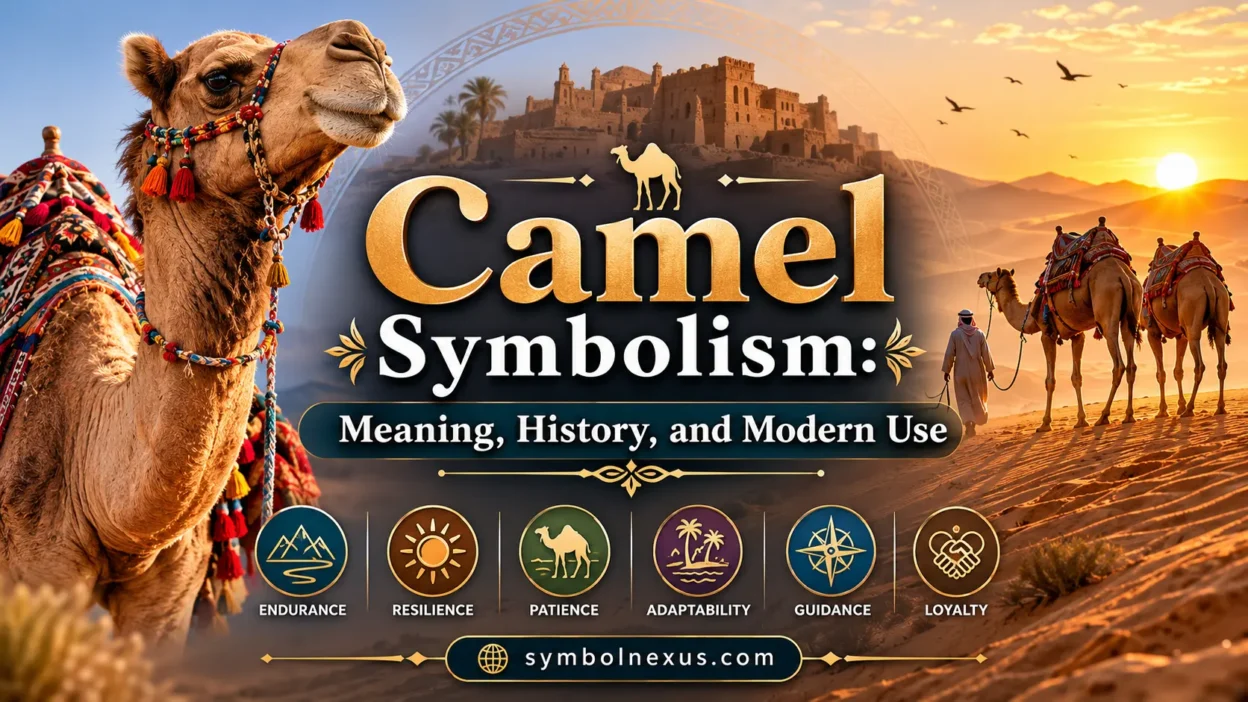
Camels are among the animals most closely associated with surviving difficult environments. Camel symbolism commonly grows from that reality: the animal represents endurance, resilience, patience, long journeys, resourcefulness, and the ability to keep moving when conditions are demanding.
Those meanings are not based only on the camel’s appearance. For thousands of years, people across North Africa, the Middle East, and Central Asia have depended on camels for transportation, trade, food, fiber, and daily work. Camel caravans also helped connect distant communities across major desert trade routes.
For modern Americans, the camel is less an everyday working animal and more a visual shorthand for deserts, perseverance, distant travel, biblical scenes, and unfamiliar landscapes. Its symbolism therefore combines real animal behavior with layers of history, religion, commerce, and popular culture.
Quick Answer
Camel symbolism most commonly represents endurance, resilience, patience, resourcefulness, and the ability to survive a difficult journey. Historically, camels have also been associated with trade, prosperity, transportation, religious reflection, and connections between distant cultures.
TL;DR
Camels commonly represent endurance, resilience, patience, and resourcefulness.
Caravan history connects them with travel, trade, and cultural exchange.
Wealth symbolism developed where camel ownership carried practical economic value.
Americans often associate camels with deserts, journeys, and biblical imagery.
Tattoos may express perseverance or surviving a difficult period.
Negative meanings such as stubbornness depend heavily on context.
What Camels Are and Why Their Physical Traits Matter
A camel’s symbolic reputation begins with what the animal can actually do.
The familiar dromedary has one hump, while the domestic Bactrian camel has two. The humps store fat rather than water, giving the animals an important energy reserve when food is scarce. Camels also possess adaptations that help them function in dry, sandy, and sometimes extremely hot or cold environments.
Humans domesticated camels more than 3,000 years ago and have used them for transportation as well as milk, meat, wool, leather, and other practical purposes. They can carry significant loads across difficult terrain, which helps explain why endurance became one of their strongest symbolic associations.
A camel therefore does not symbolize survival simply because people imagine it as tough. Its physical capabilities and long working relationship with human communities created that interpretation.
The Core Meanings Associated With Camels
Although meanings vary by culture and context, several interpretations appear repeatedly.
Context Common Meaning in the USA Related Associations Why It Fits
Desert survival Resilience Strength, adaptation Camels function in harsh environments
Long journeys Perseverance Progress, persistence They carried people and goods over distance
Caravan imagery Trade and connection Commerce, exchange Camels linked distant markets and communities
Personal symbolism Patience Self-control, endurance Their steady pace suggests persistence
Religious imagery Faith and reflection Pilgrimage, humility Camels appear in important religious traditions
Wealth imagery Prosperity Resources, status Herds could represent substantial economic value
The most useful way to understand these meanings is to see them as related rather than interchangeable. A camel tattoo chosen after overcoming hardship, for example, may mean resilience without having anything to do with commerce or religion.
Why Camels Represent Endurance and Resilience
Endurance is probably the camel’s clearest modern symbolic meaning.
Camels became essential working animals because they could travel through environments that presented serious difficulties for people and many other domesticated animals. Their usefulness in arid regions created a lasting connection between the camel and survival under pressure.
Symbolically, this can describe someone who continues despite exhaustion, scarcity, uncertainty, or a long period of difficulty.
The emphasis is usually not on dramatic strength. A lion may suggest force, while a camel more often suggests sustained effort. It survives by adapting and conserving what it needs rather than overpowering its surroundings.
That distinction makes the camel particularly suitable as a symbol of resilience after prolonged challenges.
Patience, Self-Control, and Steady Progress
Camels are also commonly interpreted as symbols of patience.
This meaning comes partly from the image of a caravan moving steadily across a broad landscape. The destination may be distant, conditions may be uncomfortable, and progress may look slow, yet the journey continues.
In personal symbolism, the camel can therefore communicate a simple idea: not every goal is reached quickly.
This interpretation works especially well for periods of education, recovery, business building, immigration, caregiving, or other long-term commitments where consistency matters more than speed.
Patience should not be presented as a universal ancient camel meaning, however. It is better understood as a modern symbolic extension of the animal’s endurance and measured movement.
Long Journeys, Travel, and Finding a Way Forward
For centuries, camels carried travelers and merchandise across long-distance routes.
That history gives the animal a natural connection with journeys. Yet its symbolism involves more than movement from one physical place to another.
A camel can represent a difficult transition in life: leaving something familiar, entering uncertainty, or continuing toward a goal when the destination still feels far away.
The meaning differs from symbols of freedom such as flying birds. Camel imagery usually suggests travel with a purpose, responsibility, or burden attached.
It is the symbolism of making the distance rather than escaping from it.
Trade, Prosperity, and the Wealth of Caravan Culture
Camels played a major role in trade networks across desert regions.
By roughly the first millennium CE, camel transportation was supporting major trans-Saharan commercial routes, including networks through which gold and many other commodities moved between regions. Camels also carried goods along routes connecting Arabia and other parts of the ancient world.
This history helps explain associations with prosperity and wealth.
In societies where camels supplied transportation, milk, fiber, meat, breeding stock, and trading capacity, owning animals could represent genuine economic resources. A healthy herd could therefore signal more than prestige; it could support a family’s livelihood.
Modern symbolic interpretations sometimes simplify this into “camel equals wealth.” The historical connection is more specific. The animal represented productive assets, mobility, and participation in trade.
Service, Responsibility, and Carrying a Burden
Another meaning comes from the camel’s role as a working and pack animal.
Camels have transported people, household goods, merchandise, and supplies across difficult terrain. That makes them useful symbols for responsibility and carrying what must be carried.
In a positive sense, the image can represent dependability: someone accepts a difficult responsibility and continues with it.
In a more somber context, however, the same image can suggest being overloaded. A camel carrying an exaggerated pile of baggage may visually communicate work pressure, emotional responsibilities, or the feeling that one more demand could become too much.
This dual meaning makes context especially important. A lightly loaded camel walking calmly may communicate capability. An exhausted animal under excessive cargo can symbolize strain or exploitation.
Camels in Islamic Religious Context
Camels hold an important place in the historical environments in which Islam emerged, and the Qur’an directly calls attention to the camel as something people should observe and contemplate.
In Surah Al-Ghashiyah, the listener is invited to consider how the camel was created alongside the sky, mountains, and earth. The passage places the familiar animal within a broader invitation to reflect on creation.
For this reason, Islamic camel imagery should not be reduced to a generic idea such as “good luck.” Depending on context, it can be associated with reflection on creation, practical provision, travel, and the historical life of communities in Arabia and neighboring regions.
Religious meaning should also be distinguished from modern decorative uses. A camel silhouette on a travel poster does not automatically carry Islamic significance.
Biblical and Christian Associations
In Christian-influenced American culture, camels often appear in biblical imagery.
One of the best-known associations comes from Jesus’ comparison involving a camel passing through the eye of a needle. In Christian interpretation, the image is generally connected with the spiritual dangers created by attachment to wealth rather than with the camel itself being a negative animal.
Camels also commonly appear in Christmas art alongside the Magi. This visual tradition has become so familiar that many people assume the biblical account specifically says the Magi traveled by camel. It does not. The camel became part of later artistic convention because it visually suggested eastern travel, caravans, and a long journey.
As a result, American Christmas imagery can give the camel additional associations with pilgrimage, sacred travel, and seeking something of great importance.
Camels, the Silk Roads, and Cultural Exchange
Camel symbolism extends beyond Arabian and North African desert culture.
Bactrian camels became important carriers along trade routes connecting Central Asia and China. Chinese art from the Tang period frequently depicted two-humped camels, including ceramic tomb figures. These animals reflected the importance of international trade and contacts with regions to China’s west.
In this context, the camel can represent connection between cultures.
Goods were not the only things moving along trade networks. Artistic styles, religious ideas, technologies, stories, and customs also traveled between communities.
A historical camel image from Central or East Asia may therefore communicate commerce, foreign contact, mobility, or cosmopolitan life rather than simply desert survival.
What the Camel Commonly Means in the United States
Camels do not occupy the same everyday cultural role in the United States that they historically held in parts of Africa and Asia.
Most Americans encounter them through zoos, films, books, advertising, travel imagery, religious art, holiday displays, or references to desert regions.
Because of that distance, American symbolism often concentrates several broad ideas into one image: heat, sand, toughness, foreign travel, and persistence.
The United States also has its own unusual camel history. During the 1850s, the U.S. Army imported camels to test whether they could transport supplies through the desert Southwest. The animals performed effectively in difficult terrain, but the experiment did not develop into a permanent military transportation system.
That episode adds an unexpectedly American layer to the camel’s familiar association with adaptation to dry landscapes.
Camel Tattoos and Personal Symbolism
Camel tattoos are less conventional than designs involving wolves, lions, butterflies, or snakes, which can make them especially personal.
Someone may choose a camel tattoo to represent surviving a difficult chapter, enduring without giving up, or continuing toward a distant goal.
A lone camel can suggest independence or inner resilience. A caravan may communicate shared purpose, family movement, migration, companionship, or the belief that difficult journeys are easier when people support one another.
Additional imagery changes the interpretation. A rising sun can emphasize a new beginning, while a desert horizon may stress uncertainty and distance. Heavy baggage can turn the meaning toward responsibility or emotional burden.
For travelers, a camel tattoo may also commemorate a particular country, desert experience, or connection with North African, Arabian, or Central Asian culture. In those cases, cultural specificity matters more than a generic symbolism dictionary.
Emotional and Psychological Meaning
Psychologically, the camel often communicates resilience without aggression.
Its symbolic message is closer to “I can continue” than “I can defeat anything.”
That distinction can make camel imagery meaningful to people whose strength has involved endurance rather than confrontation. A caregiver, immigrant, student, recovering business owner, or person rebuilding life after a setback may identify with the idea of conserving energy and continuing gradually.
The camel can also represent resourcefulness.
Its biological adaptations make it a natural metaphor for using available resources carefully. Applied to human behavior, this may suggest emotional discipline, budgeting, preparation, or knowing when to conserve effort rather than spending everything at once.
The healthiest interpretation is not endless self-sacrifice. Real resilience includes adapting intelligently, not simply carrying more weight forever.
Negative Meanings and Common Misunderstandings
Not every camel image is positive.
In cartoons and casual language, camels may be portrayed as stubborn, irritable, awkward, or overloaded. These meanings often come from human stereotypes about working animals rather than from a single historical symbolic tradition.
Another mistake is treating all camel symbolism as interchangeable across the Middle East, North Africa, Central Asia, and South Asia. Those regions contain many different societies, languages, histories, and religious traditions.
The animal may represent livelihood in one setting, trade history in another, religious reflection in another, or contemporary tourism somewhere else.
A further American complication comes from tobacco advertising. The Camel cigarette brand made camel imagery commercially recognizable, and its Joe Camel campaign became the subject of major controversy over youth-oriented cigarette marketing during the 1990s. The Federal Trade Commission formally challenged the campaign before the matter was later dismissed after broader tobacco-industry changes and settlements.
That advertising history is a modern commercial association, not traditional camel meaning.
How Camel Meaning Changed Over Time
The symbolic meaning of the camel changed because people’s relationship with the animal changed.
For pastoral communities and caravan traders, camels were not exotic images. They were working animals tied directly to transportation, food, wealth, survival, and mobility.
Trade networks expanded their association with long-distance commerce and contact between civilizations. Religious texts and art added further meanings involving reflection, wealth, pilgrimage, and sacred narratives.
In the modern United States, most people no longer experience camels as everyday economic partners. The animal has therefore become more metaphorical.
Endurance, patience, resilience, and journey symbolism now dominate because those ideas can be transferred easily from the camel’s real adaptations to human experience.
The shift illustrates an important principle of symbolism: meanings often survive even after the practical relationship that created them has faded.
Why the Camel Still Works as a Modern Symbol
The camel remains visually effective because its story is easy to understand.
A camel crossing an empty desert immediately implies distance and difficult conditions. The animal does not need to roar, fly, or attack to communicate strength.
Its strength lies in remaining capable while the environment is demanding.
That makes it unusually well suited to modern messages about persistence. It can symbolize someone who works through a long process, carries responsibility, prepares carefully, and keeps moving without needing constant dramatic victories.
At the same time, the camel’s history prevents the symbol from being only motivational. Its connections with trade routes, pastoral life, religious traditions, and cultural exchange give the image a much broader human context.
Frequently Asked Questions
Is a camel a symbol of good luck?
Not universally. Camels can suggest prosperity, valuable resources, successful travel, or abundance in some contexts, but there is no single global tradition in which every camel represents good luck.
What does a camel symbolize spiritually?
A camel can symbolize perseverance, humility, purposeful travel, and thoughtful reflection, depending on the religious tradition. In Islamic scripture, the camel appears as part of an invitation to observe creation, while Christian traditions use camel imagery in teachings and sacred art.
What does a camel tattoo mean?
A camel tattoo often represents resilience, patience, survival, or completing a difficult journey. It can also commemorate travel, cultural heritage, migration, or a personal connection with desert landscapes.
Does a camel symbolize wealth?
It can. Historically, camels could provide transportation, food, fiber, breeding value, and access to trade, making ownership economically important in many communities.
Are camels symbols of patience?
Patience is a common modern interpretation rather than a universal ancient meaning. The association comes largely from their steady travel, endurance, and ability to continue through demanding conditions.
What does a camel caravan symbolize?
A caravan can represent long journeys, cooperation, trade, migration, and connection between distant places. Compared with a lone camel, a caravan places more emphasis on community and shared movement.
Conclusion
Camel symbolism centers most strongly on endurance, resilience, patience, resourcefulness, and making steady progress through difficult conditions. These meanings developed from the animal’s real ability to work and travel in demanding environments rather than from an invented mystical tradition.
Its history adds other layers. Caravan trade connected camels with prosperity and cultural exchange, religious traditions gave them additional contexts of reflection and sacred travel, and modern American culture transformed the camel into a recognizable image of deserts, difficult journeys, and persistence.
Perhaps the most useful message carried by the camel is also the simplest: strength does not always look dramatic. Sometimes it looks like conserving what matters, adapting to the conditions, carrying what is necessary, and continuing toward a destination that is still far away.


