
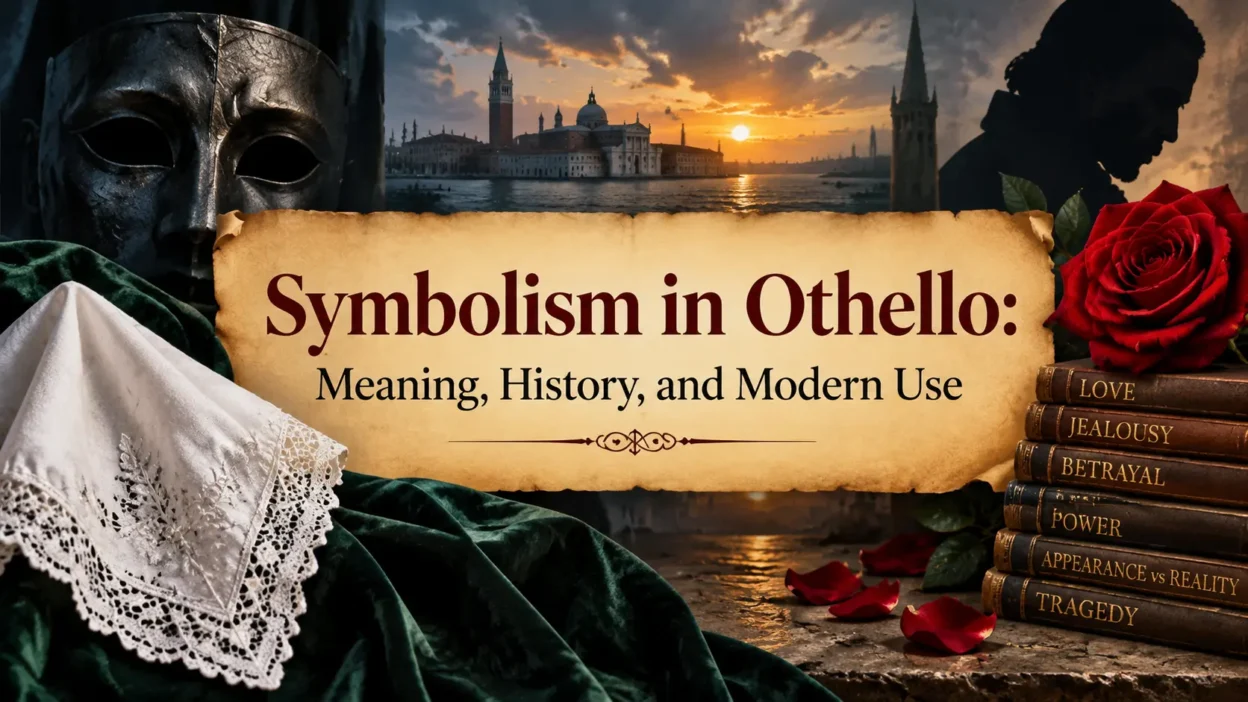
William Shakespeare’s Othello uses symbolism to explore jealousy, trust, race, identity, manipulation, and human emotions. Symbolism in Othello helps readers understand how objects, colors, animals, and repeated images reveal deeper meanings behind the characters’ actions and conflicts. The play’s symbols remain relevant because they connect personal struggles with larger social issues still discussed in modern American culture.
Written around 1603, Othello reflects the concerns of Shakespeare’s time while presenting ideas that continue to appear in modern literature, film, relationships, and discussions about prejudice. Symbols such as the handkerchief, darkness, animals, and the contrast between appearance and reality help explain how jealousy and deception can influence human behavior.
Quick Answer
Symbolism in Othello commonly represents jealousy, betrayal, identity struggles, and the conflict between appearance and reality in modern literary interpretation. Shakespeare also uses symbols such as the handkerchief, colors, and animals to reflect social attitudes, emotional conflicts, and cultural beliefs from the Renaissance period.
TL;DR
- The handkerchief symbolizes love, trust, and betrayal.
- Jealousy appears as a destructive emotional force.
- Colors represent identity, purity, and corruption.
- Animal imagery shows human weakness and disorder.
- Othello reflects historical views on race and outsiders.
- Symbols remain relevant in modern storytelling.
What Makes Symbolism Important in Othello?
Shakespeare rarely explains his themes directly. Instead, he uses repeated images and objects to communicate ideas beneath the surface of the story. In Othello, symbols allow readers to see how characters think, how society judges them, and how emotions can change their decisions.
The tragedy follows Othello, a respected military leader, whose life collapses after Iago manipulates his fears and insecurities. The symbols throughout the play show the gradual movement from love and trust toward suspicion and destruction.
For modern readers, these symbols help explain topics such as emotional manipulation, racism, relationship insecurity, and the danger of accepting appearances without evidence.
The Handkerchief as a Symbol of Love and Betrayal
The most important symbol in Othello is Desdemona’s handkerchief. Othello gives the handkerchief to Desdemona as a meaningful gift connected to their marriage and emotional bond.
The object represents:
- Love between Othello and Desdemona
- Loyalty within marriage
- Trust between partners
- The fragile nature of relationships
The handkerchief becomes more than a simple piece of fabric when Iago uses it as evidence to create a false story about Desdemona’s supposed betrayal.
When the handkerchief falls into Cassio’s possession, Othello believes the object proves Desdemona’s unfaithfulness. However, the symbol itself is innocent. The tragedy comes from the meaning that characters attach to it.
In modern relationships, the handkerchief can be understood as a reminder that objects do not create truth. Personal assumptions and insecurity can change how people interpret situations.
Jealousy as a Symbol of Emotional Destruction
Jealousy is one of the strongest symbolic forces in Othello. Shakespeare presents jealousy as something that grows slowly until it controls Othello’s thoughts and actions.
Iago famously describes jealousy as a destructive emotion that feeds itself. Although Iago manipulates Othello intentionally, Othello’s own fears allow jealousy to take control.
The symbolism of jealousy represents:
- Loss of rational thinking
- Fear of losing love
- Emotional insecurity
- The danger of manipulation
In modern American culture, jealousy is often explored in relationships, entertainment, and psychology. Othello remains relevant because it shows how unchecked suspicion can damage trust between people.
Color Symbolism: Black, White, and Images of Light and Darkness
Color symbolism plays an important role throughout Othello. Shakespeare uses light and darkness to represent emotional and moral conditions.
| Symbol | Meaning in the USA | Common Associations | Notes |
|---|---|---|---|
| Darkness | Fear, uncertainty, hidden truths | Mystery, confusion, danger | Often connected to secrecy in literature |
| Light | Truth, knowledge, clarity | Hope, honesty, understanding | Represents awareness and revelation |
| White | Purity and innocence | Peace, goodness, cleanliness | Often connected with Desdemona |
| Black | Identity and social perception | Race, power, misunderstanding | Reflects historical attitudes toward Othello |
The use of black and white imagery also connects to the racial themes of the play. Othello’s identity as a Black man in Venetian society influences how other characters view him.
Modern readers often examine these symbols carefully because Shakespeare’s use of color reflects both artistic choices and the social beliefs of the Renaissance period.
The Symbolism of Race and Identity in Othello
Race is one of the most discussed symbolic elements in Othello. Othello is respected as a skilled military commander, yet he is also treated as an outsider because he is a Moor living in Venice.
His identity represents the conflict between:
- Personal achievement and social prejudice
- Belonging and exclusion
- Individual character and public judgment
Different characters view Othello differently. Some respect his abilities, while others reduce him to stereotypes. Shakespeare uses Othello’s experiences to explore how society can influence a person’s sense of self.
For modern American audiences, this symbolism connects with ongoing conversations about identity, discrimination, cultural belonging, and the impact of stereotypes.
Animal Imagery and the Loss of Humanity
Animal symbolism appears frequently in Othello, especially through Iago’s language. He often compares people to animals to make them appear less civilized or controlled by basic desires.
Animal images symbolize:
- Instinct over reason
- Disorder and chaos
- Moral corruption
- Dehumanization
Iago uses animal comparisons to manipulate others and create negative impressions. His language encourages characters to see relationships through suspicion rather than understanding.
In modern literature and media, animal imagery is still used to show characters losing control or acting based on anger, fear, or desire.
Iago’s Symbolism: Manipulation and Hidden Evil
Iago is one of Shakespeare’s most complex villains because he rarely reveals his true intentions. His character symbolizes deception, manipulation, and the danger of trusting appearances.
Unlike traditional villains who openly show their goals, Iago presents himself as honest and loyal. The repeated use of the word “honest” around Iago becomes ironic because his public image hides his true nature.
Iago represents:
- Psychological manipulation
- False friendship
- Hidden motives
- The power of language
His character remains relevant today because manipulation through words, rumors, and misinformation continues to affect personal and public relationships.
Desdemona’s Symbolism: Innocence and Vulnerability
Desdemona symbolizes love, loyalty, and innocence. Throughout the play, she attempts to defend her marriage and maintain trust despite Othello’s growing suspicion.
Her character represents:
- Faithfulness
- Compassion
- Emotional strength
- The consequences of unfair judgment
However, Shakespeare also presents Desdemona’s vulnerability within a society where women had limited power. Her inability to protect herself against false accusations highlights issues of gender and authority.
Modern interpretations often examine Desdemona not only as a symbol of innocence but also as a character affected by social expectations.
Venice and Cyprus as Symbolic Settings
The locations in Othello also carry symbolic meaning. Venice represents order, civilization, and social structure. It is a place where Othello has earned respect through his military achievements.
Cyprus, where much of the tragedy occurs, represents uncertainty and instability. Away from Venice’s public order, personal conflicts become stronger.
The movement between these locations symbolizes the shift from:
- Control to chaos
- Public reputation to private conflict
- Stability to destruction
The setting helps show how quickly social balance can collapse when jealousy and deception take control.
Appearance vs. Reality as a Central Symbolic Theme
One of the most important ideas in Othello is the difference between what appears true and what is actually true. Shakespeare builds much of the tragedy around this conflict.
Iago’s success depends on creating false appearances. He presents himself as an honest friend while secretly planning destruction. Othello believes Iago’s words more than Desdemona’s actions, showing how appearances can become more convincing than reality.
This symbolism represents:
- The danger of judging without evidence
- The difference between reputation and character
- How deception can influence decisions
- The difficulty of recognizing hidden intentions
This theme remains meaningful in modern culture because people often face misinformation, rumors, and misleading impressions through social media, news, and personal relationships.
Marriage Symbolism: Love, Trust, and Conflict
The marriage between Othello and Desdemona symbolizes both emotional connection and vulnerability. At the beginning of the play, their relationship represents love that challenges social expectations.
Their marriage symbolizes:
- Trust between two people
- The hope for unity despite differences
- The challenges caused by insecurity
- The importance of communication
However, Iago’s manipulation transforms their marriage from a symbol of love into a symbol of broken trust.
Shakespeare shows that relationships depend not only on affection but also on honesty and confidence. When suspicion replaces communication, even strong connections can become unstable.
For modern audiences, the marriage symbolism in Othello connects with discussions about healthy relationships, emotional control, and the impact of jealousy.
The Symbolism of Reputation and Social Honor
Reputation is another major symbol in Othello. Characters throughout the play worry about how others see them.
For Othello, reputation represents his position, dignity, and acceptance in Venetian society. As a military leader, his public image is extremely important.
Cassio also values reputation because losing his position affects his sense of identity. Iago understands this and uses reputation as a tool for manipulation.
The play suggests that:
- People often connect identity with public opinion
- Reputation can influence personal choices
- Fear of shame can lead to harmful decisions
In modern American culture, reputation continues to influence careers, relationships, and public identity. Online profiles and social media have made this theme even more recognizable.
Historical Origins of Othello’s Symbolic Meanings
Shakespeare wrote Othello around 1603 during the English Renaissance. The play was influenced by European concerns about race, religion, military power, marriage, and social status.
The story is believed to have been inspired by an earlier Italian tale from Hecatommithi by Giovanni Battista Giraldi, known as Cinthio. Shakespeare expanded the original story by adding greater psychological complexity and making Iago one of literature’s most memorable manipulators.
The symbols in Othello developed from the cultural environment of Shakespeare’s time:
- The handkerchief reflected ideas about romantic loyalty.
- Color imagery reflected Renaissance associations with purity and difference.
- Outsider symbolism reflected European attitudes toward foreigners.
- Honor symbolism reflected the importance of social reputation.
Understanding the historical background helps modern readers separate Shakespeare’s artistic choices from the beliefs of the society in which he wrote.
Religious and Moral Symbolism in Othello
Although Othello is not a religious play, it contains many moral symbols connected with ideas of sin, temptation, guilt, and judgment.
Iago’s manipulation can be viewed as a symbol of temptation. He encourages Othello to act based on suspicion rather than truth.
Othello’s downfall reflects a moral conflict between:
- Reason and emotion
- Trust and suspicion
- Justice and revenge
The tragedy shows how destructive choices can develop when people allow fear and anger to control their actions.
Different readers may interpret these symbols through various religious or ethical perspectives, but the central message focuses on human responsibility and the consequences of harmful decisions.
Modern Use of Othello Symbolism in Culture
The symbols of Othello continue to appear in modern storytelling, education, theater, and popular culture.
Common modern uses include:
Literature and Film
Writers and filmmakers often use Othello-like themes when exploring:
- Jealousy between partners
- Betrayal by trusted people
- Social prejudice
- Psychological manipulation
Education
Schools and universities study Othello because its symbols help students examine human behavior, language, and social issues.
Theater and Performance
Modern productions often reinterpret Othello’s symbols through different cultural perspectives, highlighting themes such as race, identity, and power.
Personal Expression
People may reference Othello symbolism when discussing toxic relationships, emotional manipulation, or situations where trust has been damaged.
The play remains relevant because its symbols describe experiences that continue to exist in modern life.
Othello Symbolism in Tattoos, Art, and Design
Although Othello itself is not commonly represented through tattoos like animals or traditional symbols, its themes influence artistic expression.
Artists may use images connected to the play, such as:
- A white handkerchief representing lost trust
- Broken objects representing betrayal
- Dark and light contrasts representing internal conflict
- Masks representing deception
These artistic choices focus less on the literal story and more on the emotional ideas behind it.
In modern visual culture, symbols from literature often become personal representations of experiences such as heartbreak, identity struggles, or overcoming manipulation.
Common Misunderstandings About Othello’s Symbols
Because Othello contains complex themes, some symbols are often misunderstood.
One common mistake is viewing the handkerchief only as a romantic object. It is actually a symbol of how people create meaning based on their beliefs and fears.
Another misunderstanding is seeing Othello’s tragedy only as a story about jealousy. While jealousy is central, Shakespeare also explores race, social pressure, identity, and manipulation.
The symbols should be understood together because each one contributes to the larger message of the play.
Controversies and Changing Interpretations
Modern discussions of Othello often focus on race and representation. Earlier interpretations sometimes treated Othello mainly as a tragic hero destroyed by jealousy. Contemporary readers often examine how racism and social attitudes contribute to his suffering.
Important modern questions include:
- How does society influence Othello’s self-image?
- How does prejudice affect the way others see him?
- How does Iago use existing social tensions?
These discussions do not replace older interpretations. Instead, they expand understanding of the play by considering historical and cultural contexts.
The meaning of Othello continues to evolve because each generation examines its symbols through new experiences.
How Othello’s Symbolism Has Changed Over Time
When Othello was first performed, audiences may have focused more on themes of betrayal, honor, and tragedy. Over time, interpretations have expanded to include discussions of race, gender, psychology, and social power.
The symbols have remained recognizable because they address basic human experiences:
- Wanting acceptance
- Fear of losing love
- Struggling with identity
- Searching for truth
Modern readers often view Shakespeare’s symbols as flexible ideas rather than fixed meanings. The same image can reveal different lessons depending on historical and cultural perspective.
Why Othello’s Symbols Still Matter Today
The lasting importance of Othello comes from its ability to represent problems that still exist. The play examines how emotions, social beliefs, and communication shape human choices.
Its symbols help modern audiences understand:
- Why people believe false information
- How prejudice affects identity
- How trust can be damaged
- Why emotional control matters
The symbols are not only literary devices. They provide ways to discuss real human experiences.
Frequently Asked Questions About Symbolism in Othello
What is the main symbolism in Othello?
The main symbolism in Othello focuses on jealousy, betrayal, trust, identity, and deception. Shakespeare uses objects and images to show how emotions and social pressures influence human behavior.
What does the handkerchief symbolize in Othello?
The handkerchief symbolizes love, loyalty, and trust between Othello and Desdemona. After Iago uses it as false evidence, it becomes a symbol of misunderstanding and betrayal.
How does color symbolism work in Othello?
Color symbolism in Othello often contrasts light and darkness, innocence and corruption, and social acceptance and exclusion. These images help explore both personal emotions and racial identity.
Why is jealousy an important symbol in Othello?
Jealousy symbolizes the destructive effect of suspicion when it replaces trust and reason. Othello’s jealousy allows Iago’s lies to influence his actions.
What does Iago symbolize in Othello?
Iago symbolizes manipulation, deception, and hidden motives. His character shows how dishonesty and psychological control can damage relationships.
How is Othello’s symbolism relevant today?
The symbols remain relevant because modern society still experiences issues involving trust, prejudice, misinformation, and emotional manipulation. The play continues to reflect challenges in human relationships.
Conclusion
Symbolism in Othello represents the complicated relationship between emotions, identity, trust, and social judgment. Through symbols such as the handkerchief, colors, animals, and contrasting settings, Shakespeare reveals how small signs can influence major decisions.
The play’s symbols continue to matter because they address experiences that modern audiences recognize, including jealousy, insecurity, prejudice, and the struggle to understand truth. By examining these symbols, readers can better understand both Shakespeare’s world and the human behaviors that remain familiar today.


