
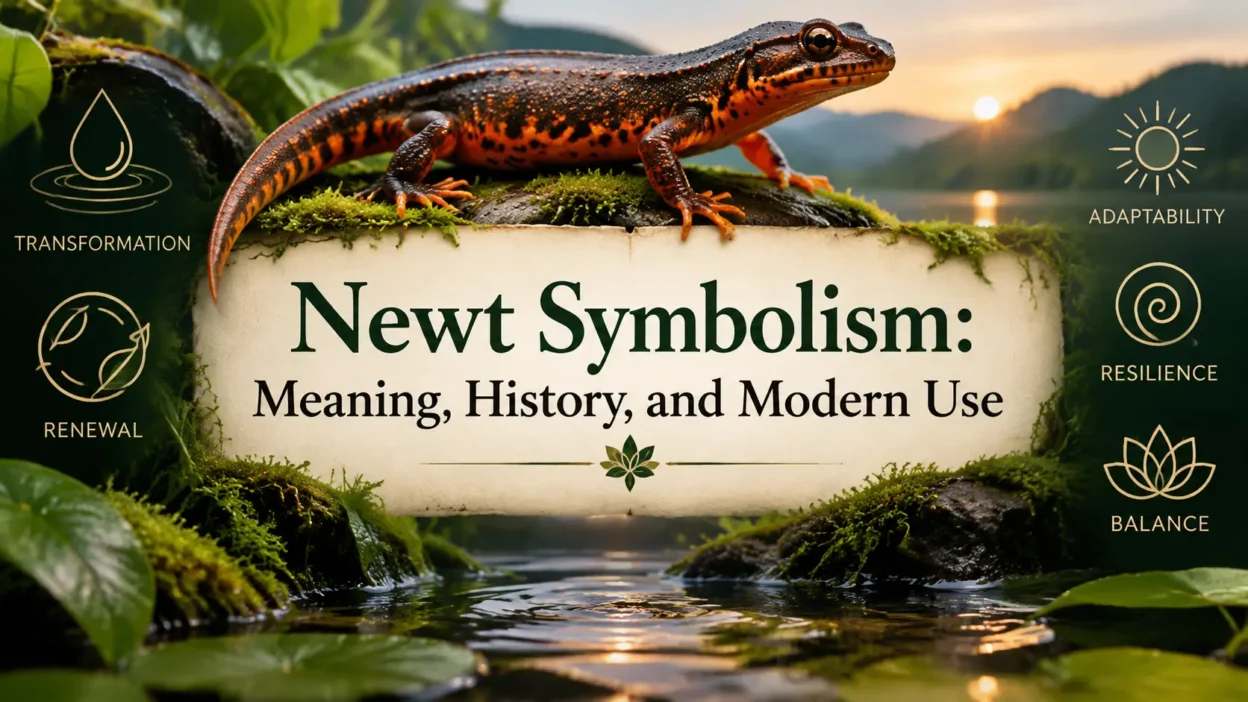
Newts are small amphibians known for their ability to live both in water and on land, their unusual life cycle, and their ability to regenerate certain body parts. Newt symbolism often represents transformation, renewal, adaptability, and the ability to move through different stages of life.
In modern American culture, newts are usually connected with ideas of personal growth, environmental awareness, patience, and survival. Unlike more common symbolic animals such as butterflies or wolves, newts carry a quieter meaning tied to natural cycles, resilience, and hidden changes that happen over time.
Their symbolism comes from their unique biology, ancient folklore, and their relationship with water, which many cultures have associated with emotions, change, and renewal. Today, people may encounter newt imagery in tattoos, nature art, fantasy stories, and environmental conversations.
Quick Answer
Newt symbolism commonly represents transformation, renewal, and adaptability in modern American culture, especially through themes of personal growth, nature, and overcoming change. Historically, newts have also been associated with regeneration, water symbolism, folklore, and the mysterious cycles of life.
TL;DR
- Newts symbolize transformation and personal renewal.
- Their regeneration connects them with healing themes.
- Water habitats represent emotional change and adaptation.
- Folklore linked newts with mystery and natural forces.
- Modern uses focus on nature and resilience.
What Is a Newt and Where Is It Found?
A newt is a type of salamander that spends part of its life in water and part on land. These small amphibians usually have slender bodies, tails, and smooth skin. Many species display bright colors, especially during breeding seasons, while others have more muted natural patterns that help them blend into their surroundings.
Newts are found in parts of North America, Europe, and Asia. In the United States, they are commonly associated with wetlands, ponds, forests, and clean freshwater environments. Because they depend on healthy ecosystems, newts are often viewed as indicators of environmental balance.
Their unusual life cycle makes them different from many other animals. They begin life as aquatic larvae, transform as they mature, and some species return to water for reproduction. This natural process has contributed to their connection with change and transformation.
What It Commonly Means in the United States
In the United States, newts do not have one single widely recognized meaning like the bald eagle or butterfly. However, people who use newt imagery often connect it with ideas based on the animal’s natural characteristics.
The most common interpretations include:
| Context | Meaning in the USA | Common Associations | Notes |
|---|---|---|---|
| Personal growth | Transformation and change | New beginnings, adaptation | Based on the newt’s life cycle |
| Nature symbolism | Environmental balance | Wetlands, conservation | Linked with ecological awareness |
| Tattoos | Resilience and renewal | Healing, survival | Often chosen for personal journeys |
| Folklore art | Mystery and hidden knowledge | Water, magic, nature | Inspired by old European stories |
Newts often appeal to people who value quiet strength rather than obvious displays of power. Their symbolism focuses on gradual improvement, survival, and adapting to new conditions.
Ancient Roots and Early Symbolism
The symbolic meaning of newts developed from human observations of amphibians in general. Ancient communities noticed that creatures living between water and land seemed to cross natural boundaries.
Because amphibians experience major physical changes during their development, many cultures connected them with ideas of transition. The movement between aquatic and terrestrial environments also encouraged associations with different worlds, including emotional, spiritual, and natural spaces.
In European folklore, salamanders and similar creatures sometimes appeared alongside stories about elemental forces. However, many historical references focused more broadly on salamanders rather than specifically on modern scientific classifications of newts.
Over time, newts became associated with themes of renewal because people observed their ability to survive environmental changes and, in some species, regenerate damaged body parts.
Newt Symbolism and Transformation
Transformation is one of the strongest meanings connected with newts. Their life cycle naturally demonstrates change, from aquatic beginnings to adult forms capable of living in different environments.
This symbolism can represent:
- personal development
- changing identity
- emotional growth
- adapting to new situations
- moving from one life stage to another
In modern storytelling, animals that transform often represent characters who discover new abilities or enter different phases of life. Newts fit this theme because their transformation is biological rather than dramatic.
For many people, the newt represents the idea that change does not happen instantly. Growth can be gradual, quiet, and unnoticed until the results become visible.
Regeneration, Healing, and Renewal
Some newt species have remarkable regenerative abilities. They can regrow certain tissues, including parts of limbs and organs, which has made them important subjects in scientific research.
Because of this ability, newts are often connected with:
- recovery after hardship
- healing processes
- rebuilding after loss
- starting again
In symbolic use, a newt does not suggest avoiding difficulties. Instead, it represents the ability to continue after challenges and rebuild in a different form.
This interpretation has made newts appealing symbols for people who want artwork or personal reminders connected with recovery and resilience.
Water Symbolism and Emotional Meaning
Newts spend much of their lives near water, which adds another layer to their symbolism. Across many cultures, water has represented emotions, memory, cleansing, and renewal.
A newt near a pond or stream may symbolize:
- emotional balance
- connection with nature
- inner change
- peaceful adaptation
Unlike animals associated with speed or dominance, newts represent patience. They move through environments carefully and survive by adjusting rather than overpowering their surroundings.
In psychological symbolism, the newt can represent accepting change instead of fighting against it.
Newt Symbolism in American Nature Culture
Environmental awareness has become one of the strongest modern connections with newts in the United States. Because newts require clean water and healthy habitats, conservation groups often use amphibians as examples of ecosystem health.
Newts can symbolize:
- protection of wetlands
- respect for biodiversity
- connection between humans and nature
- responsibility toward fragile environments
Many Americans encounter newt imagery through wildlife education, parks, nature documentaries, and conservation campaigns rather than traditional mythology.
Their symbolism reflects a growing appreciation for smaller creatures that play important roles in ecosystems.
Newts in Folklore and Mythology
Newts appear less frequently in mythology than larger symbolic animals, but they share connections with broader amphibian and salamander traditions.
European folklore sometimes described salamanders as magical creatures linked with fire, transformation, or hidden natural forces. Newts, while scientifically different, became connected to some similar ideas because of their unusual appearance and association with water.
In folklore traditions, amphibian creatures often represented the boundary between familiar and unknown places. They lived in environments that humans could observe but not always fully understand.
Modern interpretations usually separate scientific facts from folklore, viewing newts as symbols of natural adaptation rather than supernatural beings.
Newt Symbolism in Tattoos and Personal Expression
Newt tattoos are less common than butterfly, snake, or bird designs, which makes them a more unusual personal symbol. People who choose newt tattoos often want imagery that feels unique and connected to nature.
Common meanings behind newt tattoos include:
- personal transformation
- survival after difficult experiences
- connection with wildlife
- appreciation for hidden beauty
- patience during change
A realistic newt tattoo may highlight nature and conservation, while a fantasy-style design may emphasize imagination and folklore.
The meaning depends heavily on the person’s story, but the central theme is usually adaptation and renewal.
Newt Symbolism in Fashion, Art, and Design
Newts are not among the most common animal symbols in mainstream fashion, but their unusual appearance makes them appealing in nature-inspired and fantasy-based designs. Their connection with forests, ponds, and hidden ecosystems gives them a natural, earthy character.
In art, newts are often used to represent:
- harmony with the natural world
- quiet transformation
- curiosity and discovery
- overlooked beauty in small creatures
Artists may include newts alongside plants, mushrooms, water scenes, and woodland environments to create a feeling of balance and connection with nature.
In fantasy artwork, newts sometimes appear as magical or mysterious creatures because of their association with folklore. Their ability to move between water and land makes them visually suitable for stories about transitions between different worlds or states of being.
Unlike symbols that represent status or strength, newt imagery usually communicates subtle qualities. It suggests observation, patience, and respect for natural processes.
Newt Symbolism in Home Decor
Nature-inspired home decor has increased interest in small wildlife symbols, including amphibians like newts. While newts are not a traditional household symbol in the United States, they may appear in artwork, garden designs, and nature-themed decorations.
A newt image in home spaces may represent:
- peaceful connection with nature
- appreciation for ecosystems
- a calm and reflective environment
- renewal and fresh beginnings
People who enjoy woodland, cottage, or garden styles may use amphibian imagery because it creates a connection with outdoor spaces.
A pond garden featuring newts or other aquatic life can also symbolize balance between human spaces and the natural environment. In this sense, the newt becomes less about decoration and more about respecting the living world around us.
Cross-Cultural Meanings of Newts and Related Amphibians
The specific symbolism of newts varies across cultures, but many traditions have given meaning to amphibians because of their unusual relationship with water and land.
European Traditions
European folklore often grouped newts with salamanders and other amphibious creatures. These animals were sometimes connected with transformation because they appeared to exist between two environments.
Some folk traditions viewed salamander-like creatures as mysterious beings connected with natural elements. However, these stories often reflected imagination and folklore rather than scientific understanding.
East Asian Perspectives
In some East Asian traditions, salamanders and related creatures appear in stories about nature, longevity, and unusual abilities. Amphibians are sometimes connected with water environments and the importance of living in harmony with natural cycles.
Indigenous Perspectives
Many Indigenous cultures in North America have traditions that emphasize respect for animals as part of a larger ecosystem. While specific meanings differ among nations and communities, amphibians can represent relationships with waterways, seasonal changes, and environmental responsibility.
It is important to recognize that there is no single universal “native meaning” for newts. Symbolic interpretations depend on specific cultural traditions and local relationships with the animal.
The Emotional and Psychological Meaning of Newts
From a psychological perspective, animals often become symbols because humans recognize qualities in nature that reflect personal experiences. The newt’s life cycle creates a natural connection with emotional themes of change and recovery.
Newt symbolism may represent:
Acceptance of Change
Newts demonstrate that change is a normal part of life. Their transformation from aquatic larvae to adult animals reflects the idea that identity can develop over time.
Quiet Resilience
Newts do not represent aggressive survival. Instead, they survive through patience, adjustment, and adaptation. This can appeal to people who value steady progress rather than dramatic achievement.
Hidden Potential
Because newts are small and often unnoticed, they can symbolize abilities or strengths that are not immediately visible.
This interpretation connects with the idea that important growth can happen privately before others recognize it.
Positive and Negative Associations of Newt Symbolism
Most modern interpretations of newts are positive, but symbols can change depending on cultural context.
| Symbolic View | Positive Meaning | Possible Negative Interpretation |
|---|---|---|
| Transformation | Growth and new beginnings | Fear of unfamiliar change |
| Water connection | Emotional balance | Emotional uncertainty |
| Small size | Humility and hidden strength | Being overlooked |
| Mystery | Curiosity and imagination | Misunderstanding the unknown |
In modern American culture, newts are rarely associated with negative meanings. However, historical folklore sometimes portrayed amphibious creatures as strange or unfamiliar, which reflected older fears about animals people did not understand.
Today, scientific knowledge has shifted many perceptions from fear toward appreciation.
Newt Symbolism in Modern Pop Culture
Newts appear occasionally in books, movies, games, and fantasy settings. They are often used because their real-world characteristics create interesting fictional possibilities.
Common fictional themes include:
- magical transformation
- unusual abilities
- connection with nature
- wisdom from observing the natural world
Fantasy writers may use newt-like creatures to represent beings that exist between categories. Their ability to survive in multiple environments makes them useful symbols for characters who adapt to changing circumstances.
Compared with popular animals like dragons, wolves, or lions, newts usually appear in more specialized stories. Their appeal comes from uniqueness rather than popularity.
Common Misunderstandings About Newt Symbolism
Because newts are less familiar than many symbolic animals, several misunderstandings exist around their meaning.
Newts Are Not the Same as All Salamanders
People often use the words interchangeably, but newts are a specific group within salamanders. All newts are salamanders, but not all salamanders are newts.
Newts Do Not Have One Universal Meaning
There is no single symbolic definition accepted by every culture. Meanings develop through biology, folklore, personal experiences, and cultural traditions.
Regeneration Does Not Mean Immortality
Because some newts can regenerate body parts, people sometimes exaggerate their abilities. Their symbolism should be based on real biological traits rather than myths about endless life.
Folklore Is Different From Science
Stories about magical amphibians can be interesting, but they should not be confused with scientific facts about actual newts.
Understanding these differences helps preserve both cultural traditions and accurate knowledge.
How Newt Symbolism Has Changed Over Time
The meaning of newts has shifted as human relationships with nature have changed.
In older folklore, amphibians were often viewed through mystery and imagination. Their unusual appearance and connection with water made them creatures that inspired stories about hidden worlds.
Modern interpretations focus more on ecology, adaptation, and scientific discovery. Research into regeneration has given newts a stronger association with healing and biological resilience.
In the United States today, newts are increasingly viewed through environmental awareness. They represent fragile ecosystems, the importance of clean water, and the value of protecting small species.
This evolution shows how symbols change as societies gain new knowledge and develop new relationships with the natural world.
Frequently Asked Questions About Newt Symbolism
What does a newt symbolize spiritually?
A newt is often associated with transformation, renewal, and adaptation. While spiritual meanings vary between individuals and traditions, many people view the animal as a reminder that personal growth happens through different stages of life.
What does a newt tattoo symbolize?
A newt tattoo commonly represents change, resilience, healing, and a connection with nature. People may choose this design after a major life transition or as a symbol of overcoming challenges.
Are newts considered a symbol of good luck?
Newts are not widely recognized as traditional good luck symbols in American culture. However, some people interpret their connection with renewal, survival, and natural balance as positive signs.
What is the difference between newt and salamander symbolism?
Newts and salamanders share similar symbolic themes because newts are a type of salamander. Both are often connected with transformation and nature, but newts have a stronger association with water, life cycles, and environmental balance.
What does a newt represent in dreams?
Dream interpretations vary, but a newt in a dream may be connected with personal change, hidden abilities, emotional adjustment, or the need to adapt to a new situation. The meaning depends on the dreamer’s experiences and feelings.
Why are newts connected with transformation?
Newts are connected with transformation because they experience major changes during their life cycle and can live in both aquatic and land environments. Their biology naturally reflects movement from one stage of existence to another.
Is newt symbolism positive or negative?
Newt symbolism is generally positive in modern interpretations. It is most often connected with growth, healing, patience, and environmental awareness, although older folklore sometimes viewed amphibians as mysterious or unfamiliar creatures.
Conclusion
Newts represent a unique form of symbolism built around change, adaptation, and connection with the natural world. Their ability to move between water and land, along with their remarkable biological traits, has inspired meanings related to renewal, resilience, and personal growth.
In modern American culture, newt symbolism is mainly understood as a reminder that transformation can happen slowly and that even small creatures can represent important ideas. From nature art and tattoos to conservation discussions, newts reflect patience, survival, and respect for life’s changing stages.
Rather than representing dramatic power, the newt symbolizes a quieter kind of strength: the ability to adjust, recover, and continue growing in changing environments. Its meaning comes from both human imagination and the real qualities of the animal itself.


