
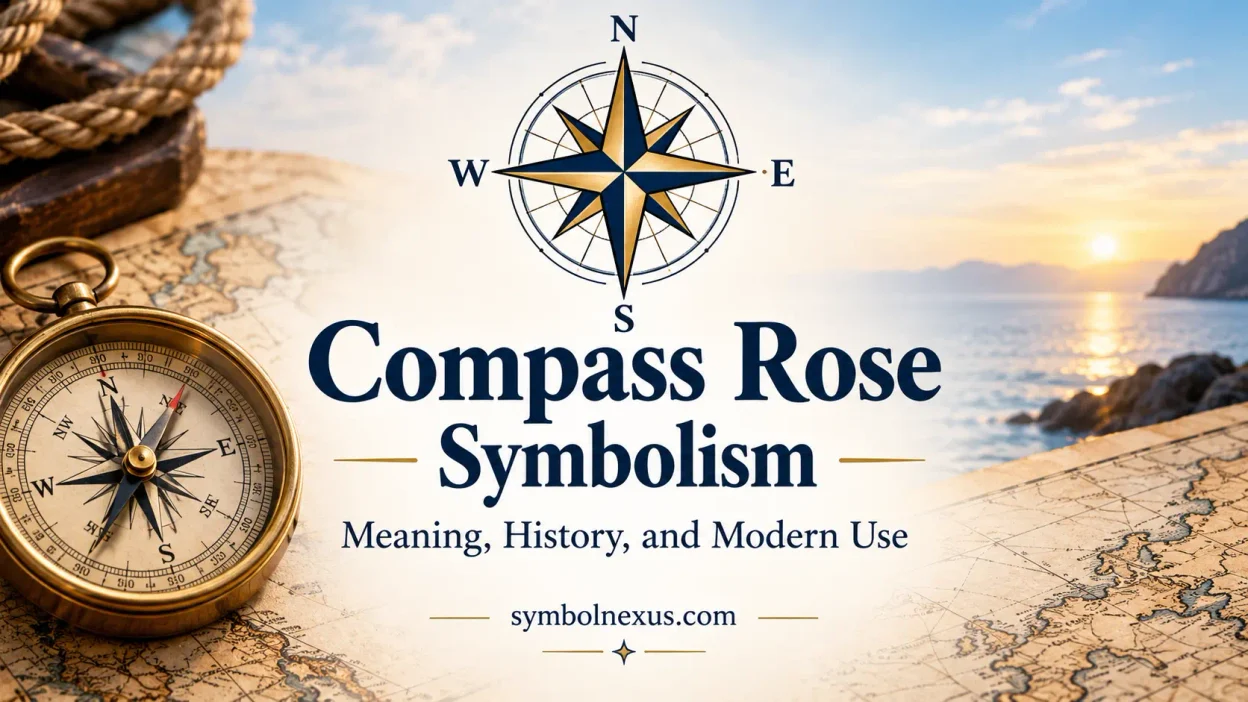
Compass rose symbolism centers on direction, guidance, exploration, and the search for a meaningful path. A compass rose is the star-shaped design found on maps and nautical charts that identifies north, south, east, west, and sometimes the smaller directions between them. Today, many Americans also recognize it as a symbol of independence, travel, self-discovery, and staying true to personal values.
The symbol connects practical navigation with a familiar human experience: deciding where to go when the next step is uncertain. A compass rose can appear on an antique map, a sailing chart, a hiking accessory, a classroom globe, or a tattoo commemorating a major life change. Although its meaning depends on the setting, the central idea is usually orientation, whether that means finding a physical destination or choosing a direction in life.
Understanding the compass rose requires looking at both its historical function and its modern interpretations. Its original purpose was to help people read directions accurately, but its recognizable shape has also become a visual shorthand for adventure, confidence, and the desire to find one’s way.
Quick Answer
Compass rose symbolism commonly represents direction, guidance, exploration, and finding your own path in modern American culture. Historically, it helped sailors and map readers navigate unfamiliar places, while its decorative forms also reflected the artistic and cultural traditions of the people who created nautical charts.
TL;DR
- Direction: The compass rose identifies the cardinal directions and helps people orient themselves.
- Guidance: It can represent reliable advice, inner values, or a clear sense of purpose.
- Exploration: Its nautical history connects it with travel, discovery, and adventure.
- Independence: Modern tattoos often express self-reliance and personal freedom.
- Stability: The fixed directions suggest having a reference point during uncertain times.
- Cultural history: Older compass roses sometimes included decorative or religious symbols.
What a Compass Rose Looks Like and What It Does
A compass rose is a circular or star-shaped figure marked with directional points. Its simplest form identifies north, south, east, and west. More detailed designs include eight, sixteen, or thirty-two points, allowing a reader to distinguish directions more precisely.
On a traditional map, north is often placed at the top, but that convention is not universal across every historical map. The compass rose helps readers understand orientation even when a chart is rotated or its layout differs from modern expectations. On nautical charts, circular markings may also distinguish true north from magnetic north, which are not always aligned.
The design’s name comes from its resemblance to a flower with pointed petals. Its visual structure makes it easy to recognize, even when reduced to a small icon or simplified into a tattoo.
People may encounter compass roses on:
- Nautical charts, atlases, and antique maps
- Navigation equipment and sailing memorabilia
- Hiking gear, outdoor clothing, and travel accessories
- Tattoos, pendants, and engraved jewelry
- Wall art, decorative maps, and home furnishings
- School materials used to teach map reading
The practical function matters because the symbol’s familiar meanings developed from its role in helping people understand where they were and where they could go.
The Core Symbolism of Direction and Guidance
Direction is the most direct meaning of a compass rose. It distinguishes one way from another and gives a person a reference point for movement. Symbolically, this can suggest having a plan, making a decision, or recognizing which course best fits a goal.
Guidance is a closely related meaning. A compass does not choose a destination for its user; it helps the user determine orientation. For this reason, a compass rose can represent a mentor, a trusted principle, a personal belief, or a practical method for making decisions.
Consider someone beginning a new career after years in an unrelated field. A compass rose might represent the values that help that person choose a direction, rather than a guarantee that every decision will be correct. Similarly, someone rebuilding a routine after a major change might use the symbol as a reminder to take the next step deliberately.
The compass rose can also represent discernment. Having many possible routes does not necessarily mean knowing which one to take. The symbol points toward the importance of orientation before movement.
Finding Your Path and Defining Personal Purpose
In modern American culture, the compass rose is often interpreted as a symbol of finding one’s way. This meaning can refer to literal travel, but it can also describe a personal journey involving education, work, family, identity, or changing priorities.
The image is especially suited to moments when someone is choosing between competing possibilities. A person may feel pulled toward a new opportunity while remaining attached to familiar surroundings. The compass rose offers a simple visual reminder that a direction can be chosen even when the entire journey is not yet clear.
Its meaning differs from a map. A map shows features, routes, and destinations, while a compass rose establishes orientation. In personal symbolism, this distinction can suggest that purpose begins with understanding one’s position and values before deciding on a destination.
The symbol does not necessarily imply that there is one predetermined path. For some people, it represents the freedom to choose a direction and change course as experience provides new information.
Exploration, Adventure, and the Call of the Unknown
Because compass roses are closely associated with navigation, they naturally evoke exploration. They may bring to mind ocean crossings, unfamiliar coastlines, long road trips, wilderness trails, and journeys into places a person has never visited.
In the United States, this interpretation fits familiar cultural images of road trips, national parks, backpacking, sailing, and independent travel. A compass rose on a travel journal or outdoor accessory can signal curiosity and a willingness to leave familiar routines behind.
Exploration does not have to involve crossing a border or traveling far from home. It may mean learning a new skill, entering a different profession, or encountering ideas that challenge established assumptions. The symbol can stand for curiosity and the readiness to navigate unfamiliar situations.
However, adventure is only one possible meaning. A compass rose on a nautical chart is first a directional tool, not necessarily a declaration of courage or a desire for risk. Its interpretation as an adventurous emblem comes from the experiences and stories associated with navigation.
Historical Origins: From Wind Directions to Compass Roses
The compass rose developed from older ways of representing winds and directions. Early navigators needed practical methods to describe where winds came from and how ships should travel. Wind roses organized directional information, eventually becoming connected with the compass systems used in maritime navigation.
By the late medieval period, compass roses had become established features of European nautical charts. The Catalan Atlas of 1375 is commonly associated with the early use of a decorated compass rose on a map. Over time, cartographers developed more elaborate designs with multiple directional points, colored lines, and distinctive markers.
These figures were more than decoration. On charts without the latitude-and-longitude grid familiar to modern map users, networks of directional lines helped readers understand bearings and relationships between places. A compass rose could be essential for orientation, particularly when the map was not arranged with north at the top.
As cartographic methods advanced, standardized coordinates made some traditional directional features less necessary for basic navigation. Compass roses nevertheless remained on many maps because they were useful, recognizable, and visually distinctive. Their survival illustrates how a practical instrument can also become a lasting graphic symbol.
What Compass Roses Meant to Sailors and Early Mapmakers
For sailors, the compass rose was closely tied to the practical problem of crossing water without obvious landmarks. A ship at sea could not always rely on mountains, roads, or visible coastlines to determine its position. Directional information helped navigators plot courses and relate one location to another.
The symbol therefore carries associations with skill, preparation, and measured judgment. Successful navigation required more than confidence. It depended on reading charts, understanding instruments, observing conditions, and responding when the intended course became unsafe or impractical.
Early mapmakers also gave compass roses distinctive visual treatments. Some emphasized the north point with an arrowhead or a fleur-de-lis, a stylized lily form. Other historical designs used crosses or additional decorative marks to distinguish directions. The exact meaning depended on the chart, its creator, and its cultural setting.
For modern readers, these historical details add another layer to the symbol. The compass rose can represent not only the wish to travel, but also the knowledge and careful decisions required to travel well.
Compass Rose Symbolism in American Culture
In the United States, the compass rose has no single official cultural meaning beyond its directional function. Its broader associations come from maritime history, mapmaking, outdoor recreation, travel, and the familiar idea of choosing one’s own path.
American culture often links navigation with independence. Road trips, wilderness journeys, sailing, and cross-country travel all involve making decisions about where to go and how to get there. A compass rose can therefore suggest self-reliance, preparation, and the ability to make progress without knowing every detail in advance.
The symbol also appears in educational settings, where children learn to identify north, south, east, and west. On a classroom map, it is a practical teaching aid. On a graduation gift, however, the same design might suggest entering a new stage of life. Context changes the interpretation without erasing the symbol’s basic connection to direction.
It is important not to confuse these personal meanings with official national symbolism. The compass rose is not the national emblem of the United States, nor does it have one universally recognized political or religious meaning. Its flexibility is part of what makes it useful in American design.
The Emotional and Psychological Meaning of a Compass Rose
A compass rose can represent the desire for stability during uncertainty. When people face a major decision, they may not know the final outcome, but they often want a reliable way to judge their next move. The symbol offers a visual expression of that need for orientation.
Its emotional meaning may also involve confidence. A person who has overcome a difficult period might associate a compass rose with learning to make decisions independently. Someone beginning a new chapter could use it as a reminder to stay connected to personal priorities while adapting to changing circumstances.
The symbol can also express belonging. A traveler might associate it with a hometown, a family member who loved the sea, or a place where an important experience occurred. When combined with coordinates or a date, the design can become a record of a specific memory rather than a general statement about adventure.
There is no scientific rule that gives a compass rose one fixed psychological meaning. Its effect depends on the person’s experiences, beliefs, and associations. For one individual, it may suggest freedom; for another, responsibility, careful planning, or the comfort of having a reference point.
Religious and Cross-Cultural Interpretations
The compass rose is primarily a navigational design, not a universal religious symbol. However, historical versions sometimes incorporated imagery that carried cultural or spiritual meaning. These details should be interpreted in their original setting rather than treated as proof that every compass rose has a religious message.
In some European nautical charts from the late medieval and early modern periods, the north point was marked with a fleur-de-lis, a stylized lily. The design could function as a decorative directional marker while also recalling heraldic or Christian associations. Some charts marked east with a cross, a choice connected in certain European traditions with the religious importance of Jerusalem.
These conventions were not universal. The appearance of a religious mark depended on the cartographer, location, period, and purpose of the chart. It is inaccurate to assume that all fleur-de-lis compass roses were intended as religious statements or that every historical compass rose expressed the same worldview.
Navigation and mapmaking also developed through contact among different societies. Knowledge of magnetic direction, navigational instruments, and chartmaking moved across regions through trade, travel, and cultural exchange. The compass rose belongs to this broader history of practical knowledge rather than to one culture alone.
For modern Americans, the design can be used in religious or spiritual contexts, but those interpretations are personal unless a specific tradition gives them a defined meaning. Someone might connect it with faith as a guide for life, while another person may choose it solely for its nautical appearance.
Compass Rose Symbolism in Tattoos and Personal Style
Compass rose tattoos are often chosen to represent direction, independence, travel, or a personal turning point. Their meaning can be especially individual because the wearer may connect the design with a journey, a relationship, a hometown, or a decision that changed the course of life.
A tattoo does not have to represent a completed journey. It might instead express an intention to live according to certain values or remain open to new experiences. Someone recovering from a difficult transition could choose a compass rose as a reminder that uncertainty does not prevent forward movement.
Design choices can add personal meaning:
- A simple four-point rose may emphasize clarity, balance, or the basic idea of direction.
- An elaborate nautical rose can highlight an interest in sailing, navigation, or maritime history.
- A compass rose with coordinates may identify a meaningful place, such as a birthplace or a location associated with a major life event.
- A compass rose combined with a ship or anchor can emphasize a connection to the sea, travel, or a maritime family background.
- A weathered or incomplete design may be used to express a period of uncertainty or a journey that remains unfinished.
These are common interpretive possibilities, not fixed rules. Two people with nearly identical tattoos may have entirely different reasons for choosing them. The wearer’s own explanation is more reliable than assumptions based on the image alone.
How Color and Design Change the Meaning
The traditional compass rose often uses contrasting points, fine lines, and a central star-like form. Some versions are highly detailed, while others use only a few clean strokes. The design can influence what viewers notice first, although color and style do not carry universal meanings.
| Design choice | Possible interpretation | Common context |
|---|---|---|
| Black or monochrome rose | Simplicity, restraint, or a classic nautical look | Tattoos, maps, minimalist decor |
| Blue accents | A visual connection with water or the sea | Maritime art, travel accessories |
| Gold or antique tones | Historic cartography and traditional craftsmanship | Vintage maps, framed prints |
| Four-point design | Basic orientation and clarity | Educational graphics, simple jewelry |
| Detailed multi-point rose | Precision, navigation, and traditional mapmaking | Nautical charts, elaborate tattoos |
These associations are suggestions, not a standard symbolic code. Blue, for example, may remind one person of the ocean but simply be a favorite color to someone else. Likewise, a gold-toned compass rose might be selected for its appearance rather than as a statement about wealth or status.
The shape also matters. A balanced, symmetrical rose can suggest order, while a more ornate version draws attention to artistry and historical detail. Neither form is inherently more meaningful than the other. The design becomes significant through the context in which it is used.
Compass Roses in Home Decor, Jewelry, and Modern Design
In home decor, a compass rose frequently appears on wall maps, framed nautical charts, globes, and travel-themed accessories. It can suit a room designed around sailing, exploration, geography, or outdoor interests. In these settings, the symbol often creates a sense of movement and connection to places beyond the home.
Jewelry offers a more personal use. A compass rose pendant, bracelet charm, or engraved ring may be given to someone leaving home, starting college, beginning a new job, or preparing for travel. The gift can communicate encouragement without promising that the journey will be easy.
In graphic design, the symbol can identify travel services, outdoor brands, navigation tools, educational materials, or organizations connected with exploration. Its directional structure makes it recognizable at a glance, which helps explain why it works as an icon even when its original navigational purpose is not relevant.
Digital maps and location-based applications have also changed how people experience direction. Users can receive turn-by-turn instructions from a phone without interpreting a traditional nautical chart. A compass rose in a digital interface may therefore function as a practical orientation tool, while a decorative version on a personal profile or travel post may signal an interest in discovery.
Not every modern use carries a hidden message. Sometimes the design is simply attractive, familiar, or appropriate for a nautical theme. Reading it accurately means distinguishing the image’s established associations from the intentions of the person or organization using it.
Positive and Negative Meanings of the Compass Rose
The compass rose is generally associated with positive ideas such as guidance, independence, preparation, and exploration. Its directional function makes it an easy symbol for having a plan or finding a route through unfamiliar territory.
However, its meanings can be more complicated. A compass rose may remind someone of a journey that ended badly, a place they had to leave, or a period when they felt unsure about their future. The symbol itself does not make these experiences positive or negative; the person’s history shapes the emotional association.
It can also suggest the pressure to choose a direction. When people feel expected to have a clear career, relationship, or life plan, the idea of finding one’s way may feel demanding rather than reassuring. In that context, the compass rose could represent the challenge of making a decision instead of confidence that the answer is already known.
There is no widely established tradition in which a compass rose is inherently an unlucky sign. Claims that a particular design automatically brings good fortune, prevents misfortune, or guarantees safe travel should be treated as personal beliefs rather than verified properties of the symbol.
Common Misunderstandings About Compass Rose Symbolism
One common misunderstanding is that a compass rose and a compass are exactly the same thing. A compass is a navigational instrument, often containing a magnetized needle, while the compass rose is a graphic representation of directions. The two are closely related, but they serve different functions.
Another mistake is assuming that the compass rose has always meant personal freedom or self-discovery. Those are modern interpretations that developed from the broader experience of navigation and travel. Historically, the design’s primary job was to communicate direction on a chart.
It is also misleading to assume that every compass rose points to a literal destination. In a tattoo or decorative object, the design may refer to personal values, family history, or an interest in geography rather than a particular place.
Finally, a compass rose should not automatically be interpreted as a religious, political, or spiritual statement. Some historical examples contain culturally meaningful decorations, but many are primarily practical or artistic. The surrounding imagery, the period, and the creator’s intentions matter when interpreting a specific example.
How to Interpret a Compass Rose in Your Own Life
If a compass rose catches your attention, start with the setting. A design on an antique nautical chart may invite questions about navigation and mapmaking, while the same image on a graduation gift may suggest guidance during a transition.
Next, consider what direction means in that situation. It could refer to a literal route, a career decision, a family connection, or the values someone wants to follow. Avoid assuming that the symbol must mean adventure simply because it resembles a navigational instrument.
The surrounding details can provide clues. Coordinates may point to a meaningful location. A ship or anchor may indicate a maritime connection. A religious emblem could introduce a spiritual interpretation, depending on the design and its history.
Personal associations are equally important. Ask what the compass rose reminds you of, whether it marks a particular experience, and why it feels relevant now. These questions are more useful than trying to find one universal definition for every example.
Ultimately, the symbol can remind a person that knowing a direction is not the same as knowing every step ahead. It represents a reference point that helps make movement possible, even when the route must change along the way.
Frequently Asked Questions
What does a compass rose symbolize spiritually?
A compass rose may represent guidance, purpose, or the desire to stay aligned with personal or religious values. This is a modern interpretive use rather than a universal doctrine shared by all spiritual traditions.
Is a compass rose a symbol of good luck?
There is no broadly established rule that a compass rose guarantees good luck. Some people may associate it with safe travel or favorable direction, but those meanings reflect personal beliefs rather than a proven effect.
What does a compass rose tattoo mean?
A compass rose tattoo often represents direction, independence, travel, or a meaningful life transition. The wearer’s experiences, accompanying symbols, and design choices determine the most personal interpretation.
What is the difference between a compass and a compass rose?
A compass is a tool used to determine direction, usually with a magnetized needle. A compass rose is the directional figure shown on maps and charts, although the term is also used for decorative designs inspired by navigational instruments.
Does the compass rose have a Christian meaning?
Some historical European compass roses included a cross or a fleur-de-lis, which could carry Christian associations in their original context. The compass rose as a whole is not exclusively Christian, and many examples have no intended religious meaning.
Why is the compass rose associated with travel?
Its original role was to help people interpret direction and navigate routes, especially on nautical charts. That practical connection made it a natural emblem for exploration, journeys, and discovering unfamiliar places.
Can a compass rose symbolize feeling lost?
Yes. A person may use the design to represent a difficult transition, uncertainty, or the process of finding direction again. This interpretation is personal and does not mean the symbol is inherently negative.
Conclusion
Compass rose symbolism begins with the practical need to understand direction and extends into modern ideas about guidance, purpose, exploration, and independence. Its history in nautical charts explains why the design remains associated with journeys, while its adaptable shape allows people to give it personal meaning in tattoos, gifts, jewelry, and decor.
In the United States, the compass rose can represent anything from a love of travel to a reminder to make decisions according to one’s values. Its meaning is not fixed by the design alone; historical context and personal experience both matter.
A compass rose does not promise a perfect route or remove uncertainty. It offers a more grounded idea: having a point of reference can help you decide where to go next.