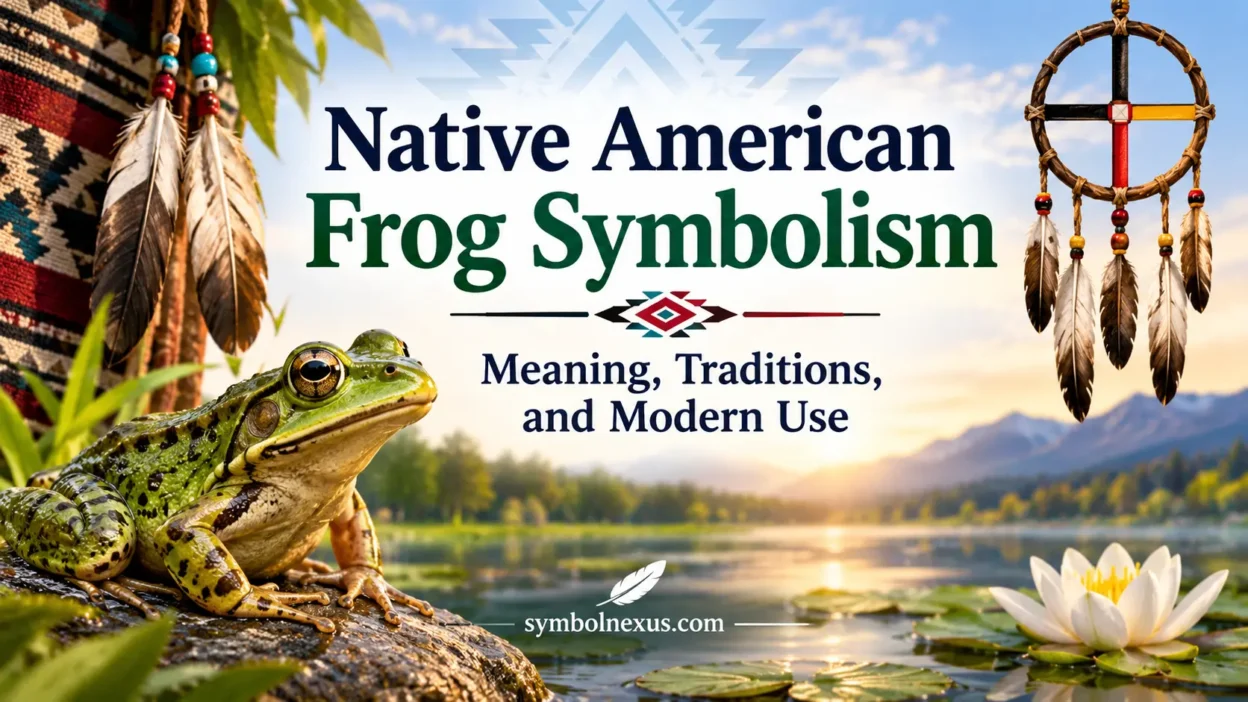
Native American frog symbolism is not one single belief shared by every Indigenous nation. In some Native American traditions, frogs are connected with water, rain, seasonal change, fertility, healing, or renewal. Their meanings depend on the nation, its stories, its environment, and the role frogs play in its cultural traditions.
Frogs live between different environments. They may begin life in water, develop through several stages, and later move onto land. Their connection to wetlands, rainfall, and changing seasons makes them meaningful figures in many cultural traditions. However, these natural qualities should not be mistaken for a universal Indigenous teaching.
In the United States, people encounter frog imagery in Indigenous art, stories, contemporary designs, and discussions of spiritual symbolism. Understanding this imagery requires more than assigning a simple meaning to the animal. It also means respecting the distinct histories and living cultures of Native American peoples.
Quick Answer
Native American frog symbolism can be associated with water, rain, renewal, fertility, and transformation, depending on the Indigenous nation and its traditions. Frogs may appear in stories, artistic designs, and teachings connected with the natural world, but there is no single frog meaning shared by all Native American cultures.
TL;DR
- Frog meanings vary among Indigenous nations and communities.
- Water and rain are important associations in some traditions.
- Frog life cycles can suggest change and renewal.
- Indigenous stories may connect frogs with environmental relationships and community teachings.
- Frog designs in Native art have specific cultural contexts.
- Modern interpretations should not be confused with traditional Indigenous beliefs.
What Frogs Represent in Some Native American Traditions
Frogs are animals closely tied to water, seasonal rhythms, and the health of their surroundings. In some Indigenous traditions, these connections help explain why frogs appear in stories and symbolic art.
Rain and water are especially relevant because many communities have lived in environments where rainfall influences crops, freshwater supplies, wildlife, and seasonal activities. A frog’s call after rain or its sudden appearance during wet weather can make it a noticeable part of the local landscape.
Still, it is important to avoid turning these observations into a claim that every Native American nation sees frogs as rain symbols. Indigenous cultures have different languages, histories, environments, and systems of belief. A meaning documented in one community cannot automatically be applied to another.
The most responsible starting point is to ask which nation, story, artwork, or cultural setting is being discussed. That context determines whether a frog represents rain, a particular character, a family or clan connection, a lesson, or something else entirely.
Why Water and Rain Matter in Frog Symbolism
Water is essential to frogs. Many species depend on ponds, streams, wetlands, or temporary pools to reproduce, and their activity often changes with rainfall and temperature. These visible patterns make frogs natural figures in stories about weather and the environment.
For communities whose lives are closely connected to seasonal water, rain can carry practical importance as well as cultural meaning. It may affect planting, food availability, travel, and the well-being of people, plants, and animals. A frog appearing during a rainy period can therefore become part of a broader understanding of environmental change.
In some Indigenous traditions, frog-related stories or imagery are associated with rain and water. The precise meaning, however, must be established through the specific tradition rather than inferred from nature alone.
It is also important to distinguish cultural symbolism from biological claims. Frogs may become more active during wet weather, but seeing or hearing one does not reliably predict rain everywhere. Traditional knowledge can include detailed observations of local environments without making every animal encounter a universal omen.
Frog Symbolism and Renewal
A frog’s life cycle offers a clear example of biological change. Many frogs hatch from eggs, develop as tadpoles, and undergo metamorphosis as they grow into adults. This process can inspire modern interpretations of frogs as symbols of development, adaptation, or a new stage of life.
These interpretations are common in contemporary symbolic writing, but they should not automatically be described as ancient Native American teachings. A modern reader may connect a frog with personal growth while an Indigenous story may give the same animal a specific role unrelated to individual transformation.
Where renewal appears in a particular Indigenous tradition, its meaning should be explained through that tradition’s own stories and teachings. It might relate to seasonal cycles, the return of water, or another culturally specific idea. General symbolism can provide a starting point for reflection, but it cannot replace documented cultural context.
For modern Americans, the frog’s life cycle often makes it an accessible image for change. People may use frog artwork in a journal, garden, classroom, or personal design to represent growth. That personal interpretation is valid as a contemporary choice, provided it is not presented as a belief held by all Native American peoples.
Frogs in Indigenous Stories and Oral Traditions
Oral traditions preserve knowledge, history, values, and relationships through stories passed between generations. Animals in these stories may act as characters, explain aspects of the natural world, expose human behavior, or help communicate community teachings.
Frogs can have roles in particular Indigenous stories, but there is no single body of Native American frog mythology. A tale from one nation may differ substantially from a story belonging to a neighboring community. Even when two traditions feature the same animal, the character’s purpose and meaning may not be the same.
Stories also should not be reduced to a short symbolic definition. A frog character might be funny, troublesome, helpful, dangerous, or complex, depending on the narrative. Its meaning emerges from what happens in the story and how that story functions within the community.
Readers should also recognize that some Indigenous stories are shared publicly while others are governed by community protocols or are not intended for unrestricted use. Respectful learning means paying attention to the context in which a story is told, who shares it, and how the community asks others to understand it.
Frog Imagery in Native American Art
Frog imagery may appear in Indigenous visual art, including pottery, carvings, textiles, jewelry, and contemporary works. The appearance and meaning of a design depend on the artist, nation, medium, and cultural context.
An animal depicted on a ceramic vessel, for example, should not be interpreted in the same way as a frog character in a story or a contemporary painting created for a gallery. The object’s purpose, the artist’s explanation, and the traditions informing the design can all affect its meaning.
Some designs may be connected to a specific community’s artistic history or cultural knowledge. Others may be contemporary expressions in which an Indigenous artist combines personal experience with inherited visual forms. Native artists are not simply preserving the past; they also make new work and interpret their cultures in the present.
When viewing frog imagery, look for information about the artist and the nation or community with which the work is associated. Avoid assuming that a design is ceremonial, sacred, or universally meaningful merely because it resembles an animal found in Indigenous art.
How Frog Meanings Differ Among Indigenous Nations
Native American peoples include hundreds of distinct federally recognized tribes and other Indigenous communities, each with its own histories and cultural practices. The phrase “Native American frog symbolism” is therefore a broad topic, not the name of one shared spiritual system.
Differences can emerge from geography, language, local wildlife, community history, and the role of a story or design. A nation living in a wetland region may have different experiences of frogs from a community in a dry landscape. Yet environment alone does not establish a symbol’s cultural meaning; stories and community knowledge matter too.
The table below offers a careful way to distinguish possible associations from claims that would require nation-specific evidence.
| Context | Possible association | Important distinction |
|---|---|---|
| Rain and wetlands | Water, rainfall, seasonal change | Meanings vary by community and place |
| Frog life cycle | Growth or transformation | Often a modern interpretation unless documented in a specific tradition |
| Oral stories | A character, lesson, or explanation | Meaning depends on the individual story |
| Indigenous artwork | Cultural identity, local imagery, or artistic expression | The artist and community context matter |
| Contemporary personal use | Renewal, nature, or adaptability | Personal meaning is not automatically traditional Indigenous belief |
This distinction is more than a matter of wording. It helps prevent a diverse set of cultures from being presented as one generalized tradition.
Frog Symbolism in the Natural World
Frogs are sensitive to changes in their habitats. Many species need suitable water, vegetation, and breeding conditions, while pollution, habitat loss, disease, and climate pressures can threaten frog populations. Their presence can therefore draw attention to the condition of nearby ecosystems.
For Indigenous communities with long-standing relationships to particular lands and waters, animals are not necessarily understood only as symbols. They may also be part of practical environmental knowledge, food systems, seasonal observation, and responsibilities toward the natural world.
That distinction matters. Describing a frog solely as a sign of good luck or spiritual transformation can overlook the animal itself and the ecosystem it depends on. A more grounded interpretation considers both the cultural context and the living creature.
In contemporary environmental education, frogs are frequently used to help explain wetlands, biodiversity, and water quality. This is a modern educational use rather than proof of a universal Native American teaching. When Indigenous ecological knowledge is discussed, it should be attributed to the relevant community and represented on its own terms.
Healing, Fertility, and Abundance: Interpret Carefully
Some modern summaries associate frogs with healing, fertility, abundance, or prosperity. These themes can arise from the animal’s relationship with water, reproduction, and seasonal growth. However, such associations are not automatically established Native American meanings.
Frogs lay eggs and often reproduce in aquatic environments, which can lead people to connect them with fertility. Their association with rain may also encourage interpretations involving crops, renewal, or abundance. These are understandable symbolic connections, but the existence of a natural relationship does not prove that a particular Indigenous nation uses the frog in this way.
The same caution applies to healing. Frogs are sometimes included in broad modern spiritual lists of healing animals, but readers should not assume that this reflects Indigenous medicine or ceremony. Specific teachings about healing may be culturally restricted, highly contextual, or unrelated to frogs.
When a source claims that “Native Americans believe frogs bring prosperity” or assigns the animal one fixed spiritual function, ask which nation and what evidence support the statement. If no specific tradition is identified, treat the claim as a general modern interpretation rather than a verified Indigenous teaching.
Frog Symbolism in Modern American Culture
In contemporary U.S. culture, frogs appear in children’s books, cartoons, garden decorations, clothing, jewelry, tattoos, and online illustrations. They may represent nature, humor, change, playfulness, or an affection for amphibians.
These meanings often come from popular culture rather than Indigenous tradition. A frog sticker on a water bottle, for instance, may simply reflect a person’s taste. A frog tattoo might represent a childhood memory, an interest in wildlife, or a personal period of change.
Native American artists may also use frog imagery in contemporary work, drawing on particular cultural traditions, personal experience, or both. Their work should be understood through their own descriptions and the specific context they provide, rather than through generic symbol dictionaries.
For American audiences, the useful distinction is between a personal modern meaning and a documented Indigenous cultural meaning. Both can be meaningful, but they are not interchangeable. Calling a modern design “Native American symbolism” without evidence can erase the artist’s actual intention and misrepresent Indigenous cultures.
Frog Tattoos, Jewelry, and Decorative Designs
People choose frog tattoos for many reasons. Some connect them with nature or wetlands; others see the life cycle as an image of change, or simply enjoy the animal’s appearance. These choices are personal and do not need to claim an Indigenous origin.
Frog jewelry and home decor may communicate an interest in wildlife, gardening, folklore, or playful design. A frog beside a pond can suggest an appreciation for outdoor spaces, while a stylized frog in a modern illustration might have no specific symbolic meaning at all.
If someone wants a design rooted in a particular Native American tradition, the responsible approach is to learn which nation or artist created the relevant imagery and whether it is appropriate to use outside its original context. Buying work directly from Indigenous artists and respecting their stated terms can help support authentic cultural expression.
Avoid copying ceremonial or community-specific designs based on a vague claim that they bring luck, protection, or spiritual power. Such claims can turn distinct cultural practices into generic decoration. A personal frog design can be meaningful without being labeled Indigenous.
Cross-Cultural Frog Meanings: What Can and Cannot Be Compared
Frogs appear in many cultures around the world, but their meanings differ. In some societies, they are associated with rain, fertility, prosperity, or transformation; in others, they may appear as trickster figures, comic characters, or signs linked to local stories.
These comparisons can help explain why frogs invite symbolic interpretation: they are visible, vocal, tied to water, and undergo dramatic physical changes as they grow. But similarities between two traditions do not prove that they share the same origin or meaning.
It is especially important not to combine Native American beliefs with Chinese, Japanese, African, European, or other traditions into a single universal “frog spirit meaning.” Each tradition has its own history, and the same animal can carry different associations in different settings.
A respectful comparison identifies the specific culture and explains the context. If that information is missing, it is better to describe a meaning as a general modern association than to assign it to an entire group.
Common Misunderstandings About Native American Frog Symbolism
One common misunderstanding is that all Native American nations share the same animal symbolism. Indigenous communities have distinct cultural traditions, and a belief documented in one place should not be presented as universal.
Another mistake is treating every modern spiritual interpretation as an ancient Indigenous teaching. Ideas such as “frog spirit animal,” “frog totem,” and “frog medicine” are often used loosely in contemporary writing. These terms can carry specific meanings in particular cultural contexts, so they should not be applied indiscriminately to Indigenous peoples.
It is also inaccurate to assume that every frog image in Native American art has a spiritual or ceremonial purpose. Artwork may have many functions, including practical, decorative, personal, historical, and contemporary artistic expression.
Finally, avoid treating Indigenous traditions as relics of the past. Native American nations and artists continue to create, adapt, teach, and debate cultural meanings today. Understanding symbolism requires attention to living communities, not just generalized accounts of ancient beliefs.
How to Interpret a Frog Symbol Respectfully
If you encounter a frog in a Native American story, artwork, or cultural discussion, begin with the source. Identify the nation, community, artist, or story when that information is available. Then consider the setting: is the frog connected with rain, a character’s actions, a particular place, or an artistic tradition?
Separate what the source explicitly says from what you infer. A frog near water may invite an interpretation about rainfall, but that does not establish that the image symbolizes rain in the artist’s tradition. Likewise, a frog changing from tadpole to adult can suggest transformation to a modern viewer without proving that transformation is its traditional cultural meaning.
When information is unavailable, acknowledge the uncertainty. You can still appreciate a design or reflect on what the animal means to you without assigning your interpretation to an Indigenous community.
The most useful approach combines curiosity with restraint: learn from specific Indigenous voices, respect cultural boundaries, and let each tradition explain itself wherever possible.
Frequently Asked Questions
What does a frog symbolize in Native American culture?
Frog symbolism varies by Indigenous nation and story. In some traditions, frogs are connected with rain, water, or particular mythological characters, while other communities may understand the animal differently.
Is the frog a sacred animal to Native Americans?
A frog may hold cultural or spiritual importance in a particular Indigenous tradition, but it is not accurate to describe it as universally sacred to all Native Americans. The meaning depends on the community, its teachings, and the context in which the frog appears.
Does a frog symbolize rain in Native American traditions?
Rain is an association found in some Indigenous stories. For example, a traditional story represented in Maidu and Pit River artist Judith Lowry’s work features Frog-Woman summoning rain and flooding the earth. This is a specific cultural narrative, not a belief that should be attributed to every Indigenous nation.
What does a frog tattoo mean in Native American symbolism?
A frog tattoo may represent an individual’s connection with nature, water, or personal change, but these meanings do not automatically come from Native American traditions. If a design is based on a specific Indigenous culture, identify its origin and respect any cultural restrictions surrounding its use.
Are frogs considered good luck in Native American cultures?
There is no single answer that applies to all Indigenous nations. Claims that frogs universally bring luck, wealth, or protection often simplify different cultural traditions or combine them with modern spiritual interpretations.
What is the difference between a frog symbol and a frog spirit animal?
A frog symbol is an image or animal given meaning within a particular context. The phrase “spirit animal” is used broadly in modern popular culture, but it can misrepresent Indigenous beliefs when applied as though every Native American nation follows the same spiritual system.
Why do frogs appear in Native American stories?
Frogs can serve as characters in stories that explore relationships, behavior, the natural world, or community teachings. Their role depends on the individual narrative, so the story itself provides a more reliable explanation than a general list of animal meanings.
Conclusion
Native American frog symbolism is best understood through the distinct stories, artistic traditions, and cultural knowledge of individual Indigenous nations. Water, rain, and environmental relationships are relevant in some traditions, while particular stories may give frogs roles that cannot be reduced to a single definition.
For modern readers, frogs can also suggest renewal, adaptability, and a connection with nature. Those personal interpretations are different from documented Indigenous teachings, and keeping the distinction clear helps preserve the accuracy and integrity of both.
The most respectful way to understand the frog is to begin with the specific culture and story behind it, recognizing that Native American traditions are diverse, living, and continually expressed by Indigenous communities today.