
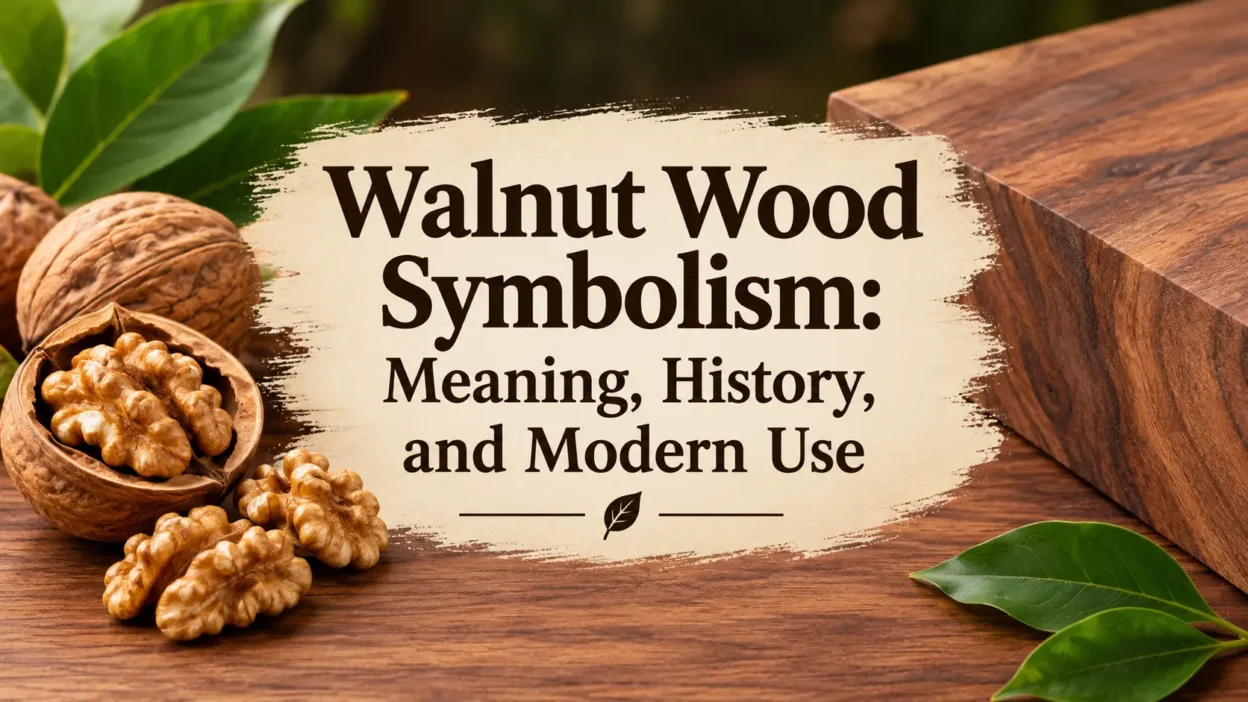
Walnut wood commonly suggests strength, craftsmanship, maturity, warmth, and lasting value. Its dark brown color, distinctive grain, and long history in furniture-making give it a visual character that feels substantial without being flashy. In the United States, walnut has also become closely associated with fine woodworking, heirloom furniture, skilled labor, and objects designed to last.
Unlike symbols that come from a single religion or mythology, walnut wood symbolism developed from several sources. The physical qualities of the tree and timber matter, but so does the history of how people used walnut. Food, shelter, furniture, tools, decorative objects, and valuable timber all contributed to the meanings attached to it.
That makes walnut especially interesting as a modern symbol. A walnut dining table can suggest family continuity, while a walnut desk can communicate seriousness and craftsmanship. The same material can feel traditional in one setting and distinctly modern in another.
Quick Answer
Walnut wood symbolism commonly represents strength, craftsmanship, stability, maturity, warmth, and lasting value in modern American culture. Historically, walnut was also associated with abundance, fertility, protection, status, and useful resources because of its valuable nuts, durable timber, and long-standing cultural importance.
TL;DR
- Walnut wood commonly represents strength, stability, craftsmanship, and lasting value.
- Its dark grain often suggests maturity, warmth, and understated luxury.
- American black walnut became important through furniture, construction, and woodworking.
- Ancient Mediterranean traditions associated walnuts with fertility and abundance.
- Heirloom walnut furniture can symbolize family continuity and generational memory.
- Modern design uses walnut to balance sophistication with natural warmth.
What Walnut Wood Looks Like and Why Appearance Matters
Walnut is not a single species. Several walnut species produce useful timber, but American black walnut (Juglans nigra) has a particularly important place in U.S. woodworking.
Its heartwood typically ranges from medium brown to rich chocolate brown, sometimes showing gray, purple, or reddish undertones. The sapwood is considerably lighter. Grain can be straight, wavy, or figured, giving individual boards a character that cannot be perfectly duplicated.
Those visual qualities help explain its symbolism.
Dark brown is often perceived as grounded and natural rather than artificial. Wood grain adds visible evidence of growth and time. When polished, walnut can look refined, but it still retains the irregularities of a natural material.
As a result, walnut often communicates controlled elegance rather than ostentation.
A walnut surface says something different from chrome, plastic, or highly glossy synthetic materials. It suggests that the material itself has value and does not need excessive decoration.
What Walnut Wood Commonly Symbolizes
The most useful way to understand walnut symbolism is to connect each meaning to a physical or cultural characteristic.
Strength comes from its reputation as a valuable hardwood used for demanding applications.
Stability comes from the wood’s practical performance and its visual weight. Walnut furniture tends to feel substantial and established.
Craftsmanship comes from its long history in cabinets, tables, desks, architectural interiors, carvings, and other carefully made objects.
Maturity is linked partly to its dark color and partly to the fact that high-quality walnut has traditionally been associated with established furniture traditions.
Warmth comes from its natural brown tones and its connection with homes, dining rooms, libraries, studies, and gathering spaces.
Longevity comes from the way walnut furniture can remain useful for decades and sometimes pass from one generation to another.
These meanings are interpretations, not universal rules. A piece of walnut does not automatically symbolize all of them. Context determines which association becomes most noticeable.
Ancient Roots and the Earlier Meaning of Walnut
Walnut symbolism predates modern woodworking.
The common walnut, Juglans regia, has a long history across parts of Europe and Asia. Ancient Mediterranean cultures valued walnuts as food, cultivated walnut trees, and incorporated the nuts into social and ceremonial practices.
Roman wedding traditions provide one of the clearest examples. Ancient sources describe walnuts being thrown or distributed during wedding processions. Later writers often connected the practice with fertility, although scholars have noted that the exact original meaning of the ritual is not completely certain.
This history gives the walnut an association with marriage, fertility, abundance, and the beginning of family life.
The distinction between walnut fruit and walnut wood is important, however. Ancient fertility symbolism primarily concerned the nut and tree, not modern walnut lumber as a decorative material.
Over time, those associations became part of the broader cultural history surrounding the walnut tree.
How Walnut Became a Symbol of Craftsmanship
The symbolic identity of walnut changed as woodworking traditions developed.
European cabinetmakers valued walnut for its attractive color, grain, and workability. During periods when walnut was a major furniture wood, finely made walnut pieces could signal refinement and social status.
In America, black walnut developed an especially strong relationship with skilled woodworking.
Colonists and later American craftspeople used walnut for furniture and practical construction. The timber’s appearance made it suitable for visible surfaces, while its physical properties made it useful for demanding applications.
That history created an important American association:
Walnut became not just a natural material, but a material transformed by human skill.
A walnut table therefore carries two ideas at once. The tree represents nature and growth; the finished table represents design, patience, measurement, joinery, and craftsmanship.
That combination explains why walnut works so well as a symbol of handmade quality.
Walnut Wood Symbolism in the United States
The American interpretation of walnut is strongly connected with black walnut.
Eastern black walnut is native to much of the central and eastern United States. Indigenous communities used different parts of the tree for food, dyes, medicine, and other practical purposes. European settlers also valued its nuts and timber.
American craftsmen eventually made black walnut one of the country’s notable furniture woods. It was used for cabinets, tables, interior woodwork, and other products. Its stability and shock resistance also made it valuable for gunstocks.
This practical history gives walnut a distinctly American symbolic layer.
In the United States, walnut can suggest:
- Resourcefulness, because the tree provided multiple useful materials.
- Craftsmanship, because skilled makers valued the wood.
- Self-sufficiency, because trees could provide food and useful timber.
- Endurance, because walnut trees and well-made walnut objects can persist for generations.
- American heritage, especially when black walnut furniture is connected with older homes, workshops, farms, or family possessions.
The symbolism is therefore more practical than mystical. American walnut often represents something useful that has been made valuable through time and skill.
What Walnut Furniture Communicates in American Homes
Furniture is where walnut symbolism becomes particularly visible.
A walnut dining table can suggest family meals, hospitality, and continuity. A walnut desk can communicate seriousness, concentration, and professional competence. A walnut cabinet may evoke tradition, careful storage, and permanence.
The material also works across different design periods.
Traditional American furniture can use walnut to create a formal, established appearance. Mid-century furniture made walnut famous for a cleaner, more modern aesthetic. Contemporary interiors often use walnut alongside white walls, stone, glass, metal, or lighter woods.
This flexibility gives walnut an unusual symbolic quality: it can represent tradition without necessarily looking old-fashioned.
In a family home, an inherited walnut table may carry an emotional meaning that has little to do with the tree itself. The wood becomes evidence of family history. Scratches, repairs, and changes in finish can become part of the object’s story.
Walnut as a Symbol of Family, Legacy, and Memory
Few materials communicate generational continuity as naturally as solid wood.
A walnut object can remain in use long after the person who purchased it is gone. This makes it an especially suitable metaphor for legacy.
Imagine a walnut dining table purchased by grandparents, used by their children, and eventually kept by their grandchildren. Its symbolism changes through each generation.
It no longer represents only furniture. It becomes a physical reminder of people, meals, celebrations, arguments, holidays, and ordinary evenings.
This is why walnut can carry a stronger sense of heritage than a disposable or easily replaced material.
The meaning is not supernatural. It comes from physical persistence and human memory.
The grain itself can also reinforce this idea. Every board records the tree’s growth in a pattern that remains visible after the tree has been cut and shaped.
Walnut’s Connection With Wealth and Understated Luxury
Walnut has also developed associations with quality and status.
Its attractive appearance, history in fine furniture, and relatively high value compared with many common woods helped establish an association with refined interiors.
But walnut usually communicates luxury differently from gold, crystal, or highly polished marble.
Its message is quieter.
A walnut desk may suggest that the owner values quality and craftsmanship rather than conspicuous display. A walnut library can feel established and serious without appearing extravagant.
This makes walnut particularly compatible with the modern idea of understated luxury.
The symbolism depends heavily on context. A simple walnut bowl does not necessarily communicate wealth. A carefully crafted walnut conference table in a prestigious office may carry a much stronger status signal.
The Emotional Meaning of Walnut’s Dark Brown Color
Color plays an important role in how walnut is perceived.
Brown is commonly associated with earth, wood, stability, warmth, comfort, and reliability. Walnut’s darker brown tones add another layer of seriousness and visual weight.
This combination can make walnut interiors feel:
- grounded rather than airy
- warm rather than clinical
- mature rather than playful
- refined rather than flashy
- natural rather than synthetic
That does not mean walnut has a scientifically fixed psychological effect. Personal experience, lighting, cultural background, and surrounding colors all influence perception.
Still, the repeated use of walnut in studies, libraries, offices, dining spaces, and furniture helps reinforce these associations.
Walnut Symbolism Across Different Contexts
Walnut can communicate different ideas depending on where it appears.
| Context | Meaning in the USA | Common Associations | Notes |
|---|---|---|---|
| Heirloom furniture | Family legacy | Memory, continuity, craftsmanship | Often becomes meaningful through personal history |
| Dining table | Family and gathering | Hospitality, stability, shared life | Particularly strong when passed between generations |
| Office or desk | Professional maturity | Focus, competence, authority | Dark wood often creates a serious visual environment |
| Interior design | Warm sophistication | Comfort, quality, understated luxury | Common in traditional and contemporary spaces |
| Carving or artwork | Craftsmanship | Patience, individuality, natural beauty | Grain becomes part of the artistic expression |
| Gift or keepsake | Lasting value | Thoughtfulness, permanence, connection | Meaning depends strongly on the relationship involved |
Walnut in Indigenous and North American History
Walnut symbolism in North America should not be reduced to European traditions.
Different Indigenous peoples used black walnut in practical and cultural ways. Historical records document uses involving food, dyes, medicine, and other everyday needs. The tree’s usefulness helped make it part of the human landscape long before modern American furniture culture developed.
Some Native American traditions also include black walnut in cultural narratives and creation stories, although these traditions differ among communities and should not be treated as one generalized “Native American meaning.”
That distinction matters.
It is more accurate to say that black walnut had specific cultural and practical relationships with particular Indigenous peoples than to claim that all Native American cultures assigned it one universal symbolic meaning.
For modern readers, this history adds another dimension to walnut: the tree is not simply a decorative symbol of American heritage. It is part of a much older North American ecological and cultural history.
Walnut, Weddings, Fertility, and Abundance
The walnut’s connection with fertility is mainly inherited from older Mediterranean traditions involving the nut and tree.
Roman wedding customs are especially important because walnuts were associated with the transition into married life. Their presence at weddings has often been interpreted as a wish for fertility and descendants, although the precise meaning of the ritual remains debated.
The symbolism makes intuitive sense within agricultural societies. A fruit-bearing tree produces nourishment, seeds, and future growth. A walnut contains a kernel protected inside a hard shell, creating an obvious metaphor for potential contained within protection.
Modern Americans generally do not see walnut furniture and immediately think of fertility.
However, the older association can still appear indirectly in wedding décor, botanical artwork, historical references, or discussions of classical symbolism.
Why Walnut Can Represent Protection
The walnut’s shell provides one of its clearest symbolic metaphors.
Inside a hard outer covering is an edible kernel. The outside protects something valuable within.
This structure naturally lends itself to ideas such as:
protection, boundaries, privacy, resilience, and hidden value.
When applied to walnut wood rather than the nut itself, this meaning becomes more abstract. A thick walnut cabinet may suggest security or preservation, while a walnut keepsake box can symbolize protecting memories or treasured possessions.
The idea should not be treated as an ancient universal doctrine. It is better understood as a visual metaphor that modern people can easily recognize.
Walnut in Modern Design, Art, and Personal Style
Today, walnut appears in much more than traditional furniture.
Architects and designers use walnut for wall panels, cabinetry, desks, dining tables, shelving, doors, musical instruments, decorative objects, and smaller handmade pieces.
Its symbolic appeal fits several current design preferences. People often want interiors that feel natural but still polished, contemporary without looking sterile, and sophisticated without excessive ornament.
Walnut fits that balance well.
It also appears in personal objects such as watches, pens, cutting boards, jewelry boxes, phone stands, and handcrafted gifts. In these cases, the symbolism often centers on craftsmanship and permanence.
Unlike mass-produced plastic, a handmade walnut object can visibly preserve the marks of material selection and human labor.
That quality makes walnut especially attractive to people who value handmade goods, natural materials, and objects intended to age rather than be quickly discarded.
Walnut in Tattoos, Art, and Personal Symbolism
Walnut is less common as a tattoo subject than animals, flowers, celestial bodies, or recognizable religious symbols. When it appears, interpretation usually depends on the individual story.
A walnut tree can represent family roots, resilience, ancestry, growth, or a connection to a particular place.
A walnut itself can represent hidden potential or the contrast between a hard exterior and valuable interior.
A walnut branch or leaf can work as a quieter nature symbol, particularly for someone with a personal connection to a walnut tree or landscape.
Because walnut does not have one universally accepted tattoo meaning, the owner’s explanation matters more than a dictionary-style definition.
Common Misunderstandings About Walnut Symbolism
One common mistake is treating every meaning associated with the walnut fruit as though it automatically belongs to walnut wood.
Fertility is a good example. Ancient wedding customs involving walnuts support a historical fertility association, but that does not mean a walnut coffee table is traditionally a fertility symbol.
Another mistake is assuming that dark wood automatically represents something negative. Walnut’s dark color has generally been associated with warmth, seriousness, quality, and maturity rather than evil or misfortune.
There is also a tendency online to present symbolic meanings as universal facts. In reality, walnut symbolism changes according to culture, historical period, object, and personal experience.
A careful interpretation asks where the walnut appears and why it was chosen.
Has Walnut Symbolism Changed Over Time?
Yes. The shift is especially clear when comparing ancient walnut traditions with modern American woodworking.
In ancient Mediterranean contexts, walnuts could relate to fertility, marriage, food, agriculture, and social ritual.
In early American life, black walnut was valued for food, dye, construction, and timber.
As American furniture-making developed, the wood increasingly represented craftsmanship, quality, and refinement.
During the modern design era, walnut became associated with clean lines, sophisticated interiors, and natural materials. Today it can suggest heritage and craftsmanship while also fitting minimalist and contemporary spaces.
The material stayed largely the same. The cultural setting changed, and the symbolism changed with it.
Frequently Asked Questions
What does walnut wood symbolize spiritually?
Walnut wood does not have one universal spiritual meaning. Depending on context, people may interpret it as a symbol of protection, wisdom, groundedness, endurance, or inner value, but these interpretations are largely cultural or personal rather than fixed religious rules.
What does walnut wood symbolize in the United States?
In the United States, walnut wood commonly suggests craftsmanship, stability, maturity, quality, and family heritage. American black walnut’s long history in furniture and woodworking gives these meanings a particularly strong connection to American material culture.
Does walnut symbolize family?
It can. Walnut furniture that remains in a home for decades can become a symbol of family continuity, shared memories, and inheritance. This meaning usually comes from the object’s history rather than from a universal walnut tradition.
Is walnut associated with fertility?
Historically, yes, especially in ancient Mediterranean traditions involving walnuts at weddings. Modern American interpretations of walnut wood are much more likely to focus on craftsmanship, warmth, stability, and heritage.
What does a walnut tree symbolize?
A walnut tree can symbolize endurance, abundance, rootedness, protection, and long-term growth. In American contexts, its symbolism is also connected with practical value because black walnut has historically provided food and highly valued timber.
Why is walnut associated with luxury?
Walnut has been used in fine furniture and high-quality woodworking for centuries, and its attractive dark grain can create a refined appearance. Its association with luxury is usually understated rather than flashy.
Is walnut wood symbolism always positive?
No. Symbolic interpretation depends on context. Walnut has also appeared in older European folklore involving ominous beliefs about walnut trees, but these traditions should not be presented as the standard modern meaning of walnut wood.
Conclusion
Walnut wood represents more than an attractive brown hardwood. Its history connects it with craftsmanship, stability, useful resources, family possessions, refined furniture, and objects built to remain in use. Older traditions involving the walnut tree and nut also contribute associations with fertility, abundance, protection, and potential.
In modern America, walnut wood symbolism is best understood through its material history. A walnut table, cabinet, desk, or heirloom can communicate maturity and quality because people have repeatedly used walnut for objects expected to serve families for years.
The most fitting modern interpretation is therefore simple: walnut represents lasting value shaped by nature, skilled work, and time.