
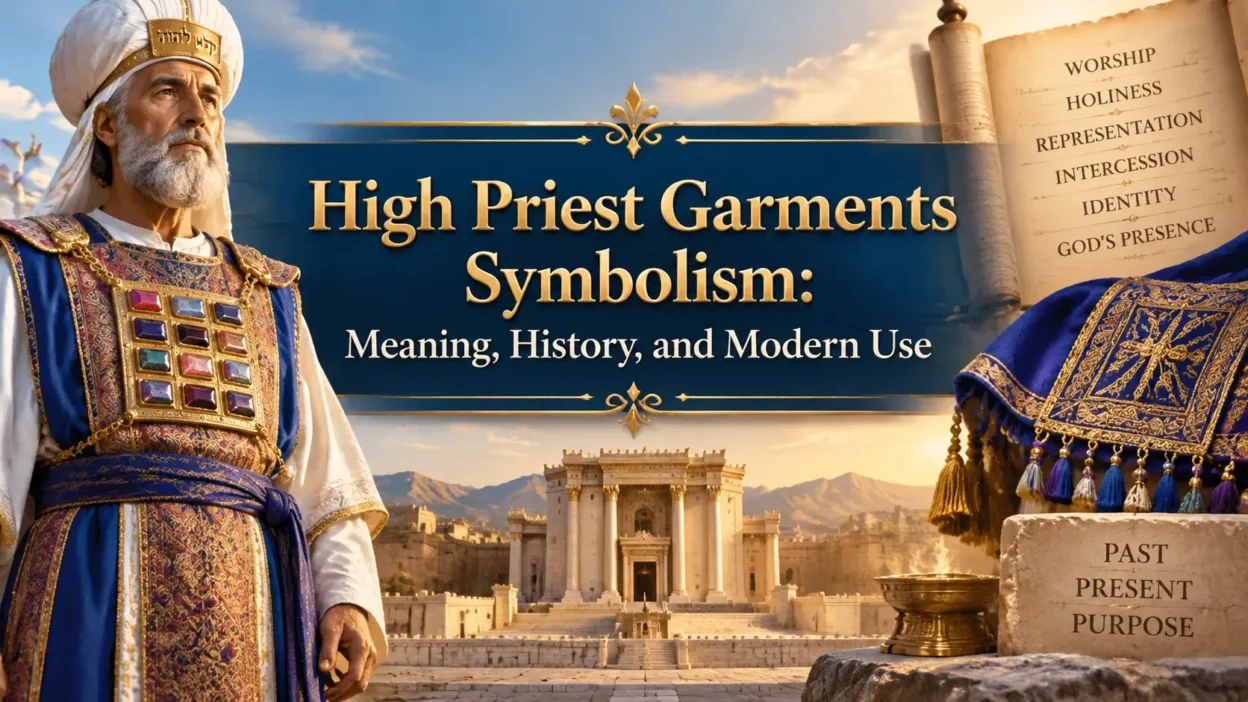
High priest garments symbolism pdf resources often help readers explore the meaning behind the sacred clothing worn by the high priest in ancient Israel. These garments were not simply ceremonial clothing; each piece represented religious duties, spiritual responsibility, and the relationship between God and the people.
In the biblical tradition, the high priest’s clothing carried specific meanings connected to worship, holiness, leadership, and service. The colors, materials, gemstones, and designs were carefully described because they reflected the role of the priest as a representative between the community and God.
Today, Americans often encounter high priest garments through Bible studies, religious artwork, educational materials, church discussions, and historical studies of ancient Judaism. Understanding these garments provides insight into how symbols communicate faith, identity, and cultural memory.
Quick Answer
High priest garments symbolism commonly represents spiritual leadership, holiness, responsibility, and connection between God and people in modern Christian and Jewish understanding. Historically, these garments symbolized the sacred duties of Israel’s high priest, including worship, sacrifice, and carrying the concerns of the community before God.
TL;DR
- High priest garments represented sacred responsibility and spiritual leadership.
- Each clothing piece carried a specific biblical meaning.
- Colors and gemstones reflected holiness and identity.
- Jewish and Christian traditions interpret garments differently.
- Modern believers use the imagery for faith education.
What Were the High Priest Garments?
The high priest garments were the special clothing worn by the highest-ranking priest in ancient Israel. They are mainly described in the biblical books of Exodus and Leviticus, where instructions explain their design, materials, and purpose.
Unlike ordinary clothing, these garments marked the high priest as someone set apart for religious service. The clothing showed that the priest carried a unique role in ceremonies, especially during important worship events such as the Day of Atonement.
The traditional garments included:
- Ephod
- Breastplate of judgment
- Robe
- Tunic
- Turban
- Sash
- Golden plate worn on the forehead
Each item had a separate function and symbolic purpose.
The Main Symbolic Meaning of High Priest Garments
The central meaning of high priest garments is representation. The high priest stood before God on behalf of the people, making the clothing a symbol of responsibility and spiritual connection.
The garments also represented:
- Holiness and purity
- Divine service
- Religious authority
- Community responsibility
- Commitment to worship
The clothing reminded people that leadership in faith required humility, dedication, and accountability.
In modern American religious discussions, the high priest’s clothing is often viewed as a visual reminder that spiritual leaders are called to serve others rather than seek personal status.
Ancient Roots and Biblical Origins of the Garments
The origins of high priest garments come from ancient Israelite worship traditions. According to the biblical account, God gave Moses detailed instructions for creating the garments for Aaron, the first high priest of Israel.
The instructions emphasized quality materials, careful craftsmanship, and symbolic details. The garments were designed to reflect the importance of the priest’s role in religious ceremonies.
Ancient societies often used clothing to show identity and authority. Kings wore crowns, military leaders wore uniforms, and priests wore special clothing. In this context, the high priest garments communicated sacred authority rather than political power.
Symbolism of the Ephod and Its Meaning
The ephod was one of the most important parts of the high priest’s clothing. It was an apron-like garment made with valuable materials and worn over the robe.
The ephod contained two shoulder stones engraved with the names of the twelve tribes of Israel. This design symbolized that the high priest carried the entire nation before God.
The meaning of the ephod included:
| Garment Element | Meaning in Biblical Tradition | Modern Interpretation |
|---|---|---|
| Ephod | Carrying the tribes of Israel | Responsibility for others |
| Shoulder Stones | Remembering the people before God | Leadership and care |
| Gold Details | Honor and sacred purpose | Value and dedication |
| Fine Fabric | Special religious service | Respect for faith traditions |
For many modern readers, the ephod represents the idea that leaders should remember and support the people they serve.
The Breastplate of Judgment and the Twelve Stones
The breastplate was attached to the ephod and contained twelve gemstones representing the twelve tribes of Israel. Each stone carried the identity of a tribe, creating a symbolic connection between the priest and the whole community.
The breastplate represented:
- Unity among different groups
- Individual value within a larger community
- Divine guidance
- Remembering every person
The twelve stones are often discussed in Christian teaching as symbols of God’s relationship with His people. Some later traditions also connect these stones with ideas about spiritual identity and personal significance.
In modern American religious art, gemstone imagery from the breastplate often appears in illustrations, educational materials, and church lessons.
Meaning of the Colors Used in High Priest Garments
The colors of the garments were carefully selected. Each color carried cultural and religious associations in ancient Israel.
Common colors included:
Blue:
Often associated with heaven, divine connection, and obedience to God’s commands.
Purple:
Connected with royalty, honor, and importance because purple dyes were rare and expensive.
Scarlet:
Represented richness, sacrifice, and ceremonial importance.
White Linen:
Symbolized purity, cleanliness, and holiness.
Gold:
Represented value, glory, and sacred dedication.
These colors continue to influence religious artwork today, where they are used to communicate ideas about holiness and worship.
The Robe of the High Priest and Its Symbolic Meaning
The robe worn by the high priest was another important part of the sacred clothing described in biblical tradition. Unlike ordinary garments, this robe included specific details that communicated religious meaning.
The robe was traditionally described as being blue and worn beneath the ephod. Around its lower edge were decorative elements, including pomegranates and bells.
The pomegranates represented abundance, fruitfulness, and the richness of God’s blessings. The bells served a practical and symbolic purpose, as their sound marked the priest’s movement during sacred service.
The robe’s symbolism can be understood through several ideas:
- A visible sign of the priest’s sacred role
- A reminder of careful worship practices
- A connection between human service and divine commands
- A representation of spiritual dedication
For modern readers, the robe often represents the idea that actions in religious leadership should reflect respect, responsibility, and awareness.
The Turban and Golden Plate on the Forehead
The high priest also wore a special head covering called a turban. Attached to the front of the turban was a golden plate engraved with the words often translated as “Holy to the Lord.”
This small but important detail carried one of the clearest messages of the entire garment system. It showed that the high priest’s role was dedicated to God and that sacred service required a mindset of holiness.
The forehead plate symbolized:
- Complete dedication to God
- Purity of purpose
- Religious commitment
- The importance of spiritual focus
In modern religious discussions, the golden plate is often viewed as a reminder that faith involves both outward actions and inner commitment.
The Role of Linen, Gold, and Precious Materials
The materials used in high priest garments were not chosen randomly. Ancient cultures often used valuable materials to communicate importance, and the biblical descriptions follow this pattern.
Gold represented honor and sacred value. Fine linen represented cleanliness and dignity. Precious stones represented the importance of the people represented by the priest.
The materials created a visual message:
| Material | Symbolic Meaning | Modern Understanding |
|---|---|---|
| Gold | Honor and sacred dedication | Value and respect |
| Fine Linen | Purity and cleanliness | Spiritual discipline |
| Precious Stones | Identity and remembrance | Individual worth |
| Blue Fabric | Connection with heaven | Faith and devotion |
The use of these materials shows how physical objects can communicate beliefs and values.
High Priest Garments Symbolism in the United States
In the United States, high priest garments are mainly understood through religious education, biblical studies, and Christian communities. Many Americans encounter these symbols through sermons, Bible classes, artwork, documentaries, and historical discussions.
Different groups interpret the garments in different ways.
For many Christians, the garments point toward themes of:
- Jesus as a spiritual mediator
- Sacrifice and redemption
- The relationship between God and humanity
- The importance of holiness
For Jewish communities, the garments are connected primarily with the ancient Temple priesthood, historical tradition, and biblical heritage.
Modern American interpretations usually focus less on recreating the clothing and more on understanding the ideas behind it, such as service, responsibility, and devotion.
Cross-Cultural and Religious Interpretations
High priest garments have significance beyond one religious community. They are part of a larger human tradition where special clothing represents spiritual authority.
In many cultures, religious leaders wear distinctive clothing to show their role:
- Buddhist monks wear robes connected with simplicity and discipline.
- Christian clergy often wear garments connected with worship and tradition.
- Jewish religious leaders use clothing and symbols connected with faith practices.
The high priest garments fit into this wider pattern. They show how societies use clothing to communicate identity, responsibility, and sacred purpose.
Emotional and Psychological Meaning of the Garments
Symbols often affect people because they connect visible objects with invisible ideas. High priest garments carry emotional meanings related to belonging, responsibility, and faith.
For many believers, the imagery creates feelings of:
- Respect for religious tradition
- Connection with ancient history
- A sense of spiritual order
- Appreciation for community
The twelve stones on the breastplate especially create a message of personal value. The symbolism suggests that each person matters and that communities are made from individuals with unique identities.
Why High Priest Garments Appear in Art and Education
High priest garments are frequently shown in religious paintings, Bible illustrations, museum displays, and educational materials because they help people visualize ancient worship practices.
Since the original garments no longer exist, modern representations are based on biblical descriptions and historical research.
Artists often highlight:
- The colorful fabrics
- The gemstones
- The golden details
- The connection between the priest and the people
These images help students and religious audiences understand ancient traditions through visual storytelling.
Modern Uses of High Priest Garment Symbolism
Today, high priest garments appear in several forms:
- Bible study materials
- Religious artwork
- Educational posters
- Historical documentaries
- Church teaching resources
- Jewelry inspired by biblical symbols
Some people also use related imagery in personal faith expressions, including decorative items and artwork.
However, the symbolism is usually more important than the physical recreation of the clothing. Modern discussions focus on what the garments represent rather than simply copying their appearance.
Common Misunderstandings About High Priest Garments
Because the garments contain many symbolic details, they are sometimes misunderstood.
One common misunderstanding is that every detail has a universally agreed meaning. While many interpretations are widely accepted, some symbolic explanations developed later through religious traditions rather than directly from the original biblical descriptions.
Another misunderstanding is treating the garments as magical objects. In their historical context, the clothing represented a role and responsibility. The garments themselves were not described as having independent power.
Understanding the historical setting helps separate traditional symbolism from later interpretations.
How the Meaning of High Priest Garments Has Changed Over Time
The meaning of high priest garments has evolved as different communities studied and interpreted them.
In ancient Israel, the garments identified the high priest and supported Temple worship. Later Jewish traditions remembered them as important symbols of priestly heritage.
Christian interpretations often connected the garments with broader ideas about mediation, sacrifice, and spiritual leadership.
Today, many people view the garments as historical symbols that communicate lessons about faith, service, and responsibility.
The clothing has moved from being a practical religious requirement to becoming a widely recognized symbol in religious education and cultural discussion.
High Priest Garments Symbolism in Modern Faith and Culture
| Context | Meaning in the USA | Common Associations | Notes |
|---|---|---|---|
| Bible Study | Understanding ancient worship | History and faith education | Used for learning biblical traditions |
| Religious Art | Visual representation of holiness | Priestly service and devotion | Common in illustrations |
| Christian Teaching | Spiritual leadership themes | Mediation and sacrifice | Interpretations vary by denomination |
| Jewish Heritage | Ancient priestly tradition | Temple history | Connected with biblical identity |
| Personal Reflection | Responsibility and commitment | Service and faith | Often used symbolically |
FAQs About High Priest Garments Symbolism
What do high priest garments symbolize?
High priest garments symbolize holiness, responsibility, religious leadership, and the connection between God and the community. They represent the special duties of the high priest in ancient Israelite worship.
Why did the high priest wear special clothing?
The high priest wore special clothing to show his unique role in religious ceremonies. The garments separated his priestly duties from ordinary daily activities and represented his responsibility before God.
What do the twelve stones on the breastplate mean?
The twelve stones represented the twelve tribes of Israel. They symbolized that the high priest carried the identity and concerns of the entire community during sacred duties.
Are high priest garments still used today?
The original high priest garments are not used in modern Temple worship because the ancient priestly system ended. Today, they are mainly studied through religious education, historical research, and artwork.
What does the golden plate on the priest’s forehead represent?
The golden plate represented dedication to God through the phrase “Holy to the Lord.” It symbolized that sacred service required commitment and purity of purpose.
Do Christians and Jews interpret these garments differently?
Yes. Jewish traditions generally view them through the history of ancient Israel and priesthood, while many Christian traditions connect them with broader theological ideas about worship and spiritual symbolism.
Can high priest garments be used as a modern symbol?
Yes. Many people use the imagery as a symbol of faith, service, leadership, and dedication. The meaning usually focuses on the values represented by the garments rather than the clothing itself.
Conclusion
High priest garments symbolism pdf materials help people explore how ancient clothing communicated ideas about faith, identity, and responsibility. The garments were designed to represent the high priest’s sacred role and connection with the people he served.
From the breastplate and gemstones to the robe and golden forehead plate, each element carried a message about devotion, community, and religious purpose. Today, high priest garments symbolism pdf remains a useful way for many readers to study these ancient symbols and understand their place in modern faith discussions.
The lasting importance of these garments comes from the ideas they represent: serving others, honoring traditions, and recognizing the responsibilities that come with spiritual leadership.


