
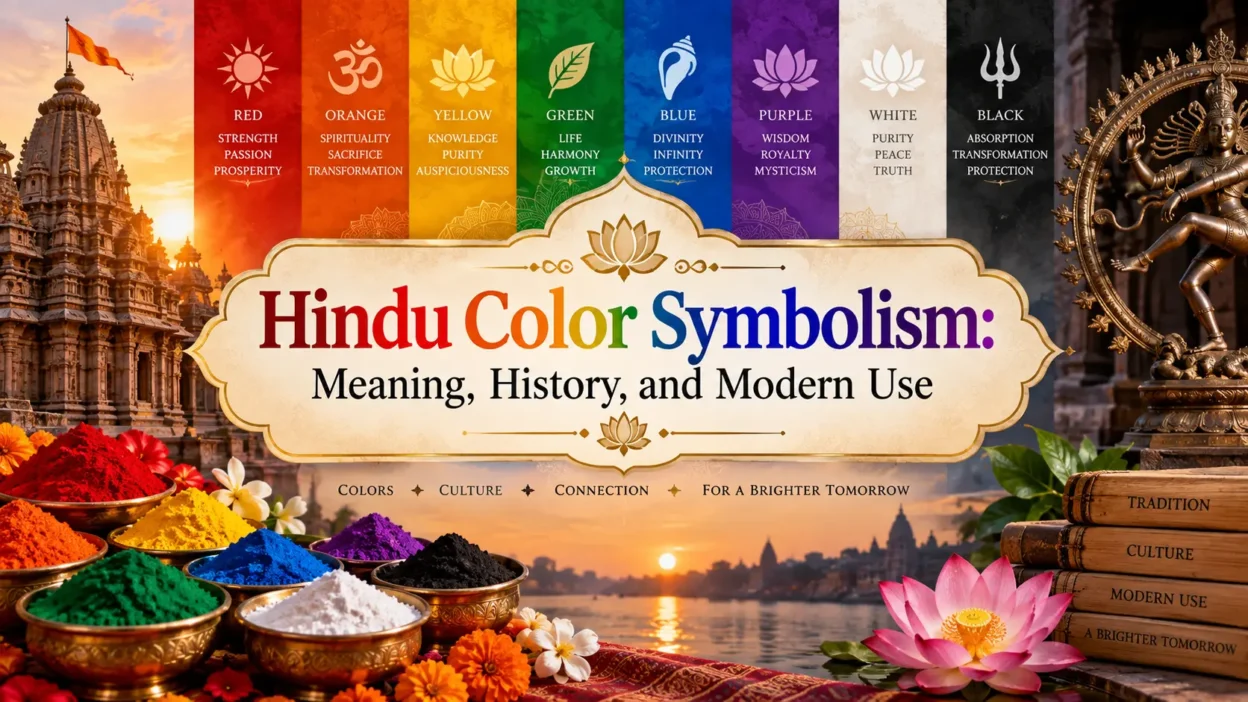
Color plays an important role in Hindu religious life, art, clothing, festivals, rituals, and personal expression. Hindu color symbolism is not a single fixed system in which every color has one universal definition. Meanings can change according to the deity, ritual, region, religious tradition, and situation.
For people in the United States, Hindu colors often appear in temples, festival celebrations, wedding clothing, religious artwork, yoga spaces, jewelry, and South Asian cultural events. Saffron robes, red wedding clothing, white garments, yellow offerings, and colorful Holi powders can all carry meanings that go beyond decoration.
Understanding these colors requires some historical context. Hindu traditions developed over many centuries, and symbolic associations grew through Vedic ritual, devotional traditions, mythology, temple practices, festivals, and regional customs.
Today, these colors can communicate ideas such as devotion, purity, prosperity, love, sacrifice, celebration, transformation, and spiritual discipline. However, their meanings should be interpreted within context rather than treated as rigid rules.
Quick Answer
Hindu color symbolism commonly connects saffron with renunciation and spiritual discipline, red with life and auspiciousness, white with purity and peace, and yellow with knowledge and prosperity. Other colors, including green, blue, black, and orange, can carry different religious and cultural meanings depending on the deity, tradition, ritual, and region.
TL;DR
- Saffron often represents renunciation, spiritual discipline, and sacred fire.
- Red commonly signals life, love, fertility, celebration, and auspiciousness.
- White is associated with purity, peace, simplicity, and mourning.
- Yellow can represent knowledge, learning, prosperity, and devotion.
- Blue often appears with divine figures such as Krishna and Vishnu.
- Color meanings vary across Hindu traditions, regions, and religious contexts.
Why Color Matters in Hindu Traditions
Hindu religious practice uses visual symbols extensively. Color can help communicate an idea before a person reads a text or hears an explanation.
A particular color may appear in clothing, flowers, powders, painted images, temple decorations, food offerings, flags, or ritual objects. The repeated use of a color creates an association between the visual experience and the religious idea behind it.
For example, saffron clothing is strongly associated with Hindu monks and ascetics. Red may appear prominently during weddings and celebrations. Yellow clothing and offerings can appear in ceremonies connected with Vishnu or particular days of religious observance.
However, these associations should not be treated as universal commandments. Hinduism includes many traditions, schools, communities, and regional customs. A color that has one association in one setting can have another meaning elsewhere.
Ancient Roots of Hindu Color Symbolism
Some color associations developed from the natural world and from ancient ritual practices. Fire, sunlight, flowers, plants, metals, blood, ash, and the changing colors of the sky all provided visible images that became connected with religious ideas.
Vedic ritual placed particular importance on fire, or Agni. Because fire was central to sacrifice and communication with the divine, shades resembling fire eventually became strongly connected with sacred activity.
The color white also gained associations with cleanliness, simplicity, and ritual purity. Yellow and gold could suggest sunlight, prosperity, knowledge, and abundance. Red naturally connected with blood, vitality, fertility, and the visible force of life.
Over time, mythology and devotional traditions added new layers of meaning. Colors became associated with particular gods, goddesses, planets, festivals, foods, flowers, and ritual practices.
This history explains why Hindu color symbolism is better understood as a network of associations than as a simple color chart.
Saffron and Orange: Renunciation and Spiritual Discipline
Saffron is among the most recognizable colors associated with Hindu religious life. It appears prominently in the clothing of many Hindu monks, ascetics, and spiritual teachers.
Its association with fire is important. Fire transforms whatever it consumes, making it a useful religious image for letting go of worldly attachment. For this reason, saffron can represent renunciation, sacrifice, discipline, and dedication to spiritual practice.
Saffron also appears on religious flags and temple decorations. In these settings, it can communicate religious identity and devotion.
In the United States, people may encounter saffron in Hindu temples, religious festivals, spiritual communities, yoga settings, and South Asian cultural events. It can also appear in artwork depicting Hindu saints and deities.
It is worth distinguishing religious saffron from ordinary orange. Modern clothing and design may use similar shades simply because they are visually appealing. The religious meaning depends on context.
Red: Life, Love, Fertility, and Auspiciousness
Red is one of the most important colors in Hindu celebrations and ceremonies. It commonly suggests life, vitality, love, fertility, strength, and auspiciousness.
Red is especially visible in Hindu weddings. Brides may wear red clothing or incorporate red into their wedding attire, jewelry, decorations, or ceremonial details. The color can communicate love, fertility, prosperity, and the significance of marriage.
Red also has associations with Shakti, the divine feminine power represented through goddesses and traditions centered on sacred feminine energy.
Red powder, flowers, clothing, and markings may appear during religious ceremonies. Vermilion, known in different contexts as sindoor, is also associated with marriage and auspiciousness.
For Americans encountering red in a Hindu ceremony, it is useful to avoid assuming that it carries exactly the same meaning as Western romantic red. Hindu traditions can connect red with family life, fertility, sacred power, celebration, and religious devotion as well as romantic love.
White: Purity, Peace, Simplicity, and Mourning
White often represents purity, peace, simplicity, and spiritual cleanliness in Hindu traditions.
White clothing may appear in religious settings because it communicates restraint and simplicity. It can be particularly significant for people following devotional or ascetic practices.
White also has a notable relationship with mourning. In many Hindu communities, white clothing is traditionally associated with grief and funeral observances. This differs from the dominant contemporary American custom of wearing black for mourning.
That difference can create confusion for Americans encountering Hindu funeral traditions. White does not simply mean happiness or celebration in every Hindu setting. Its meaning depends heavily on context.
White flowers, ash, clothing, and religious objects can also carry associations with purity and spiritual practice.
Yellow: Knowledge, Learning, and Prosperity
Yellow is often connected with knowledge, learning, prosperity, and auspicious beginnings.
Its relationship with sunlight and golden tones helps explain some of these associations. Yellow can suggest warmth, abundance, clarity, and the productive side of life.
Yellow is particularly associated with Vishnu in some Hindu traditions and may appear in clothing, flowers, food offerings, and religious celebrations connected with him.
The color also appears during educational and religious observances. In some communities, yellow clothing or yellow foods may be part of ceremonies associated with learning, spiritual development, or prosperity.
For Americans, yellow can therefore represent more than cheerfulness. In a Hindu context, its meaning may involve learning, devotion, abundance, and religious observance.
Blue: Divine Presence and the Infinite
Blue has a distinctive place in Hindu religious art because major deities such as Krishna and Vishnu are frequently depicted with blue or blue-toned skin.
The color helps distinguish these divine figures from ordinary human characters in traditional artistic conventions. Blue can also suggest the vastness of the sky or ocean, providing an image of something expansive and difficult to contain.
Krishna’s blue appearance is one of the most recognizable examples. Images of Krishna often combine blue skin with yellow clothing, creating a visual pairing that has become familiar in Hindu art around the world.
In the United States, blue Hindu imagery is common in temple artwork, books, statues, festival decorations, clothing, and home devotional spaces.
It is important, however, not to reduce blue to one universal definition such as “peace.” Its religious meaning comes from the particular figure, story, and tradition in which it appears.
Green: Nature, Renewal, and Prosperity
Green has connections with vegetation, growth, fertility, renewal, and the natural world. These associations make sense in a religious tradition that has historically maintained strong relationships with nature, agriculture, sacred trees, plants, rivers, and seasonal cycles.
Green may appear in festival decorations, clothing, flowers, and contemporary Hindu designs. It can communicate freshness and life, although its meaning is generally less standardized across Hindu traditions than some of the associations attached to saffron or red.
In modern American settings, green can also reflect a broader cultural connection with nature and environmental awareness. That interpretation may overlap with Hindu ideas about life and the natural world without being exclusively religious.
The context matters: green clothing worn at a festival may be cultural or fashionable, while green used alongside particular religious symbols may carry a more specific devotional meaning.
Black: Protection, Time, and Ambiguous Meanings
Black is more complicated than many popular color-symbolism charts suggest. It should not automatically be described as a Hindu symbol of evil.
In some Hindu traditions, black can be associated with powerful or fierce divine forms, protection, time, destruction, or the forces that confront disorder. The meaning may become particularly important in traditions connected with deities such as Kali or Shani.
Black can therefore have religious significance without representing something morally negative.
At the same time, some Hindu communities may avoid particular colors during certain ceremonies because of local customs or beliefs about auspiciousness. These practices vary significantly.
For Americans, the most important point is that black should be interpreted according to the specific ritual or deity involved rather than through a simple Western “good versus bad” framework.
Gold: Prosperity, Divinity, and Abundance
Gold is strongly associated with wealth, beauty, prosperity, status, and abundance across many Hindu cultural settings.
Its connection with Lakshmi, the goddess associated with wealth and prosperity, helps explain why gold-colored decorations, jewelry, coins, lamps, and ceremonial objects can be especially prominent during festivals and auspicious occasions.
Gold also appears in temple architecture, religious artwork, clothing, jewelry, and wedding decorations. Its visual connection with sunlight and precious metal contributes to its association with value and abundance.
In the United States, gold may appear in Hindu weddings, Diwali decorations, jewelry, temple interiors, and festive clothing. Sometimes it has religious meaning; at other times it simply reflects South Asian artistic traditions.
Color and Hindu Festivals
Festivals provide some of the clearest examples of color symbolism in Hindu culture.
Holi is famously known as the festival of colors. Participants traditionally use colored powders and water as part of a celebration associated with spring, joy, social interaction, and renewal.
Diwali also uses color extensively. Homes and public spaces may be decorated with colorful designs, flowers, lamps, fabrics, and rangoli patterns.
During Navaratri and other religious celebrations, clothing colors can also change according to regional traditions, deities, days, or community customs.
For Hindu Americans, festivals often combine inherited traditions with contemporary American settings. A celebration may take place in a temple, community center, university, neighborhood, or private home while retaining familiar colors, foods, clothing, music, and rituals.
Hindu Colors in Weddings and Family Ceremonies
Color becomes especially visible during Hindu weddings.
Red, gold, orange, yellow, and other bright colors may appear in bridal clothing, decorations, flowers, jewelry, invitations, and ceremonial spaces. These colors help establish the festive character of the event while also connecting it with ideas of prosperity, fertility, love, and auspiciousness.
Yellow may appear during pre-wedding ceremonies in some communities. Red can be prominent in bridal clothing. Gold jewelry can symbolize prosperity and celebration.
There is no single Hindu wedding color code. Practices vary by region, family, language group, religious tradition, and personal preference.
Hindu American families may also combine traditional colors with Western wedding styles. A bride might wear a traditional red sari for one ceremony and a Western white dress for another event, demonstrating how symbolism can coexist across cultures.
Color in Hindu Art, Temples, and Deity Images
Color helps viewers recognize and understand Hindu religious imagery.
Artists may use specific colors for divine figures, clothing, objects, animals, flowers, backgrounds, and sacred environments. These choices can distinguish one deity from another or reinforce a story associated with the figure.
For example, Krishna’s blue appearance and yellow clothing form a familiar visual combination. Saffron flags can identify Hindu religious spaces, while red and yellow powders may appear during ceremonies.
Temple colors can also reflect regional architecture rather than a universal religious rule. Bright colors are common in some temple traditions, while other temples may use stone, white, gold, or more restrained palettes.
For this reason, interpreting a Hindu image requires looking at the entire composition rather than assigning meaning to one color alone.
Hindu Color Symbolism in the United States
In modern America, Hindu colors appear in both religious and cultural settings.
Hindu temples across the country may use saffron flags, colorful deity images, flowers, fabrics, and ceremonial objects. Hindu American communities also use traditional colors during Diwali, Holi, Navaratri, weddings, religious classes, and cultural programs.
Outside religious communities, Hindu-inspired colors can appear in yoga studios, meditation spaces, fashion, jewelry, home decor, tattoos, and digital artwork.
However, the presence of an Indian or Hindu-associated color does not automatically make an object religious. A saffron shirt, red decoration, or blue artwork may simply reflect personal taste.
The safest interpretation comes from context, especially when dealing with religious symbols.
Emotional and Psychological Associations
Color can influence emotional perception even when no formal religious symbolism is intended.
Red tends to attract attention and can communicate excitement, warmth, passion, or urgency. White can create an impression of simplicity and calm. Yellow often feels bright and optimistic. Blue can suggest spaciousness or calmness, while green is commonly connected with nature and renewal.
Hindu traditions add cultural and religious layers to these broad emotional associations.
For example, red at a Hindu wedding may communicate celebration and auspiciousness in addition to warmth or romance. White at a Hindu funeral may communicate mourning and simplicity rather than the Western association of purity alone.
This distinction matters because color psychology is not identical to religious symbolism. A person’s emotional response to a color may differ from the meaning that color has within a particular Hindu ritual.
How Hindu Color Meanings Have Changed
Hindu color symbolism has never been completely static. Meanings have developed through changing religious practices, regional customs, artistic traditions, and social life.
Modern globalization has added another layer. Hindu communities now interact with other cultures through immigration, education, travel, media, fashion, and social platforms.
As a result, a color may carry several meanings at once. A Hindu American may choose red because it connects with family tradition, because it looks festive, or because it represents an important religious ceremony. These motivations can coexist.
Commercial culture has also separated some colors from their original religious settings. Saffron, for example, may be used in products or designs that have little connection with Hindu religious practice.
The meaning of a color therefore depends not only on its traditional association but also on who is using it and why.
Common Misunderstandings About Hindu Colors
One common mistake is assuming that every Hindu color has one universal definition. Hinduism contains many traditions, so symbolic meanings can vary.
Another mistake is treating online color charts as religious laws. A list saying “red always means X” or “black always means Y” usually removes the cultural and ritual context that gives the color its meaning.
It is also misleading to assume that every colorful object used by a Hindu person has religious significance. Clothing, jewelry, artwork, and home decor can be chosen for cultural, aesthetic, personal, or religious reasons.
Finally, Hindu symbolism should not be interpreted through Western Christian or modern New Age systems without qualification. Similar colors can carry very different meanings across religious traditions.
Hindu Colors at a Glance
| Color | Common Hindu Associations | Common U.S. Context | Important Note |
|---|---|---|---|
| Saffron | Renunciation, fire, spiritual discipline | Temples, monks, religious flags | Strongly linked with religious identity |
| Red | Life, love, fertility, auspiciousness | Weddings, festivals, ceremonies | Meaning changes with ritual context |
| White | Purity, peace, simplicity, mourning | Religious ceremonies and funerals | Mourning use differs from common U.S. customs |
| Yellow | Knowledge, learning, prosperity | Festivals, offerings, religious clothing | Often associated with Vishnu and auspicious occasions |
| Blue | Divine imagery, vastness, transcendence | Krishna and Vishnu artwork | Strongly depends on deity and artistic tradition |
| Green | Growth, nature, renewal, prosperity | Festivals, clothing, decorative art | Less universally defined than saffron or red |
Frequently Asked Questions
What is the most sacred color in Hinduism?
There is no single color that all Hindus consider the most sacred. Saffron has an especially strong religious association because of its connection with fire, renunciation, ascetic life, and spiritual discipline.
What does red mean in Hindu culture?
Red commonly represents life, vitality, love, fertility, celebration, and auspiciousness. It is particularly visible in weddings and ceremonies, although its exact meaning depends on the tradition and occasion.
Why do Hindu monks wear saffron?
Saffron clothing is associated with renunciation and spiritual discipline. Its connection with fire provides a visual reminder of transformation and the decision to move away from attachment to ordinary material life.
Why is white worn at some Hindu funerals?
White can represent simplicity, purity, and detachment, making it appropriate in many mourning traditions. This differs from the common American practice of using black as the primary mourning color.
What does yellow symbolize in Hinduism?
Yellow can represent knowledge, learning, prosperity, devotion, and auspiciousness. It is also associated with Vishnu in some Hindu traditions and may appear in clothing, flowers, and food offerings.
Does black have a negative meaning in Hinduism?
Not necessarily. Black can have associations with powerful deities, protection, time, and forces that confront disorder, so describing it simply as “evil” is inaccurate.
Do all Hindus follow the same color symbolism?
No. Hindu traditions differ by region, community, deity, religious school, family, and ritual practice. A color may have one association in one context and a different or additional meaning in another.
Conclusion
Color in Hindu traditions is best understood as a flexible visual language rather than a fixed dictionary. Saffron can point toward renunciation, red toward life and auspiciousness, white toward purity or mourning, yellow toward knowledge and prosperity, and blue toward divine imagery, but context always matters.
For Americans encountering Hindu color symbolism, the most useful approach is to look beyond the color itself. Consider the ceremony, deity, clothing, festival, object, regional tradition, and reason for using the color.
That approach respects the diversity of Hindu practice while making the symbolism easier to understand in contemporary American life.


