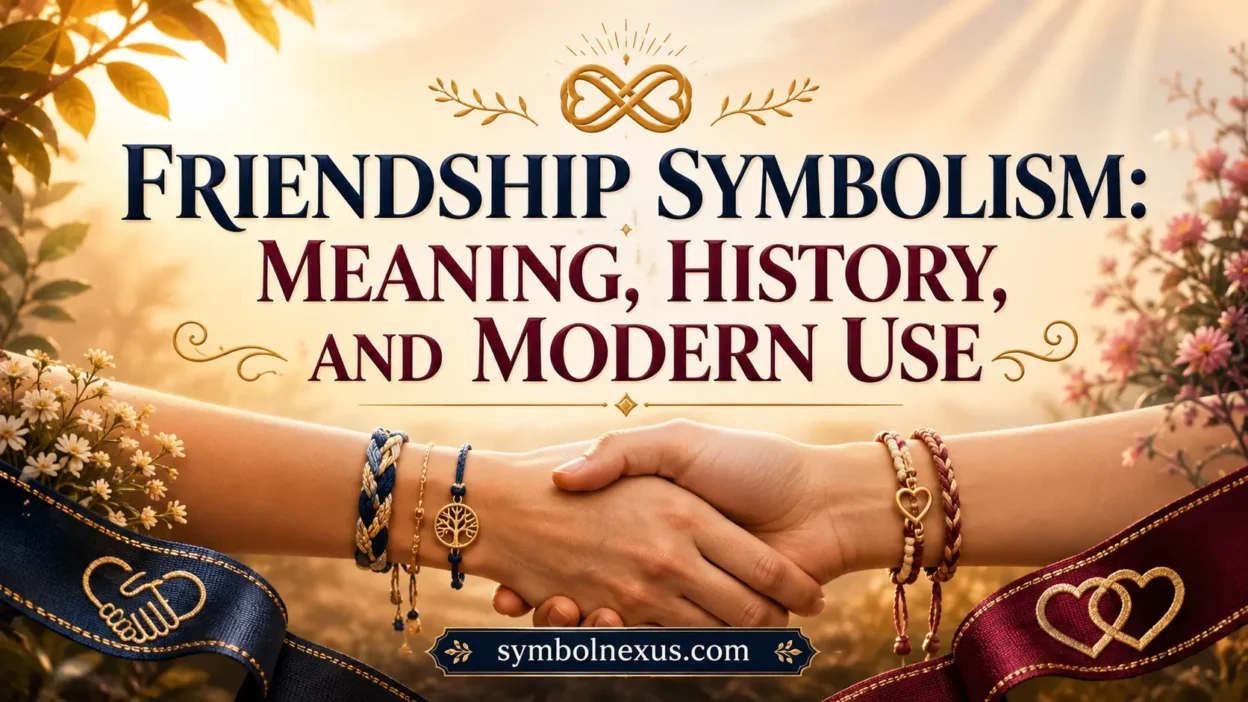
Friendship symbolism gives visible form to qualities that are otherwise difficult to show: trust, loyalty, mutual support, shared memories, and the decision to remain connected. In the United States, people express these ideas through bracelets, flowers, matching jewelry, clasped hands, tattoos, photographs, colors, and other personal objects.
Unlike a national flag or religious emblem, friendship does not have one universally accepted symbol. Its visual language has developed from many traditions. Some symbols have documented historical associations with friendship, while others gained that meaning through modern gift-giving, fashion, popular culture, or personal interpretation.
That variety is part of what makes the subject useful. A yellow flower, handmade bracelet, or matching tattoo can communicate friendship, but its exact meaning depends on who gives it, who receives it, and the cultural setting around it.
Quick Answer
Friendship symbolism commonly represents trust, loyalty, companionship, mutual support, and lasting connection in modern American culture. Historically, friendship has also been expressed through clasped hands, meaningful jewelry, flowers, and exchanged gifts that represent fidelity, affection, remembrance, or social bonds.
TL;DR
- Friendship symbols usually express trust, loyalty, support, and belonging.
- Bracelets turn shared experiences into wearable reminders.
- Clasped hands have long represented trust and committed bonds.
- Flowers can communicate friendship, but meanings change across eras.
- Modern symbols often gain meaning through personal stories and pop culture.
- No single friendship symbol is universal across cultures.
What Friendship Symbols Commonly Mean in the United States
Most American friendship symbols center on reciprocity. Friendship is not simply liking another person; it normally implies that both people recognize and maintain the relationship. Psychological descriptions likewise treat friendship as a voluntary, relatively lasting relationship involving concern for one another.
For that reason, common symbolic themes include:
| Context | Meaning in the USA | Common Association | Notes |
|---|---|---|---|
| Friendship bracelet | Connection and belonging | Shared experiences | Often handmade or exchanged |
| Clasped hands | Trust and commitment | Mutual support | Has older European precedents |
| Claddagh ring | Friendship with love and loyalty | Irish heritage | Hands represent friendship |
| Yellow flowers | Cheerful platonic affection | Celebration and appreciation | Meanings vary by flower and era |
| Matching jewelry | Shared identity | Closeness and memory | Usually personally defined |
| Infinity or knot design | Enduring connection | Continuity | Often a modern interpretation |
The most important distinction is that these objects represent friendship because communities or individuals give them that role. A bracelet is simply a bracelet until an exchange, memory, inscription, or relationship gives it social meaning.
Why Friendship Is Represented Through Objects and Gestures
Friendship is intangible, so people often use physical objects to make the relationship visible. A gift can mark the day two people met, a shared trip, graduation, a difficult period they survived together, or an ordinary joke that became meaningful only to them.
This helps explain why handmade objects are especially effective friendship symbols. Their value does not necessarily come from expensive materials. The time spent choosing colors, making an item, writing a message, or remembering an inside joke becomes part of the gift.
Gestures work similarly. A handshake, embrace, exchanged object, or clasped-hands design can visually communicate cooperation and mutual recognition. In symbolic terms, two separate people are shown voluntarily connecting with each other.
That emphasis on choice fits the nature of friendship itself: unlike most family relationships, friendships are generally formed and maintained voluntarily.
Ancient Ideas That Shaped the Meaning of Friendship
There is no single ancient origin for modern friendship symbols. However, Western ideas about friendship were strongly shaped by Greek philosophical discussions of philia, a term broader than the modern English word friendship. It could include affectionate relationships among friends, relatives, fellow citizens, and other close associates.
Aristotle treated friendship as an important part of a flourishing human life and examined relationships formed around usefulness, pleasure, and appreciation of another person’s character. His discussions helped establish an enduring Western idea: the strongest friendship involves more than convenience. It depends on mutual regard.
These philosophical traditions did not create a specific modern friendship icon. Instead, they contributed to the qualities later represented symbolically: goodwill, reciprocity, loyalty, shared values, and concern for another person’s welfare.
Clasped Hands: An Older Symbol of Trust and Connection
Two joined or clasped hands are among the clearest historical images associated with friendship, fidelity, agreement, and committed relationships.
One important example appears in fede rings. Their name comes from an Italian expression referring to hands joined in faith or trust. Versions of the design have roots extending back to Roman ring traditions and became especially prominent in medieval and later European jewelry. Clasped hands could represent friendship, betrothal, marriage, or fidelity depending on context.
This history matters because the hands should not automatically be interpreted as purely platonic. The same motif could mark romantic commitment.
In modern friendship jewelry and tattoos, however, joined hands naturally suggest mutual support: one person meeting another rather than standing alone. The image works because the symbolism is visible in the gesture itself.
The Claddagh and Its Three-Part Message
The Irish Claddagh ring combines three elements: two hands holding a heart topped by a crown. In its familiar interpretation, the hands represent friendship, the heart represents love, and the crown represents loyalty. The recognizable form developed in Galway and is documented from the early modern period.
That combination makes the Claddagh especially useful as a friendship symbol because it does not isolate companionship from other qualities. It suggests that a close bond can contain affection and loyalty without necessarily being romantic.
Irish migration also helped make the design familiar far beyond Galway. Today Americans may wear Claddagh jewelry to recognize friendship, romantic commitment, family connection, or Irish heritage.
Context therefore matters. Calling every Claddagh ring a friendship ring oversimplifies its meaning. Friendship is one part of a three-part symbolic design.
Friendship Bracelets Turn Relationships Into Wearable Memories
Few objects communicate friendship as directly in modern American culture as the friendship bracelet.
The basic symbolism comes from exchange. One person makes, chooses, or gives something that the other person can physically carry. Names, initials, dates, beads, colors, words, and inside jokes can make the bracelet highly specific to a relationship.
A Smithsonian collection object offers an especially direct example: a bracelet connected with girls who became friends while held at an immigration detention center in Texas. In that setting, the object represented connection under difficult circumstances rather than fashion alone.
Bracelet trading received another major cultural boost during Taylor Swift’s Eras Tour, where fans exchanged bead bracelets carrying song references, phrases, and jokes. The practice transformed the friendship bracelet from a symbol shared between established friends into a way for strangers in the same community to acknowledge one another.
Flowers and Colors Associated With Friendship
Flowers offer one of the most changeable forms of symbolic communication.
In nineteenth-century floriography, published flower dictionaries assigned meanings to plants so that bouquets could communicate messages. Smithsonian Gardens notes that ivy could represent friendship in Victorian flower language. It also emphasizes that these meanings changed across time and were never completely fixed.
Modern Americans are more likely to associate yellow roses with cheerful friendship or platonic affection. Yet this is a good example of why flower meanings require caution. Earlier flower traditions could also connect yellow roses with jealousy, fading love, or infidelity.
Color symbolism works in the same flexible way. Yellow often feels friendly because it is visually bright and culturally associated with cheerfulness, but there is no rule stating that every yellow object automatically means friendship.
The giver’s intention remains more important than a color chart.
Circles, Knots, and Infinity Designs
Modern jewelry and tattoo culture frequently uses circles, knots, linked shapes, and infinity signs to represent long-lasting friendship.
Their appeal is easy to understand. A continuous line can suggest something without an obvious ending. Two interlocking shapes can represent separate lives that remain connected. Knotted designs can suggest bonds that are difficult to undo.
Still, it is important to separate modern interpretation from documented historical meaning.
For example, Celtic interlace is a genuine historical artistic tradition found in monuments and illuminated manuscripts, but modern labels such as “Celtic friendship knot” may assign a specific meaning that ancient users did not document. Historical knotwork had complex artistic and religious contexts rather than one standardized dictionary of friendship meanings.
A friendship knot can therefore be meaningful today without needing an invented ancient explanation.
Matching Jewelry and Tattoos as Shared Identity
Matching symbols shift attention from the object itself to the relationship between two copies of it.
Friends may choose matching rings, necklaces, charms, small tattoos, coordinates, initials, flowers, stars, dates, animals, or phrases. Each individual design can have its own meaning, but the duplication creates an additional message: we chose this together.
This makes matching symbols particularly suited to friendships formed around shared experiences. Two friends might choose a mountain after traveling together, a wave after growing up near the coast, or a tiny image connected to an inside joke.
Tattoo meanings deserve special care because permanent designs often accumulate several interpretations. An infinity symbol might mean friendship to one person, family to another, and personal endurance to someone else.
A design becomes a friendship symbol through agreed meaning, not simply because it appears on an online symbolism chart.
Friendship in American Celebrations and Public Culture
American friendship is usually celebrated privately through birthdays, graduations, reunions, weddings, school activities, group trips, and gift exchanges rather than through one major national holiday.
At the international level, the United Nations recognizes July 30 as the International Day of Friendship. The observance was proclaimed in 2011 and frames friendship broadly as a way to encourage understanding among individuals, peoples, countries, and cultures.
That public interpretation expands the idea beyond best friends. Friendship can also symbolize peaceful cooperation, community building, and relationships across social boundaries.
In the United States, schools and community groups sometimes use friendship-themed craft projects, cards, circles, or bracelets to teach inclusion and social connection. Smithsonian educational programming, for example, has used friendship-bracelet activities to connect creativity with relationships and happiness.
Digital Culture Has Created a New Symbolic Language of Friendship
Friendship is increasingly represented through digital behavior rather than permanent emblems.
Group photos, shared memes, recurring emojis, private nicknames, matching profile images, playlists, tagged memories, and ongoing group chats can all function symbolically. Their meaning comes from repetition and shared context.
An emoji that seems ordinary to outsiders may have a specific meaning within a friendship because of a past conversation. A song may become a friendship symbol because two people heard it during an important event. A photograph may represent years of connection despite containing no traditional friendship imagery at all.
This resembles older symbolic systems more than it might appear. Victorian flower dictionaries allowed objects to carry messages beyond their literal appearance; digital communities do something similar with images, reaction icons, phrases, and cultural references.
The vocabulary changed. The human habit of encoding relationships did not.
Emotional and Psychological Meaning
At an emotional level, friendship symbols often communicate belonging.
Receiving a meaningful object can say, “I recognize our relationship,” “I remember what we experienced,” or “You remain part of my life.” The emotional value is therefore tied less to the object than to recognition and continuity.
Symbols can also act as memory cues. A bracelet from summer camp, a concert ticket, an old photograph, or a matching necklace can reconnect someone with a specific period and the person who shared it.
Another common theme is reliability. Clasped hands, linked circles, and durable materials visually suggest stability, which makes them natural choices for representing trust.
Healthy friendship, however, is not measured by whether two people possess matching objects. Friendship is a relationship, while its symbols are reminders or expressions of that relationship. Psychological definitions emphasize the ongoing voluntary bond and mutual concern rather than possession of any particular token.
Cross-Cultural Meanings Require Context
Friendship exists in every society, but symbols should not be treated as if they have identical meanings everywhere.
The Claddagh belongs to an Irish cultural history. European flower languages reflect particular historical conventions. Clasped-hand jewelry developed through specific Western traditions. Modern American bracelet exchanges have their own social settings.
Problems arise when an attractive design is removed from its original context and marketed as a universal ancient symbol.
Claims about Indigenous imagery deserve particular caution. Online charts frequently assign fixed meanings such as “friendship” to supposedly universal Native American signs. Indigenous nations, however, have distinct languages, artistic systems, histories, and traditions. A meaning documented for one people should not automatically be attributed to all Native cultures.
Respectful interpretation begins by identifying the specific community behind a symbol rather than using “Native American” as one undifferentiated culture.
Common Misunderstandings About Friendship Symbols
The largest misconception is that every symbol has one official definition.
Symbolic meaning rarely works that way. Even well-established motifs change by place and period. Clasped hands have represented friendship, fidelity, marriage, and agreement. Flowers gained conflicting definitions in different dictionaries. Yellow roses have carried both warm and less positive associations.
A second problem is invented antiquity. Jewelry stores, tattoo pages, and social posts sometimes describe modern designs as ancient friendship symbols without documenting that claim.
A third misunderstanding involves romantic imagery. Hearts, Claddagh rings, roses, and linked hands can represent friendship, but they can also communicate romantic love.
The safest interpretation considers three things together: the documented history of the design, its current cultural use, and the meaning intended by the people using it.
How Friendship Symbols Have Changed Over Time
Earlier friendship symbols often belonged to broader systems of social meaning. Rings could express vows or fidelity. Flowers could send coded messages. Hand gestures could communicate agreement and trust.
Modern American symbolism has become increasingly personalized.
Instead of choosing from a fixed symbolic vocabulary, friends frequently create their own. A bead bracelet might contain a song title. Two tattoos might reproduce a childhood drawing. A charm may refer to a television series, vacation, hobby, or joke understood by only two people.
Popular culture can also change symbolism rapidly. The friendship-bracelet exchanges surrounding the Eras Tour show how an already familiar object can acquire a new communal function. Fans began using bracelets not only to celebrate existing friendships but also to initiate brief moments of connection with strangers.
The direction of change is clear: friendship symbols have become increasingly participatory and personal.
Choosing a Symbol for a Friendship
The most meaningful choice is usually the one connected to the actual relationship.
For a longtime friend, an object tied to shared history may communicate more than a generic emblem. Friends who value tradition might prefer a Claddagh design or clasped hands. Someone who enjoys handmade gifts may appreciate a bracelet. A plant lover may prefer flowers or ivy. Others may choose a symbol completely unrelated to traditional friendship imagery.
Consider whether the symbol communicates the right kind of affection. Hearts and roses can sometimes appear romantic. Permanent tattoos also deserve more thought than temporary or replaceable objects.
Cultural background matters as well. If a design comes from a specific tradition, learning its documented meaning creates a more respectful and accurate connection to it.
Ultimately, personal significance and informed choice matter more than finding an supposedly “official” symbol.
Frequently Asked Questions
What is the most common symbol of friendship?
There is no single official friendship symbol in the United States. Friendship bracelets, clasped hands, Claddagh designs, yellow flowers, and matching jewelry are among the most recognizable choices, but their meanings depend on context.
What color represents friendship?
Yellow is commonly associated with cheerful platonic affection in modern gift culture, especially through yellow roses. However, color meanings are culturally flexible, so yellow should be understood as a popular association rather than a universal rule.
What flower symbolizes friendship?
Ivy had a documented friendship meaning in Victorian floriography, while yellow roses are widely used for friendship in modern culture. Flower meanings change across eras, which means historical and contemporary interpretations may differ.
What does a friendship bracelet symbolize?
A friendship bracelet usually represents connection, shared memories, belonging, or appreciation between the giver and wearer. Modern bracelet trading can also create temporary bonds among members of the same community or fandom.
Is the Claddagh a friendship symbol?
Yes, friendship is one of the three traditional ideas represented in the Claddagh design. The hands signify friendship, while the heart represents love and the crown represents loyalty.
What does an infinity symbol mean between friends?
Friends commonly use the infinity sign to represent an enduring bond or the intention to remain connected. That is primarily a modern personal interpretation rather than evidence that the mathematical infinity sign was historically created as a friendship emblem.
Can friendship symbols also represent romantic love?
Yes. Clasped hands, hearts, roses, rings, and even the Claddagh can appear in both platonic and romantic contexts. The surrounding relationship, inscription, gift occasion, and personal intention usually determine the most appropriate interpretation.
Conclusion
The strongest friendship symbolism centers on mutual trust, loyalty, shared experience, remembrance, and the choice to remain connected. Bracelets, flowers, clasped hands, meaningful jewelry, and matching designs all express these ideas, but none functions as a universal code.
History also shows why context matters. Some symbols carry documented traditions, while others received their friendship associations much more recently. A modern interpretation does not become less meaningful simply because it is modern; it becomes more accurate when its history is described honestly.
In the end, a friendship symbol works best when both people understand what it represents. Its value comes from the relationship attached to it, not from the object alone.