
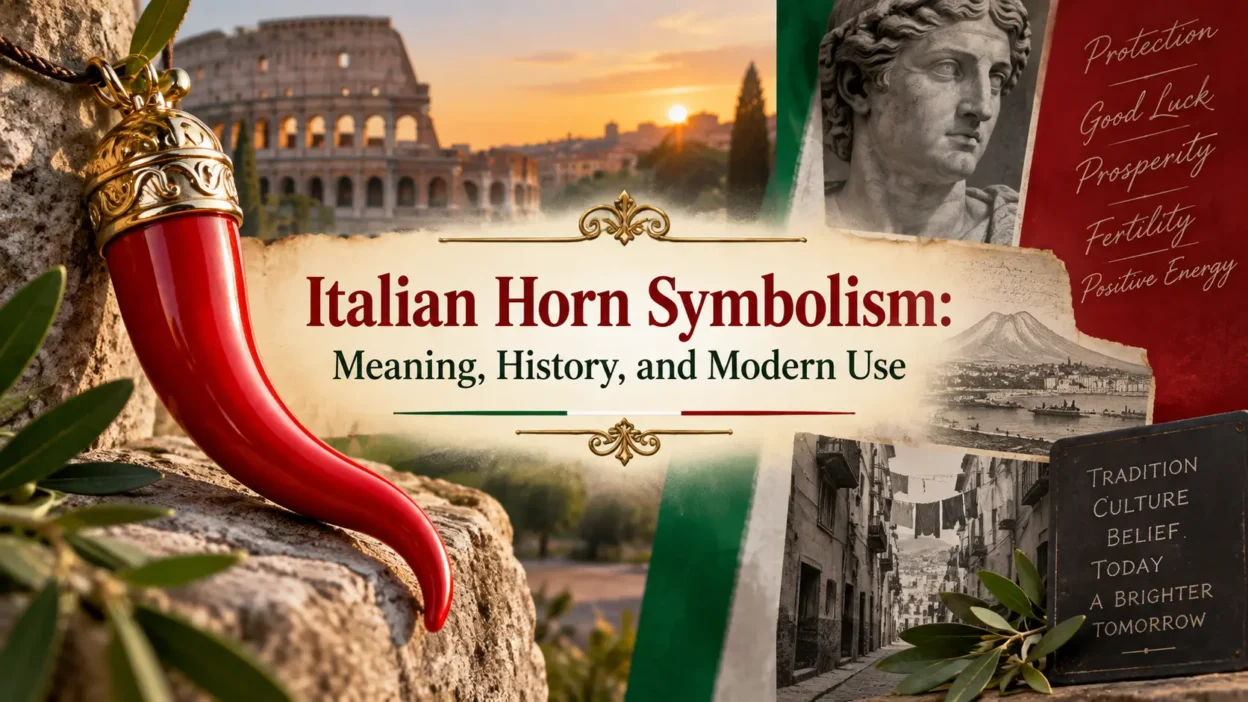
The Italian horn, often called the cornicello or corno, is a small, curved charm associated with good luck and protection. You may have seen it as a necklace, keychain, car charm, or decoration in an Italian American home. Its bright red, tapered shape makes it easy to recognize.
For many people in the United States, the Italian horn represents more than an attractive piece of jewelry. It can express family heritage, affection, good wishes, or a connection to Italian culture. In traditional southern Italian folklore, especially around Naples, the charm also has a protective role against the evil eye, or malocchio.
Its history, however, is more complicated than the modern souvenir version suggests. Horns have carried ideas of strength, fertility, abundance, and protection in Mediterranean cultures for a very long time. The specific modern Neapolitan cornicello developed within a much later mixture of local folklore, religious traditions, superstition, craftsmanship, and popular culture.
Quick Answer
Italian horn symbolism commonly represents good luck, protection, prosperity, and affection in modern American culture. In southern Italian tradition, particularly Naples, the red cornicello is also associated with protection from the evil eye, fertility, strength, and the avoidance of misfortune.
TL;DR
- The Italian horn commonly represents luck and protection.
- Naples is strongly associated with the modern cornicello tradition.
- The horn is traditionally linked with the evil eye.
- Red represents vitality, prosperity, and protection in this tradition.
- Italian Americans often wear it as jewelry or family heritage.
- Today, it also works as a gift and decorative symbol.
What Does the Italian Horn Look Like?
The traditional cornicello is not simply a miniature version of an ordinary animal horn. It usually has a long, narrow, gently twisted, tapered shape that can resemble a chili pepper. Traditional examples are often red, although modern versions come in gold, silver, ceramic, plastic, coral, and other materials.
The charm may hang from a chain or bracelet. People also attach it to keyrings, bags, cars, storefronts, or household decorations.
That shape matters because the object is recognized as a protective charm rather than merely a representation of an animal. Its distinctive point and curve have become part of its cultural identity.
What Does the Italian Horn Mean in the United States?
In the United States, the Italian horn most commonly communicates good fortune and protection.
Someone might wear one because they believe it brings luck. Another person may wear it because their parents or grandparents came from Italy. For others, it is simply a familiar Italian American symbol.
This distinction matters. Not everyone who wears a cornicello follows the traditional beliefs surrounding it. A person can appreciate the charm as part of family heritage without believing that it literally prevents bad luck.
The symbol can therefore carry several meanings at once:
- Good luck — a wish for favorable outcomes.
- Protection — especially protection from misfortune or envy.
- Family heritage — a visible connection to Italian ancestry.
- Prosperity — a wish for success and well-being.
- Love and affection — especially when given as a gift.
- Strength and vitality — ideas connected with the horn itself.
Recent coverage of the Neapolitan tradition also shows the charm being presented as a symbol of love and fortune, including as a Valentine’s Day gift.
How Did the Italian Horn Become a Protective Symbol?
The exact origin of the modern cornicello cannot be reduced to one ancient event. Claims that today’s charm has an uninterrupted history stretching thousands of years should be treated cautiously.
What is clearer is that horns have had symbolic value across ancient Mediterranean cultures. Animal horns naturally suggested physical strength, fertility, abundance, and power. Horn-shaped objects could also become amulets.
The Roman world provides an important part of this larger background. Horns and other phallic forms could have protective associations, particularly in beliefs surrounding the evil eye. The Metropolitan Museum of Art notes that horn-related protective gestures appeared in ancient Greek, Etruscan, and Roman art, showing that horn imagery had multiple meanings long before the modern Italian charm.
This does not prove that the modern cornicello existed in exactly its present form in ancient Rome. Instead, it shows that the symbolic ingredients behind the tradition have much older Mediterranean roots.
Why Is the Italian Horn Associated With the Evil Eye?
The cornicello is especially associated with protection against the evil eye, known in Italian traditions as malocchio.
The basic belief behind the evil eye is that envy, an ill-intentioned look, or excessive admiration can bring misfortune to another person. Similar beliefs appear across many cultures, although the details differ.
In southern Italian folklore, the horn became one of several objects and gestures associated with protection from this perceived danger. Its purpose was therefore not simply to “bring luck” in a general sense. It could also serve as a defensive symbol against something believed to cause bad fortune.
This helps explain why the horn may appear in places connected with everyday life. A person might wear one for personal protection or display one in a home or vehicle.
The belief is cultural and folkloric, not a scientifically established protective effect. Its importance comes from tradition, family practice, and shared cultural meaning.
Why Is the Italian Horn Usually Red?
Red is one of the most recognizable features of the Neapolitan cornicello.
Within the tradition, red is associated with life, vitality, strength, prosperity, and protection. Its strong visual presence also makes the charm easy to identify.
Some explanations connect the color with blood and life, while others emphasize its association with red peppers and fertility. Modern Neapolitan descriptions commonly treat the intense red color as an important part of the charm’s identity.
It is worth avoiding a universal claim that “red always means protection.” Color symbolism changes between cultures and historical periods. In this particular tradition, however, red became closely tied to the protective and fortunate character of the cornicello.
What Do the Horn’s Shape and Point Represent?
The horn’s unusual shape contributes to its symbolism.
Animal horns naturally suggest strength and physical power. In older agricultural societies, animals were also closely connected with food, labor, wealth, and reproduction. This made horns suitable symbols for prosperity and fertility.
The modern cornicello adds another layer. Its long, pointed, crooked form distinguishes it from an ordinary curved goat or cattle horn. Traditional descriptions emphasize its tapered point and bent shape as features of an authentic lucky horn.
The shape can therefore be understood as part of a broader protective visual language. Rather than being a neutral decoration, the unusual form signals that the object belongs to a tradition of charms and amulets.
Is the Italian Horn Connected to Fertility?
Yes. Fertility is an important historical association, although it is not necessarily the first meaning an American wearer thinks of today.
The connection comes partly from the symbolic history of horns and from ancient Mediterranean associations with fertility. Modern accounts of the Neapolitan cornicello also connect its form with fertility and with the ancient god Priapus, a figure associated with male fertility.
There is also a broader connection between fertility and prosperity. For agricultural communities, successful reproduction of people, animals, and crops affected the survival and wealth of the household.
Today, most Americans who wear an Italian horn are unlikely to interpret it specifically as a fertility symbol. Luck, protection, Italian identity, and family tradition are usually more recognizable meanings.
Italian Horn Symbolism at a Glance
| Context | Meaning in the USA | Common Associations | Notes |
|---|---|---|---|
| Necklace or bracelet | Luck and protection | Jewelry, heritage | Often worn as a personal charm |
| Gift | Good wishes and affection | Family, friendship, romance | Traditional customs place importance on gifting |
| Car charm | Protection from misfortune | Travel, safety, luck | Commonly seen as a cultural charm |
| Home décor | Heritage and good fortune | Italian American identity | Can be decorative as well as symbolic |
| Traditional Neapolitan use | Protection from the evil eye | Malocchio, prosperity | Strongly rooted in southern Italian folklore |
Why Is the Italian Horn Often Given as a Gift?
One of the best-known customs surrounding the cornicello is that it should be received as a gift rather than purchased for oneself.
This belief appears in modern accounts of Neapolitan tradition and gives the charm a social meaning. The object is not simply something you acquire; it becomes a gesture from one person to another.
That custom also explains why the charm works well as a present.
Giving someone an Italian horn can communicate:
“I want good things for you.”
It can therefore function as a small expression of care, especially when given before travel, during an important life event, or simply as a token of family heritage.
Modern versions sometimes include hearts and are exchanged romantically, including around Valentine’s Day.
Italian Horn Meaning in Italian American Culture
The symbol has a particularly interesting place in the United States because Italian immigration transformed it from a regional Italian charm into a broader Italian American cultural symbol.
For families with Italian roots, a cornicello may appear alongside other reminders of family heritage. It can be worn by someone who considers it a lucky charm, but it can also represent grandparents, family stories, food traditions, or an ancestral connection to southern Italy.
Over generations, the original superstition may become less important while the identity symbolism remains.
That is common with cultural objects. A younger Italian American might not believe in the evil eye but still recognize the red horn immediately and understand what it represents within their family.
In this way, the cornicello can move from protective amulet to heritage symbol without completely losing its older meaning.
How Is the Italian Horn Used Today?
You can find the Italian horn in many forms today.
Jewelry
Necklaces, bracelets, earrings, and charms are among the most common forms. A small horn can be worn every day without looking like a traditional religious object.
Keychains
The symbol works especially well as a keychain because it is small, durable, and easy to carry.
Cars
Some people hang Italian horns from rearview mirrors. In this setting, the charm can represent protection during travel or simply Italian American identity.
Home Décor
Ceramic or metal horns can appear in kitchens, entryways, offices, and other spaces. A decorative horn may carry traditional meaning, family meaning, or both.
Tattoos
An Italian horn tattoo can combine several ideas: luck, protection, heritage, family, and personal identity. The meaning becomes particularly personal when the tattoo represents someone’s Italian American background.
Gifts
The charm remains well suited to birthdays, weddings, Valentine’s Day, graduations, new homes, and other occasions where someone wants to wish another person well.
Modern Italian artisans continue producing handmade versions in materials including terracotta, coral, gold, and silver.
What Does an Italian Horn Tattoo Symbolize?
An Italian horn tattoo most often symbolizes protection, good luck, Italian heritage, or a connection to family.
For someone with Italian ancestry, the tattoo may honor parents, grandparents, or a family tradition. For another person, it may simply represent a desire for good fortune.
The tattoo can also be combined with names, dates, roses, hearts, flags, or other symbols. Those additions can change the emphasis. For example, a horn paired with a family name may focus more strongly on heritage, while one paired with a heart may emphasize love and family bonds.
There is no single universal tattoo meaning. Personal context matters.
How Does the Italian Horn Compare With Other Protective Symbols?
The cornicello belongs to a much larger human tradition of using objects as protective symbols.
The nazar, for example, uses an eye-shaped design in traditions associated with protection from the evil eye. The hamsa uses a hand form and carries protective meanings in several Middle Eastern and North African traditions.
The Italian horn is different because its symbolism developed within southern Italian and broader Mediterranean folk traditions. Its defining shape, red color, gifting customs, and connection with malocchio give it a distinctive cultural identity.
This comparison also shows why “evil eye symbol” should not be treated as one universal category. Different communities developed different objects, beliefs, rituals, and explanations for protection.
Italian Horn Symbolism and Religion
The Italian horn is not a standard Christian symbol in the way a cross, dove, or fish is.
It belongs primarily to Italian folk tradition and superstition. However, many Italian communities historically blended everyday folk practices with Catholic cultural life. That means a person could participate in both religious traditions and folk customs without viewing them as completely separate parts of daily life.
The ancient background is also not exclusively Christian. Horn imagery existed in pre-Christian Mediterranean cultures, and later European traditions gave horns many different meanings.
Therefore, calling the cornicello simply a “Christian symbol” would be misleading. Its story is better understood as a mixture of folk belief, ancient symbolism, regional tradition, and later cultural identity.
Common Misunderstandings About the Italian Horn
Several popular explanations oversimplify the history.
First, the Italian horn is not simply an “Italian evil eye symbol.” It is specifically connected with southern Italian traditions, particularly Naples, while modern Italian Americans may use it in broader ways.
Second, its history is not completely settled. Modern sources often describe extremely ancient origins, sometimes reaching back thousands of years. Those claims should not automatically be treated as proof that the modern cornicello existed unchanged during those periods. Contemporary versions developed through a long process of cultural change.
Third, the horn does not have one fixed meaning. Protection and luck are central, but fertility, prosperity, strength, affection, and heritage can also matter.
Finally, wearing one does not necessarily mean someone is superstitious. In the United States, it may simply express cultural pride or family connection.
How Has the Symbol’s Meaning Changed?
The Italian horn has moved through several overlapping stages.
Older horn symbolism emphasized strength, fertility, abundance, and protection. Mediterranean cultures already used horn imagery in religious, social, and protective contexts.
Southern Italian folklore later gave the horn a particularly recognizable role in protecting against the evil eye. The Neapolitan cornicello became strongly identified with luck and protection.
Italian immigration then carried the symbol beyond Italy. In the United States, it became increasingly connected with Italian American identity.
Today, the symbol can function simultaneously as a folk charm, a fashion accessory, a family keepsake, a gift, a tattoo design, and a marker of cultural heritage.
That flexibility helps explain why an object with roots in regional folklore remains recognizable in contemporary American culture.
What Does the Italian Horn Symbolize Emotionally?
Emotionally, the horn often communicates a simple human wish: “May you be safe and lucky.”
That message can become especially meaningful when someone gives the charm to another person.
It may represent:
- concern for someone’s well-being
- affection between family members
- pride in cultural heritage
- hope for success
- remembrance of older generations
- a desire to avoid misfortune
For an Italian American family, the emotional meaning may come less from the object’s supposed supernatural ability and more from what the object represents.
A charm handed down by a grandparent, for example, can become a personal family symbol regardless of whether its owner believes in its protective powers.
FAQ About Italian Horn Symbolism
What does an Italian horn symbolize?
An Italian horn commonly symbolizes good luck, protection, prosperity, and affection. In southern Italian folklore, it is especially associated with protection against the evil eye and with avoiding misfortune.
Is the Italian horn a symbol of good luck?
Yes. Good luck is one of its best-known modern meanings. The Neapolitan cornicello is traditionally treated as a lucky charm, although many people in the United States now wear it mainly as a cultural or family symbol.
Why is the Italian horn red?
Red is traditionally associated with vitality, strength, prosperity, and protection in the Neapolitan tradition. The red color also helps distinguish the traditional cornicello from ordinary horn-shaped decorations.
Should an Italian horn be given as a gift?
Traditional Neapolitan custom says that the charm should be given rather than purchased for yourself. Modern practice is more flexible, but gifting remains an important part of its cultural meaning.
What does an Italian horn tattoo mean?
An Italian horn tattoo can represent protection, luck, Italian heritage, family, or personal identity. Its meaning depends on the person wearing it and any other imagery included in the tattoo.
Is the Italian horn a religious symbol?
It is primarily a folk and cultural symbol rather than an official Christian symbol. Its history includes older Mediterranean traditions and later southern Italian folklore, so it should not be treated as exclusively Christian.
Does the Italian horn really protect against the evil eye?
That is a matter of traditional belief, not a scientifically demonstrated effect. Within Neapolitan folklore, the cornicello is used as a protective charm against the malocchio, while many modern Americans appreciate it mainly for its cultural and personal meaning.
Conclusion
The Italian horn is best understood as a symbol with several layers rather than one fixed definition. In modern American culture, it most often represents good luck, protection, affection, prosperity, and Italian heritage, while its Neapolitan roots connect it more specifically with the evil eye, fertility, and strength.
The history also explains why Italian horn symbolism remains relevant today. What began within regional traditions of southern Italy now appears in American jewelry, tattoos, cars, homes, gifts, and family keepsakes. Its meaning has changed with time, but the basic message remains recognizable: a wish for good fortune and protection.
For many people, that is what makes the little horn meaningful—not a promise that it can control fate, but a tangible reminder of family, culture, and the hope that someone you care about will be well.


