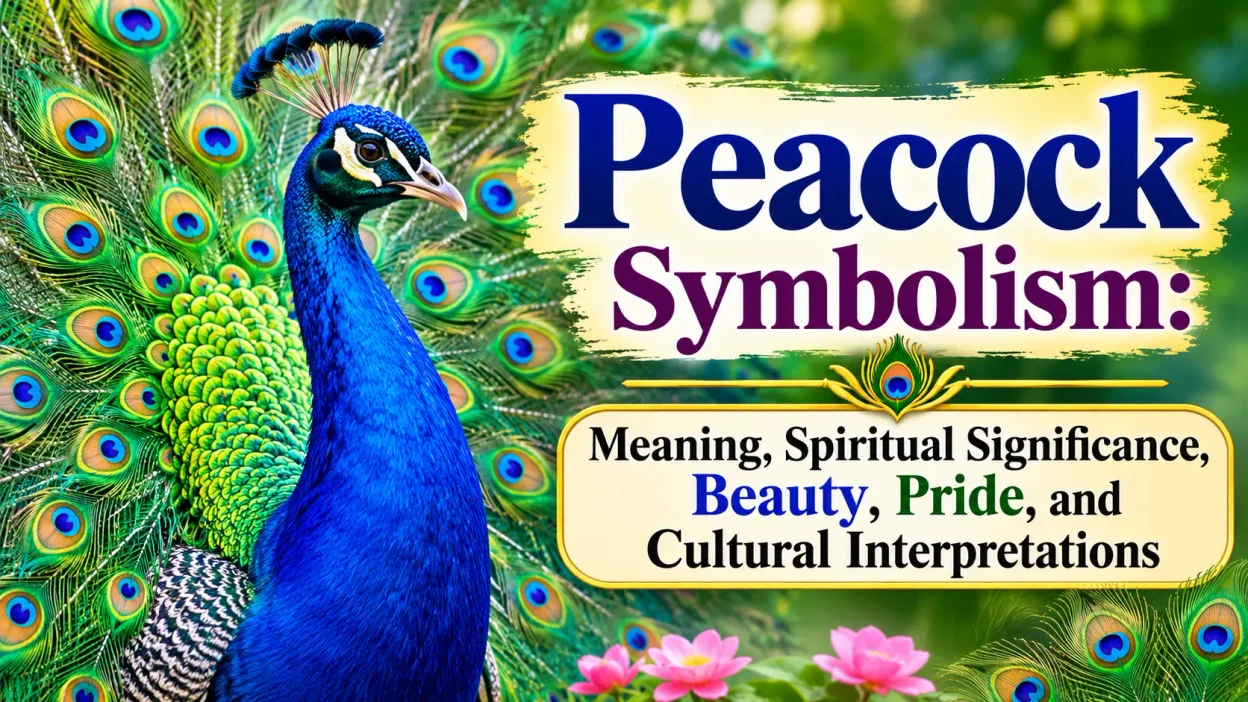
The peacock is one of the most visually striking birds in the world. Known for its brilliant feathers, colorful patterns, and impressive courtship display, it has inspired myths, religious traditions, artwork, and symbolic interpretations across many cultures.
Peacock symbolism is commonly associated with beauty, confidence, pride, wisdom, renewal, protection, and spiritual awareness. Its magnificent tail feathers can represent self-expression and individuality, while the eye-like patterns on those feathers are sometimes interpreted as symbols of watchfulness, perception, and protection.
In different religious and cultural traditions, the peacock carries distinct meanings. It appears in Hindu mythology, Buddhist art, Greek mythology, Christian symbolism, and South Asian cultural traditions. Its meaning can also change depending on whether the bird is seen displaying its feathers, flying, appearing in a dream, or leaving behind a feather.
Understanding peacock symbolism offers a fascinating look at how nature becomes connected with human beliefs, emotions, and spiritual ideas.
What Does a Peacock Symbolize?
A peacock generally symbolizes beauty, pride, confidence, dignity, renewal, wisdom, and spiritual awareness.
Its most common symbolic meanings include:
- Beauty and elegance: Its colorful plumage represents visual beauty and grace.
- Pride and confidence: Its impressive display can symbolize self-assurance and personal identity.
- Wisdom and awareness: The eye-like markings on its feathers are associated with perception and watchfulness.
- Renewal and immortality: The bird’s seasonal feather shedding and regrowth can inspire ideas of renewal.
- Protection: In some traditions, its feathers are associated with spiritual protection.
- Prosperity: Its magnificent appearance has made it a symbol of abundance and good fortune in some cultures.
- Spiritual awakening: Its beauty and symbolism can represent inner growth and awareness.
- Individuality: The peacock can encourage people to express their unique qualities.
These meanings are not universal. Cultural traditions and personal interpretations influence how the bird is understood.
1. Peacock Symbolism and Beauty
Beauty is one of the most recognizable meanings associated with the peacock.
The bird’s iridescent blue, green, bronze, and gold-colored plumage makes it a natural symbol of elegance, attraction, and visual perfection.
In symbolic interpretations, the peacock can represent the beauty of individuality. Its feathers are different from those of most other birds, reminding us that personal qualities and differences can be valuable.
The peacock may also symbolize the importance of appreciating beauty beyond physical appearance. Its impressive display can inspire reflection on creativity, personality, confidence, and inner qualities.
2. Pride, Confidence, and Self-Expression
A peacock displaying its magnificent tail is often used as a symbol of confidence and pride.
Its upright posture and elaborate feathers create an image of self-assurance. This makes the bird a popular symbol of personal expression, dignity, and individuality.
Positive interpretations include:
- Being comfortable with who you are.
- Recognizing your abilities and achievements.
- Expressing your creativity without fear.
- Developing healthy self-confidence.
- Taking pride in your personal identity.
However, peacock symbolism also has a more complicated side. Because the bird displays its feathers so prominently, it can represent vanity, arrogance, excessive pride, or the desire for attention.
The peacock therefore offers a lesson about balance: confidence can be empowering, but pride becomes harmful when it turns into superiority.
3. Peacock Spiritual Meaning
In modern spiritual interpretations, the peacock is often associated with awakening, transformation, protection, and awareness.
Its eye-like feather patterns inspire the idea of seeing beyond appearances and becoming more conscious of the world around us.
Some commonly suggested spiritual meanings include:
Spiritual Awareness
The peacock’s feather patterns can symbolize observation, insight, and the ability to recognize deeper meanings.
Personal Transformation
Its changing feathers and magnificent appearance can represent personal development and the discovery of hidden potential.
Inner Beauty
The bird may remind people that true beauty involves character, kindness, wisdom, and self-acceptance.
Protection and Guidance
In some spiritual traditions and modern interpretations, peacock feathers are associated with protection and divine watchfulness.
Confidence in Your Journey
The peacock can represent the courage to express yourself and move forward without hiding your individuality.
These are symbolic interpretations rather than scientifically verified spiritual effects.
4. Peacock Symbolism in Different Cultures
The peacock has a long history in mythology, religious art, and cultural traditions. Its meanings vary significantly across regions.
Hindu Peacock Symbolism
The peacock holds an important place in Hindu mythology.
It is especially associated with Lord Kartikeya, also known as Murugan or Skanda, who is commonly depicted riding a peacock. The bird is connected with courage, divine power, victory, and the overcoming of negative forces.
The peacock is also associated with Goddess Saraswati in some regional artistic and devotional traditions. Saraswati is the goddess of knowledge, learning, music, and the arts.
In these contexts, the peacock can represent:
- Wisdom and knowledge.
- Divine beauty.
- Courage and victory.
- Spiritual discipline.
- The relationship between nature and divinity.
The bird’s association with particular deities varies across Hindu traditions and regional depictions.
Buddhist Peacock Symbolism
In some Buddhist traditions, the peacock represents wisdom, compassion, and the transformation of negative qualities.
Its ability to consume certain toxic creatures has inspired a metaphor in which wisdom transforms poison into something beneficial.
The peacock is also associated with Amitabha Buddha in some Buddhist artistic and iconographic traditions.
In this context, it may symbolize the transformation of desire, attachment, and ignorance into greater awareness.
Greek Peacock Symbolism
In Greek mythology, the peacock is associated with Hera, the queen of the gods.
According to a well-known myth, Hera placed the eyes of the hundred-eyed giant Argus on the peacock’s feathers after his death.
This story explains the eye-like patterns on the bird’s tail in Greek mythology.
Because of this association, the peacock can symbolize:
- Watchfulness.
- Protection.
- Royal dignity.
- Divine power.
- Beauty and majesty.
Roman Peacock Symbolism
The Romans inherited many associations between the peacock and Hera, whom they identified with Juno.
The bird became associated with Juno and was sometimes connected with royalty, status, and immortality.
Peacocks also appeared in Roman decorative art and funerary contexts, where they could suggest eternal life or the continuation of the soul.
Persian and South Asian Symbolism
Peacocks have been admired in Persian and South Asian art, architecture, poetry, and royal traditions.
Their impressive appearance made them symbols of luxury, beauty, dignity, and prestige.
The famous Peacock Throne of Mughal India reflects the bird’s association with royal magnificence and authority.
5. Peacock Symbolism in Christianity
In Christian art and symbolism, the peacock has often been associated with immortality, resurrection, eternal life, and spiritual renewal.
One historical reason for this association is the ancient belief that peacock flesh did not decay after death. This belief was incorrect biologically, but it contributed to the bird’s symbolic connection with immortality.
Early Christian artists used peacocks in mosaics, church decorations, and funerary imagery.
The peacock’s annual feather renewal also provided a visual metaphor for resurrection and new life.
Common Christian interpretations include:
- Immortality: The hope of eternal life.
- Resurrection: The promise of life beyond death.
- Renewal: Spiritual restoration and transformation.
- Divine beauty: The magnificence of God’s creation.
- Paradise: The bird’s association with heavenly beauty.
However, the Bible does not establish a detailed doctrine assigning these meanings to peacocks. They are primarily historical Christian artistic and devotional interpretations.
6. Peacock Symbolism by Feather Colors
A peacock’s feathers contain several striking colors, and each color can inspire different symbolic meanings.
| Color | Common symbolic interpretation |
|---|---|
| Blue | Wisdom, confidence, calmness, and spiritual awareness |
| Green | Growth, renewal, harmony, and abundance |
| Gold | Wealth, success, prestige, and divine beauty |
| Bronze | Strength, stability, and dignity |
| White | Purity, peace, innocence, and spiritual renewal |
| Black | Mystery, protection, transformation, and the unknown |
| Multicolored | Individuality, creativity, diversity, and self-expression |
These associations are modern or traditional interpretive meanings rather than fixed rules shared by every culture.
7. White Peacock Symbolism
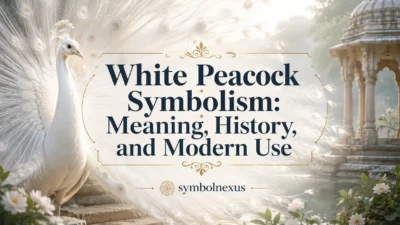
A white peacock is particularly striking because its feathers appear completely white rather than displaying the familiar blue and green iridescence.
White peacocks are generally associated with leucism, a genetic condition that reduces pigmentation. They are not necessarily albino.
Symbolically, a white peacock may represent:
- Purity and innocence.
- Peace and tranquility.
- Spiritual awakening.
- Transformation and renewal.
- Divine beauty.
- Inner clarity.
In modern spiritual interpretations, seeing a white peacock may inspire thoughts about personal growth, emotional balance, or a fresh beginning.
Its association with purity and spiritual renewal makes it a popular image in decorative and religious-inspired artwork.
8. Peacock Feather Symbolism
Peacock feathers are admired for their distinctive eye-like patterns and beautiful colors.
In different traditions, they are associated with protection, wisdom, prosperity, beauty, and spiritual awareness.
The feather’s eye-like marking is sometimes interpreted as a symbol of watchfulness or the ability to see beyond appearances.
In Hindu traditions, peacock feathers have a particularly recognizable connection with Lord Krishna, who is frequently depicted wearing a peacock feather in his crown.
This association can represent divine beauty, joy, love, and spiritual devotion.
In some Buddhist contexts, peacock feathers are also connected with wisdom and the transformation of negative qualities.
Modern interpretations often associate a peacock feather with:
- Personal confidence.
- Protection and awareness.
- Spiritual growth.
- Creativity and individuality.
- Good fortune and abundance.
A feather does not have one universal meaning, and its significance depends on the cultural or personal context.
9. Peacock Symbolism in Dreams
Dreaming about a peacock can be interpreted in several ways depending on what happens in the dream and how you feel.
The bird may represent confidence, recognition, beauty, pride, or the desire to express yourself.
Dreaming of a Peacock Displaying Its Feathers
A peacock spreading its tail may symbolize confidence, creativity, recognition, or a desire to be appreciated.
It may encourage you to acknowledge your abilities and express your personality.
Dreaming of a White Peacock
A white peacock may symbolize peace, clarity, innocence, or a new beginning.
Some spiritual interpretations connect it with personal awakening and emotional renewal.
Dreaming of a Flying Peacock
A flying peacock may represent freedom, ambition, personal growth, or the desire to rise above limitations.
Dreaming of a Dead Peacock
A dead peacock may symbolize disappointment, the loss of confidence, changing priorities, or the end of a period of recognition.
It may also reflect concerns about appearance, self-worth, or personal identity.
Dreaming of a Peacock Feather
A peacock feather may represent beauty, wisdom, protection, creativity, or the desire to recognize your unique qualities.
Dream interpretations are subjective. They should be understood as reflections or personal associations rather than reliable predictions.
10. Peacock Symbolism in Love and Relationships
In love and relationships, the peacock can symbolize attraction, romance, beauty, loyalty, and self-expression.
Its elaborate courtship display makes it a natural symbol of admiration and romantic attention.
Some common interpretations include:
- Attraction: The beauty and display of the peacock can represent romantic interest.
- Confidence: It may symbolize feeling comfortable and secure in a relationship.
- Loyalty: In some modern interpretations, it represents devotion and commitment.
- Individuality: It can encourage partners to appreciate each other’s unique qualities.
- Pride: It may also warn against vanity, jealousy, or excessive attention-seeking.
The peacock’s symbolism can therefore represent both the beauty of attraction and the importance of emotional balance.
11. Peacock Symbolism in Good Luck and Prosperity
In some cultures and modern spiritual interpretations, peacocks are associated with good fortune, prosperity, abundance, and success.
Their colorful appearance and historical connection with royal settings have contributed to these associations.
A peacock may symbolize:
- Financial prosperity.
- Professional success.
- Recognition and achievement.
- Personal abundance.
- Confidence in future opportunities.
In some South Asian decorative traditions, peacock motifs are used in homes, clothing, jewelry, and celebrations because of their association with beauty and auspiciousness.
However, seeing a peacock does not guarantee wealth or success. Its connection with good fortune is symbolic and cultural.
12. Peacock Symbolism in Nature and the Animal Kingdom
The peacock’s natural behavior also helps explain its symbolic meanings.
The term peacock technically refers to the male bird, while peafowl refers to the species group that includes males, females, and young birds.
The male Indian peafowl is famous for its elaborate train, which contains colorful feather structures with distinctive eye-like markings.
During courtship, the male spreads and vibrates its train to attract a female.
This natural display has inspired symbolic associations with:
- Attraction and courtship.
- Confidence and self-expression.
- Beauty and individuality.
- Competition and recognition.
- The relationship between appearance and identity.
The peacock’s feathers also undergo natural replacement, which can inspire symbolic interpretations of renewal and change.
13. Peacock Symbolism in Art, Literature, and Fashion
Throughout history, peacocks have appeared in paintings, textiles, architecture, jewelry, poetry, and decorative design.
Their distinctive appearance makes them useful symbols for communicating beauty, luxury, royalty, pride, and spiritual meaning.
In art, a peacock may represent:
- Royalty and authority.
- Elegance and refinement.
- Immortality and resurrection.
- Vanity and excessive pride.
- Creativity and individuality.
- The beauty of nature.
In fashion and jewelry, peacock-inspired designs often communicate glamour, confidence, sophistication, and uniqueness.
In literature, the bird may be used to describe a character who is proud, attractive, ambitious, or overly concerned with appearances.
14. What Does It Mean When You See a Peacock?
Seeing a peacock can be a memorable experience because of its unusual beauty and impressive display.
Some people interpret the encounter spiritually, while others simply appreciate the bird as a remarkable part of nature.
Possible symbolic interpretations include:
- Express yourself: Recognize your abilities and allow your personality to shine.
- Build confidence: Be comfortable with your individuality.
- Appreciate beauty: Notice the positive qualities in yourself and your surroundings.
- Seek wisdom: Look beyond outward appearances.
- Embrace change: Recognize opportunities for personal growth.
- Balance pride: Be confident without becoming arrogant.
The meaning of seeing a peacock is personal rather than a guaranteed supernatural message.
15. Peacock Symbolism and Personal Growth
The peacock can be a meaningful symbol of personal development because it combines beauty, confidence, and transformation.
Its appearance may inspire people to recognize their strengths and develop a healthier relationship with their identity.
The bird can encourage you to:
- Accept your individuality.
- Celebrate your achievements without comparing yourself with others.
- Develop confidence in your abilities.
- Avoid allowing pride to become arrogance.
- Appreciate inner qualities as much as outward appearance.
- Continue growing through life’s changes.
Its symbolism reminds us that confidence is not simply about attracting attention. It is also about understanding your worth and expressing yourself with authenticity.
Frequently Asked Questions About Peacock Symbolism
1. What does a peacock symbolize spiritually?
Spiritually, the peacock is commonly associated with beauty, wisdom, protection, transformation, confidence, and awareness. Its exact meaning depends on the cultural or religious tradition.
2. Is a peacock a symbol of good luck?
In some cultures and modern spiritual interpretations, the peacock represents prosperity, abundance, success, and good fortune. However, it does not guarantee a positive event.
3. What does a peacock feather symbolize?
A peacock feather may symbolize protection, wisdom, beauty, confidence, and spiritual awareness. In Hindu tradition, it is especially associated with Lord Krishna.
4. What does a white peacock symbolize?
A white peacock commonly represents purity, peace, innocence, renewal, and spiritual growth. Its white appearance makes it a popular symbol of elegance and transformation.
5. What does a peacock symbolize in Christianity?
In Christian art, the peacock has historically symbolized immortality, resurrection, eternal life, and spiritual renewal. These associations developed through Christian artistic traditions rather than a specific biblical command.
6. What does a peacock symbolize in Hinduism?
In Hinduism, the peacock is associated with Lord Kartikeya and, in some traditions, Goddess Saraswati. It can represent courage, divine beauty, wisdom, and spiritual power.
7. What does a peacock symbolize in Buddhism?
In some Buddhist traditions, the peacock represents wisdom and the transformation of negative qualities. It is also associated with certain Buddhist figures and artistic traditions.
8. What does dreaming about a peacock mean?
A peacock in a dream may symbolize confidence, beauty, recognition, pride, or self-expression. The meaning depends on the dream’s details and the dreamer’s personal experiences.
9. Does a peacock symbolize immortality?
Yes. In ancient and Christian artistic traditions, the peacock became associated with immortality and eternal life. Its natural feather renewal also contributed to this symbolic interpretation.
10. Why is the peacock associated with pride?
The peacock’s impressive tail display makes it a natural image of confidence, beauty, and self-presentation. This has also led to its use as a symbol of vanity and excessive pride.
11. What does seeing a peacock mean in your life?
Some people interpret seeing a peacock as a reminder to express individuality, develop confidence, appreciate beauty, and embrace personal growth. It is not a universal omen or prediction.
12. What is the difference between peacock and peafowl symbolism?
Peacock symbolism usually focuses on the male bird’s colorful tail and courtship display. Peafowl is the broader term for the birds as a group, including males, females, and young. Symbolic discussions often use peacock as a general name for the bird.
Conclusion
Peacock symbolism represents a fascinating combination of beauty, pride, confidence, wisdom, protection, and spiritual renewal. Its magnificent feathers and impressive courtship display have made it an enduring symbol in mythology, religion, art, and cultural traditions.
In Hinduism, the peacock is connected with divine figures and spiritual power. In Buddhism, it can represent wisdom and transformation. In Greek mythology, it is associated with Hera and watchfulness, while Christian art has used it as a symbol of immortality and resurrection.
The peacock also carries an important personal message: embrace your individuality, recognize your strengths, and express yourself with confidence. At the same time, its association with vanity reminds us that genuine beauty is not only about appearance but also about character, wisdom, and humility.
Ultimately, the peacock encourages a balance between confidence and humility, outer beauty and inner growth, and personal expression and self-awareness.