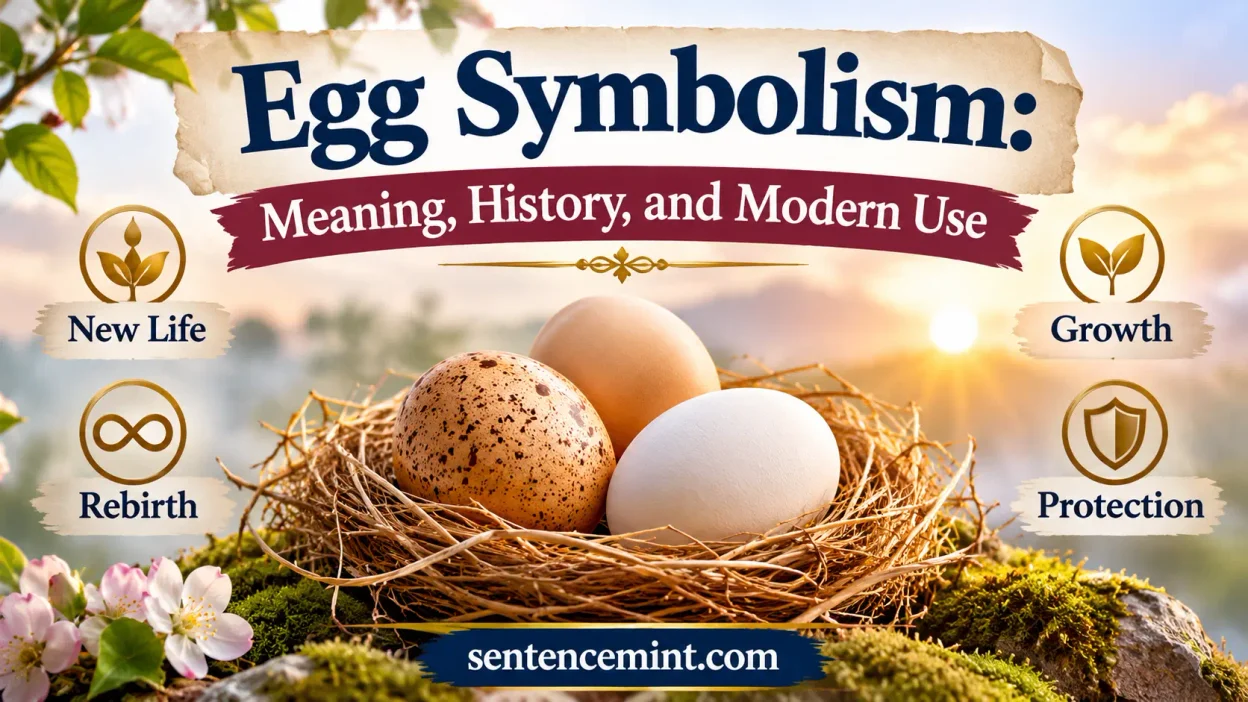
An egg is a familiar part of everyday life, but its symbolic meaning reaches far beyond food and nutrition. Across different cultures, the egg has represented fertility, creation, renewal, potential, and the beginning of life. Its simple structure—a protective outer shell surrounding the possibility of new life—makes it a natural symbol of transformation and hidden possibilities.
In American culture, eggs are particularly associated with Easter, spring celebrations, family traditions, and new beginnings. Decorated Easter eggs represent renewal and seasonal change, while eggs appearing in artwork and literature often suggest something valuable waiting to develop. Their connection with birth and growth also makes them meaningful in religious traditions, mythology, and personal expression.
The symbolism of an egg depends on its cultural and historical context. Some traditions connect it with the creation of the universe, while others use it to represent fertility, spiritual awakening, protection, or the temporary boundary between potential and reality.
Quick Answer
Eggs commonly symbolize new beginnings, fertility, rebirth, and potential in modern American culture, especially through Easter celebrations and springtime traditions. Historically, eggs have also represented creation, cosmic origins, renewal, and the cycle of life in different religious and cultural traditions.
TL;DR
- Eggs symbolize new beginnings, fertility, and the potential for life.
- Easter eggs represent resurrection, renewal, and springtime celebrations.
- Ancient traditions connected eggs with creation and cosmic origins.
- The protective shell symbolizes safety and hidden possibilities.
- Broken eggs can represent transformation, vulnerability, or unexpected change.
- Modern egg imagery appears in art, jewelry, tattoos, and popular culture.
1. The Core Symbolic Meaning of an Egg
The egg is one of the most recognizable symbols of life and potential. Its association with creation comes from its natural ability to contain and protect developing life.
An egg has several physical characteristics that contribute to its symbolism. The outer shell provides protection, the interior contains nourishment, and the possibility of a developing organism represents the beginning of something new.
Its most common symbolic meanings include:
New beginnings: An egg represents the start of a new stage, opportunity, or experience.
Fertility and creation: Because eggs are connected with reproduction, they have long represented fertility, motherhood, and the continuation of life.
Rebirth and renewal: The emergence of a living creature from an egg makes it a natural representation of transformation and renewal.
Potential and possibility: An unhatched egg contains the possibility of life that has not yet become visible.
Protection and security: Its shell provides a boundary around the developing life inside, making it a symbol of safety and preservation.
Wholeness and unity: The egg’s rounded shape can represent completeness, continuity, and the connection between beginnings and endings.
These meanings are closely related, but they are not interchangeable. An egg used in a spring celebration may communicate renewal, while an egg appearing in a creation myth may represent the origin of the universe.
2. Why Eggs Symbolize New Beginnings
One of the strongest associations of an egg is the beginning of something new. This meaning comes directly from its role in reproduction and the development of living organisms.
Before hatching, an egg contains a developing life that remains hidden from the outside world. When the shell opens and a young animal emerges, something that was previously unseen becomes visible.
This natural process provides a meaningful comparison with human experiences.
An egg can represent:
- Starting a new relationship or chapter in life.
- Beginning a career or educational journey.
- Discovering an opportunity.
- Developing a new idea or creative project.
- Moving beyond an earlier stage of personal growth.
In American culture, this association appears particularly strongly during spring. Gardens begin growing, flowers bloom, and animals enter new reproductive cycles. Eggs therefore fit naturally into seasonal celebrations that emphasize fresh starts.
An egg can also represent an opportunity that needs time and care before it develops. Just as a developing chick cannot emerge before it is ready, some personal goals require patience before they become successful.
3. Egg Symbolism in Ancient History
Eggs were important to ancient societies because they were connected with food, reproduction, agriculture, and seasonal changes.
Long before modern scientific explanations of embryonic development, people could observe that certain eggs produced living animals. This visible relationship between an apparently ordinary object and the emergence of life encouraged symbolic associations with creation and renewal.
In ancient Egyptian mythology, the egg was connected with creation traditions. Some accounts describe the emergence of a primordial egg from which a creator deity or the forces associated with creation appeared. Interpretations varied among different Egyptian religious traditions.
Ancient Greek philosophical and religious traditions also included cosmic egg imagery. In Orphic creation traditions, a cosmic egg appears in accounts of the origin of the universe and the emergence of the first divine beings.
In ancient Chinese cosmological traditions, the cosmic egg is associated with the separation of opposing elements and the formation of the universe in stories about Pangu.
These examples show how people used the egg as a way to imagine the beginning of existence. Its enclosed structure offered a convenient image for something containing the potential for an entire world.
Eggs also had practical significance in ancient agriculture and food systems. Their seasonal availability and connection with reproduction helped strengthen their associations with fertility and abundance.
4. Egg Symbolism in the United States
In the United States, eggs are particularly recognizable symbols of Easter, spring, family activities, and renewal.
Easter celebrations frequently include decorated eggs, egg hunts, and baskets filled with colorful treats. These traditions have made eggs familiar symbols of seasonal happiness and new beginnings for American families.
The Easter egg also has religious associations. In Christian traditions, eggs became connected with the resurrection of Jesus Christ and the promise of new life. Their symbolism developed through different regional customs and historical practices.
Outside religious celebrations, eggs appear in American everyday life in several ways.
- Spring decorations: Painted eggs and egg-shaped ornaments communicate seasonal renewal.
- Family traditions: Easter egg hunts create memories and bring generations together.
- Food culture: Eggs represent nourishment, breakfast traditions, and everyday household cooking.
- Design: Egg shapes appear in decorative objects, pottery, illustrations, and jewelry.
- Education: Eggs are frequently used to teach children about animal development and the beginnings of life.
Egg imagery can also appear in advertising and packaging because people readily recognize its connection with nourishment, freshness, and natural production.
In contemporary American culture, the egg therefore combines several meanings: family, faith, food, springtime, and the possibility of new life.
5. Egg Symbolism in Christianity and Easter
One of the most familiar religious associations of eggs in the United States is Christianity’s celebration of Easter.
Easter commemorates the resurrection of Jesus Christ. The egg became associated with this celebration because its enclosed shell and the emergence of new life offer a visual comparison with resurrection.
The egg can represent:
The resurrection: Life emerging from an enclosed shell provides a symbolic image of life overcoming death.
Hope: The beginning of new life represents the promise of spiritual renewal.
Transformation: An egg changing into a living creature offers an image of a new stage of existence.
Faith and renewal: Easter eggs can serve as reminders of Christian beliefs about resurrection and the possibility of spiritual renewal.
Historically, decorated eggs became part of Easter customs in different Christian communities. Some Eastern Christian traditions developed particularly elaborate practices involving red eggs, which can represent Christ’s blood and resurrection.
In the United States, Easter egg coloring and egg hunts have also become popular family activities, including among people who participate in the celebrations primarily as a cultural holiday.
It is important to distinguish the egg’s traditional Christian associations from the broader commercial and recreational customs that developed around Easter.
6. Egg Symbolism Across Different Cultures
Eggs have appeared in creation stories, seasonal celebrations, religious practices, and traditional artwork across different societies.
| Cultural tradition | Symbolic meaning | Common association |
|---|---|---|
| Ancient Egyptian traditions | Creation and beginnings | Primordial creation stories |
| Ancient Greek Orphic traditions | Cosmic origins | The cosmic egg |
| Chinese mythology | Formation of the universe | Pangu and cosmic creation |
| Christian traditions | Resurrection and renewal | Easter eggs |
| Persian Nowruz traditions | Spring and new beginnings | Seasonal celebrations |
In Persian cultural traditions, eggs are associated with Nowruz, the celebration of the Persian New Year. Decorated eggs can appear on the Haft-Seen table, where they are commonly connected with fertility and new life.
In Chinese culture, eggs also have associations with birth and family celebrations. Red-dyed eggs, for example, are traditionally distributed in some communities to mark a baby’s arrival and celebrate the new addition to a family.
These traditions demonstrate that the egg’s symbolism often develops from the same natural observation: life can begin inside something that appears ordinary from the outside.
7. The Cosmic Egg: Symbolism of Creation and the Universe
The cosmic egg is an important image in several mythological and philosophical traditions.
Unlike an ordinary egg representing the birth of an individual creature, the cosmic egg represents the origin of existence itself.
In these creation stories, the universe begins within an enclosed structure. The egg eventually opens, breaks, or separates into different elements, allowing the world to emerge.
The cosmic egg can represent:
- The origin of the universe.
- The relationship between order and chaos.
- The unity of existence.
- The potential contained within creation.
- The emergence of different forms of life.
In ancient Greek Orphic traditions, the cosmic egg is connected with the emergence of Phanes, a primordial divine figure associated with creation.
In Chinese mythology, stories about Pangu describe the universe developing from a primordial egg. When it separates, the lighter elements rise and form the heavens, while the heavier elements settle and become the earth.
These accounts are not identical, but they share a common idea: an apparently enclosed beginning can contain the potential for an entire world.
8. Egg Symbolism in Spirituality
In spiritual contexts, eggs often represent transformation, protection, renewal, and the relationship between visible and hidden life.
Their symbolism is especially connected with the idea that something important can develop before it becomes visible to others.
A person beginning a spiritual journey, for example, may interpret the egg as a reminder that personal growth requires time, patience, and protection.
Different spiritual interpretations include:
Inner potential: The egg represents abilities or possibilities that have not yet developed.
Spiritual rebirth: Emerging from the shell can represent leaving behind an earlier identity.
Protection: The shell symbolizes a boundary that preserves something valuable during development.
Wholeness: The egg’s enclosed form can represent completeness and the unity of existence.
Renewal: Its association with birth makes it a symbol of beginning again.
These interpretations are not part of one universal spiritual doctrine. Their meaning varies according to individual beliefs and cultural traditions.
9. The Emotional and Psychological Meaning of Eggs
Eggs can communicate different emotional ideas because they combine protection, vulnerability, and the possibility of growth.
An intact egg appears simple and self-contained, yet it can be easily damaged. This contrast makes it a useful symbol for something valuable that requires careful treatment.
Psychologically, egg imagery may suggest several experiences.
Hope: An unhatched egg can represent optimism about something that has not yet happened.
Vulnerability: A fragile shell can symbolize emotional sensitivity and the need for protection.
Patience: Development inside an egg takes time, making it a representation of gradual progress.
Possibility: The egg contains the potential for something that has not yet appeared.
Personal transformation: Hatching can represent a person moving into a new stage of life.
In artwork and storytelling, these associations can help communicate the emotional experience of waiting for change or protecting an important opportunity.
10. Egg Symbolism in Dreams
Dream interpretations are subjective and should not be treated as scientifically established predictions. However, eggs in dreams are commonly associated with new opportunities, personal growth, vulnerability, and potential.
The condition of the egg and the dreamer’s actions can influence its personal meaning.
Seeing an intact egg: May represent an opportunity, a new beginning, or something valuable that is still developing.
Finding eggs: Can suggest discovering possibilities or recognizing opportunities that were previously overlooked.
Breaking an egg: May represent transformation, the end of an earlier stage, or concern about losing something valuable.
Hatching an egg: Can symbolize progress, personal development, or the arrival of a new opportunity.
Seeing broken eggs: May reflect disappointment, vulnerability, or an experience that did not develop as expected.
Collecting eggs: May suggest preserving resources, preparing for the future, or appreciating what one has gained.
A dream about eggs does not have one fixed interpretation. Personal memories, current challenges, and emotional experiences are more useful than treating dream symbols as universal predictions.
11. Egg Symbolism in Literature, Art, and Popular Culture
Artists and writers frequently use eggs because they provide a recognizable image of beginnings, transformation, and the relationship between fragility and possibility.
In literature, an egg can represent a character’s potential or an opportunity that has not yet developed. A fragile egg may also communicate the difficulty of protecting something valuable.
Visual artists have explored eggs through still-life paintings, surrealist artwork, sculptures, and symbolic illustrations.
A notable example is the use of egg imagery in the work of Salvador Dalí. Eggs appear in several of his artworks and architectural designs, where they can suggest birth, transformation, and the mysteries of existence.
Eggs also appear in modern popular culture through animation, children’s stories, cooking programs, and fantasy narratives. Their recognizable shape makes them useful for representing surprise, discovery, and the beginning of an unexpected event.
In these settings, the egg can serve as more than a natural object. It becomes a visual representation of something waiting to emerge.
12. Egg Symbolism in Tattoos and Personal Expression
Egg-inspired tattoos are less common than traditional flower or animal designs, but they can carry meaningful personal associations.
People may choose egg imagery to express beliefs about new beginnings, family, fertility, transformation, and personal growth.
Different designs can communicate different ideas.
Hatching egg tattoo: Represents transformation, development, and the beginning of a new chapter.
Egg with a chick: Can symbolize family, motherhood, care, and new life.
Golden egg tattoo: May represent valuable opportunities, abundance, and something precious.
Broken egg tattoo: Can communicate vulnerability, change, or freedom from earlier limitations.
Cosmic egg tattoo: May represent universal creation, spiritual curiosity, and the interconnectedness of existence.
Decorated Easter egg tattoo: Can express religious beliefs, seasonal traditions, family memories, or cultural identity.
Some people combine egg imagery with flowers, birds, stars, or other symbols to create a design that reflects their personal experiences.
13. Egg Symbolism in Food, Fertility, and Family Traditions
Eggs have a practical connection with nourishment and reproduction, which explains their importance in traditional family celebrations.
In many societies, eggs have been associated with abundance because they provide food and are connected with the continuation of animal life.
In some cultural traditions, eggs are prepared or distributed during celebrations involving birth, marriage, seasonal renewal, and family gatherings.
In modern American households, eggs are particularly associated with breakfast, cooking, and family meals. They are also common ingredients in holiday baking and celebratory foods.
Their connection with fertility has made them meaningful in some traditions involving marriage and family growth. However, the specific practices and interpretations vary considerably between cultures.
The egg’s symbolic relationship with family is therefore closely connected with its natural role in sustaining and continuing life.
14. Broken Egg Symbolism: Transformation and Vulnerability
An intact egg represents protected potential, but a broken egg introduces a different set of associations.
Once the shell breaks, the egg can no longer maintain its original form. This physical change can represent the end of one stage and the beginning of another.
Broken eggs can symbolize:
- The end of an earlier situation.
- A sudden or unexpected change.
- Emotional vulnerability.
- Lost opportunities.
- Freedom from previous limitations.
- Transformation and new possibilities.
The meaning depends on what happens after the shell breaks.
An egg hatching successfully can communicate a positive transition, while an egg breaking accidentally may suggest disappointment or a sense of loss.
This distinction is important because breaking does not always represent destruction. In the natural process of hatching, the shell must open for new life to emerge.
15. Positive and Negative Meanings of Egg Symbolism
Eggs are generally associated with positive ideas because of their relationship with life and creation. However, their fragility also gives them several challenging interpretations.
Positive associations
- Fertility and creation.
- New beginnings and opportunities.
- Hope and renewal.
- Family and motherhood.
- Spiritual rebirth.
- Protection and safety.
- Abundance and nourishment.
- Personal development.
Negative associations
- Fragility and vulnerability.
- Fear of losing something valuable.
- Unfulfilled potential.
- Unexpected disruption.
- Disappointment and missed opportunities.
- Overprotection or fear of change.
The same egg can communicate different meanings depending on its condition and surroundings.
An intact egg may represent safety and potential, while a broken egg may represent vulnerability or the transition into something new.
16. How Egg Symbolism Has Evolved in Modern Culture
The symbolic meaning of eggs has developed through centuries of religious traditions, mythology, agriculture, family celebrations, and artistic expression.
In ancient societies, eggs were closely connected with reproduction, food, seasonal cycles, and creation stories. Their ability to contain developing life made them recognizable images of fertility and new beginnings.
Religious traditions later gave eggs additional meanings. Christian communities developed Easter egg customs associated with resurrection, while other cultural traditions connected eggs with spring festivals, birth celebrations, and the creation of the universe.
In contemporary American culture, eggs remain especially visible during Easter and springtime. They also appear in family activities, decorative designs, children’s education, food traditions, and commercial imagery.
Modern artists and designers continue to use egg shapes to communicate simplicity, protection, potential, and transformation.
Despite changes in lifestyle and technology, the egg remains a recognizable symbol because its physical characteristics continue to provide a straightforward visual comparison with the beginning and development of life.
Frequently Asked Questions
1. What does an egg symbolize spiritually?
An egg can symbolize spiritual rebirth, protection, renewal, and hidden potential. Its enclosed structure represents something valuable developing before it becomes visible.
2. Is an egg a symbol of good luck?
In some cultural traditions, eggs are associated with fertility, prosperity, abundance, and new beginnings. However, their connection with good luck varies between communities and is not a universal belief.
3. What does an egg symbolize in Christianity?
In Christian traditions, eggs are particularly associated with Easter and the resurrection of Jesus Christ. They represent new life, hope, and renewal.
4. What does a broken egg symbolize?
A broken egg can represent vulnerability, unexpected change, transformation, or the ending of an earlier stage. When an egg hatches, however, the broken shell can also symbolize the beginning of new life.
5. What does an egg symbolize in dreams?
Eggs in dreams may represent opportunities, personal growth, fertility, or something valuable that is still developing. The interpretation depends on the condition of the egg and the dreamer’s personal circumstances.
6. Why does an egg symbolize creation?
An egg contains the possibility of developing life within a protective outer shell. This natural process has inspired creation stories in several ancient cultural traditions, including Egyptian, Greek, and Chinese mythology.
7. What does a golden egg symbolize?
A golden egg commonly represents exceptional value, prosperity, abundance, and rare opportunities. It can also suggest the importance of protecting something valuable.
Conclusion
The egg is a widely recognized symbol of creation, fertility, renewal, protection, and new beginnings. Its connection with developing life has given it an important place in mythology, religious traditions, seasonal celebrations, literature, and modern American culture.
From Easter celebrations and ancient cosmic creation stories to contemporary tattoos and artistic designs, egg symbolism reflects the relationship between potential and transformation. Its fragile shell represents protection, while the life developing inside represents possibilities that have not yet become visible.
Ultimately, an egg reminds us that meaningful beginnings often develop quietly before they become visible to the world. What appears small and ordinary may contain the possibility of something entirely new.