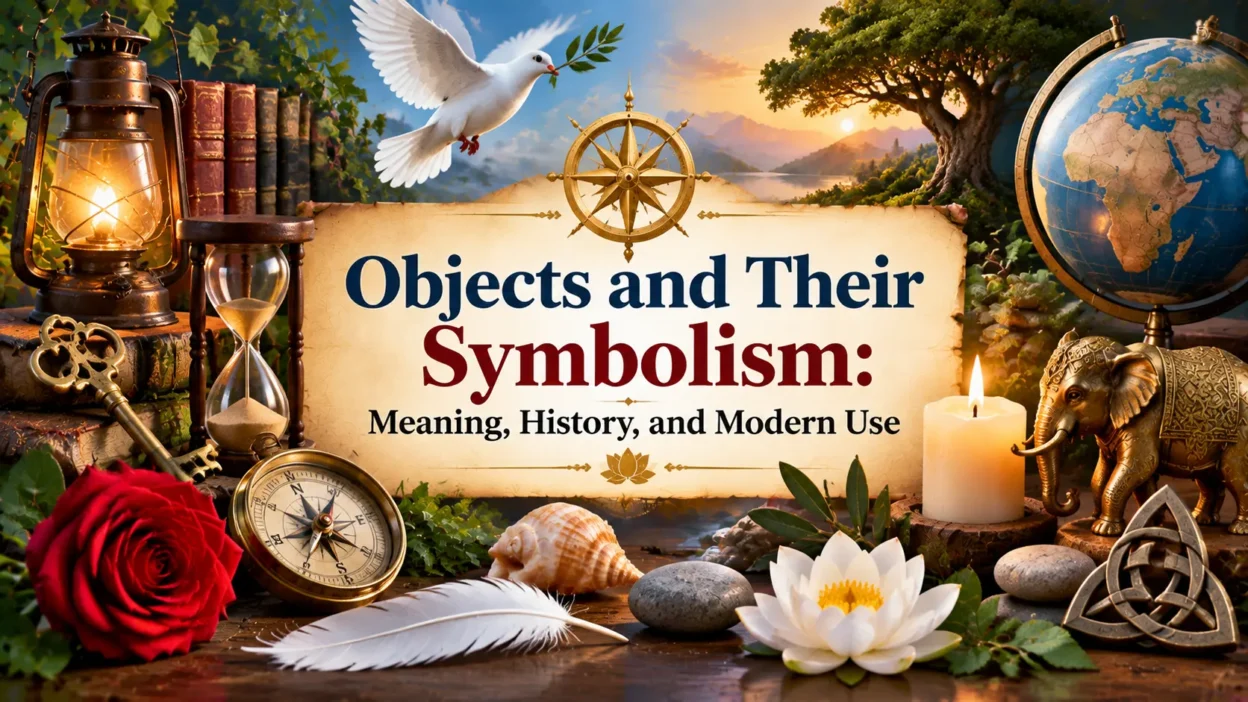
Objects and their symbolism explain how ordinary items can represent ideas, emotions, beliefs, memories, and cultural values. A simple object such as a ring, key, candle, mirror, or flower may carry meanings that go beyond its physical purpose. In many cases, people connect objects with important experiences, traditions, and personal identities.
In the United States, symbolic objects appear in everyday life through celebrations, home decoration, fashion, art, religion, and personal expression. A wedding ring represents commitment, a flag represents national identity, and a family photograph represents connection and memory. These meanings develop through shared cultural experiences rather than from the object itself.
Understanding symbolism helps explain why certain objects feel meaningful across generations. Their meanings can change over time depending on history, social values, and personal interpretation.
Quick Answer
Objects and their symbolism commonly represent emotions, beliefs, relationships, and cultural ideas in modern American culture, especially through items used in celebrations, personal style, and daily life. Historically, objects have also carried religious, social, and traditional meanings that developed across different societies.
TL;DR
- Objects often represent ideas beyond their physical purpose.
- American culture uses symbolic objects in daily life.
- Historical traditions shape many object meanings.
- Personal experiences influence symbolic interpretations.
- Tattoos, jewelry, and decor use objects as identity symbols.
Why Everyday Objects Become Symbols
An object becomes symbolic when people attach a shared meaning to it. The meaning does not usually come from the material itself but from human experiences, stories, and traditions.
For example, a key is a practical tool used to open locks. However, many cultures associate keys with opportunity, knowledge, access, and new beginnings. A candle provides light, but it can also represent hope, remembrance, spirituality, or celebration.
Symbolism allows people to communicate ideas without words. A person wearing a certain piece of jewelry, displaying a specific decoration, or keeping a meaningful object may be expressing something about their beliefs, memories, or personality.
Objects gain symbolic value through:
- Cultural traditions
- Religious practices
- Historical events
- Family customs
- Personal experiences
- Artistic expression
Common Objects and Their Symbolic Meanings
Different objects develop different meanings depending on cultural background and personal interpretation.
| Object | Meaning in the USA | Common Associations | Notes |
|---|---|---|---|
| Ring | Commitment and connection | Marriage, promises, relationships | Often linked with weddings |
| Key | Opportunity and access | New beginnings, knowledge | Used in jewelry and art |
| Candle | Hope and remembrance | Birthdays, memorials, spirituality | Meaning depends on context |
| Mirror | Self-reflection | Identity, appearance, truth | Appears in folklore and art |
| Tree | Growth and stability | Family, nature, life | Common in environmental symbolism |
Historical Origins of Object Symbolism
Humans have used symbolic objects since ancient civilizations. Early societies created meanings around tools, ornaments, animals, weapons, and natural materials.
Ancient Egyptians used objects such as the ankh to represent life and placed meaningful items in burial practices. Ancient Greeks connected objects with mythology, gods, and human qualities. Many Indigenous cultures around the world developed symbolic relationships with natural materials, tools, and ceremonial objects.
Religious traditions also shaped object symbolism. Sacred objects, clothing, artwork, and ritual items often represented spiritual beliefs and community identity.
Over time, meanings changed as societies changed. An object that once had a religious purpose may later become a decorative symbol, while another object may gain new meaning through popular culture.
How Americans Interpret Symbolic Objects Today
In the United States, objects often represent personal stories and shared cultural values.
A graduation cap symbolizes achievement and education. A flag represents national identity and belonging. A baby shoe saved by parents may represent family memories and important life moments.
American culture frequently uses symbolic objects during major events:
- Wedding rings during marriage ceremonies
- Flowers during celebrations and memorials
- Holiday decorations during seasonal traditions
- Family heirlooms passed between generations
- Sports items showing loyalty and community
Unlike fixed definitions, many American interpretations depend on individual experiences. The same object can represent different things to different people.
Objects in Religion and Spiritual Traditions
Many religions use objects to communicate beliefs and create connections between physical life and spiritual ideas.
Examples include:
- Crosses in Christianity representing faith and sacrifice
- Prayer beads used in several religious traditions for devotion and meditation
- Lamps and candles used in ceremonies representing light and guidance
- Sacred texts representing knowledge and spiritual teachings
Religious objects often carry meanings that are deeply connected to community practices. Their symbolism usually depends on specific traditions and beliefs rather than universal interpretations.
Emotional and Psychological Meaning of Objects
Objects can hold strong emotional value because humans connect physical items with memories and experiences.
A childhood toy may represent innocence and family memories. A handwritten letter may represent love, friendship, or a past relationship. A piece of jewelry may remind someone of a person or important moment.
Psychologically, meaningful objects can provide:
- A sense of identity
- Emotional comfort
- Connection to the past
- A reminder of personal goals
- A feeling of belonging
This explains why people often keep objects that have little practical value but significant personal meaning.
Symbolism of Objects in Home Design and Decoration
Home decoration often uses objects to express personality and values.
Americans commonly use symbolic items such as:
- Plants representing growth and freshness
- Artwork representing creativity or inspiration
- Family photos representing connection
- Antiques representing history and tradition
- Natural materials representing simplicity and comfort
Interior design often combines visual appeal with emotional meaning. A decorative object may be chosen because it creates a certain feeling or reminds someone of a meaningful place.
Objects in Tattoos and Personal Expression
Tattoos frequently use objects as symbols of identity, memories, and personal beliefs.
Common symbolic tattoo objects include:
- Compasses representing direction and journeys
- Clocks representing time and important moments
- Anchors representing stability
- Keys representing discovery or change
- Flowers representing growth and transformation
The meaning of a tattoo object is usually personal. Two people may choose the same symbol but connect it with completely different experiences.
Objects in Fashion and Jewelry
Fashion often uses objects to communicate personality, status, memories, or cultural connections.
Jewelry is one of the strongest examples. Rings, necklaces, bracelets, and charms often carry symbolic meanings.
A heart-shaped pendant may represent love. A family heirloom may represent heritage. A charm bracelet may preserve memories through individual symbols collected over time.
Modern fashion also changes meanings. An object once associated with a specific tradition may become a popular design element without the original meaning being widely understood.
Modern Digital Culture and Symbolic Objects
Digital culture has expanded how people understand symbolic objects.
Objects appear in:
- Emojis
- Online profiles
- Digital artwork
- Gaming environments
- Social media posts
A virtual gift, profile image, or digital item can represent friendship, achievement, humor, or identity.
For example, a digital badge may symbolize accomplishment, while a virtual item in a game may represent progress or membership in a community.
Misunderstandings and Misuse of Object Symbols
Symbols can sometimes be misunderstood because meanings change between cultures and generations.
An object may have a positive meaning in one tradition but a different interpretation elsewhere. Historical symbols may also be reused in modern contexts that remove them from their original meaning.
Understanding symbolism requires looking at:
- Historical background
- Cultural context
- Intended meaning
- Modern interpretation
A symbol should not be judged only by appearance. Its meaning often depends on how and why it is used.
How Object Meanings Change Over Time
Symbolic meanings are not permanent. They evolve as societies develop.
For example, objects connected with technology have gained new meanings in recent decades. A phone is not only a communication device; it can represent connection, identity, and modern lifestyle.
Similarly, natural objects such as trees, stones, and flowers continue to gain new interpretations through environmental movements and personal expression.
Symbolism changes because human experiences change.
Why People Continue Using Symbolic Objects
People use symbolic objects because they help communicate ideas that are difficult to express with words.
Objects can represent:
- Love
- Memory
- Achievement
- Belief
- Hope
- Personal identity
A meaningful object creates a connection between the physical world and human emotions. This connection explains why symbolic objects remain important in modern society.
FAQ About Objects and Their Symbolism
What do objects symbolize in general?
Objects can symbolize emotions, beliefs, memories, relationships, and cultural values. Their meanings usually develop through traditions, personal experiences, and shared understanding.
Why do humans give objects symbolic meanings?
Humans create symbolic meanings because objects help represent ideas that are difficult to express directly. A physical item can become a reminder of a person, event, belief, or goal.
Do objects have the same meaning in every culture?
No. Symbolic meanings vary between cultures, religions, and communities. An object considered meaningful in one society may have a different interpretation elsewhere.
What objects commonly symbolize love?
Common symbols of love include rings, hearts, flowers, and personal gifts. Their meanings often come from relationships, traditions, and emotional connections.
Why are objects important in American culture?
Objects play an important role in American culture because they represent identity, family history, celebrations, achievements, and personal memories.
Can everyday objects become symbols?
Yes. Ordinary objects can become symbolic when people connect them with meaningful experiences. A simple item can represent a major life event or personal belief.
Are symbolic objects always positive?
No. Symbolic meanings can be positive, negative, or complex depending on history and cultural context. The meaning depends on how people interpret and use the object.
Conclusion
Objects and their symbolism show how humans transform ordinary items into meaningful representations of ideas, emotions, and experiences. From wedding rings and family heirlooms to candles, keys, and natural objects, symbols help people express values that go beyond physical appearance.
In modern American culture, symbolic objects continue to appear in homes, celebrations, fashion, tattoos, and digital spaces. Their meanings are shaped by history, tradition, and personal stories.
Understanding objects and their symbolism helps reveal the connection between the things people keep and the ideas those things represent.


