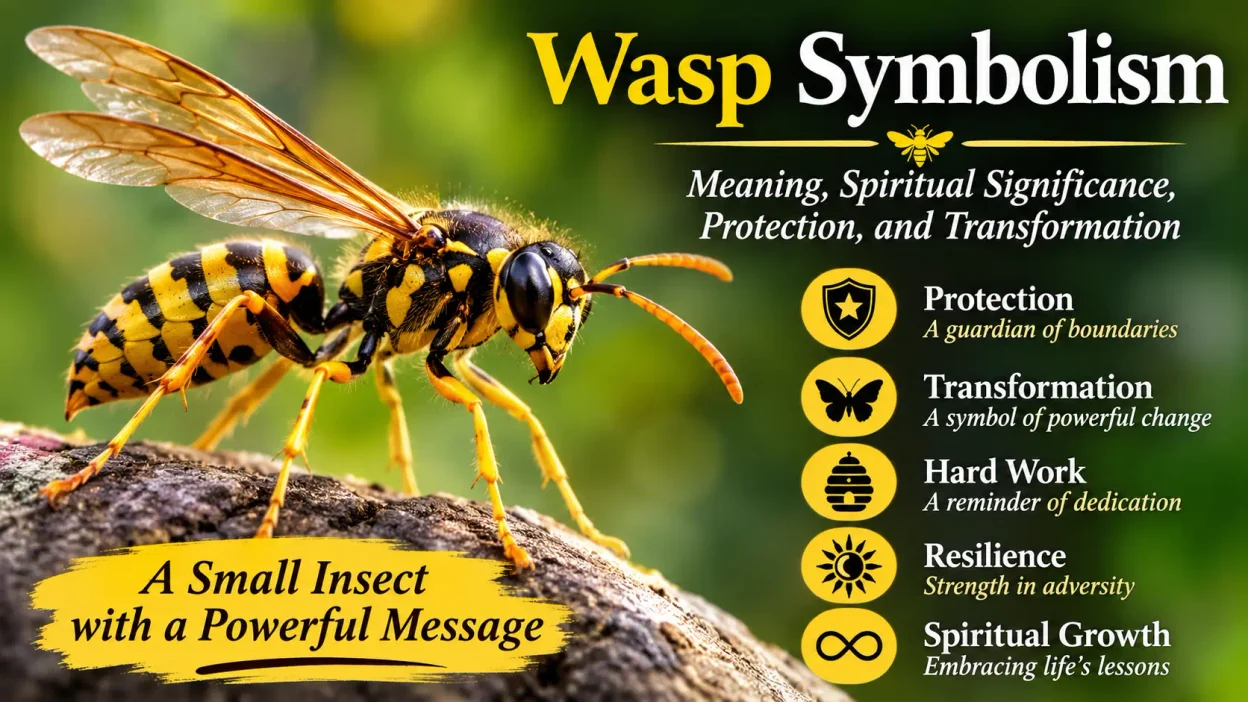
Wasp symbolism is closely connected to determination, protection, productivity, courage, independence, and personal boundaries. Although wasps are often feared because of their painful stings, these insects also display remarkable intelligence, organization, and persistence. Their ability to build intricate nests, defend their colonies, and work toward specific goals makes them powerful symbols of discipline, resourcefulness, and resilience.
Unlike butterflies, which are commonly associated with beauty and transformation, wasps often represent a more assertive kind of personal growth. They remind us that progress sometimes requires courage, decisive action, and the willingness to protect what matters. Their presence can also encourage people to examine their boundaries, relationships, and responses to challenging situations.
Across spiritual interpretations and cultural traditions, wasps may represent everything from hard work and community to aggression, warning, and self-defense. Their meaning often depends on the circumstances in which they appear and the emotions they create.
This guide explores wasp symbolism in depth, including its spiritual meaning, biblical associations, cultural interpretations, dream symbolism, and the significance of different types of wasps.
What Does a Wasp Symbolize?
A wasp commonly symbolizes protection, determination, productivity, courage, independence, and strong personal boundaries. Its behavior offers several symbolic lessons about working toward goals, defending important values, and adapting to difficult circumstances.
Some of the most recognized meanings of wasp symbolism include:
- Protection: A wasp’s defensive behavior represents the importance of protecting yourself, your family, and what you value.
- Determination: Its persistent activity can symbolize commitment and the ability to keep working toward a goal.
- Productivity: The construction and maintenance of a wasp nest represent organization, cooperation, and purposeful effort.
- Courage: A wasp may symbolize standing your ground when facing challenges.
- Boundaries: Its warning behavior can represent the need to establish and respect personal limits.
- Independence: Many wasps live and hunt independently, making them symbols of self-reliance and resourcefulness.
- Transformation: Their life cycle, which includes complete metamorphosis, can represent development and personal change.
- Warning and awareness: A wasp’s presence may encourage greater attention to your surroundings and decisions.
Wasp symbolism is not exclusively positive. Because some species can become defensive or aggressive when threatened, they can also represent conflict, irritation, anger, and the consequences of ignoring boundaries.
Spiritual Meaning of Wasps
Spiritually, wasps are often interpreted as symbols of determination, protection, personal strength, and purposeful action. Their behavior can offer useful metaphors for people navigating difficult situations or working toward meaningful goals.
1. Protection and Personal Boundaries
One of the strongest symbolic meanings of a wasp is protection. Wasps can defend their nests when they perceive a threat, demonstrating how important boundaries are for survival.
In a spiritual interpretation, this behavior may encourage you to protect your emotional well-being, recognize unhealthy relationships, and establish limits when necessary.
The wasp reminds us that being kind does not mean allowing others to disrespect our boundaries.
2. Determination and Persistence
Wasps are persistent insects. They search for food, construct nests, and continue performing tasks that support their survival.
Symbolically, this behavior represents determination and commitment. A wasp may serve as a reminder to remain focused on your objectives, even when progress feels slow.
Its message can be especially meaningful when you are facing obstacles that require patience and consistent effort.
3. Productivity and Organization
Many wasp species demonstrate impressive organizational behavior. Social wasps, such as yellowjackets and paper wasps, build colonies in which individuals perform different roles.
Their nests require careful construction and maintenance, making them symbols of planning, cooperation, and productive effort.
Spiritually, wasp symbolism may encourage you to organize your priorities, use your time wisely, and approach responsibilities with greater discipline.
4. Courage and Self-Confidence
A wasp’s ability to defend itself can symbolize courage and confidence. Rather than avoiding every challenge, it represents the importance of responding when something valuable is threatened.
In personal interpretations, the wasp may encourage you to speak honestly, stand up for your beliefs, and trust your ability to handle difficult circumstances.
5. Independence and Resourcefulness
Many wasp species are solitary hunters. They find food, construct nests, and reproduce without depending on a large colony.
This behavior makes solitary wasps particularly strong symbols of independence and self-reliance.
Their spiritual meaning may encourage you to develop your abilities, trust your judgment, and recognize the value of working independently.
6. Transformation and Personal Growth
Wasps undergo complete metamorphosis, developing through egg, larval, pupal, and adult stages.
This natural process can symbolize transformation, development, and the gradual movement from one stage of life to another.
A wasp may therefore represent the importance of accepting change, learning from experience, and allowing yourself to grow beyond previous limitations.
7. Awareness and Decisive Action
Wasps are attentive to their surroundings and respond quickly when they detect threats or opportunities.
Symbolically, they can represent awareness, alertness, and the ability to make timely decisions.
Their appearance may encourage you to pay attention to situations you have been overlooking and take practical steps rather than postponing important choices.
Wasp Symbolism in Different Cultures
Wasps have appeared in folklore, mythology, art, and traditional stories in different parts of the world. Their cultural meanings vary considerably, and not every tradition assigns them a specific spiritual message.
Wasp Symbolism in Ancient Egypt
In ancient Egyptian symbolism, the wasp was associated with royalty and authority. The insect appeared in connection with the king and the political identity of Lower Egypt.
The wasp, together with the sedge plant, was used in royal titulary to represent the king’s rule over the Two Lands. This association gives the wasp a historical connection with leadership, sovereignty, and political power.
Its meaning in this context is more specific than modern interpretations of courage or productivity.
Wasp Symbolism in Ancient Greece
In ancient Greek literature and art, wasps could represent aggression, defensiveness, and social conflict.
A well-known example is Aristophanes’ comedy The Wasps, in which the chorus consists of elderly jurors who behave with the stinging and combative energy associated with wasps.
The play uses the insect as a humorous symbol of anger, stubbornness, and an intense attachment to familiar habits.
This cultural association highlights the wasp’s connection with confrontation and strong reactions.
Wasp Symbolism in European Folklore
In some European folk traditions, wasps were associated with summer, agricultural activity, and seasonal changes. Their presence around gardens and fruit trees made them familiar parts of rural life.
They could also symbolize irritation, danger, or the consequences of disturbing something that should be left alone.
Specific beliefs differ between regions, so there is no single universal European interpretation.
Wasp Symbolism in Japanese Culture
Wasps and hornets are familiar in Japan, where some species are known for their powerful stings and defensive behavior.
The Japanese giant hornet, for example, has a reputation for danger and strength. In modern cultural imagery, hornets may therefore suggest power, intimidation, and the need for caution.
These associations are primarily shaped by the insects’ real-world behavior rather than by one universal religious meaning.
Wasp Symbolism in Indigenous Traditions
Wasps and other insects appear in the ecological knowledge, stories, and artistic traditions of different Indigenous communities.
However, Indigenous cultures are diverse, and their beliefs should not be treated as one shared symbolic system. A particular wasp may have local significance based on the environment, community history, or specific oral tradition.
It is more accurate to understand these meanings within their individual cultural contexts rather than assigning a universal Indigenous interpretation.
Wasp Symbolism in the Bible
Wasps are not given a major symbolic role in the Bible in the same way that certain animals, plants, and insects are. However, the Bible does mention the hornet, a close relative of wasps, in several passages.
These references are important because they connect stinging insects with divine judgment, fear, and the removal of enemies.
1. Hornets as Instruments of Divine Judgment
In Exodus 23:28, God tells the Israelites that hornets will be sent ahead of them to drive out certain inhabitants of the land.
The hornets appear as part of a promise of divine assistance during the Israelites’ journey.
In this context, the insects can be interpreted as symbols of divine intervention and the power to overcome obstacles.
2. Hornets and the Removal of Enemies
Deuteronomy 7:20 also refers to hornets being sent against remaining enemies.
The passage emphasizes that the Israelites would receive help in overcoming opposition. The hornet imagery represents a force that disrupts and drives away those standing in their path.
3. Hornets as a Symbol of Fear
Joshua 24:12 recalls the use of hornets against the inhabitants of the land.
The reference reinforces the idea of an unexpected force that creates fear and weakens resistance.
From a symbolic perspective, hornets in these passages can represent judgment, disruption, divine power, and the removal of opposition.
Important distinction: The Bible specifically mentions hornets in these passages, not wasps in general. Although hornets belong to the broader wasp family, it is more accurate to describe these references as hornet symbolism rather than direct biblical references to wasps.
Wasp Symbolism in Dreams
Dreaming about wasps can carry different symbolic interpretations depending on what the insects are doing and how you feel during the dream.
Wasps may represent conflict, pressure, protection, persistence, or situations that require your attention. Dream interpretations are subjective and should not be treated as predictions or guaranteed spiritual messages.
Dreaming of a Single Wasp
A single wasp may symbolize an individual challenge, an uncomfortable relationship, or a situation that requires careful attention.
It could reflect a problem that seems small but has the potential to become more serious if ignored.
Dreaming of a Wasp Sting
Being stung by a wasp may represent emotional pain, criticism, betrayal, or a conflict that has affected you deeply.
The dream may encourage you to examine whether someone’s words or actions have crossed your boundaries.
Dreaming of a Wasp Nest
A wasp nest may symbolize family responsibilities, community relationships, teamwork, or a situation involving several people.
If the nest appears peaceful, it may reflect organization and cooperation. If it seems threatening, it could represent tension or an environment that feels difficult to manage.
Dreaming of Many Wasps
A large number of wasps may symbolize stress, overwhelming responsibilities, or several problems demanding your attention at once.
The dream could reflect a feeling that you are surrounded by conflict or pressure.
Dreaming of Killing a Wasp
Killing a wasp in a dream may represent an attempt to overcome a difficult situation, end a conflict, or regain control over your personal space.
It may also reflect frustration or a desire to remove something that has been bothering you.
Dreaming of a Wasp Flying Around You
A wasp flying near you may symbolize irritation, uncertainty, or an unresolved issue that continues to attract your attention.
It could be a reminder to address a concern instead of allowing it to create unnecessary anxiety.
Dreaming of a Dead Wasp
A dead wasp may represent the end of a conflict, the resolution of a difficult situation, or a reduction in emotional pressure.
It may also symbolize a change in how you respond to challenges.
What Does It Mean When a Wasp Visits You?
When a wasp appears near you, its presence can attract attention because of its distinctive appearance and behavior. In spiritual interpretations, some people associate this encounter with determination, protection, awareness, and the importance of boundaries.
Possible symbolic interpretations include:
- A reminder to stay focused: Continue working toward your goals instead of becoming distracted.
- A message about boundaries: Protect your time, energy, and personal space.
- A call for courage: Face an uncomfortable situation with confidence.
- An invitation to be productive: Organize your priorities and take practical action.
- A reminder to stay aware: Pay attention to your surroundings and the decisions you make.
There is no scientific evidence that a wasp’s visit carries a supernatural message. Its behavior is generally explained by ordinary needs such as searching for food, finding nesting materials, or defending its colony.
Different Types of Wasps and Their Symbolic Meanings
There are thousands of wasp species, and their behaviors differ considerably. Some are social, while others live independently. Their different characteristics can inspire different symbolic interpretations.
Paper Wasp Symbolism
Paper wasps are known for building open, umbrella-shaped nests from fibers they collect and process into a paper-like material.
Symbolically, they can represent:
- Creativity and construction
- Cooperation and community
- Organization and planning
- Protection of family
- Resourcefulness
Their nests demonstrate how simple materials can be transformed into something functional through consistent effort.
Yellowjacket Symbolism
Yellowjackets are social wasps recognized by their yellow-and-black markings. They can become defensive when their colonies are threatened.
Symbolically, yellowjackets may represent:
- Alertness and awareness
- Strong personal boundaries
- Defensiveness and courage
- Community protection
- The importance of caution
Their presence can also serve as a metaphor for situations in which small conflicts become intense when people feel threatened.
Mud Dauber Wasp Symbolism
Mud daubers are solitary wasps that construct nests from mud. They typically hunt spiders and provision their nests for developing offspring.
Their behavior makes them symbols of:
- Patience and preparation
- Independence
- Practical intelligence
- Careful construction
- Self-reliance
A mud dauber can represent the value of preparing for the future and building something through steady effort.
Potter Wasp Symbolism
Potter wasps are known for constructing distinctive mud nests that resemble small pots or vessels.
They can symbolize:
- Creativity and craftsmanship
- Resourcefulness
- Planning and precision
- Individual effort
- Building a secure foundation
Their nests offer a striking example of how instinctive behavior can produce intricate structures.
Cicada Killer Wasp Symbolism
Cicada killer wasps are large solitary wasps that hunt cicadas to provide food for their developing offspring.
Symbolically, they may represent:
- Strength and confidence
- Strategic action
- Persistence
- Independence
- Preparation and responsibility
Their hunting behavior can serve as a metaphor for pursuing goals with focus and determination.
Hornet Symbolism
Hornets are a group of large social wasps. Some species are highly defensive, particularly near their nests.
They can symbolize:
- Authority and power
- Protection and loyalty
- Intimidation and warning
- Courage under pressure
- The consequences of crossing boundaries
Hornet symbolism is often more intense than the symbolism associated with smaller wasps because of their size and defensive reputation.
Wasp Symbolism in Love and Relationships
In relationships, wasps can symbolize loyalty, protection, independence, and the importance of maintaining healthy boundaries.
Their social behavior offers a metaphor for cooperation, while their defensive nature highlights the need to protect personal well-being.
Possible relationship meanings include:
- Loyalty: Protecting and supporting the people who matter.
- Independence: Maintaining your identity within a relationship.
- Boundaries: Recognizing when personal limits need to be respected.
- Communication: Addressing problems before they become larger conflicts.
- Cooperation: Working together toward shared goals.
A wasp may also represent the negative side of relationships, such as jealousy, arguments, defensiveness, or unresolved resentment.
Its symbolism encourages a balance between protecting yourself and allowing healthy emotional connections to develop.
Wasp Symbolism and Personal Transformation
The wasp’s life cycle provides a natural example of transformation. Like butterflies, wasps undergo complete metamorphosis, changing from eggs into larvae, then pupae, and finally adults.
This process can represent the different stages of personal development.
A wasp may symbolically encourage you to:
- Accept that growth takes time.
- Learn from difficult experiences.
- Develop the skills needed for new challenges.
- Release habits that prevent progress.
- Become more confident in your abilities.
Unlike transformation symbolism that focuses mainly on beauty or rebirth, wasp symbolism often emphasizes purposeful growth, practical effort, and the strength needed to adapt.
Wasp Symbolism: Positive and Negative Meanings
Wasps have both admirable and intimidating qualities, which makes their symbolism complex.
| Positive Meanings | Negative Meanings |
|---|---|
| Determination | Aggression |
| Protection | Defensiveness |
| Productivity | Overwork |
| Courage | Intimidation |
| Independence | Isolation |
| Organization | Rigidity |
| Awareness | Anxiety |
| Transformation | Conflict |
The positive meanings focus on discipline, resilience, and self-protection. The negative meanings reflect the risks of becoming overly defensive, aggressive, or unwilling to compromise.
What Can a Wasp Teach Us?
Wasp symbolism offers several practical lessons that can be applied to everyday life.
Protect your boundaries. You can be considerate without allowing others to take advantage of you.
Work with determination. Meaningful progress often requires consistency rather than sudden bursts of effort.
Stay organized. Planning and preparation can make difficult responsibilities easier to manage.
Be independent. Developing your own skills and judgment helps you respond confidently to challenges.
Recognize when to act. Not every disagreement requires confrontation, but important problems should not always be ignored.
Adapt to change. Personal growth involves learning new ways to handle unfamiliar situations.
The wasp’s symbolism is most useful when it encourages thoughtful action rather than unnecessary aggression.
Frequently Asked Questions About Wasp Symbolism
1. What does a wasp symbolize spiritually?
A wasp commonly symbolizes protection, determination, courage, productivity, independence, and personal boundaries. In spiritual interpretations, it may encourage you to remain focused and protect what matters.
2. Is seeing a wasp a good omen?
Some spiritual interpretations view a wasp as a positive symbol of persistence, productivity, and protection. Others associate it with warnings, conflict, or the need for caution. Its meaning depends on personal beliefs and circumstances.
3. What does a wasp symbolize in the Bible?
The Bible mentions hornets in Exodus 23:28, Deuteronomy 7:20, and Joshua 24:12. They are associated with divine intervention and the removal of enemies. These passages refer specifically to hornets rather than wasps generally.
4. What does it mean when a wasp stings you spiritually?
Some symbolic interpretations connect a wasp sting with emotional pain, conflict, crossed boundaries, or the need to address an uncomfortable situation. A real wasp sting, however, is a defensive response or other natural insect behavior, not evidence of a spiritual message.
5. What does dreaming about wasps mean?
Dreaming about wasps may symbolize stress, conflict, protection, determination, or unresolved problems. The meaning depends on the dream’s details and the emotions you experience.
6. What does a wasp nest symbolize?
A wasp nest can symbolize teamwork, family, organization, productivity, and protection. A threatening nest may also represent tension or a situation that requires caution.
7. What does a yellowjacket symbolize?
A yellowjacket may symbolize alertness, strong boundaries, courage, and community protection. Its defensive behavior can also represent aggression or the consequences of provoking conflict.
8. What does a black wasp symbolize?
Black wasps can be interpreted as symbols of mystery, independence, strength, and protection. These associations are modern symbolic interpretations rather than universal cultural meanings.
9. What does a dead wasp symbolize?
A dead wasp may represent the end of a difficult situation, the resolution of conflict, or the release of emotional tension. Some people interpret it as a sign of moving beyond an old challenge.
10. Are wasps symbols of transformation?
Yes. Wasps undergo complete metamorphosis, which makes them suitable symbols of development, adaptation, and personal transformation. Their life cycle represents change through distinct stages.
11. What is the difference between wasp and hornet symbolism?
Wasp symbolism commonly emphasizes productivity, boundaries, determination, and protection. Hornet symbolism often places greater emphasis on power, authority, intimidation, and strong defense. Hornets are a particular group within the broader wasp family.
12. What does a wasp represent in relationships?
In relationships, wasps can symbolize loyalty, cooperation, independence, and healthy boundaries. They may also represent defensiveness or conflict when emotional limits are ignored.
Conclusion: The Deeper Meaning of Wasp Symbolism
Wasp symbolism combines determination, protection, productivity, courage, independence, and transformation. These insects demonstrate how persistence, organization, and awareness can support survival and growth. Their defensive behavior also offers a reminder that healthy boundaries are important and that protecting what matters sometimes requires confidence.
Across history and culture, wasps have carried different associations. Ancient Egyptian royal imagery connected the wasp with authority, while ancient Greek comedy used it to represent anger and combative behavior. Biblical passages mentioning hornets associate them with divine intervention and the removal of enemies.
In dreams and modern spiritual interpretations, wasps may represent unresolved conflict, personal strength, emotional boundaries, or the need to take decisive action. Their meaning depends on the surrounding circumstances rather than following one universal interpretation.
Ultimately, the wasp reminds us that strength is not simply about defending ourselves. It is also about working with purpose, respecting boundaries, adapting to change, and knowing when to act. Its symbolism encourages a balanced approach to life—one that combines courage with awareness and determination with thoughtful judgment.