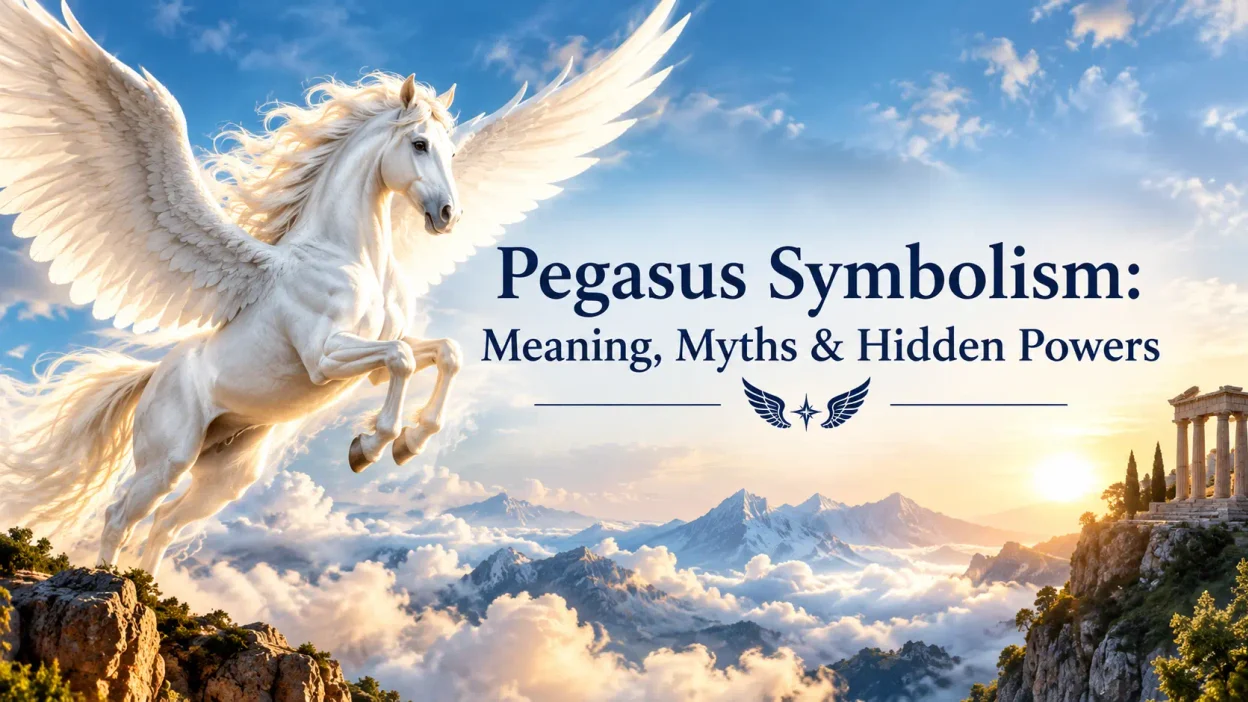
Pegasus symbolism connects the image of a winged horse with freedom, imagination, artistic inspiration, and the desire to rise beyond ordinary limitations. In Greek mythology, Pegasus is an immortal horse whose wings allow him to move between the earthly world and the realm of the gods. Today, Americans often recognize Pegasus through fantasy art, tattoos, books, astronomy, and commercial imagery, even if they do not know the original stories.
Unlike an ordinary horse, Pegasus combines physical strength with the ability to fly. That unusual combination helps explain why artists and storytellers have used him to represent creative ambition, independence, courage, and extraordinary possibilities. His image can suggest an escape from restrictions, but the older myths also offer a reminder that ambition needs judgment and humility.
Understanding Pegasus means looking beyond the familiar white horse with feathered wings. His story includes a dramatic birth from Medusa, a partnership with the hero Bellerophon, a connection to poetry and the Muses, and an eventual place among the stars. Each part contributes to the meanings people associate with him today.
Quick Answer
Pegasus symbolism most commonly represents freedom, imagination, artistic inspiration, and the ambition to overcome limitations in modern American culture. In ancient Greek mythology, the winged horse was associated with heroic achievement, divine power, poetic inspiration, and the boundary between the mortal world and the heavens.
TL;DR
- Pegasus represents freedom, creativity, ambition, and the ability to rise above limitations.
- Greek mythology connects his birth to Medusa and his adventures to Bellerophon.
- His hoof was associated with the creation of a spring sacred to the Muses.
- Modern Americans encounter Pegasus in tattoos, fantasy art, literature, and astronomy.
- The myth also warns against excessive pride and ambition without restraint.
- Pegasus tattoos often express independence, artistic identity, hope, or personal transformation.
What Pegasus Looks Like and Why It Matters
Pegasus is usually depicted as a horse with large feathered wings. Artists often portray him as white, although ancient and later representations do not follow one universal color scheme. His body may appear powerful and muscular, while his wings suggest lightness, speed, and the ability to travel beyond the ground.
The contrast between a horse’s strength and a bird’s flight is central to his symbolism. Horses traditionally evoke movement, endurance, energy, and partnership with humans. Wings introduce another dimension: the possibility of crossing boundaries that normally restrict movement.
Pegasus therefore brings together two different ideas. His horse-like body suggests grounded strength, while his wings suggest freedom from physical limits. Neither quality completely replaces the other.
This visual combination makes Pegasus useful in paintings, sculptures, book illustrations, jewelry, and digital artwork. A rearing Pegasus may communicate determination and readiness for action. A horse flying through open clouds may suggest freedom, imagination, or escape. A calm Pegasus with folded wings can convey grace, dignity, and quiet confidence.
The Main Meanings of Pegasus Symbolism
Several related meanings appear in modern interpretations of Pegasus, but the details of the image often determine which one stands out.
Freedom and independence: Wings allow Pegasus to move beyond the ordinary limits of the ground. His image can represent personal independence, a fresh start, or the wish to escape circumstances that feel restrictive.
Creativity and imagination: Pegasus is closely associated with poetry and the Muses in later classical traditions. This connection makes him an especially fitting emblem for writers, artists, musicians, and people who value imaginative thinking.
Ambition and achievement: His partnership with Bellerophon connects Pegasus to heroic action and difficult challenges. He can represent the determination to pursue a demanding goal.
Hope and possibility: A winged horse presents an impossible combination as if it were natural. In contemporary art, that image can stand for believing that a different future is possible.
Spiritual elevation: Pegasus’s association with the gods and the heavens can suggest rising above ordinary concerns or reaching toward a higher ideal. This interpretation is symbolic rather than proof of a particular religious teaching.
These meanings overlap, but they are not identical. Someone choosing Pegasus for an art studio may emphasize creativity, while someone selecting the image for a tattoo may focus on freedom or personal achievement.
Ancient Greek Origins of Pegasus
Pegasus comes from Greek mythology, where he appears in stories involving Medusa, Poseidon, the hero Bellerophon, and the gods of Mount Olympus. One of the earliest important literary accounts appears in Hesiod’s Theogony, an ancient Greek poem describing the origins of the gods and the structure of the divine world.
In the familiar version of the story, Pegasus is born when the hero Perseus beheads Medusa, the Gorgon whose gaze could turn people to stone. Pegasus and Chrysaor, a figure often described as a warrior, emerge from Medusa’s body. Pegasus is associated with Poseidon, who had a connection to horses as well as the sea.
His extraordinary birth places him between violence and wonder. He comes into the world during a frightening event, yet becomes a creature associated with divine service, heroic achievement, and inspiration. This detail makes a modern interpretation of Pegasus as a symbol of transformation understandable, although transformation is a later interpretive emphasis rather than the only meaning of the original myth.
The ancient stories do not provide one perfectly consistent biography. Different writers emphasize different parts of Pegasus’s life, including his relationship with Bellerophon, his service to Zeus, and his association with springs and the heavens.
That variation matters because modern summaries often combine several versions into one simple story. Pegasus is best understood as a mythological figure whose symbolism developed through many retellings.
Pegasus, Bellerophon, and the Meaning of Heroism
One of the best-known Pegasus stories involves Bellerophon, a hero who needed the winged horse’s help to defeat the Chimera. The Chimera was a fearsome creature commonly described as combining features of a lion, a goat, and a serpent.
In versions of the myth, Bellerophon receives divine assistance in capturing or taming Pegasus. Athena is particularly associated with the golden bridle that enables the hero to control the extraordinary horse. With Pegasus, Bellerophon can fight the Chimera from the air, giving him an advantage against a dangerous opponent.
This partnership adds several meanings to the winged horse.
First, Pegasus can represent the abilities needed to accomplish something that would otherwise seem impossible. The horse does not simply symbolize personal strength; he provides a special capacity that the hero cannot achieve alone.
Second, the story highlights cooperation between human determination and something beyond ordinary human power. In modern terms, Pegasus might represent a valuable talent, an unexpected opportunity, a trusted partner, or the creative ability that helps someone solve a difficult problem.
Third, the myth distinguishes courage from recklessness. Bellerophon’s achievements are followed by an attempt to reach the home of the gods, an act associated with excessive ambition. In common versions of the story, he falls while Pegasus continues upward.
Pegasus can therefore symbolize achievement without necessarily endorsing unlimited ambition. The story invites a distinction between pursuing a challenging goal and assuming that success makes every goal appropriate.
Why Pegasus Is Associated With Poetry and Creativity
Pegasus’s connection to artistic inspiration is one of the most influential parts of his later symbolism.
In Greek tradition, the Muses were divine figures associated with poetry, music, dance, history, and other forms of artistic or intellectual expression. Pegasus became connected to them through the spring called Hippocrene on Mount Helicon, a place associated with poetic inspiration.
In a well-known version of the story, Pegasus strikes the ground with his hoof and brings forth the spring. The water becomes linked with the Muses and the inspiration they provide to poets.
This association helps explain why Pegasus appears in European art connected with scholarship, literature, and creative achievement. During the Renaissance, classical mythology became an important source of imagery for artists and educated patrons. Pegasus could serve as an emblem of literary ambition and intellectual culture.
The connection remains relevant in the United States. A writer might choose Pegasus for a personal logo, a publisher might use the horse in a fantasy design, or an artist might include him in a painting about imagination.
In these settings, Pegasus does not simply mean having ideas. He can represent the movement from imagination to expression: turning an idea into a poem, a sketch into a finished painting, or an ambitious concept into a completed project.
What Pegasus Means in Modern American Culture
In the United States, Pegasus is generally recognized as a figure from Greek mythology and fantasy. His image often communicates freedom, aspiration, creativity, or extraordinary ability without requiring viewers to know every detail of the ancient stories.
American fantasy books, films, games, and illustrations frequently use winged horses to suggest magical worlds, heroic journeys, and creatures that exist beyond everyday experience. Pegasus is especially suited to this role because the horse is familiar while the wings make him extraordinary.
His image can also communicate personal identity. A person who chooses Pegasus may want to express independence, imagination, a love of mythology, or a refusal to accept ordinary limits. The meaning depends on the individual, rather than on a fixed national tradition.
Pegasus also appears in institutional and commercial settings. The winged horse has been used in company logos, decorative branding, and public imagery. The flying red horse associated with Mobil is one recognizable American commercial example. In such contexts, the image may communicate speed, motion, energy, or a memorable visual identity rather than a direct reference to Greek poetry.
These uses show how a mythological figure can acquire practical meanings in modern life. A viewer may recognize Pegasus as a brand symbol without thinking about Bellerophon or the Muses at all.
Pegasus Symbolism in Art and Literature
Artists have interpreted Pegasus in different ways according to their periods and purposes.
In ancient Greek art, Pegasus appears in scenes connected with mythology, including his relationship with Bellerophon. Images on pottery and other objects helped preserve stories that were also shared through poetry and oral retellings.
During the Renaissance, Pegasus became associated with classical learning and artistic inspiration. Small sculptures and decorative objects featuring the winged horse could express a patron’s interest in literature, scholarship, or the classical past.
Later artists used Pegasus to explore imaginative and emotional themes. The French artist Odilon Redon returned to the subject in paintings, drawings, and prints. His treatment of mythological subjects often favored dreamlike imagery over literal storytelling, making Pegasus a vehicle for exploring imagination and the unseen dimensions of experience.
In literature, Pegasus can represent a means of reaching a world beyond everyday reality. A winged horse may carry a character toward a distant destination, provide a route into a fantasy setting, or make an impossible journey imaginable.
The exact meaning depends on the work. Pegasus can stand for freedom in one story and creative inspiration in another. In a darker narrative, the same creature might emphasize the distance between human ambition and the limits of human control.
Pegasus Symbolism in Tattoos and Personal Style
Pegasus tattoos commonly express freedom, imagination, courage, independence, or the pursuit of a personal goal. The winged horse offers a recognizable mythological image without being tied to one specific modern movement or identity.
The design can change the emphasis.
- Pegasus in flight: Often suggests freedom, progress, escape, or the desire to move beyond limitations.
- Pegasus with raised wings: Can convey readiness, confidence, strength, or determination.
- A calm Pegasus: May emphasize grace, balance, dignity, or creative identity.
- Pegasus with a starry background: Can connect the image to astronomy, dreams, or aspirations.
- Pegasus with a book or musical element: May highlight writing, learning, poetry, or artistic work.
Color also influences interpretation. White may suggest clarity, innocence, or idealism in a particular design, while black may create a mood of mystery, seriousness, or visual contrast. These are design associations, not universal rules.
Some people choose Pegasus because of a personal connection to Greek mythology. Others simply like the combination of a horse’s strength and the freedom of flight. Neither explanation needs to be more significant than the other.
A tattoo does not have one guaranteed meaning. If the image is intended to represent a particular experience, value, or memory, the wearer’s own explanation is often more reliable than a generic symbolism list.
Pegasus in Astronomy and the Night Sky
Pegasus is also the name of a constellation recognized in Western astronomy. Its name comes from the mythological winged horse, linking the figure to the visible sky.
The constellation is especially recognizable through the asterism known as the Great Square of Pegasus, formed by four prominent stars. Although the square is a familiar guide for locating the constellation, one of its corners is formed by a star traditionally associated with Andromeda.
For modern viewers, Pegasus in the night sky can suggest exploration, wonder, and the relationship between mythology and astronomy. Ancient cultures often used stories to give memorable identities to patterns of stars, and the names of many constellations preserve elements of classical tradition.
Astronomical Pegasus should be distinguished from spiritual claims about seeing the constellation. A person may interpret its appearance as personally meaningful, but astronomy does not establish that the constellation predicts events or sends individual messages.
The constellation’s cultural value lies partly in how it connects observation of the natural world with storytelling. A familiar pattern of stars becomes easier to remember when attached to a character with a recognizable story.
Spiritual and Psychological Interpretations
Pegasus does not belong to one universal religious system, and its symbolism varies according to personal beliefs. Some contemporary readers interpret the winged horse as a symbol of spiritual growth, the imagination, or the effort to move beyond limiting circumstances.
Its upward flight makes it a natural image for aspiration. In artwork, a Pegasus rising toward the sky may represent a person’s desire to develop, discover a sense of purpose, or move toward a more fulfilling life.
Psychologically, the contrast between horse and wings can offer a useful metaphor. The horse represents strength, instinct, and grounded action; the wings suggest imagination, possibility, and freedom. Together, they portray the wish to remain capable in the practical world while pursuing something larger than immediate responsibilities.
This interpretation can be useful without treating Pegasus as a clinical or supernatural sign. Seeing a winged horse in a dream does not have one scientifically established meaning. Its personal significance depends on the dreamer’s memories, emotions, and circumstances.
For one person, Pegasus might represent an opportunity they are ready to pursue. For another, it might express a need for more independence or a return to creative work. The image can prompt reflection, but it cannot diagnose a person’s emotional state or predict what will happen next.
Cross-Cultural Context: Is Pegasus a Universal Symbol?
Pegasus originates in Greek mythology, and many of its established meanings come from that cultural background. Its association with Bellerophon, the Muses, and the divine world should not automatically be assigned to every culture that depicts a winged horse.
Other traditions have their own winged creatures and supernatural horses. Their meanings may overlap with Pegasus in themes such as speed, protection, transcendence, or the relationship between earthly and heavenly realms. Similar appearances, however, do not prove that the stories share the same origin or significance.
In modern global popular culture, fantasy imagery often blends mythological influences. A winged horse may appear in a game or illustration without following the Greek narrative closely. Viewers may still associate it with freedom or magic, even when the creator has not intended a specifically classical meaning.
The distinction is important when discussing cultural symbolism. Pegasus can be interpreted through Greek and Greco-Roman mythology, later European art, and modern American popular culture. Other winged animals should be understood through their own histories rather than treated as versions of Pegasus by default.
Positive and Negative Meanings of Pegasus
Pegasus is usually presented positively in contemporary American imagery, but the mythology contains more than a simple message of success.
| Context | Common interpretation | Important detail |
|---|---|---|
| Art and poetry | Creativity and inspiration | Connected with the Muses and Hippocrene |
| Personal identity | Freedom and independence | Often emphasized in modern tattoos |
| Heroic stories | Courage and achievement | Pegasus helps Bellerophon confront the Chimera |
| Spiritual imagery | Aspiration and elevation | A modern interpretation, not one universal doctrine |
| Stories about pride | Limits of ambition | Bellerophon’s attempted ascent ends in a fall |
| Business and branding | Speed, energy, and distinction | Commercial use may not refer to the ancient myth |
The negative or cautionary side comes mainly from the story of Bellerophon. His extraordinary achievements do not protect him from the consequences of trying to rise beyond his proper place in the mythological order.
That episode makes Pegasus more complex than a straightforward emblem of winning. The winged horse can represent ambition, but the story also asks what happens when ambition loses its sense of proportion.
In contemporary use, a Pegasus image does not automatically communicate arrogance or recklessness. Those meanings become relevant when the image appears alongside themes of pride, overconfidence, or a character’s attempt to exceed reasonable limits.
Common Misunderstandings About Pegasus Symbolism
One common misunderstanding is that Pegasus has always represented artistic inspiration above all else. His connection with the Muses became particularly influential in later classical and European traditions, but earlier mythology also emphasizes his divine origin, heroic associations, and relationship with Zeus.
Another misconception is that every Pegasus image must be white. White is common in modern illustrations, but it is an artistic convention rather than a requirement of the mythology. Artists can use other colors to establish mood, contrast, or a distinct visual style.
Pegasus is also sometimes treated as a universal spiritual messenger. Some people may personally interpret the image that way, but Greek mythology does not establish a single modern spiritual meaning that applies to everyone.
Finally, Pegasus should not be confused with every winged horse in fantasy. A creator may design an original creature inspired by the same general idea without intending to portray the specific mythological figure. Details such as Bellerophon, Medusa, the Muses, or the constellation help establish a more direct connection to Pegasus.
Recognizing these distinctions makes it easier to interpret the symbol accurately without stripping it of its imaginative appeal.
How to Interpret Pegasus in a Personal or Creative Context
The best way to interpret Pegasus is to consider where the image appears, how it is depicted, and what role it plays in the surrounding story.
Start with the wings. Are they spread in flight, raised as if preparing to move, or folded against the body? Flight may emphasize freedom or ambition, while a grounded pose may place more attention on strength, patience, or restraint.
Next, consider the setting. A Pegasus beside a book, fountain, or musical instrument may point toward the myth’s connection with creativity. One facing a monster may emphasize courage and the pursuit of a difficult goal. A Pegasus among stars may connect the image to astronomy or aspirations that seem larger than ordinary life.
Finally, consider the person or organization using the symbol. A writer, a sports team, a business, and a tattoo wearer may select the same image for entirely different reasons. Context is more informative than assuming that every example carries an identical message.
Pegasus works especially well as a symbol because its meaning can be specific without being fixed. Its mythology provides a foundation, while the modern setting helps determine which part of that tradition matters most.
Frequently Asked Questions
What does Pegasus symbolize spiritually?
Pegasus may represent spiritual aspiration, freedom, imagination, or the desire to move beyond ordinary limitations. These are contemporary interpretations shaped by the winged horse’s association with the heavens, rather than meanings shared by every religion.
What does a Pegasus tattoo mean?
A Pegasus tattoo often expresses independence, creativity, ambition, courage, or personal freedom. Its exact meaning depends on the design and the wearer’s reasons for choosing it.
Why is Pegasus associated with creativity?
In Greek mythology, Pegasus became connected with Hippocrene, a spring on Mount Helicon associated with the Muses. Because the Muses represented artistic and intellectual pursuits, Pegasus later became an emblem of poetic inspiration and creative achievement.
Is Pegasus a symbol of good luck?
Some people may use Pegasus as a personal emblem of hope or success, but it is not universally established as a good-luck symbol. Its traditional associations focus more on mythology, heroic achievement, divine power, and inspiration.
What does a white Pegasus symbolize?
In modern artwork, a white Pegasus may suggest innocence, clarity, grace, hope, or idealism. These meanings depend on the artist’s choices and the surrounding imagery rather than a single ancient rule.
What lesson does the story of Pegasus and Bellerophon teach?
The story combines heroic achievement with a warning about excessive pride. Bellerophon’s attempt to reach the realm of the gods is often interpreted as a reminder that ambition needs humility and an understanding of limits.
Is Pegasus a real constellation?
Yes. Pegasus is an officially recognized constellation in the night sky, named after the winged horse of Greek mythology. Its stars can be observed as part of the night sky, although the horse itself is a mythological figure rather than a real animal.
Conclusion
Pegasus symbolism brings together freedom, creativity, ambition, and the desire to move beyond ordinary limitations. Its meaning comes from a specific mythological history: the winged horse’s birth from Medusa, his partnership with Bellerophon, his association with poetic inspiration, and his connection to the heavens.
In modern American culture, Pegasus appears in tattoos, art, fantasy stories, astronomy, and commercial imagery. Depending on the context, he may represent personal independence, artistic imagination, heroic achievement, or the need to balance ambition with humility.
The lasting appeal of Pegasus lies in the contrast at the center of his image: a strong, grounded animal with the ability to fly. That contrast gives the winged horse a clear meaning without limiting every viewer to the same interpretation.