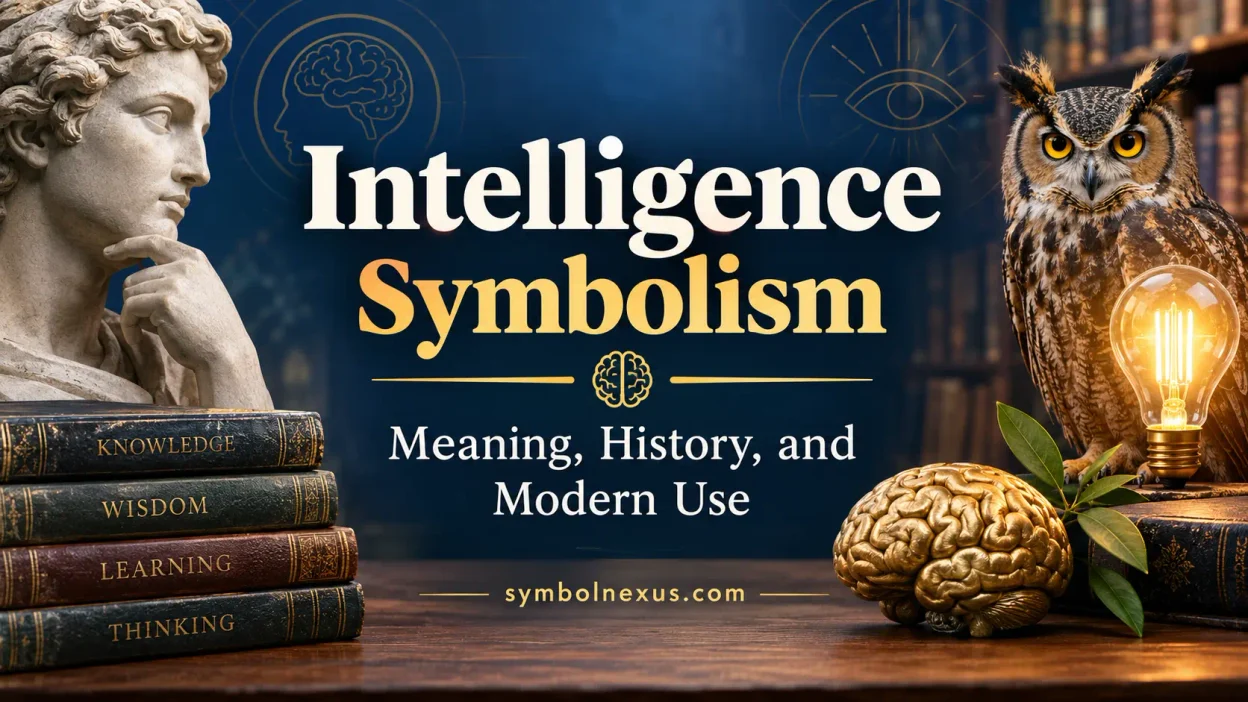
Intelligence symbolism refers to the images, objects, animals, and visual signs people use to represent knowledge, reasoning, learning, creativity, and good judgment. In the United States, a light bulb above someone’s head, an owl beside a stack of books, or a brain-shaped graphic can quickly communicate the idea of being smart. These symbols help people express an abstract quality through something familiar and easy to recognize.
However, intelligence does not have just one symbolic form. A book may represent education, a chessboard may suggest strategy, and a magnifying glass may stand for careful investigation. Each image emphasizes a different part of thinking, from gaining information to solving problems and questioning assumptions.
Understanding intelligence symbolism also means looking beyond familiar images. Some symbols reflect ancient religious traditions, while others developed through schools, popular entertainment, scientific imagery, and modern technology. Their meanings depend on the setting, the audience, and the kind of intelligence being celebrated.
Quick Answer
Intelligence symbolism commonly represents knowledge, wisdom, clear thinking, creativity, and the ability to solve problems in modern American culture. Historically, symbols such as the owl, books, and the lamp of learning connected intelligence with wisdom, education, observation, and the pursuit of knowledge.
TL;DR
- The owl commonly represents wisdom, observation, and thoughtful judgment.
- Books and lamps symbolize learning, education, and the search for knowledge.
- Light bulbs represent ideas, discoveries, and sudden understanding.
- Chess pieces suggest strategy, planning, and intellectual discipline.
- Brain imagery represents cognition, memory, reasoning, and scientific study.
- Modern interpretations increasingly include creativity, collaboration, and critical thinking.
What Intelligence Symbolism Represents
Intelligence is an abstract ability, so cultures often represent it through visible things associated with thinking and learning. These images turn a complex concept into a recognizable sign.
The most common meanings include knowledge, wisdom, reasoning, curiosity, creativity, and problem-solving. Although people often use these terms together, they describe different qualities. Knowledge involves information a person has acquired. Wisdom involves judgment and experience. Reasoning helps someone evaluate evidence, while creativity supports new ideas and unexpected solutions.
A symbol may emphasize one quality more than another. A stack of books usually suggests education and accumulated knowledge. A chessboard implies planning and anticipating consequences. A light bulb represents a new idea, while an owl often conveys observation and wisdom.
Intelligence symbols can also communicate social status. Academic robes, advanced degrees, formal libraries, and scientific instruments may signal expertise or professional achievement. Yet these signs show how intelligence is presented or recognized, not necessarily how intelligent a person is.
The central idea is that intelligence symbolism expresses how people understand thinking, learning, and judgment. It does not provide a reliable measure of anyone’s actual intellectual ability.
The Owl as a Symbol of Wisdom and Intelligence
The owl is one of the best-known symbols of wisdom in Western culture. Its large forward-facing eyes, quiet movements, and nighttime activity have helped people associate it with close observation, patience, and awareness.
A major historical influence comes from ancient Greece, where the owl was associated with Athena, a goddess connected with wisdom, strategy, skilled work, and civic life. The owl appeared in Greek art and on Athenian coins, giving it a public identity as well as a religious one. Roman culture later connected Athena with Minerva, helping preserve related imagery in the classical tradition.
In modern American life, owls frequently appear on classroom materials, library decorations, children’s books, and educational merchandise. A cartoon owl wearing glasses or sitting beside books can suggest a knowledgeable teacher or an eager student.
The owl also has meanings beyond intelligence. Because it is active at night, some cultures have associated it with darkness, death, warnings, or the unknown. Those associations differ by place and tradition, so an owl should not automatically be interpreted as a sign of wisdom or danger.
When an owl appears in an illustration, tattoo, or decorative object, its meaning depends on the surrounding details. Books may emphasize learning, a moon may suggest night and mystery, and a thoughtful pose may highlight observation.
Books, Libraries, and the Pursuit of Knowledge
Books symbolize intelligence because they preserve information and allow knowledge to pass between people and generations. A book can represent formal education, personal curiosity, historical memory, or the effort required to understand a subject.
Libraries strengthen this association. Shelves filled with books suggest a collection of ideas waiting to be explored. In American schools and public libraries, books often symbolize access to education and the opportunity to learn independently.
A single open book can communicate a different idea from a closed volume. An open book may suggest discovery, study, transparency, or a willingness to learn. A closed book can represent stored knowledge, a completed lesson, or a subject that remains unexplored. These meanings are contextual rather than fixed rules.
Books also appear in graduation illustrations, academic logos, and professional branding. In these settings, they often communicate preparation and intellectual achievement. Yet reading widely is only one route to understanding. Practical experience, discussion, experimentation, and observation can also develop intelligence.
The symbolic value of a book therefore lies not only in what it contains but also in the human activity it represents: asking questions, learning from others, and revising one’s understanding.
Light Bulbs and the Moment of Discovery
A light bulb above a person’s head is a familiar modern symbol for an idea. In cartoons, advertisements, educational graphics, and digital conversations, it usually means that someone has recognized a solution or suddenly understood something.
The image works through a simple visual comparison. Light makes objects easier to see, so illumination becomes a metaphor for understanding. When an unclear problem becomes understandable, people often describe the experience as seeing the light or having a bright idea.
In American popular culture, the light bulb is especially associated with invention, creativity, and practical problem-solving. It may appear beside a person developing a business plan, a student solving a difficult question, or a team discovering a new approach.
Its meaning is not limited to academic intelligence. A useful idea might come from experience, artistic imagination, careful observation, or an ordinary conversation. The symbol celebrates the moment when separate pieces of information form a clearer picture.
A light bulb can also represent innovation in science and technology, particularly when paired with gears, circuits, or laboratory imagery. In such designs, it suggests turning an idea into something useful.
However, a sudden insight is only one part of intelligent thinking. Research, testing, patience, and revision often follow the initial moment of inspiration.
The Brain as a Symbol of Thinking
The human brain is a direct visual representation of mental activity. In modern American culture, brain illustrations commonly appear in science education, medical communication, psychology, technology, and discussions about memory or learning.
A realistic brain drawing often emphasizes anatomy and scientific understanding. A simplified cartoon brain may communicate intelligence, concentration, or mental effort. A glowing brain can suggest inspiration or intense activity, while a brain connected to computer circuitry may represent artificial intelligence or human-machine interaction.
Brain imagery became especially common as scientific explanations of cognition gained a larger place in public education and popular media. Today, diagrams of neurons, neural networks, and brain regions help explain aspects of perception, language, memory, and decision-making.
Still, the brain should not be treated as a simple visual scorecard for intelligence. Human cognition involves complex processes, and intelligence cannot be fully understood through one picture or a single physical feature. A stylized brain is a communication tool, not a complete explanation of how thinking works.
Brain symbols are also used humorously. A person might post a cartoon brain to represent overthinking, forgetfulness, or mental exhaustion. These uses show that intelligence imagery can communicate the effort and limitations of thinking as well as its achievements.
Chess as a Symbol of Strategy and Mental Discipline
Chess often symbolizes strategic intelligence because players must evaluate positions, consider possible responses, and plan several moves ahead. Unlike a simple image of knowledge, a chessboard suggests active thinking under constraints.
In American culture, chess appears in educational programs, films, business metaphors, and personal designs. A chess piece may represent patience, planning, competition, or the ability to anticipate another person’s actions.
Different pieces can add further associations, although there is no universal symbolic code. The king may suggest responsibility or vulnerability, the queen may suggest flexibility and influence, and a knight may evoke unconventional movement. These meanings depend on the design and the person interpreting it.
Chess is also used as a metaphor for decision-making in politics, business, and relationships. Describing a situation as a chess game implies that each action may influence later options. This can communicate foresight, but it can also make ordinary cooperation sound like manipulation or conflict.
Importantly, chess represents one form of intellectual activity rather than intelligence as a whole. Logical analysis and strategic planning matter, but empathy, practical judgment, communication, and creative thinking also contribute to how people solve real-world problems.
The Magnifying Glass and the Search for Truth
A magnifying glass symbolizes close examination, curiosity, and attention to detail. It is often shown beside a detective, researcher, scientist, or investigator because it suggests looking beyond the surface.
The image is particularly useful when intelligence involves gathering evidence rather than immediately reaching a conclusion. A magnifying glass implies that an answer must be examined, clues must be compared, and assumptions may need to be questioned.
In American detective stories and mystery entertainment, the magnifying glass became a recognizable shorthand for investigation. In educational materials, it may represent inquiry-based learning, observation, or the scientific method.
The symbol can also express skepticism in a positive sense. A careful thinker does not accept every claim automatically but asks what supports it. This form of intelligence depends on patience and a willingness to distinguish evidence from speculation.
A magnifying glass may be paired with fingerprints, documents, maps, or scientific specimens to clarify the type of investigation involved. Without those details, it usually communicates general curiosity and close attention.
Its central message is that understanding often requires more than a quick impression. Sometimes the intelligent response is to look again.
The Fox and Intelligence in Animal Symbolism
The fox commonly represents cleverness, adaptability, and the ability to navigate difficult situations. Its reputation in folklore often comes from its perceived alertness and resourcefulness rather than from the academic kind of intelligence represented by books or school imagery.
In European fables and other storytelling traditions, the fox frequently appears as a character that relies on wit. It may escape danger, outsmart a stronger opponent, or find an indirect route to a goal. These stories made the fox a recognizable figure for cleverness, although they sometimes portray that cleverness as cunning or deception.
In the United States, fox imagery appears in children’s stories, character design, clothing, tattoos, and decorative art. A fox may symbolize independence, quick thinking, adaptability, or playful intelligence.
Its meaning depends on how the animal is depicted. A calm fox in a woodland setting may suggest alertness and self-reliance. A grinning fox in a fable-inspired illustration may imply trickery. A geometric fox logo may simply communicate agility or a clever brand identity.
The fox also provides a useful contrast with the owl. The owl tends to represent wisdom and thoughtful observation, while the fox more often represents practical cleverness and adaptability. Neither animal has a universal meaning, and neither should be treated as proof of human or animal intelligence in a symbolic context.
Ancient Roots of Intelligence Symbols
Many familiar symbols of intelligence developed through religious imagery, philosophy, storytelling, and educational traditions. Ancient Greece played an important role in the Western association between wisdom and the owl, especially through Athena. The goddess represented not just abstract knowledge but also strategy, skilled work, and sound judgment.
The lamp or torch became another recurring image for learning and understanding. Light could make a dark space visible, creating a natural metaphor for insight. Later intellectual and educational traditions used illumination to describe the process of gaining knowledge or moving away from ignorance.
Written texts also carried intellectual meaning long before modern schools existed. Manuscripts, scrolls, and libraries represented the preservation and transmission of ideas. Their value came from the labor involved in recording information and the possibility of learning from people who lived elsewhere or in earlier times.
These associations did not develop in one straight line. Different societies used different images to express wisdom, discernment, memory, or divine knowledge. Some traditions also associated nocturnal animals with danger or death, showing that a symbol’s meaning could change with religious beliefs and local experience.
Modern intelligence symbols often combine these older associations with contemporary ideas about science, creativity, education, and technology.
Intelligence Symbolism in American Education and Public Life
In the United States, intelligence is often represented through educational objects and institutions. Books, graduation caps, diplomas, pencils, microscopes, and school mascots appear in settings that celebrate learning and academic progress.
A graduation cap usually symbolizes the completion of a course of study. A diploma represents a formally recognized qualification. A pencil may stand for practice, writing, and the development of skills, while a microscope suggests scientific investigation.
These images are common in graduation announcements, school websites, classroom posters, library programs, and educational campaigns. They help communicate a shared message: learning requires effort, and acquiring knowledge can open opportunities.
American public life also uses intellectual symbols to represent professional expertise. Scientific equipment may identify a research organization, books may feature in a university emblem, and abstract network patterns may suggest data analysis or computing.
However, academic symbols should not be confused with a complete definition of intelligence. Formal credentials indicate that someone has met particular educational requirements. They do not capture every person’s creativity, practical judgment, emotional understanding, or ability to learn outside a classroom.
The most inclusive interpretation of intelligence recognizes many ways of thinking and learning rather than treating one educational path as the only sign of intellectual ability.
Intelligence Symbols in Technology and Artificial Intelligence
Technology has expanded the visual language used to represent intelligence. In contemporary American design, artificial intelligence may be depicted through neural networks, connected nodes, digital brains, circuit patterns, and glowing geometric shapes.
These images suggest information processing, pattern recognition, automation, or connections between data points. A network diagram may represent a system that identifies relationships, while a digital brain may make a complex technology easier to recognize at a glance.
Such imagery is especially common in software branding, science communication, educational platforms, and discussions of machine learning. It often combines older symbols of knowledge with the visual style of modern computing.
The symbolism can be misleading if it implies that a machine thinks exactly like a person. A glowing digital brain is a design convention, not evidence of human-like consciousness, understanding, or wisdom. Likewise, the appearance of a network does not explain how a system reaches its outputs.
Technology symbols are most useful when they communicate a specific function, such as analysis, learning from data, or automated assistance. They become less informative when they use generic futuristic imagery to suggest intelligence without explaining what the technology actually does.
This modern development reflects a broader shift: intelligence is now discussed not only as a human capacity but also as a set of processes that people attempt to model, measure, or automate.
Positive and Negative Meanings of Intelligence Symbols
Intelligence symbols usually carry positive associations, but their meanings can become complicated. An owl, book, or light bulb may suggest wisdom, curiosity, and discovery. A chessboard may communicate foresight, while a magnifying glass can imply careful reasoning.
Other interpretations are less flattering. A fox may represent cunning that crosses into dishonesty. A brain can be used to mock someone who overthinks. A stack of books may suggest intellectual pride when the image emphasizes status rather than learning.
Intelligence can also become a symbol of exclusion. When education or technical language is presented as proof that some people are inherently superior, the symbol shifts from celebrating knowledge to reinforcing social divisions. A diploma may demonstrate a real achievement, but it should not be used to dismiss the experience or abilities of people without the same credential.
Symbols can also reinforce narrow stereotypes about who looks intelligent. Glasses, formal clothing, laboratory coats, or particular facial expressions may be used in illustrations to signal expertise, but none of these features establishes a person’s actual abilities.
A thoughtful interpretation separates the quality being represented from assumptions about the person or group shown. Intelligence is better understood through learning, reasoning, creativity, and judgment than through appearance alone.
Intelligence Symbolism Across Cultures
Symbols of intelligence vary across cultures, religions, and historical traditions. The owl’s connection with Athena is particularly influential in Western imagery, but it is not a universal belief. In some communities, owls have been associated with warnings, death, or spiritual concerns rather than wisdom.
Written knowledge also carries different meanings depending on the tradition. A sacred text may represent divine guidance and moral understanding, while a scholarly manuscript may emphasize study, interpretation, or preservation of learning. These meanings overlap, but they are not identical.
Light is another widespread metaphor for understanding. It can represent revelation, insight, guidance, or the discovery of truth, although the specific meaning depends on the religious or philosophical setting. It would be inaccurate to assume that every tradition uses light in the same way.
Animal symbolism requires particular care. Indigenous nations and communities have distinct histories, teachings, and relationships with animals. There is no single interpretation of intelligence symbols that can accurately represent all Indigenous cultures.
When interpreting a symbol from another culture, the most responsible approach is to consider its specific origin and use. A familiar Western meaning may be relevant, but it should not replace the meaning held within the tradition where the symbol appears.
Emotional and Psychological Meaning of Intelligence Symbols
Intelligence symbols can express more than the desire to appear knowledgeable. They may communicate curiosity, confidence, patience, independence, or the wish to understand a difficult situation.
Someone who chooses a book tattoo might value lifelong learning. A chess piece could represent strategic thinking or the experience of making careful decisions. A light bulb may commemorate a creative breakthrough, while an owl might express a personal commitment to observation and reflection.
These interpretations are individual rather than universal. Two people can choose the same image for different reasons. One person may see an owl as a reminder to think before acting, while another may simply enjoy its appearance or connect it with a favorite book.
Intelligence symbols can also express a person’s aspirations. A student may use a brain or book illustration to represent academic goals. A researcher might choose imagery associated with discovery, while an entrepreneur may prefer a symbol of innovation.
The emotional meaning often comes from the story attached to the object. The symbol provides a visible reminder, but the person’s experience gives it personal significance.
It is also worth remembering that intelligent thinking does not require constant certainty. Curiosity, openness to correction, and the ability to acknowledge what one does not know are important parts of learning.
Intelligence Symbolism in Tattoos, Jewelry, and Personal Style
In tattoos and jewelry, intelligence symbols often communicate identity, values, or personal history. The design may celebrate education, intellectual independence, curiosity, or a meaningful moment of discovery.
An owl tattoo is often associated with wisdom and observation. A book may represent a love of reading, a particular period of study, or the importance of preserving knowledge. A light bulb can symbolize creativity, while a chess piece may stand for strategy and patience.
Some people combine symbols to create a more specific meaning. An owl holding a book may emphasize learning and wisdom. A brain surrounded by stars might suggest imagination and scientific curiosity. A magnifying glass over a small object can represent a commitment to examining details.
Jewelry often uses simpler designs. A small book pendant, an owl charm, or a geometric brain motif may communicate an interest without making a large visual statement. In clothing and accessories, these images can function as personal expressions, decorative choices, or references to academic and scientific interests.
There is no official meaning for any of these designs. Their significance depends on the wearer’s intentions, the surrounding imagery, and the cultural associations the viewer recognizes.
Common Misunderstandings About Intelligence Symbolism
One common misunderstanding is that a symbol of intelligence represents every form of intelligence equally. In reality, different images emphasize different abilities. Books suggest learning, chess suggests strategy, a light bulb suggests insight, and a magnifying glass suggests investigation.
Another mistake is treating an animal symbol as a scientific statement. An owl may represent wisdom in art, but its symbolic reputation does not establish a human quality. Similarly, a fox can represent cleverness in folklore without serving as a universal measurement of animal cognition.
People may also assume that symbols have the same meaning everywhere. Historical and cultural context can change an image’s interpretation, sometimes reversing its emotional tone. An owl may be admired in one setting and feared in another.
A further misconception is that intelligence means knowing everything. Many symbols celebrate achievement, but learning also involves uncertainty, mistakes, and revision. A person who asks careful questions may demonstrate better judgment than someone who simply presents confident answers.
Finally, intelligence symbolism should not be used to rank human worth. Symbols can celebrate education and thought, but no single object, credential, animal, or visual style can establish a person’s overall ability or value.
Intelligence Symbols and Their Common Meanings
The following table summarizes familiar symbols and the ideas they most often communicate in modern American contexts.
| Symbol | Common Meaning | Typical Context |
|---|---|---|
| Owl | Wisdom, observation, judgment | Schools, books, art, tattoos |
| Book | Knowledge, learning, education | Libraries, classrooms, graduation |
| Light bulb | Inspiration, discovery, new ideas | Cartoons, business, design |
| Brain | Cognition, memory, reasoning | Science, medicine, technology |
| Chessboard | Strategy, planning, foresight | Games, business, personal designs |
| Magnifying glass | Curiosity, evidence, close examination | Investigation, research, education |
These associations are common conventions rather than universal rules. The same symbol can communicate different ideas when its style, surrounding objects, or cultural setting changes.
How to Interpret an Intelligence Symbol Correctly
Start by identifying the symbol itself. Is it an owl, an open book, a brain, a chess piece, or a light bulb? Then examine what appears alongside it. Books may reinforce a theme of education, while circuits can shift the meaning toward computing or artificial intelligence.
Next, consider where the image appears. A school logo has a different purpose from a tattoo, a museum artwork, or a technology company’s branding. Institutional settings often emphasize learning and expertise, while personal designs may express an individual’s goals or memories.
Historical context can clarify the meaning further. An owl shown beside Athena draws on classical mythology. A lamp or torch may connect with the metaphor of illumination and knowledge. A digital brain belongs more naturally to modern scientific and technological imagery.
Finally, avoid assuming that the symbol tells you everything about its owner or creator. Images communicate associations, not complete biographies. If the meaning matters, the creator’s explanation or the context of the artwork may provide the clearest answer.
Intelligence symbolism becomes easier to understand when visual details, historical background, and intended use are considered together.
Frequently Asked Questions
What is the most common symbol of intelligence?
The owl is one of the most recognizable symbols of intelligence and wisdom in Western culture. Books, light bulbs, and brain illustrations are also common, with each emphasizing a different aspect of learning or thinking.
What does an owl symbolize in relation to intelligence?
An owl commonly represents wisdom, observation, and careful judgment. Its association with Athena in ancient Greek culture helped establish this meaning in Western art, although other traditions have connected owls with different ideas.
What does a light bulb symbolize?
A light bulb usually represents a new idea, sudden understanding, or creative discovery. In cartoons and modern design, it visually communicates the moment when a problem becomes clearer or a solution comes to mind.
What does intelligence symbolism mean in a tattoo?
An intelligence-themed tattoo can express curiosity, education, creativity, strategic thinking, or a commitment to lifelong learning. The exact meaning depends on the wearer’s personal experience and the specific design.
Are intelligence symbols the same across cultures?
No. Some symbols, such as books and light, have broad associations with learning or understanding, but their meanings vary across cultural and religious traditions. Animal symbols, particularly owls, can carry very different associations depending on the community.
Does a brain symbol represent intelligence better than an owl?
A brain more directly represents mental processes and scientific study, while an owl traditionally represents wisdom and thoughtful observation. Neither image measures intelligence; each communicates a different idea through visual symbolism.
Can intelligence symbolism have a negative meaning?
Yes. A fox may suggest deception as well as cleverness, and academic imagery can sometimes be used to imply superiority or exclusion. The surrounding context determines whether a symbol celebrates learning or reinforces an unhelpful stereotype.
Conclusion
Intelligence symbolism gives visible form to ideas that are otherwise difficult to represent. Owls suggest wisdom, books communicate learning, light bulbs represent discovery, and chessboards evoke strategy. Each symbol highlights a different part of the process of thinking and understanding.
In modern American culture, these images appear in education, technology, art, personal style, and popular entertainment. Their meanings continue to evolve as people develop new ways to describe knowledge, creativity, and problem-solving.
Ultimately, intelligence symbolism is most meaningful when it celebrates curiosity, sound judgment, and the willingness to learn. A symbol can express an ideal, but the thinking and actions behind it give that ideal practical value.