
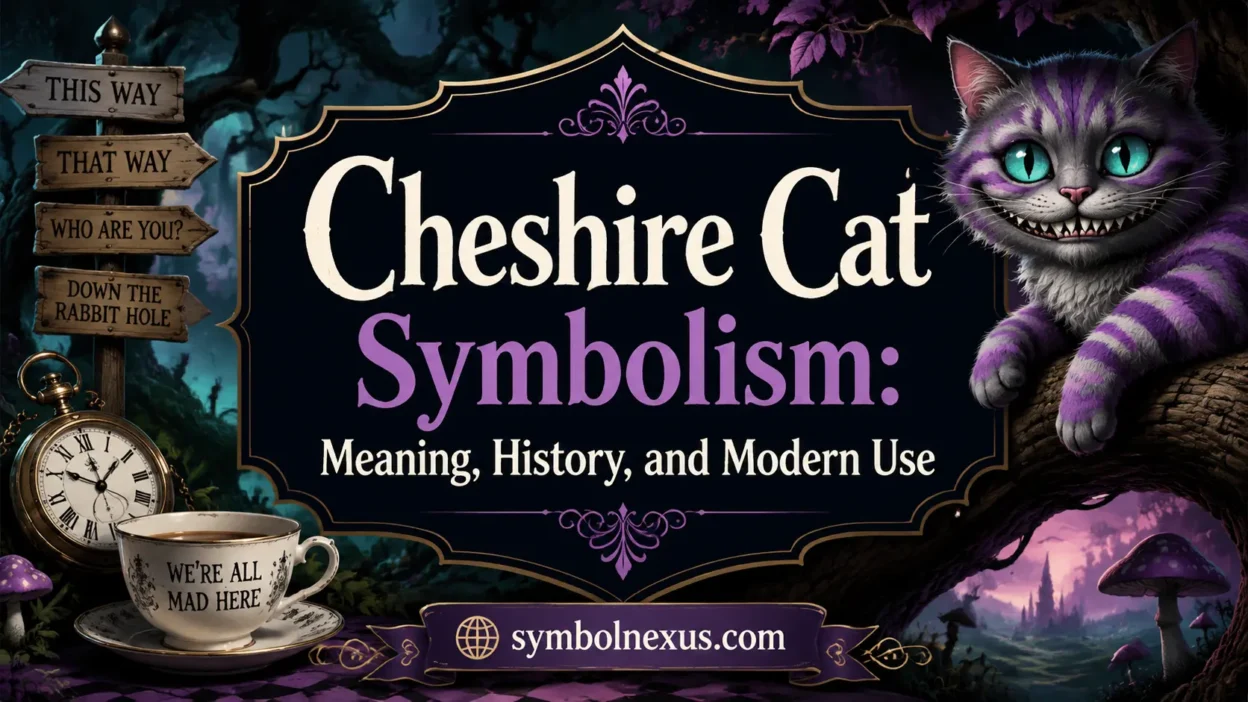
The Cheshire Cat is one of the most recognizable fictional symbols in Western culture, often remembered for its mysterious smile, disappearing body, and unusual way of speaking. Cheshire cat symbolism is commonly connected with curiosity, cleverness, individuality, and the idea of seeing beyond ordinary appearances.
Although the character became famous through Lewis Carroll’s Alice’s Adventures in Wonderland, the meanings associated with the Cheshire Cat have grown beyond the original story. Today, people interpret it as a symbol of imagination, uncertainty, humor, independence, and the ability to question reality.
In the United States, the Cheshire Cat appears in books, movies, artwork, tattoos, clothing, home decor, and digital culture. Its meaning can change depending on the context. For some people, the character represents playful intelligence, while others view the famous grin as a reminder that appearances can hide deeper truths.
Quick Answer
Cheshire cat symbolism commonly represents curiosity, cleverness, individuality, and playful mystery in modern American culture. Historically, the character became associated with imagination, uncertainty, and questioning reality through Lewis Carroll’s Alice’s Adventures in Wonderland.
TL;DR
- Cheshire Cat represents curiosity and clever thinking.
- The character originated in Lewis Carroll’s famous novel.
- Americans often connect it with creativity and individuality.
- The disappearing smile symbolizes uncertainty and illusion.
- Tattoos use it to express humor and personal identity.
- Modern culture views it as a playful icon.
What the Cheshire Cat Looks Like and Where People Encounter It
The Cheshire Cat is usually portrayed as a striped cat with a wide, unusual smile, bright eyes, and a relaxed but mysterious personality. The most famous version comes from illustrations of Alice’s Adventures in Wonderland, where the cat appears and disappears while offering confusing but meaningful advice to Alice.
The character’s most recognizable feature is the grin. In many interpretations, the smile remains visible even after the rest of the body disappears. This unusual image has become the central visual element connected with the Cheshire Cat.
Today, people encounter the Cheshire Cat in many forms:
- Animated films and television
- Book illustrations
- Fantasy artwork
- Tattoos and clothing designs
- Online memes and digital graphics
- Collectible items and home decoration
Because the character combines humor with uncertainty, it easily fits both playful and philosophical settings.
The Core Meaning of Cheshire Cat Symbolism
The Cheshire Cat carries several meanings because of its unusual personality and behavior. Unlike traditional heroes or villains, the character exists between categories. It helps explain why people continue to interpret it in different ways.
Curiosity and Exploration
One of the strongest meanings connected with the Cheshire Cat is curiosity. In Alice’s Adventures in Wonderland, the character encourages Alice to think differently and explore unfamiliar situations.
The Cheshire Cat represents the willingness to ask questions instead of accepting everything at face value. This interpretation connects with creativity, learning, and personal discovery.
Many people who identify with this meaning see the Cheshire Cat as a symbol of an open mind.
Cleverness and Intelligence
The Cheshire Cat is known for wordplay, unusual answers, and the ability to understand situations differently from others. Because of this, it often symbolizes intelligence that does not follow ordinary rules.
Rather than representing traditional academic knowledge, the character reflects quick thinking, imagination, and social awareness.
In modern culture, the Cheshire Cat can represent someone who solves problems creatively or approaches life from a unique perspective.
Mystery and Uncertainty
The Cheshire Cat’s ability to vanish creates one of its most recognized symbolic meanings: uncertainty.
The disappearing act suggests that some things cannot be fully understood or controlled. The character reminds audiences that life can contain unanswered questions and unexpected changes.
This meaning often appears in artwork where the Cheshire Cat represents the unknown or the hidden side of reality.
Ancient Roots and Early Influences Behind the Cheshire Cat
Although the Cheshire Cat itself is a literary creation from the 19th century, its style reflects older traditions involving talking animals, trickster figures, and symbolic creatures.
Many cultures have used animals in stories to represent human qualities. Cats, in particular, have often been connected with independence, observation, and mystery.
Before Lewis Carroll created his famous character, cats already appeared in folklore as creatures associated with intelligence and unusual behavior. These earlier ideas helped create a cultural background where a clever, unpredictable cat character felt familiar.
The Cheshire Cat’s personality also resembles the traditional “trickster” figure found in many storytelling traditions. Tricksters often challenge normal rules, reveal hidden truths, and encourage people to think differently.
How Lewis Carroll Created the Modern Cheshire Cat Meaning
The Cheshire Cat became widely recognized through Lewis Carroll’s 1865 novel Alice’s Adventures in Wonderland. In the story, the character does not simply provide information. Instead, the cat challenges Alice’s understanding of logic, identity, and direction.
One famous aspect of the character is the conversation about choices and paths. The Cheshire Cat suggests that knowing where someone wants to go matters before deciding which direction to take.
Because of moments like this, readers have interpreted the character as a symbol of self-awareness and personal decision-making.
Over time, the Cheshire Cat became more than a fictional character. It developed into a cultural symbol connected with imagination, questioning, and unconventional thinking.
Cheshire Cat Symbolism in the United States
In American culture, the Cheshire Cat is usually understood as a playful symbol rather than a religious or traditional emblem. Its popularity comes largely from literature, entertainment, and personal expression.
Americans often associate the Cheshire Cat with:
| Context | Meaning in the USA | Common Associations | Notes |
|---|---|---|---|
| Literature | Imagination and curiosity | Fantasy, storytelling | Connected to Carroll’s novel |
| Tattoos | Individuality and humor | Personal identity | Often chosen for unique personality |
| Pop culture | Playfulness and mystery | Movies, animation | Recognizable character image |
| Home decor | Creativity and fun | Whimsical style | Used in artistic spaces |
| Digital culture | Humor and cleverness | Memes and graphics | Adapted for online expression |
In the United States, the Cheshire Cat often appeals to people who enjoy creativity and dislike predictable ideas. It is especially popular among fans of fantasy, literature, and alternative art styles.
The symbol does not usually carry one fixed meaning. Instead, its interpretation depends on how and where it appears.
The Cheshire Cat as a Symbol of Individuality
The Cheshire Cat does not behave like a typical character. It does not follow ordinary expectations, and it does not provide simple answers. This unusual personality has made it a symbol of individuality.
People often connect with the character because it represents being comfortable with being different.
In personal expression, the Cheshire Cat may communicate:
- A love of imagination
- A playful personality
- Independence from social expectations
- Appreciation for unusual ideas
For this reason, the symbol appears frequently in creative communities, including artists, writers, and people who enjoy fantasy culture.
Why the Cheshire Cat Appears in Tattoos and Personal Style
Cheshire Cat tattoos are popular because the image allows for many interpretations. Some people choose the character because they love Alice’s Adventures in Wonderland, while others connect with its symbolic meanings.
Common tattoo meanings include:
- Curiosity about life
- Enjoyment of humor and irony
- A unique personality
- Acceptance of uncertainty
- Love for fantasy and storytelling
The famous grin is especially meaningful because it can represent confidence, hidden emotions, or the idea that something remains even after everything else changes.
Tattoo designs may range from colorful cartoon versions to darker artistic interpretations.
Frequently Asked Questions
What does Cheshire Cat symbolism represent?
Cheshire Cat symbolism commonly represents curiosity, cleverness, individuality, and imagination. It can also reflect uncertainty because of the character’s disappearing body and mysterious behavior.
Is the Cheshire Cat a positive symbol?
Yes, most modern interpretations view the Cheshire Cat positively. It is often associated with creativity, humor, and independent thinking, although some people interpret the grin as representing hidden emotions or uncertainty.
What does a Cheshire Cat tattoo mean?
A Cheshire Cat tattoo can represent different ideas depending on the person. Common meanings include creativity, love of fantasy, curiosity, individuality, and comfort with life’s unpredictable moments.
Does the Cheshire Cat have a spiritual meaning?
The Cheshire Cat does not have an official spiritual meaning. However, some people connect it with broader themes such as questioning reality, personal discovery, and seeing beyond appearances.
Why is the Cheshire Cat always smiling?
The Cheshire Cat’s smile is one of its defining features from Alice’s Adventures in Wonderland. Symbolically, the grin is often interpreted as representing confidence, mystery, humor, or the difference between appearances and reality.
Is the Cheshire Cat a symbol of deception?
Not usually. While some interpretations connect the character’s mysterious behavior with hidden motives, the most common meanings focus on curiosity, creativity, and playful intelligence.
Why is the Cheshire Cat popular today?
The Cheshire Cat remains popular because its image works well in books, movies, art, tattoos, and online culture. Its combination of humor and mystery allows people to connect with it in different ways.
Conclusion
The Cheshire Cat has grown from a fictional character into a widely recognized cultural symbol. Its unusual smile, disappearing form, and clever personality have given it meanings connected with curiosity, creativity, individuality, and uncertainty.
In modern American culture, Cheshire cat symbolism is often used to express a playful attitude toward life and a willingness to think differently. Whether seen in tattoos, artwork, entertainment, or digital spaces, the character continues to represent the idea that reality can be more complicated than it first appears.
The lasting appeal of the Cheshire Cat comes from its ability to mean different things to different people while still keeping its original spirit of imagination and curiosity.


