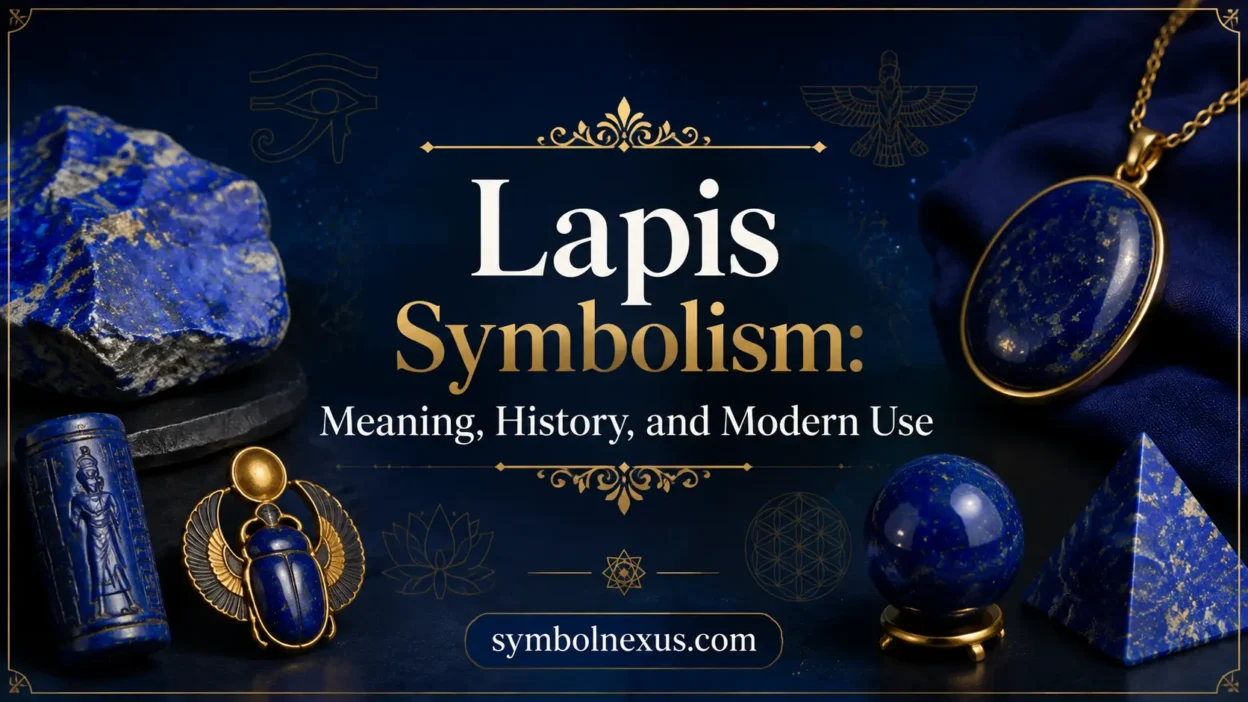
Lapis symbolism connects one of the world’s most recognizable blue gemstones with ideas of wisdom, truth, communication, and personal expression. Lapis lazuli, commonly called lapis, is a deep blue stone often marked with golden pyrite flecks that make it visually distinctive. For thousands of years, people have valued it not only for its beauty but also for the meanings attached to its color and rarity.
In modern American culture, lapis is often associated with confidence, creativity, learning, and self-expression. People encounter it in jewelry, artwork, home decor, spiritual practices, and personal keepsakes. While some traditions give the stone religious or mystical meanings, many people today appreciate it simply as a symbol of knowledge, individuality, and artistic inspiration.
Understanding lapis requires looking at both its historical role and its modern interpretation. The stone has traveled across civilizations, appeared in royal objects, influenced artists, and continues to represent ideas that connect the past with present-day personal identity.
Quick Answer
Lapis symbolism commonly represents wisdom, truth, creativity, and communication in modern American culture, especially in jewelry, art, and personal expression. Historically, lapis lazuli was valued by ancient civilizations as a rare stone connected with royalty, spirituality, and knowledge.
TL;DR
- Lapis represents wisdom, truth, and creativity.
- Ancient cultures prized its rare blue color.
- Americans use lapis in jewelry and design.
- The stone symbolizes confidence and expression.
- Religious traditions gave lapis sacred meanings.
- Modern views focus on beauty and identity.
What Lapis Lazuli Looks Like and Where It Appears
Lapis lazuli is a blue metamorphic rock made mainly from lazurite, with smaller amounts of calcite and pyrite. Its most recognizable feature is its rich blue color, which can range from bright azure to deep midnight blue. Small golden pyrite particles often create a star-like appearance across the surface.
Unlike many gemstones that are transparent or crystal-like, lapis has an opaque appearance. This unique look has made it popular for carvings, decorative objects, pigments, and jewelry.
People today commonly see lapis in:
- Rings and necklaces
- Bracelets and earrings
- Decorative bowls and sculptures
- Artwork and paintings
- Interior design pieces
- Collectible stones
Its appearance has always contributed to its symbolism. The combination of blue and gold naturally connects the stone with the sky, stars, wealth, and artistic imagination.
What Lapis Commonly Means in the United States
In the United States, lapis is generally understood as a symbol of intelligence, creativity, and personal confidence. Many people choose lapis jewelry because its appearance feels distinctive and expresses individuality.
The stone’s blue color often influences these interpretations. Blue is commonly connected with calmness, trust, stability, and communication in American color psychology. Because of this association, lapis is often viewed as a fitting symbol for writers, artists, teachers, and people who value learning.
Modern interpretations usually focus less on supernatural beliefs and more on personal meaning. Someone may wear lapis because it represents:
- A commitment to education
- Creative goals
- Speaking honestly
- Personal growth
- Appreciation for history and art
Ancient Roots and Early Symbolism
Lapis lazuli has one of the longest recorded histories among decorative stones. It was especially valued in ancient Mesopotamia, Egypt, and other early civilizations because of its intense blue color and limited natural sources.
Ancient Egyptians used lapis in jewelry, burial objects, and decorative art. The stone appeared in important cultural objects because blue was associated with the heavens, protection, and divine connection.
In Mesopotamian societies, lapis was considered a precious material connected with status and importance. Its rarity made it suitable for royal items and ceremonial objects.
The stone’s early symbolism developed from several factors:
- Its unusual blue color
- Its difficulty to obtain
- Its connection with luxury
- Its use in important cultural objects
Over time, these associations helped create the idea of lapis as a stone connected with wisdom, power, and higher knowledge.
Lapis Symbolism in Ancient Egypt and Religious Traditions
Ancient Egyptian culture gave lapis some of its most recognized historical meanings. The stone was frequently used in amulets, beads, and burial decorations. Its blue color was connected with the heavens and spiritual protection.
Some Egyptian artwork used crushed lapis lazuli to create blue pigments. The famous shade known as ultramarine was later produced from lapis and became one of the most valuable artistic colors.
In religious contexts, lapis has been connected with:
- Divine wisdom
- Protection
- Spiritual awareness
- Connection with the heavens
Other cultures also respected the stone, although meanings differed. In many cases, lapis represented importance, beauty, and access to something rare rather than a single universal belief.
Lapis Meaning in Art, Design, and Creativity
Few stones have influenced art as strongly as lapis lazuli. Before modern synthetic pigments became common, artists valued ground lapis because it produced a brilliant blue color.
During the Renaissance period, ultramarine created from lapis was often reserved for important artistic subjects because of its high cost. The color became associated with prestige and careful craftsmanship.
Today, lapis continues to represent:
- Artistic imagination
- Original thinking
- Creative confidence
- Appreciation for craftsmanship
Designers often use lapis colors in interiors, fashion, and branding because the shade combines calmness with sophistication.
| Context | Meaning in the USA | Common Associations | Notes |
|---|---|---|---|
| Jewelry | Confidence and individuality | Beauty, expression | Often worn as a personal symbol |
| Art | Creativity and inspiration | History, craftsmanship | Connected with famous blue pigments |
| Home Decor | Calm and elegance | Luxury, sophistication | Used as an accent color |
| Personal Growth | Learning and communication | Wisdom, honesty | Popular in symbolic jewelry choices |
Emotional and Psychological Associations of Lapis
Many people connect lapis with emotional qualities because of its color and cultural history. Blue shades often create feelings of calm, trust, and stability, while the stone’s golden details can suggest value and uniqueness.
From a psychological perspective, people may choose lapis because it represents qualities they want to express:
- Clear communication
- Self-confidence
- Curiosity
- Emotional balance
- Creative thinking
The meaning of the stone often depends on personal experience. For one person, lapis may represent academic achievement. For another, it may symbolize artistic identity or a meaningful life transition.
Why People Choose Lapis for Jewelry and Tattoos
Lapis has remained popular in personal style because it combines visual appeal with symbolic meaning. Unlike some gemstones that are chosen mainly for tradition or value, lapis often attracts people who appreciate its unusual appearance.
In jewelry, lapis can symbolize:
- Knowledge
- Honesty
- Creativity
- Personal voice
Some people also choose lapis-inspired tattoos or artwork because the stone represents ideas rather than wealth. A blue gemstone image may communicate a connection with learning, imagination, or self-expression.
Tattoo symbolism is always personal. The same design may represent different experiences depending on the person wearing it.
Lapis in Modern American Culture and Identity
Modern American use of lapis reflects a broader interest in objects that carry personal stories. People often choose symbols that represent values, memories, or goals.
Lapis appears in:
- Handmade jewelry markets
- Artistic communities
- Wellness spaces
- Fashion collections
- Home decoration
For many Americans, the stone’s meaning comes from its connection to creativity and individuality rather than ancient beliefs alone.
It can represent someone who values knowledge, enjoys artistic expression, or wants a reminder of personal growth.
Cross-Cultural Meanings of Lapis
Although lapis has different interpretations around the world, several themes appear repeatedly. Many cultures connected the stone with importance, beauty, and sacred spaces.
Examples include:
- Ancient Egypt: protection and heavenly associations
- Mesopotamia: status and ceremonial value
- South Asian traditions: spiritual awareness and inner understanding
- European art traditions: luxury and artistic excellence
These meanings are not identical, but they share a common appreciation for lapis as a rare and meaningful material.
Religious and Spiritual Interpretations
Some religious and spiritual traditions have given lapis symbolic importance. The stone has appeared in sacred objects and artistic representations because of its striking appearance and association with the sky.
In some modern spiritual communities, lapis is connected with:
- Reflection
- Truthfulness
- Inner understanding
- Personal awareness
However, these interpretations are belief-based rather than scientific facts. Many people appreciate lapis simply as a cultural and artistic symbol without attaching spiritual meaning to it.
Common Misunderstandings About Lapis Symbolism
Because gemstones often appear in spiritual discussions, lapis meanings can sometimes become exaggerated. Some claims present the stone as having guaranteed effects on health, emotions, or life outcomes.
A more balanced understanding separates cultural symbolism from factual claims.
Lapis can symbolize:
- Wisdom in cultural traditions
- Creativity in artistic contexts
- Personal meaning for individuals
However, wearing lapis does not scientifically prove that it changes personality, health, or circumstances.
How Lapis Symbolism Has Changed Over Time
The meaning of lapis has evolved as societies changed. In ancient civilizations, the stone was strongly connected with royalty, religion, and rare resources.
Later, artists valued it for its role in creating exceptional blue pigments. Today, many people view it as a symbol of creativity, self-expression, and personal style.
The stone’s meaning has expanded from public status to individual identity. Instead of representing only wealth or power, lapis now often represents personal values and creative expression.
Modern Uses of Lapis in Fashion, Decor, and Digital Culture
Lapis continues to appear in modern design because of its distinctive color. Designers use lapis-inspired shades in clothing, accessories, websites, and home interiors.
Common modern uses include:
- Blue gemstone jewelry
- Luxury-inspired decor
- Artistic themes
- Social media aesthetics
- Personalized gifts
Digital culture has also influenced how people understand symbols. A person may choose a lapis image, emoji-style artwork, or blue gemstone design online because it communicates sophistication, creativity, or calmness.
Common Misuse and Distorted Interpretations
Lapis symbolism is sometimes simplified into a single meaning, such as “wisdom stone” or “truth stone.” While these ideas come from real cultural associations, they do not represent every tradition.
Another issue is marketing language. Some sellers may attach unsupported promises to gemstones to increase interest. Understanding lapis requires recognizing both its cultural value and the limits of symbolic interpretation.
The strongest meaning comes from history, art, and personal connection rather than exaggerated claims.
Frequently Asked Questions
What does lapis symbolize?
Lapis commonly symbolizes wisdom, creativity, truth, and communication. Its meaning comes from its historical importance, blue color, and use in art and cultural objects.
What does lapis mean in jewelry?
In jewelry, lapis often represents individuality, confidence, and appreciation for knowledge or creativity. Many people choose it because it combines beauty with personal symbolism.
Is lapis a religious symbol?
Lapis has appeared in religious and sacred objects in several cultures, including ancient Egypt. However, its meaning depends on the specific tradition and personal belief.
Why is lapis associated with wisdom?
Lapis became connected with wisdom because ancient cultures valued it as a rare and important material used in significant objects. Its association with knowledge continued through art and tradition.
What does a lapis tattoo symbolize?
A lapis tattoo may represent creativity, honesty, learning, or personal growth. Like most tattoos, its meaning depends on the individual’s experience and intention.
Is lapis symbolism positive or negative?
Lapis symbolism is generally positive, focusing on ideas such as creativity, wisdom, and expression. Negative meanings are uncommon and usually come from misunderstandings or unusual interpretations.
Conclusion
Lapis symbolism represents a connection between beauty, knowledge, creativity, and human expression. From ancient royal objects to modern jewelry and design, the stone has maintained its place as a meaningful cultural symbol.
Today, people often view lapis as a reminder of learning, honesty, and individuality. Whether appreciated for its history, artistic value, or personal meaning, lapis continues to show how a natural object can carry different stories across generations.