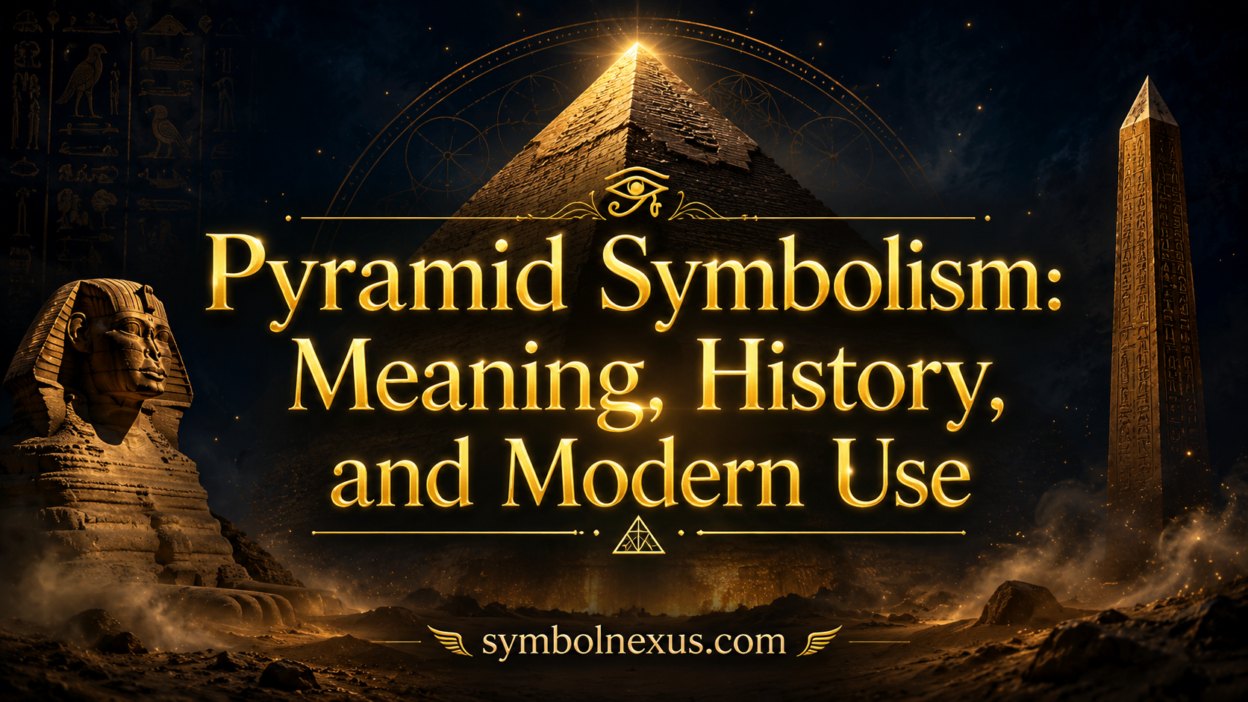
Pyramids are among the most recognizable structures in the world, yet pyramid symbolism changes considerably depending on context. A pyramid may suggest strength and permanence, upward progress, sacred authority, the afterlife, or an ordered hierarchy.
Those meanings did not all come from one civilization. Ancient Egyptian royal pyramids, Maya temple-pyramids, and the unfinished pyramid on the Great Seal of the United States developed within very different cultural settings. Treating them as versions of one universal mystical symbol can erase those differences.
In modern American culture, the form also appears far beyond monuments. It turns up on money, in logos, tattoos, jewelry, interior design, organizational diagrams, entertainment, and conspiracy-themed imagery. Understanding the pyramid therefore means separating documented historical meanings from newer interpretations attached to its distinctive shape.
Quick Answer
Pyramid symbolism commonly represents strength, stability, achievement, and upward progress in modern American culture. Historically, pyramids have also been connected with royal afterlife beliefs in ancient Egypt, sacred ritual and elevated temple space in Mesoamerica, and national endurance on the Great Seal of the United States.
TL;DR
- Pyramids commonly suggest stability, endurance, ambition, and upward movement.
- Egyptian pyramids were closely connected with kingship and the afterlife.
- Mesoamerican pyramids often supported temples and important public rituals.
- The U.S. Great Seal uses a pyramid for strength and duration.
- Modern tattoos often personalize ideas of growth, balance, or perseverance.
- Conspiracy interpretations should not be confused with documented historical meaning.
What a Pyramid Looks Like and Why Its Shape Matters
A geometric pyramid has a broad base and sides that rise toward a single apex. That visual movement — from wide and grounded to narrow and elevated — helps explain many modern interpretations.
The broad base can suggest support or foundation. The narrowing sides imply concentration, direction, and ascent. The highest point naturally draws the eye upward, so artists and designers can use the form to communicate ambition, culmination, authority, or a movement from many elements toward one goal.
Physical stability also matters. Monumental stone pyramids have survived for thousands of years, strengthening modern associations with durability and permanence.
These visual readings are useful, but they should not be projected backward as though every ancient society consciously used pyramids to mean “personal growth” or “success.” Historical meaning depended on the people who built each structure.
What It Commonly Means in the United States
For Americans today, the pyramid usually carries several overlapping associations rather than one fixed definition.
| Context | Meaning in the USA | Common Associations | Notes |
|---|---|---|---|
| Civic imagery | Endurance and national strength | Foundation, continuity, union | Seen on the $1 bill |
| Personal symbolism | Growth and achievement | Ambition, persistence, reaching goals | Common in contemporary design |
| Spiritual imagery | Ascent or higher awareness | Meditation, transcendence, focus | Usually a modern interpretation |
| Historical imagery | Ancient civilization | Egypt, monuments, archaeology | Meaning depends on culture |
| Negative usage | Unequal or deceptive structure | Pyramid schemes, concentrated power | Derived from hierarchical shape |
Strength and endurance are especially well documented in American civic symbolism. More personal meanings — balance, ambition, self-development, or spiritual ascent — are modern interpretive uses rather than official definitions.
That distinction matters because a symbol can acquire new meanings without those meanings being ancient.
Ancient Egyptian Roots: Kingship, Burial, and the Afterlife
Ancient Egypt is the culture most Americans immediately associate with pyramids.
The Egyptian pyramid developed from earlier royal tomb forms. King Djoser’s Step Pyramid at Saqqara, built during the Old Kingdom, marked a major development in monumental stone architecture. Later rulers constructed the smooth-sided pyramids now associated most strongly with Giza.
These structures were not isolated geometric monuments. Royal pyramids belonged to larger funerary complexes that could include temples, causeways, chapels, burial spaces, and places where rituals honoring the deceased ruler were performed. Their purpose was closely connected with royal death and continued existence beyond death.
Later Old Kingdom pyramid chambers also contained religious compositions now called the Pyramid Texts. These writings concerned the deceased ruler’s successful transition into the afterlife and relationship with divine powers.
Because of that history, an Egyptian pyramid can appropriately evoke royal authority, death, remembrance, eternity, and the hope for continued existence after death.
Solar and Ascent Meanings in Ancient Egypt
The pyramid’s relationship with Egyptian religion goes beyond simply functioning as a tomb.
Scholars have long examined connections between pyramid architecture, royal ascent, and Egyptian solar theology. One interpretation sees the sloping form as related to the rays of the sun, fitting an Old Kingdom religious environment in which the king’s relationship with the sun god became increasingly important.
Ancient mortuary texts also describe the deceased king moving into a transformed divine existence. That provides historical grounds for associating Egyptian pyramids with ascent, but the modern expression “rising to a higher level of consciousness” should not automatically be treated as an ancient Egyptian doctrine.
The safer historical interpretation is that pyramid complexes connected royal burial with divine order, transformation after death, and the ruler’s ongoing religious status.
Modern spiritual traditions have expanded those themes considerably.
Mesoamerican Pyramids: Sacred Mountains, Temples, and Ritual
Not all ancient pyramids were Egyptian-style tombs.
Across Mesoamerica, civilizations created monumental stepped structures that often served as platforms for temples and ceremonial activity. At cities such as Teotihuacan, major pyramidal platforms structured sacred and political spaces, while access to elevated areas could be controlled and tied to ritual authority.
Among the ancient Maya, pyramidal architecture could also evoke sacred mountains. Maya imagery and architecture linked mountains with supernatural places, caves, water, sustenance, and relationships between rulers and the sacred landscape. Some pyramidal buildings were explicitly treated as constructed mountains.
Astronomical observation was important in some Maya architectural settings as well. Buildings at sites such as Chichén Itzá interacted with the movements of the sun and other cycles important to calendrical and ceremonial life.
These traditions should remain distinct from Egyptian ones. Similar shapes do not prove a single shared religious meaning.
The Pyramid on the U.S. Dollar and Great Seal
One of the most familiar American pyramids is small enough to carry in a wallet.
The reverse of the Great Seal of the United States contains an unfinished 13-step pyramid beneath the Eye of Providence. The design was adopted by the Continental Congress in 1782, and both sides of the Great Seal later appeared on the one-dollar bill.
The historical explanation is unusually clear: the pyramid was intended to signify strength and duration. The number thirteen throughout the Great Seal refers to the original states, while the unfinished form has also been explained in official U.S. currency educational materials as representing a country that was not yet complete.
This gives the pyramid a distinctly American layer of meaning: a durable political structure being built for the future.
The Eye of Providence above it is a separate element of the overall design. Combining the eye and pyramid into a single supposedly ancient Egyptian emblem can therefore be historically misleading.
Why the Pyramid Suggests Stability and Endurance
Few geometric forms communicate stability as efficiently as a pyramid.
Visually, its weight appears concentrated near the ground. Each higher level depends upon the wider structure beneath it. Unlike an inverted shape, it looks difficult to overturn.
This is one reason the form works so naturally as a metaphor for institutions, civilizations, and lasting accomplishments. The same logic appears in the American Great Seal, where the documented association is strength and duration.
In personal symbolism, the foundation may instead represent values, family, education, experience, or discipline. The peak then becomes whatever a person hopes to build upon that foundation.
That personal reading is modern, but it follows intuitively from the structure’s visual logic.
Achievement, Hierarchy, and the Idea of Rising Up
The pyramid is also a common visual model for hierarchy.
Its horizontal levels make it easy to arrange ideas from broad to narrow, basic to advanced, or numerous to exclusive. Businesses, textbooks, infographics, and organizational models have used pyramidal diagrams for precisely that reason.
This gives the symbol two contrasting modern meanings.
For one person, climbing upward may represent achievement: learning skills, developing discipline, or working toward a demanding goal. For another, the same shape may represent unequal power, with a small group positioned above a much larger base.
Context determines which interpretation dominates. A pyramid used in motivational art may celebrate progress. A pyramid used in social criticism may emphasize concentrated privilege or authority.
Spiritual and Esoteric Interpretations
Modern spiritual movements often interpret pyramids as symbols of concentration, transcendence, balance, cosmic order, or a connection between earthly and higher realms.
Those meanings are real as modern symbolic uses, but historical caution is essential.
Claims that pyramid geometry itself produces scientifically proven healing fields, preserves objects through unexplained forces, or channels a universal form of energy go beyond what ancient architecture alone can demonstrate.
A person can still use a pyramid in meditation, spiritual jewelry, or personal ritual without claiming that the interpretation is archaeologically ancient or scientifically established.
That distinction allows contemporary symbolism to exist without rewriting the history of Egypt or Mesoamerica.
Emotional and Psychological Meaning
Emotionally, the pyramid can communicate both security and aspiration.
Its base creates an impression of groundedness. Its apex introduces direction. Together, those features make it suitable for expressing a desire to remain stable while continuing to grow.
People who identify with the form may therefore use it to represent discipline, perseverance, self-control, long-term planning, or the completion of a demanding journey.
There is also a more intimidating side. Monumental pyramids can make an individual feel physically small. That scale can communicate authority, social power, mortality, or the enormous resources of a civilization.
The emotional response is therefore not always peaceful or uplifting. Awe and uneasiness can exist together.
Why It Appears in Tattoos, Jewelry, and Personal Style
In tattoos, the pyramid is especially adaptable because a simple outline remains recognizable even at a small size.
Someone may choose it to mark a personal achievement, a period of rebuilding, or the importance of maintaining a strong foundation. Others use Egyptian-inspired pyramids because they are interested in archaeology, ancient art, mortality, or the visual character of desert monuments.
A pyramid combined with a sun may suggest illumination or renewal. Mountains can strengthen themes of endurance and ascent. An eye above a pyramid often shifts the design toward U.S. Great Seal imagery, esoteric symbolism, surveillance themes, or conspiracy culture.
Because combinations change the message, the surrounding imagery matters as much as the triangle-like outline itself.
Jewelry follows similar patterns. Minimalist pyramid pendants may function primarily as geometric design, while elaborate pieces may deliberately reference Egyptian or spiritual traditions.
Architecture, Decor, and Visual Design
Modern architects and designers use pyramid forms because they carry an immediate sense of monumentality.
A pyramidal roof can feel ordered and stable. A glass pyramid can combine an ancient silhouette with modern materials. Decorative objects may use the shape for geometric simplicity without intending any religious message.
In American homes and commercial spaces, pyramid forms also appear in shelving, lamps, sculptures, paperweights, art prints, and branded graphics.
Meaning becomes more flexible in these settings. Sometimes a pyramid is simply attractive geometry. Elsewhere, a designer deliberately uses it to communicate luxury, antiquity, durability, mystery, or ambition.
Not every decorative pyramid needs a symbolic explanation.
Pop Culture, Digital Media, and Conspiracy Imagery
Film, games, music artwork, internet memes, and social media have given the pyramid a much darker modern vocabulary.
It can indicate secret knowledge, hidden societies, surveillance, ancient technology, aliens, supernatural forces, or powerful elites. The pyramid-and-eye combination is particularly common because audiences immediately recognize its resemblance to imagery on the dollar bill.
These associations are effective storytelling devices, but entertainment has helped blur the difference between documented history and fictional conspiracy symbolism.
The Great Seal’s pyramid was officially explained as representing strength and duration, not evidence of control by a hidden organization. Claims that the dollar-bill design was secretly created as an Illuminati emblem are later interpretations rather than the documented purpose of the 1782 design.
Pop culture can change what a symbol feels like without changing where that symbol historically came from.
Common Misunderstandings and Misuse
Several recurring claims deserve caution.
First, there is no single ancient “pyramid religion.” Egyptian, Maya, Teotihuacan, and later Western uses belong to different societies with different beliefs and political systems.
Second, Egyptian pyramids should not be reduced to vague statements about “energy.” They were real royal monuments embedded in specific funerary and religious traditions.
Third, the pyramid and Eye of Providence on American currency should not automatically be labeled an Egyptian, Illuminati, or Masonic emblem. The documented explanation of the U.S. design centers on national strength, duration, providence, and the founding of the new republic.
Finally, modern personal interpretations are not necessarily wrong simply because they are modern. A tattoo can legitimately mean resilience to its wearer. The mistake occurs when that personal meaning is presented as an established ancient belief without evidence.
How the Meaning Has Evolved
The history of the pyramid shows how symbols accumulate meaning.
In ancient Egypt, monumental pyramids were tied closely to royal burial, kingship, religious transformation, and the afterlife. In parts of Mesoamerica, stepped pyramidal architecture provided elevated sacred spaces and could evoke mountains, temples, political authority, astronomical order, or ritual relationships with the landscape.
Eighteenth-century America gave the form another major interpretation when the Great Seal used it to represent strength and duration.
Modern culture then expanded the vocabulary further. Achievement, personal growth, hierarchy, corporate structure, spirituality, conspiracies, fashion, and graphic design all became possible contexts.
The pyramid has survived symbolically because its simple geometry can support many ideas while remaining instantly recognizable.
Frequently Asked Questions
What does a pyramid symbolize spiritually?
In modern spiritual practice, a pyramid often represents ascent, concentration, balance, or movement from earthly concerns toward a higher goal. These interpretations genuinely vary by tradition and are largely contemporary constructions — they shouldn’t be presented as beliefs directly inherited from ancient Egypt, even when they borrow its imagery.
What does a pyramid tattoo mean?
A pyramid tattoo commonly represents stability, ambition, endurance, transformation, or a strong personal foundation, with the base often symbolizing what someone has built on and the apex representing what they’re working toward. Adding an eye above it shifts the meaning noticeably — toward providence, esoteric symbolism, or conspiracy imagery — depending on what surrounds the design.
What did pyramids symbolize in ancient Egypt?
Egyptian royal pyramids were tightly bound up with kingship, burial, religious ritual, and the hope of continued existence after death — they weren’t standalone monuments but the centerpiece of larger funerary complexes. The Pyramid Texts found in later Old Kingdom chambers give some of the strongest direct evidence for how closely these structures were tied to a ruler’s transformation in the afterlife.
What does the pyramid on the dollar bill mean?
It comes from the reverse of the Great Seal of the United States, adopted in 1782, and its documented meaning is strength and duration. The thirteen steps reference the original states, and the pyramid’s unfinished top has been officially interpreted as representing a still-developing nation — not, despite popular claims, evidence of a hidden organization’s involvement.
Is the pyramid a positive or negative symbol?
It can genuinely be either, and the same shape supports both readings without contradiction. Stability, achievement, endurance, and sacred elevation are the positive associations; pyramid schemes, rigid hierarchy, and concentrated power at the top of a much larger base are the negative ones — context is really what decides which reading applies.
Are Egyptian and Maya pyramids symbolic in the same way?
No, and this is an important distinction to hold onto. Egyptian royal pyramids were fundamentally tombs bound to specific funerary beliefs, while Maya and other Mesoamerican pyramidal structures more often functioned as elevated platforms for temples and public ritual, frequently evoking sacred mountains and political authority rather than personal burial and afterlife transformation.
one “Illuminati” symbol?
Why do the pyramid and the Eye of Providence so often get labeled as Mostly because the two elements appear together on the dollar bill and visually resemble imagery popularized by entertainment and internet conspiracy culture. Historically, though, they’re documented as separate design elements of the 1782 Great Seal — the pyramid represents strength and duration, the eye represents providence — combined for a specific founding-era purpose, not evidence of secret control.
Can a personal or spiritual meaning for a pyramid be valid even if it’s not historically ancient?
Yes — a modern interpretation isn’t automatically wrong just because it’s modern; a tattoo genuinely can mean resilience or personal growth to the person wearing it. The distinction that matters is honesty about origin: using a pyramid as a personal symbol of ambition is fine, but presenting that specific meaning as an established ancient Egyptian or Maya belief without evidence crosses into historical inaccuracy.
Why does the pyramid work so well as a symbol for both achievement and hierarchy?
Its shape naturally supports both readings because it visually organizes anything from broad-to-narrow or many-to-few, which is exactly the same structure used to represent either “climbing toward a goal” or “unequal distribution of power.” Whether a given pyramid image celebrates progress or critiques concentrated privilege depends entirely on the surrounding context, not on the geometry itself.
Do modern claims about pyramid “energy” or healing power have any historical basis?
No — this is one of the clearer cases where a popular modern claim outruns the actual archaeological evidence. Ancient pyramid architecture is well documented in terms of its religious, funerary, and ceremonial functions, but claims about scientifically proven energy fields or object-preserving forces go well beyond anything ancient builders demonstrated or historical sources support.
Conclusion
A pyramid earns its symbolic weight the same way it earns its physical stability: from the base up. Every meaning this shape carries — endurance, ambition, sacred authority, concentrated power — traces back to the same simple visual fact: a wide foundation holding up a single point, built to outlast whoever built it. That’s not a coincidence of geometry. It’s the reason three unrelated civilizations, separated by oceans and centuries, independently reached for the same form to say something about permanence.
What they didn’t share was the reason for that permanence, and collapsing those reasons into one universal “ancient pyramid meaning” is where most casual pyramid symbolism goes wrong. Egypt built for a king’s journey into the afterlife. Mesoamerican cities built elevated ground for ritual and the sacred mountain the ritual required. Revolutionary America built a seal meant to say a fragile new country intended to last. Three different pyramids, three different reasons to build one — the shape recurs because it works, not because one civilization’s meaning secretly explains all the others.
That’s the discipline worth keeping when a pyramid shows up today, whether in a tattoo, on a dollar bill, or in a conspiracy meme: let the shape mean what it visually suggests — foundation, ascent, endurance — and let the specific history around it, not assumption, decide the rest.


