
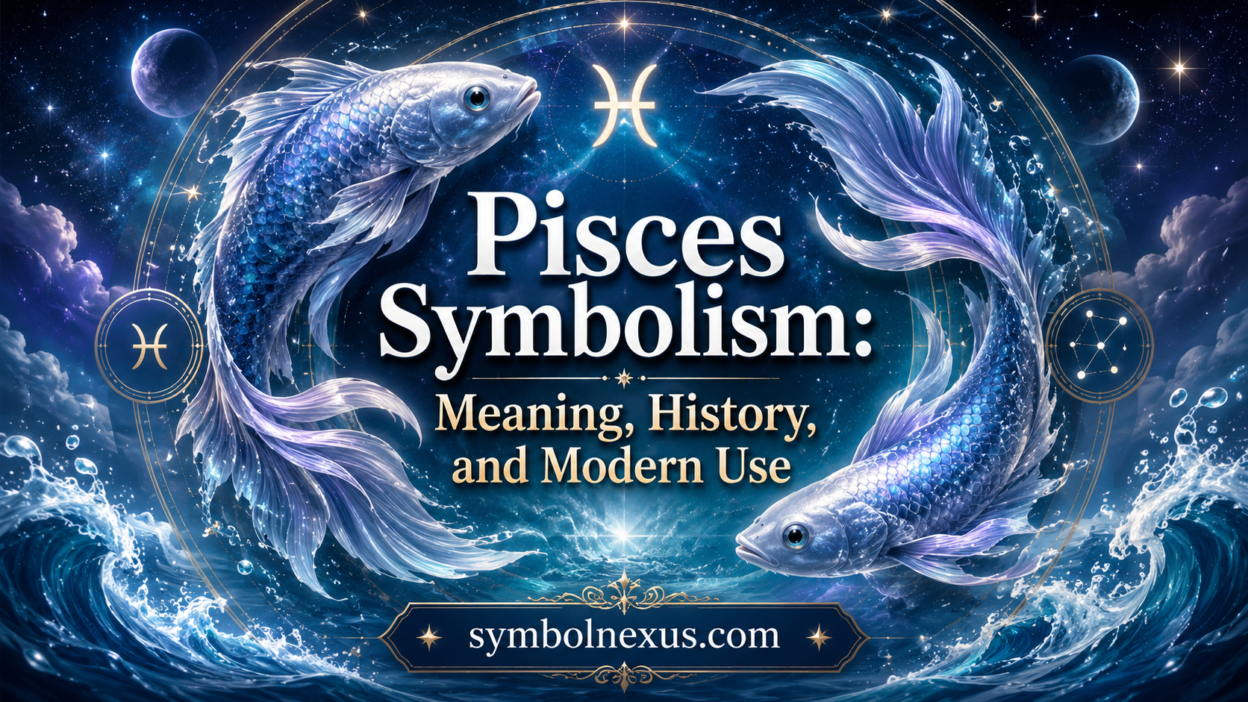
Pisces symbolism centers on two fish, usually shown connected while moving in different directions. In modern American astrology, the image is commonly associated with empathy, imagination, intuition, adaptability, emotional sensitivity, and the tension between inner experience and everyday reality.
Pisces is the twelfth and final sign in the Western zodiac. In tropical astrology, it generally covers birthdays from about February 19 through March 20. Its imagery has much older roots than modern horoscope culture, however, and versions of the paired fish have appeared across ancient Mediterranean, Middle Eastern, Islamic, and South Asian traditions.
Today, people may encounter Pisces on birth-chart apps, necklaces, tattoos, clothing, social media profiles, artwork, or zodiac-themed gifts. Some use it as an astrological identity, while others simply appreciate the two-fish design as a symbol of emotion, duality, movement, or connection.
Quick Answer
Pisces symbolism commonly represents intuition, compassion, imagination, emotional sensitivity, adaptability, and two competing directions within one person. Historically, its paired-fish image developed through older zodiac traditions and was later connected with classical myths, astrological systems, and artistic representations across several cultures.
TL;DR
- Two fish commonly represent duality, connection, and shifting direction.
- Water associations emphasize emotion, intuition, and receptiveness.
- Pisces is the final sign of the Western zodiac.
- Its imagery has ancient Near Eastern and classical roots.
- Americans often use it for identity, art, jewelry, and tattoos.
- Astrological personality claims should not be confused with scientific evidence.
What the Pisces Symbol Looks Like
The best-known Pisces emblem is the glyph ♓, made from two curved vertical shapes connected by a horizontal line. Visually, it suggests two fish or two bodies joined together.
In illustrated zodiac art, the sign is usually more literal: two fish appear side by side, head-to-tail, or oriented in opposing directions. Medieval European representations often showed a pair of fish aligned with their heads facing opposite ways. Other traditions altered their position, color, surroundings, and decorative details while keeping the essential two-fish identity.
The name Pisces itself is Latin for “fishes,” reflecting the fact that the sign is traditionally plural rather than a single fish.
That detail matters symbolically. One fish could suggest a single path. Two connected fish naturally invite ideas about relationship, contrast, movement, and the difficulty of separating one side of experience from another.
What Pisces Commonly Means in the United States
In contemporary American culture, Pisces is most often understood through Western astrology. People who identify with the sign commonly associate it with being compassionate, imaginative, artistic, emotionally perceptive, flexible, or highly responsive to other people.
The same symbolic vocabulary also has a more difficult side. Sensitivity may be interpreted as becoming overwhelmed. Imagination can become avoidance. Adaptability can turn into weak boundaries or uncertainty.
These ideas belong to astrological tradition and popular culture rather than scientifically established personality categories. That distinction allows the symbol to be discussed seriously without presenting horoscope traits as biological or psychological facts. Astronomy studies celestial objects through evidence and observation, whereas astrology assigns interpretive meaning to celestial positions.
| Context | Common U.S. Meaning | Typical Association | Important Note |
|---|---|---|---|
| Zodiac identity | Emotional awareness | Empathy, intuition | Based on astrological tradition |
| Two fish | Duality | Opposing impulses | Interpretations vary |
| Water imagery | Feeling and receptivity | Imagination, sensitivity | Symbolic rather than scientific |
| Tattoo or jewelry | Personal identity | Birth sign, connection | Meaning depends on wearer |
| Social media | Personality shorthand | Creativity, emotion | Often playful or simplified |
Why Two Fish Matter So Much
The pair of fish gives Pisces one of the zodiac’s clearest visual expressions of duality.
Modern interpretations often imagine one fish moving one way while the other pulls elsewhere. This can symbolize competing desires: withdrawal versus connection, realism versus imagination, independence versus attachment, or the internal world versus external responsibilities.
The connecting line or cord changes the image. The fish are not simply opposites; they remain part of one design. As a result, the symbol can communicate tension without complete separation.
That makes it useful beyond literal astrology. Someone may choose the paired fish to represent two sides of their personality, two important relationships, emotional complexity, or the need to remain connected while following different paths.
The interpretation should not become too rigid, though. Historical artists did not always arrange the fish in exactly the same direction, and there is no single ancient statement establishing every modern psychological interpretation.
Ancient Roots of the Zodiac Fish
Pisces did not begin with social media horoscopes or modern Western personality descriptions. The twelve-sign zodiac developed from much older astronomical and astrological traditions in Mesopotamia and was subsequently transmitted and transformed across the ancient Mediterranean world.
Late Babylonian records show an established twelve-sign zodiac and include Pisces among the signs associated with the calendar. Other surviving astronomical traditions distinguish components corresponding to the fish that later became part of the familiar constellation.
It is therefore safer to say that Pisces has Mesopotamian roots than to claim that every feature of today’s two-fish symbol came directly from one Babylonian picture or story.
As astronomical knowledge traveled, Greek and later Roman writers inherited celestial patterns from earlier traditions while attaching their own names, stories, and interpretations to them. This blending of observation, mythology, and cultural transmission helped produce the form of the zodiac that eventually became familiar in Europe and America.
The Greek Myth Behind the Two Fish
One well-known classical explanation connects Pisces with Aphrodite and Eros.
In versions of the story, the goddess and her son encounter the monstrous Typhon or Typhoeus. To escape danger, they either transform themselves into fish and enter the water or receive help from fish. The animals are then associated with the stars. Modern astronomical education still recounts the transformation story as one traditional explanation for the constellation.
Stories differ in their details, which is important when discussing ancient mythology. There was not necessarily one fixed narrative repeated identically by every writer or region.
Symbolically, however, the later myth strengthened ideas that fit the paired fish naturally: escape, preservation, close connection, and movement through a dangerous environment.
Modern readers sometimes turn those themes into personality claims, but the myth is better understood first as a traditional explanation for a celestial image.
Water, Adaptability, and the Final Zodiac Sign
In Western astrology, Pisces belongs to the water element, alongside Cancer and Scorpio. It is also classified as a mutable sign, a category traditionally associated with transition and adaptability.
Those classifications help explain much of its modern symbolic language.
Water frequently serves as a metaphor for feeling because it moves, surrounds, reflects, changes shape, and responds to its container. For Pisces, that imagery contributes to associations with emotional receptivity, imagination, compassion, and intuition.
Its mutable classification adds ideas such as flexibility, transition, responsiveness, and changing direction.
Pisces also occupies the twelfth and final position in the standard Western zodiac sequence. That placement has encouraged modern astrologers to describe it in terms of endings, release, completion, transition, or preparation for a new cycle beginning with Aries.
These are interpretations created within astrology, not measurable properties of the constellation itself.
Emotional and Psychological Associations
The emotional side of Pisces is one reason the symbol remains popular even among people who treat astrology casually.
Someone may use the sign to communicate, “I feel things intensely,” “I trust intuition,” or “I have a strong imaginative life.” In that setting, Pisces functions almost like a visual personality adjective.
Compassion is another common association. Because the sign is often described as receptive to the emotions of others, it can symbolize sympathy, gentleness, or the desire to help.
Yet that same imagery produces cautionary meanings. An extremely receptive person may struggle to separate other people’s emotions from their own. A vivid imagination may provide creativity but also become a place to retreat when reality feels unpleasant.
For that reason, one of the most useful contemporary interpretations is not simply “sensitive.” It is sensitivity that requires boundaries.
That idea gives the symbol more psychological nuance without claiming that everyone born during Pisces season shares the same personality.
Pisces in American Culture Today
Astrology occupies an unusual position in the United States: it can be a belief system, entertainment, identity language, aesthetic style, or some combination of those things.
A large national survey released in 2025 found that 28% of U.S. adults said they consulted astrology or a horoscope at least once or twice a year, while 27% said they believed astrology could affect people’s lives. The research also showed that many Americans who engage with astrology and related practices approach them primarily for fun rather than as a basis for major decisions.
American interest is not entirely new. Zodiac columns and horoscope culture became increasingly visible in newspapers and popular culture around the turn of the twentieth century, helping move astrology from specialized circles into everyday entertainment.
Today, the smartphone has replaced the newspaper horoscope for many users, but the underlying appeal is similar: zodiac signs provide compact stories through which people can discuss personality, relationships, moods, and identity.
Pisces in Tattoos and Body Art
Pisces tattoos can be highly literal or almost invisible to anyone unfamiliar with zodiac imagery.
The simplest version is the ♓ glyph. Its clean geometry works well for small tattoos on the wrist, ankle, finger, neck, shoulder, or behind the ear.
More elaborate designs use two realistic koi, decorative fish, constellations, waves, moons, stars, flowers, or circular compositions. Two fish forming a ring can emphasize continuity, balance, or an ongoing cycle.
For someone born under the sign, the tattoo may simply mark personal identity. For another person, two fish can represent a pair of loved ones, competing parts of the self, adaptation after change, or an emotional connection that survives separation.
A fish tattoo should not automatically be labeled Pisces, however. Fish carry many unrelated meanings in Christianity, Buddhism, East Asian art, maritime culture, family traditions, and other contexts. The surrounding imagery and the wearer’s own explanation matter.
Jewelry, Fashion, and Home Decor
Pisces also works well as decorative imagery because both its glyph and its fish motif are easy to stylize.
Zodiac necklaces frequently use the ♓ sign, the constellation pattern, or miniature fish. Rings and bracelets may incorporate birthstones or celestial imagery, while earrings can use mirrored fish to emphasize symmetry.
Fashion designs often lean toward water imagery: waves, blues and greens, pearls, shells, moons, stars, and fluid shapes. These additions are modern aesthetic choices rather than mandatory historical components of the sign.
In home decor, Pisces may appear on zodiac posters, constellation prints, candles, wall hangings, birth-chart art, or personalized gifts.
In these settings, the symbol often carries less emphasis on prediction and more on identity. A person may wear a Pisces pendant in much the same way someone else wears an initial, birth flower, or hometown symbol.
Pisces Across Islamic and South Asian Art
The two-fish image traveled far beyond classical European art.
In the medieval Islamic world, zodiac signs appeared on metalwork, manuscripts, ceramics, and other objects. Artists represented Pisces as two fish, drawing on zodiac iconography inherited and adapted from earlier Greek astronomical traditions. In some settings, zodiac designs were also linked with beliefs about celestial influence, protection, or royal authority.
South Asian astrology likewise recognizes a fish sign commonly called Mina or Meena. A surviving early nineteenth-century Indian painting, for example, portrays the sign as two large golden fish in a river scene and connects it with a much older astrological textual tradition.
These traditions should not be collapsed into a single universal interpretation. Similar imagery can survive across cultures while the religious, philosophical, artistic, and astrological ideas surrounding it differ considerably.
The shared pair of fish demonstrates transmission and adaptation, not proof that every society understood Pisces in exactly the same way.
Spiritual Interpretations of Pisces
Modern spiritual writers often connect Pisces with surrender, compassion, transcendence, dreams, intuition, or a sense of connection beyond the individual self.
Some of that language grows from the sign’s water symbolism. Water dissolves boundaries visually, so it lends itself easily to metaphors about emotional openness or losing the division between self and surroundings.
The sign’s position at the end of the zodiac also contributes to themes of release and completion.
However, these spiritual interpretations are not universal religious teachings. Christianity, Judaism, Islam, Hindu traditions, Buddhism, modern Pagan movements, and secular astrology do not assign one shared theological meaning to Pisces.
It is particularly important not to treat the fish of Pisces as automatically equivalent to the Christian fish symbol. Both involve fish imagery, but their histories and functions are different.
Digital Culture, Memes, and Zodiac Identity
Social media has made zodiac symbolism faster, funnier, and much more exaggerated.
A Pisces meme might describe someone crying over a movie, disappearing into a fantasy world, becoming attached too quickly, creating art at 2 a.m., or absorbing everyone else’s mood. These posts take recognizable astrological stereotypes and amplify them for humor.
That exaggeration can be entertaining, but it also flattens a complex symbol into a personality cartoon.
Digital zodiac culture often works because the categories are flexible enough for users to reinterpret themselves. Someone may reject “dreamy” but embrace “creative.” Another may identify strongly with compassion while ignoring the stereotype of emotional instability.
As a result, online Pisces identity is often participatory. People do not merely receive an ancient symbol; they continually remake its meaning through memes, profile bios, videos, artwork, fashion, and relationship discussions.
Common Misunderstandings About Pisces
One frequent mistake is assuming the zodiac sign and the astronomical constellation are exactly the same thing.
They are related historically, but modern tropical astrology divides the zodiac into twelve equal 30-degree sectors beginning from the March equinox. Astronomical constellations, by contrast, are actual designated regions of the sky with unequal sizes and boundaries. Because of Earth’s long-term axial precession, the astrological signs do not line up neatly with the constellations that originally contributed their names.
Another mistake is treating every commonly listed Pisces trait as ancient. Many modern personality descriptions developed through later astrological practice and popular culture.
It is also misleading to claim that Pisces proves someone is naturally artistic, emotionally unstable, psychic, compassionate, or compatible with particular partners. Such claims belong to astrological interpretation and are not established psychological conclusions.
Finally, two fish do not always symbolize conflict. Depending on the design and the person using it, they may communicate partnership, balance, continuity, family, adaptation, or simply zodiac identity.
How the Meaning Changed Over Time
The long history of Pisces shows how symbols accumulate rather than preserve one frozen meaning.
Its earliest background lies in ancient celestial observation and Near Eastern zodiac traditions. Greek and Roman culture added classical names and myths. Medieval European and Islamic artists preserved and reinterpreted the paired fish in manuscripts and decorative objects. South Asian astrological traditions developed their own frameworks around the fish sign.
Later, printed almanacs and newspaper horoscopes helped bring zodiac identity into everyday Western popular culture. American horoscope culture expanded during the twentieth century, while the internet and social platforms turned signs into highly personalized identity labels.
As a result, a Pisces image can now operate on several levels at once. It may represent an ancient constellation, an astrological birth sign, a family connection, an aesthetic preference, emotional self-description, or a humorous online identity.
The symbol survived not because its meaning stayed unchanged, but because two connected fish proved remarkably adaptable.
Frequently Asked Questions
What does the Pisces symbol represent?
The Pisces symbol represents two fish and is traditionally associated with the twelfth sign of the Western zodiac. Modern interpretations commonly connect the pair with emotional sensitivity, adaptability, intuition, duality, and different impulses existing within the same person.
Why are there two fish in Pisces?
The paired fish come from long-standing zodiac iconography and were later explained through classical myths involving fish, Aphrodite, and Eros. Modern astrology often interprets their contrasting directions as competing desires or the tension between imagination and practical reality.
What does a Pisces tattoo mean?
A Pisces tattoo often represents someone’s birth sign, but it can also express duality, emotional depth, connection, adaptation, or two important sides of a person’s life. The glyph ♓ is usually more explicitly astrological than an ordinary fish design.
Is Pisces a spiritual symbol?
It can be used spiritually, particularly in modern astrology, where it may represent compassion, intuition, release, dreams, or connection. Those meanings are interpretive rather than universal teachings shared by all religions.
Does Pisces symbolize two personalities?
Not literally. The two fish are often interpreted as duality or opposing tendencies, but they do not indicate a psychological condition or scientifically established split personality.
Is the Pisces zodiac sign the same as the Pisces constellation?
No. They share a historical connection and a name, but an astrological sign is a defined portion of the zodiac used within astrology, while the constellation is an astronomical region containing actual stars.
Is Pisces considered a positive or negative symbol?
Pisces is neither inherently positive nor negative. Its common associations have constructive sides—such as compassion, creativity, flexibility, and imagination—and cautionary sides, including escapism, uncertainty, emotional overwhelm, or weak boundaries.
Conclusion
Pisces symbolism is best understood through the image of two connected fish: separate enough to move differently, yet still joined within one design. That visual structure has allowed the sign to represent duality, emotion, adaptability, imagination, connection, and changing direction in modern culture.
Its story reaches far beyond contemporary horoscope descriptions. Ancient Near Eastern astronomy, classical mythology, medieval art, cross-cultural astrological traditions, newspaper horoscopes, and today’s digital culture have all contributed layers to the way people understand the sign.
For modern Americans, Pisces can be serious belief, personal identity, artistic shorthand, or simply a familiar zodiac image. Its enduring usefulness comes from the flexibility of the symbol itself: two figures moving through the same waters without having to mean exactly the same thing.


