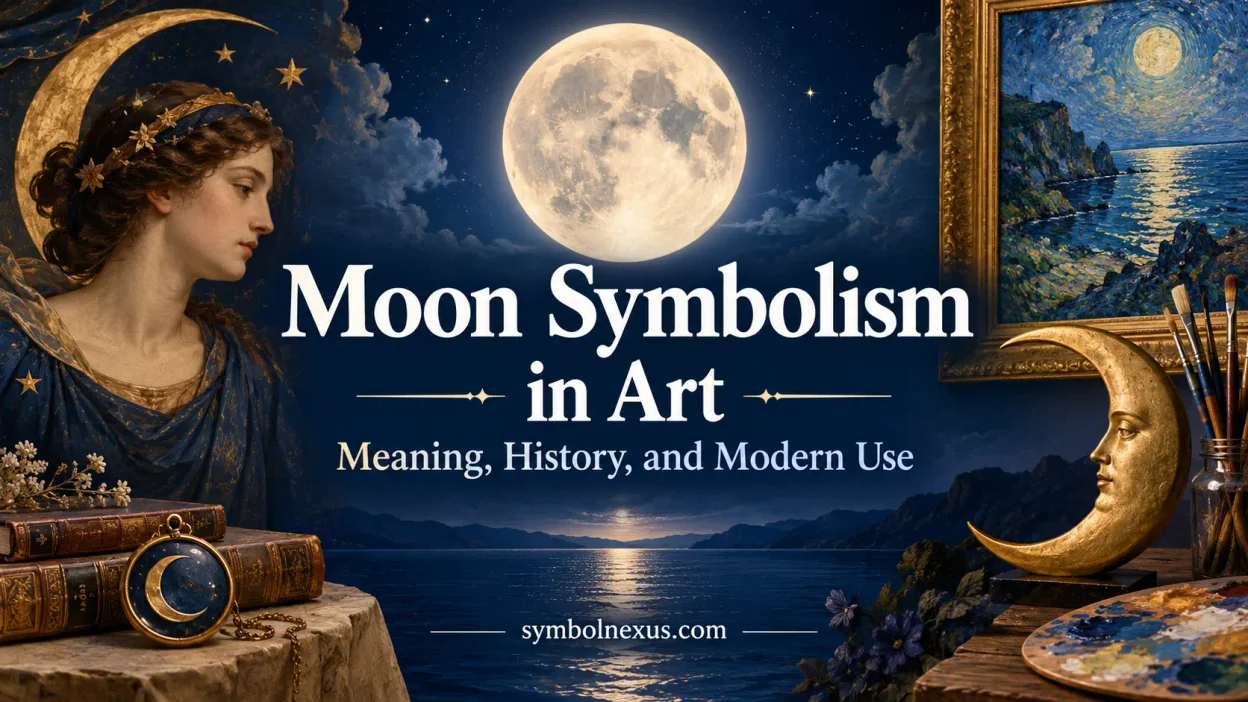
Moon symbolism in art often represents mystery, changing emotions, time, and the relationship between the natural world and human experience. Artists use the moon’s changing phases, pale light, and position in the sky to suggest feelings that may be difficult to express directly. A full moon over a quiet landscape, for example, can create a sense of peace, while a thin crescent above a lonely figure may suggest uncertainty or change.
The moon is especially important in American art because it connects landscape painting, romantic imagery, religious traditions, popular culture, and the history of space exploration. Artists have portrayed it as a source of beauty, a marker of time, a spiritual presence, and a distant destination beyond Earth.
Its meaning is not fixed. A moon can suggest hope in one painting and grief in another. To understand what it symbolizes, readers need to consider its phase, color, surroundings, historical setting, and relationship to the people or objects in the artwork.
Quick Answer
Moon symbolism in art commonly represents mystery, emotional reflection, romance, and change in modern American culture. Historically, artists have also used the moon to express religious belief, natural cycles, mortality, feminine associations, and humanity’s desire to understand the universe.
TL;DR
- The moon often represents change, reflection, romance, and the unknown.
- Romantic-era artists used moonlight to create emotional landscapes.
- Lunar phases can suggest beginnings, endings, growth, or renewal.
- American art connects moon imagery with nature, spirituality, and space exploration.
- Color, composition, and surrounding figures shape the moon’s meaning.
- Modern artists use lunar imagery to explore identity, memory, and isolation.
What the Moon Represents in Art
The moon offers artists a recognizable image with several possible meanings. Unlike the sun, which often appears as a source of direct light and energy, the moon reflects sunlight and illuminates the darkness indirectly. This visual difference makes it useful for expressing subtle emotions, hidden thoughts, and experiences that remain uncertain.
In many paintings, the moon represents the unknown. It may appear beyond a distant mountain, behind clouds, or above an empty sea. Its presence draws attention to what lies outside the viewer’s immediate understanding.
The moon can also represent reflection. Its light encourages viewers to slow down and consider a scene rather than simply observe its action. A quiet moonlit landscape may communicate solitude, longing, or acceptance without showing a character expressing those feelings.
Other common meanings include:
- Change: The moon’s phases show that appearances do not remain constant.
- Romance: Moonlight often provides a setting for intimacy and longing.
- Time: The lunar cycle offers a visible way to mark passing days and months.
- Spirituality: The moon may connect earthly life with a larger cosmic order.
- Mortality: Its movement through darkness can suggest endings, loss, and renewal.
These meanings overlap, but they are not interchangeable. The moon’s role in the composition helps determine which interpretation makes the most sense.
Ancient Roots and Early Lunar Imagery
Long before modern painting, people represented the moon through carved objects, religious images, calendars, and decorative patterns. Lunar imagery appeared in cultures that observed the sky to track seasons, organize agricultural activity, and mark important communal events.
In ancient Greek and Roman traditions, the moon was associated with divine figures, including Artemis and Diana. Artists could therefore use lunar imagery to evoke a deity, sacred protection, hunting, or the natural world. Other ancient traditions connected lunar cycles with timekeeping and the rhythms of life.
These associations were never identical across cultures. Some traditions linked the moon with female deities, while others represented lunar figures as male or understood the moon through different spiritual relationships. The moon’s changing appearance encouraged varied explanations of its role in the cosmos.
Early lunar imagery also had practical functions. Calendars and astronomical diagrams represented the moon’s movement, while religious art sometimes placed the moon alongside the sun to indicate cosmic order or the scope of creation.
As artistic traditions developed, the moon became more than an astronomical object. It could identify a divine presence, establish a sacred setting, or make an image feel connected to forces larger than the human world.
The Moon in Medieval and Religious Art
In medieval European religious art, the sun and moon sometimes appeared in scenes involving Christ, the Virgin Mary, or major biblical events. Their presence could suggest the heavens witnessing an event, the order of creation, or the cosmic importance of the subject.
The moon also appeared in images of the Crucifixion. Depending on the work and tradition, its placement could contribute to a sense of mourning, supernatural disturbance, or the scale of the event. These interpretations depend on the specific image rather than a universal rule that the moon always represents sadness or evil.
Religious paintings could also use the moon to establish nighttime settings for prayer, visions, or spiritual encounters. Its reflected light offered a visual way to suggest illumination without depicting ordinary daylight.
In contemporary viewing, it is easy to interpret every moon as a symbol of intuition or personal transformation. That approach can overlook the original religious context. When the moon appears in an older sacred image, its meaning may depend more on the surrounding figures, biblical narrative, and artistic conventions than on modern ideas about lunar energy.
Romanticism and the Moonlit Landscape
The Romantic movement of the late eighteenth and nineteenth centuries helped establish the moon as a major subject in European landscape art. Romantic artists often explored nature as a setting for awe, longing, solitude, and reflection. Moonlight was especially useful because it changed familiar landscapes into scenes that felt emotionally charged.
German painter Caspar David Friedrich frequently used moonlit landscapes to place human figures within a vast natural world. In works showing people contemplating the moon, the figures often appear small compared with the surrounding landscape. This contrast encourages viewers to consider solitude, friendship, spiritual questions, and humanity’s place in nature.
The moon does not necessarily provide an answer in these paintings. Instead, it creates space for contemplation. The viewer sees people looking toward something distant, but their thoughts remain unknown.
This approach influenced how later audiences understood moonlit art. A landscape under a full moon could become a portrait of a state of mind rather than simply a record of a place. The natural setting carries emotional meaning through light, scale, and atmosphere.
Romantic moon imagery continues to shape modern film posters, book covers, photography, and decorative art. Artists still use moonlight to suggest that a familiar location contains something beyond ordinary experience.
Moon Symbolism in American Art
American artists developed their own approaches to lunar imagery, particularly through landscape painting. During the nineteenth century, painters associated with the Hudson River School and related traditions explored dramatic scenery, wilderness, and the relationship between people and the natural world.
Moonlight gave these artists a way to transform rivers, mountains, forests, and coastal settings into scenes of quiet grandeur. Rather than merely showing a landscape after sunset, they could use light and darkness to create an emotional response.
Thomas Cole and other landscape painters worked within a period when nature could be understood as beautiful, spiritually significant, and central to national identity. In such paintings, the moon might encourage contemplation of wilderness or the limits of human control over the natural world.
Later American artists moved beyond realistic landscapes. Arthur Dove’s 1935 painting Moon, for instance, simplifies lunar imagery into abstract forms and unusual colors. The moon becomes part of an experiment in shape, atmosphere, and the artist’s experience of nature rather than a straightforward celestial portrait.
American moon imagery also changed after the development of spaceflight. The lunar landing of 1969 gave the moon a more direct connection to technology, scientific achievement, and exploration. Artists could now represent it not only as a distant source of wonder but also as a destination people had reached.
This history shows why the moon has no single American meaning. It can stand for wilderness, personal reflection, national achievement, scientific curiosity, or the desire to move beyond familiar boundaries.
What Different Moon Phases Symbolize in Art
Artists sometimes use lunar phases to suggest different stages of an experience. These interpretations are common visual associations, not fixed rules that every painting follows.
| Moon phase or form | Common artistic association | How context changes the meaning |
|---|---|---|
| New moon | Hidden potential, absence, or a fresh beginning | Darkness may suggest privacy, danger, or rest |
| Crescent moon | Growth, transition, or anticipation | It may also identify a specific religious or mythological tradition |
| Half moon | Balance, division, or a turning point | Shadows can create tension or visual symmetry |
| Full moon | Completion, visibility, romance, or heightened emotion | It may suggest celebration, unease, or supernatural activity |
| Eclipsed moon | Disruption, uncertainty, or a change in order | In historical works, it may refer to a particular event or belief |
A crescent moon often appeals to artists because its incomplete shape suggests something still developing. It may appear beside a young character, a new landscape, or an object associated with hope. However, a crescent can also carry a specific religious meaning, so its interpretation should account for the artwork’s cultural setting.
The full moon offers a different visual effect. Its circular shape is easy to recognize, and its light can reveal details that darkness would otherwise conceal. This visibility may suggest clarity or completion, but it can also expose a character to danger or make an ordinary scene feel unsettling.
An eclipse changes the expected appearance of the moon. In an artwork, it may suggest a disturbance in the natural order, although the artist might simply be depicting an astronomical event. The surrounding details determine whether a symbolic reading is justified.
Light, Shadow, and the Emotional Meaning of Moonlight
Moonlight changes the way viewers read a scene. It creates strong contrasts, soft edges, elongated shadows, and areas of partial visibility. These effects can influence the mood before the viewer identifies any symbolic subject.
Soft silver light may create calm, tenderness, or distance. A moon obscured by clouds may suggest uncertainty or emotional restraint. A bright moon surrounded by deep darkness can make the landscape feel exposed, as if a character has become visible at a vulnerable moment.
Artists also control where the viewer looks. A moon placed near the center of the composition can become the main subject. A small moon near the edge may suggest distance or emphasize the size of the surrounding landscape.
Color matters, too. A white or pale blue moon may create a cool, quiet atmosphere, while a yellow or orange moon can suggest warmth, haze, or an unusual natural condition. Red lunar imagery may evoke danger or intensity, but it can also reflect an eclipse, atmospheric effects, or deliberate artistic choices.
Moonlight therefore works on two levels. It contributes to the physical appearance of the scene, and it shapes the viewer’s emotional response. Its symbolic meaning emerges from the interaction between those functions.
Romance, Longing, and Human Connection
The moon frequently appears in art about love because it creates a shared setting for private emotions. Two people beneath the same moon may seem connected even when they stand far apart. A moon visible through a window can suggest that someone is remembering a distant partner or imagining a meeting that has not yet happened.
Moonlight also allows artists to suggest intimacy without showing a direct embrace. A quiet night scene, a figure looking out over the water, or a pair of silhouettes beneath a pale sky can communicate longing through distance and atmosphere.
In American popular culture, this association appears in romantic illustrations, wedding decorations, jewelry, music imagery, and photographs. A crescent or full moon can signal affection while remaining less literal than a heart.
However, moonlight does not always represent happy love. It can accompany separation, jealousy, grief, or a relationship that exists only in memory. A solitary figure looking at the moon may be seeking comfort rather than celebrating romance.
The strongest interpretation comes from the relationship between the figures and the scene. If two characters face each other, the moon may frame their connection. If one figure stands alone, it may emphasize the distance between desire and reality.
The Moon as a Symbol of Time and Transformation
The moon changes shape in a predictable cycle, making it a natural image for change and the passage of time. Artists can use this cycle to suggest that experiences develop through stages rather than remaining fixed.
A sequence of lunar phases may represent growth, decline, renewal, or the movement from uncertainty toward understanding. In a narrative painting or illustration, the moon can also establish the passage of time without requiring a clock or written explanation.
The lunar cycle is especially useful in works about personal change. A crescent might accompany a beginning, while a full moon could mark a moment of visibility or recognition. A waning moon might suggest retreat, reflection, or an ending. These are interpretive possibilities rather than universal definitions.
The moon can also connect individual experience with natural rhythms. A person may age, lose a relationship, or begin again while the moon continues its cycle. That contrast can make human change feel temporary within a larger world.
This symbolism remains common in contemporary art, including illustrations about healing, life transitions, and self-discovery. The moon provides a visual structure for change without implying that every ending leads automatically to a better beginning.
Spirituality, the Feminine, and the Unseen
Many artistic traditions connect the moon with spiritual experience, divine figures, or aspects of life that cannot be understood through ordinary observation. Its changing face and reflected light make it suitable for expressing uncertainty, contemplation, and the relationship between the visible world and unseen forces.
Some Western artistic traditions associate the moon with feminine figures, fertility, or goddesses such as Artemis and Diana. These associations appear in mythology-inspired paintings, sculpture, and decorative imagery. They are historically important, but they should not be treated as a universal connection between the moon and women.
Other traditions use lunar imagery differently. The moon may be associated with a male deity, a sacred calendar, a story about animals, or a religious practice. The same crescent shape can carry distinct meanings depending on whether it appears in a mythological scene, a religious setting, or a contemporary decorative design.
In modern art, the moon can represent intuition or an inward-looking state of mind. An artist might use it to suggest a character’s private thoughts or a sense of connection to something larger than the self.
Still, a spiritual interpretation should be grounded in the artwork. A moon in a night landscape may simply establish time and lighting. It becomes a stronger spiritual symbol when other visual details or the artist’s stated intentions support that reading.
The Moon and Mortality in Art
The moon’s appearance in darkness can make it an effective symbol of death, grief, and the limits of human life. In some artworks, its pale light creates an atmosphere of mourning. In others, it continues to shine over a ruined building, an empty field, or a deserted road, emphasizing the contrast between a lasting natural world and temporary human existence.
The moon can also represent renewal in works concerned with death. Because it appears to disappear and return, it may suggest continuity after loss or the possibility of a new stage. This does not mean that the moon always promises an afterlife or rebirth; such meanings depend on the cultural and religious context.
Artists sometimes combine the moon with bare trees, tombstones, decaying structures, or solitary figures. These details guide the viewer toward themes of mortality. A full moon alone, however, is not sufficient evidence that a painting concerns death.
The moon’s ability to support both loss and renewal makes it especially useful in art that explores grief. It can hold two ideas at once: a particular life or relationship has ended, while time and the natural world continue.
Cross-Cultural Meanings of the Moon in Art
Moon imagery appears in many cultures, but its meanings vary according to religious traditions, folklore, artistic conventions, and local stories.
In Japanese visual culture, lunar scenes have often appeared in poetry-inspired imagery, seasonal subjects, and stories involving figures such as the moon rabbit. The moon may evoke beauty, distance, seasonal change, or a familiar tale rather than a general symbol of mystery.
In Chinese traditions, lunar imagery can be connected with the Mid-Autumn Festival, family reunion, and stories associated with Chang’e. In this setting, the moon may suggest separation and reunion at the same time, especially when family members celebrate while apart.
In Islamic art and cultural settings, the crescent may be associated with religious identity in some contexts, but it is not a universal symbol used identically by every Muslim community. Its presence in a modern artwork may signal a specific cultural or national reference rather than an abstract idea about the moon.
Indigenous peoples of the Americas have distinct lunar traditions, stories, and ceremonial calendars. These should not be reduced to one generalized “Native American meaning.” Artists working with specific Indigenous traditions may use lunar imagery in ways that depend on community knowledge and cultural context.
Comparing these traditions helps explain why the moon cannot be assigned one universal meaning. A thoughtful interpretation asks which story, practice, or visual tradition the artist is drawing upon.
How Modern Artists Use Moon Imagery
Contemporary artists use the moon in painting, photography, digital illustration, sculpture, film, and graphic design. Some aim for scientific accuracy, while others distort its scale, color, or position to communicate an idea.
In photography, the moon may create a focal point above a city skyline or natural landscape. A tiny moon over a large building can emphasize scale, while a close-up lunar image can draw attention to texture and surface. A moon reflected in water can introduce symmetry or suggest a connection between the sky and the earth.
Digital artists often combine the moon with surreal landscapes, floating figures, oversized plants, or impossible architecture. These scenes use the moon as a familiar reference point in a world that otherwise breaks ordinary expectations.
Film and book illustrations frequently use a large moon to signal fantasy, suspense, romance, or an approaching change. This convention is effective because viewers recognize the moon immediately, even when its exact meaning depends on the story.
Modern lunar art also reflects space exploration. The moon can symbolize scientific ambition, collective achievement, or the tension between technological progress and the environment. In this context, it is both an artistic image and a real destination shaped by human activity.
Why the Moon Appears in Tattoos, Jewelry, and Home Decor
Outside galleries, the moon is a popular motif because it is visually simple and adaptable. Its circular shape, crescent outline, and recognizable phases work well in small designs and larger decorative pieces.
A moon tattoo may express personal change, a connection to nature, a meaningful life stage, or an interest in astronomy. Some people pair it with stars, flowers, waves, or animals to give the design a personal narrative. The image alone cannot establish what the wearer believes or has experienced.
Moon jewelry often uses the crescent because it fits neatly into pendants, earrings, and delicate patterns. Depending on the wearer and design, it may suggest femininity, spirituality, romance, or simply an appreciation for celestial imagery.
In home decor, moon prints and moon-phase displays can create a calm nighttime atmosphere. A large full moon may serve as a dramatic focal point, while a sequence of phases can suggest rhythm and change. These choices may be aesthetic rather than spiritual.
Social media has also encouraged highly stylized moon imagery, including moon-phase graphics, celestial collages, and personalized illustrations. Such images can communicate mood or identity, but they do not carry a single agreed-upon interpretation.
Common Misunderstandings About Moon Symbolism
One common mistake is assuming that every moon in art represents femininity, intuition, or supernatural power. Those associations exist in particular traditions, but many artists use the moon for reasons involving light, composition, astronomy, or landscape.
Another mistake is treating the full moon as inherently sinister. Popular horror imagery has linked full moons with werewolves and other supernatural events, but the full moon also appears in peaceful landscapes, romantic scenes, celebrations, and religious imagery. Its emotional effect depends on the context.
A third misunderstanding is assuming that a symbol’s meaning stays unchanged across cultures. A crescent moon in a mythological painting, a religious design, and a modern tattoo may refer to entirely different ideas.
Viewers can also overinterpret color. A red moon may seem ominous, but the color could represent an actual lunar eclipse, atmospheric conditions, or a deliberate visual choice. Without supporting details, it is better not to assign a definite meaning.
Finally, not every artistic decision is symbolic. Sometimes an artist includes the moon because it is part of the landscape or because its light creates a compelling composition. A strong interpretation considers symbolism without assuming that every detail hides a coded message.
How to Interpret the Moon in a Painting
Start by observing the moon’s physical appearance. Is it full, crescent-shaped, partly hidden, unusually colored, or reflected in water? These details provide the first clues, but they do not settle the meaning on their own.
Next, look at the rest of the composition. A moon above two figures may support a reading about companionship or romance. The same moon above an empty road could suggest loneliness, travel, or uncertainty. A moon beside a religious figure may carry a more specific spiritual meaning.
Consider the light and atmosphere. Soft light and open space may create calm, while sharp contrasts and heavy shadows can increase tension. Pay attention to where the moon directs your eye and whether it dominates the scene or remains distant.
The historical setting also matters. A nineteenth-century Romantic landscape may use the moon to encourage contemplation of nature, while a modern space-themed artwork may focus on exploration or technology. Cultural symbols should be interpreted within their own traditions rather than assigned a single global meaning.
Finally, distinguish what the artwork shows from what you personally feel. Your response can be meaningful, but it is not automatically the artist’s intention. The most convincing interpretation connects visual evidence, historical context, and emotional response without claiming more certainty than the artwork allows.
Frequently Asked Questions
What does the moon symbolize in art?
The moon commonly represents change, reflection, romance, mystery, and the passage of time. Its meaning depends on the artwork’s cultural background, composition, and surrounding imagery.
Why do artists use the full moon in paintings?
A full moon provides a clear focal point and illuminates nighttime scenes. Artists may use it to suggest visibility, completion, romance, tension, or supernatural activity, depending on the setting.
What does a crescent moon mean in art?
A crescent can suggest transition, growth, anticipation, or an incomplete stage of life. In religious and cultural artwork, it may also carry a specific meaning tied to the tradition being represented.
Does the moon always symbolize femininity?
No. Some mythological and artistic traditions connect the moon with female deities or feminine qualities, while others associate it with male figures or different concepts. The artwork’s context determines whether a feminine interpretation is appropriate.
What does a moonlit landscape symbolize?
A moonlit landscape often encourages reflection on nature, solitude, distance, or the unknown. Romantic-era artists used moonlight to create emotional atmosphere, but a particular scene may also emphasize place, weather, or visual contrast.
What does the moon symbolize in modern American art?
Modern American art uses the moon to explore nature, personal emotion, abstraction, cultural identity, and space exploration. Its meaning ranges from private reflection to collective interest in scientific discovery.
Is the moon a positive or negative symbol in art?
The moon can suggest comfort, hope, love, and renewal, or it can contribute to images of grief, uncertainty, and danger. Neither interpretation is universal; the surrounding scene determines the tone.
Conclusion
Moon symbolism in art draws on the moon’s changing phases, reflected light, and place in human culture. Artists use it to explore romance, time, spirituality, solitude, mortality, and the relationship between people and the natural world. Its meaning can shift from one painting to another, even when the moon looks almost identical.
In American art, the moon has moved from Romantic landscapes and atmospheric night scenes to abstraction, popular imagery, and representations of space exploration. Across these forms, the most reliable interpretation comes from looking closely at the artwork itself. The moon may illuminate the scene, but its symbolism becomes clear only when its light, setting, and surrounding details are considered together.