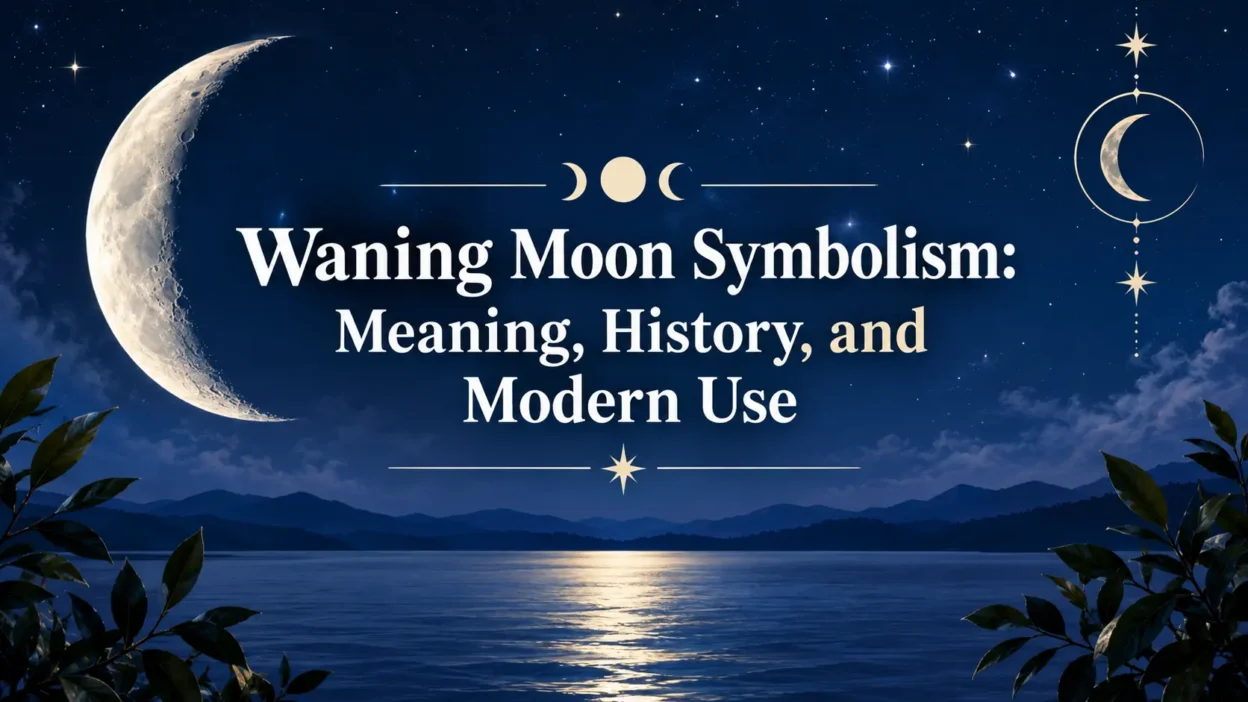
The waning moon is the phase in which the illuminated portion of the Moon appears to shrink after the full moon. In modern American culture, waning moon symbolism commonly relates to release, reflection, rest, completion, and letting go.
People notice the waning moon in calendars, night-sky photography, astrology, spiritual practices, tattoos, jewelry, and decorative art. Its appearance naturally invites questions about endings and transitions because the visible light decreases night by night.
The symbolism is not fixed to one tradition. Different cultures have connected lunar cycles with agriculture, timekeeping, religious observances, fertility, mortality, renewal, and personal reflection. Today, Americans often interpret the waning moon through a mixture of traditional lunar imagery, popular spirituality, personal symbolism, and everyday appreciation of the night sky.
Quick Answer
Waning moon symbolism commonly represents release, reflection, rest, completion, and letting go in modern American culture. Historically, declining lunar light was connected with changing cycles of time, seasonal practices, religious observances, and ideas about endings before renewal.
TL;DR
- The waning moon often represents release, closure, and reflection.
- Its shrinking light naturally suggests completion and transition.
- Ancient societies used lunar phases to organize calendars and rituals.
- Americans often associate it with rest, self-reflection, and personal change.
- Tattoos and jewelry use it to express growth through letting go.
- Its meaning varies across cultures, religions, and individual beliefs.
What Is the Waning Moon?
The waning moon refers to the part of the lunar cycle after the full moon and before the next new moon. During this period, the Moon still reflects sunlight, but the portion visible from Earth becomes progressively smaller.
From the Northern Hemisphere in the United States, the waning moon typically appears as a bright disk becoming increasingly less illuminated. The exact appearance depends on whether the Moon is in its waning gibbous or waning crescent phase.
The word waning itself means decreasing or becoming less. That linguistic association contributes significantly to the symbolism. Unlike the full moon, which visually suggests abundance and fullness, the waning moon presents a gradual reduction.
This makes it an especially natural image for endings, simplification, and transition.
What the Waning Moon Commonly Means in the United States
In contemporary American culture, the waning moon is most often interpreted as a symbol of letting go. People may use it to represent releasing an old habit, moving beyond a difficult period, finishing a chapter, or making room for something new.
Another common association is rest. Because the Moon is moving away from its brightest phase, the waning period can serve as a visual reminder that not every stage of life requires outward activity or visible progress.
For some people, it represents reflection rather than action. The symbolism fits moments when someone wants to review what happened, decide what should remain, and leave unnecessary commitments behind.
These interpretations are especially common in modern wellness, journaling, astrology, spiritual communities, and personal design.
Ancient Roots and Early Lunar Symbolism
The symbolism of the waning moon cannot be traced to one single ancient civilization. Lunar phases were visible everywhere people observed the night sky, so societies developed different ways of understanding them.
Ancient cultures frequently used the Moon as a practical method of tracking time. A lunar month offered a recurring pattern that could help organize religious observances, agricultural activities, and civic calendars.
The changing Moon also encouraged symbolic comparisons with human life. A brightening Moon could suggest growth or emergence, while a diminishing Moon could correspond to decline, completion, or preparation for another cycle.
That does not mean every ancient culture specifically believed that a waning moon represented “letting go” in the modern psychological sense. Contemporary interpretations often build on older observations while giving them new personal meanings.
The Moon as a Symbol of Cycles and Change
One of the strongest reasons the waning moon carries symbolic meaning is its position within a repeating cycle.
The Moon does not simply disappear after becoming smaller. It eventually reaches the new moon and begins appearing larger again. This creates a useful symbolic pattern:
fullness → decline → darkness → renewal
For many modern readers, that sequence represents a broader truth about change. Periods of completion do not necessarily mean permanent loss. They can be part of a continuing process.
This is why the waning moon can have a positive meaning without representing happiness or success. Its message is often about accepting a necessary transition rather than trying to maintain a previous state indefinitely.
Waning Moon Symbolism in American Culture
The United States does not have one standardized cultural interpretation of lunar phases. Instead, several traditions overlap.
Popular astrology has helped make lunar phases familiar to a broad American audience, while contemporary spiritual practices often assign different intentions to different phases. Artists and designers also use lunar imagery because its shape communicates ideas without requiring a specific religious belief.
The waning moon can therefore appear in very different settings:
- Journals and planners
- Meditation and wellness materials
- Jewelry
- Tattoos
- Home decor
- Poetry and fiction
- Photography
- Social media graphics
- Astrology content
- Nature-inspired fashion
In these contexts, the symbol usually communicates transition, introspection, or an appreciation for natural cycles rather than a formal religious doctrine.
Waning Moon Meaning in Astrology
Astrology gives lunar phases an interpretive framework that differs from astronomy. In popular astrology, the waning period is often associated with reviewing experiences, reducing excess, releasing attachments, and preparing for a new cycle.
The exact interpretation varies among astrological traditions. Some divide the waning period into additional stages and assign different themes to each one.
It is important to distinguish this symbolic framework from scientific claims. Astronomy describes the waning moon as a predictable change in the Moon’s illuminated appearance caused by its position relative to Earth and the Sun. Astrology gives that astronomical cycle personal or psychological interpretations.
For people who use astrology as a reflective practice, the waning moon may function as a prompt for examining priorities rather than as a scientifically established influence on behavior.
Emotional and Psychological Associations
The waning moon can evoke a quieter emotional atmosphere than the full moon.
Its decreasing light may suggest:
- Acceptance
- Solitude
- Reflection
- Closure
- Relief
- Patience
- Simplification
- Emotional processing
- Rest
- Preparation
The symbolism can be particularly meaningful during periods of transition. Someone ending a relationship, leaving a job, changing priorities, or recovering from an exhausting period might identify with the image of something gradually becoming smaller without completely disappearing.
There is also an important distinction between loss and release. Loss implies something has been taken away, while release suggests a deliberate decision to stop carrying something. Modern symbolic interpretations frequently favor the second idea.
Religious and Spiritual Interpretations
Lunar symbolism appears in numerous religious and spiritual traditions, but the meaning of a waning moon depends heavily on context.
In Islam, lunar observation has an important role in determining the timing of months and religious occasions. The Islamic calendar is lunar, making the changing Moon relevant to religious timekeeping. However, this should not be confused with the modern practice of assigning psychological meanings to individual lunar phases.
In some contemporary spiritual communities, the waning moon is associated with purification, reflection, or releasing unwanted patterns. These interpretations are modern spiritual frameworks rather than universal religious teachings.
Other traditions have used lunar cycles in calendars, festivals, agriculture, or ritual timing without treating the waning phase as a symbol of personal emotional release.
The safest interpretation is therefore contextual: the Moon has broad religious importance, but specific meanings for its waning phase differ considerably.
Waning Moon Meaning Across Different Cultures
Lunar symbolism is widespread, but there is no single cross-cultural definition of the waning moon.
In ancient Mesopotamia, Egypt, Greece, Rome, China, Mesoamerica, and many other societies, lunar cycles played important roles in calendars and cultural life. However, the specific symbolism attached to lunar phases varied according to local beliefs.
Some traditions connected lunar change with deities, fertility, agriculture, or time. Others focused more on celestial observation and calendar systems.
Modern online discussions sometimes combine elements from unrelated traditions and present them as one ancient belief. Such claims should be treated cautiously. A symbolic meaning may be genuinely useful today without needing an invented ancient origin story.
What the Waning Moon Represents in Personal Growth
The waning moon can represent a stage of personal development in which the goal is subtraction rather than addition.
Someone may use the image when deciding to:
- Stop an unhealthy routine
- Declutter a home
- End an unproductive commitment
- Forgive and move forward
- Leave behind an outdated identity
- Review a difficult experience
- Create more personal space
This symbolism differs from the common cultural emphasis on constant improvement. Instead of asking, “What should I achieve next?” the waning moon encourages a different question: “What no longer needs to come with me?”
That distinction makes the symbol useful for people who view growth as a process of editing as well as building.
Why the Waning Moon Appears in Tattoos and Jewelry
Lunar imagery works well in tattoos and jewelry because it is visually recognizable and open to personal interpretation.
A waning crescent can represent a particular period in someone’s life, while a sequence of lunar phases can represent continuous change. Some people pair the Moon with stars, flowers, mountains, water, or botanical designs to create a more individualized meaning.
Common interpretations include:
- Moving forward after an ending
- Accepting change
- Remembering a past chapter
- Choosing simplicity
- Finding peace in solitude
- Trusting a natural cycle
A waning moon tattoo does not automatically indicate a specific spiritual belief. For many Americans, it is simply a personal symbol of change or an aesthetic connection with the night sky.
Waning Moon Symbolism in Art, Decor, and Digital Culture
The waning moon has become a familiar visual motif in modern design.
In home decor, it can create a nocturnal, reflective atmosphere. In illustration and photography, the reduced illumination provides a strong contrast with a dark sky. In digital culture, moon graphics frequently accompany posts about journaling, self-care, reflection, astrology, or personal transitions.
The symbol also works particularly well in minimalist designs. A thin crescent requires very little visual space while still communicating a recognizable lunar idea.
Its meaning changes with surrounding imagery. A waning moon beside wilted flowers may suggest endings, while the same moon beside new leaves may emphasize renewal and continuity.
| Context | Meaning in the USA | Common Associations | Notes |
|---|---|---|---|
| Personal reflection | Letting go | Closure, review, acceptance | Common in journaling and wellness |
| Tattoos | Life transition | Change, memory, new chapters | Meaning is highly personal |
| Astrology | Release and evaluation | Cycles, rest, preparation | Interpretive rather than scientific |
| Home decor | Quietness | Night, nature, calm | Often primarily aesthetic |
| Religious context | Lunar timekeeping | Calendar, observance, cycles | Meaning depends on tradition |
Positive and Negative Meanings of the Waning Moon
A waning moon can appear negative because its visible light is decreasing. Words such as decline, ending, and disappearance may initially suggest loss.
Yet the symbolism is often more balanced.
Positive interpretations include:
- Letting go
- Emotional maturity
- Rest
- Closure
- Simplification
- Acceptance
- Preparation
More difficult interpretations include:
- Decline
- Separation
- Loneliness
- Aging
- Loss
- Uncertainty
The surrounding context usually determines which interpretation is intended. A memorial design might use the waning moon to represent absence, while a wellness journal might use it to symbolize releasing unnecessary stress.
Common Misunderstandings About the Waning Moon
One common misconception is that the waning moon has one universally accepted symbolic meaning. It does not.
Another is the claim that every ancient culture associated the waning moon with the same process of “release.” Historical lunar traditions were much more diverse than many modern summaries suggest.
It is also easy to confuse astronomical and astrological interpretations. Astronomy explains the physical lunar phase. Astrology and spiritual practices may attach personal or symbolic meanings to that phase, but those meanings are interpretive.
Finally, a waning moon should not automatically be described as a symbol of bad luck. Although some folklore has treated particular lunar periods cautiously, there is no universal rule that a waning moon represents misfortune.
How the Meaning Has Evolved Over Time
The symbolism of the waning moon has shifted from primarily collective observation toward increasingly personal interpretation.
For early societies, lunar phases were closely connected with practical timekeeping and communal calendars. Religious and agricultural practices could depend on knowing where the Moon was in its cycle.
In modern America, the Moon remains visible as a natural calendar marker, but its symbolic role has expanded. It now appears in personal branding, tattoos, wellness culture, art, astrology, and social media.
The modern meaning of “release” is particularly notable. It reflects contemporary interest in self-reflection and intentional change. Instead of treating the waning Moon simply as a stage of celestial decline, many people reinterpret it as a useful metaphor for deciding what to leave behind.
How to Interpret a Waning Moon for Yourself
There is no requirement to adopt a particular spiritual interpretation.
If the waning moon catches your attention, consider what its visual pattern suggests in your own circumstances. You might see it as a reminder to finish something, reduce unnecessary commitments, reflect on a recent experience, or simply appreciate the changing night sky.
The most useful personal symbolism usually comes from the context surrounding the image. A moon on a memorial necklace, for example, may carry a very different meaning from one chosen for bedroom decor.
Rather than asking what the waning moon is supposed to mean, it can be more productive to ask what its gradual change represents in your own life.
Frequently Asked Questions
What does a waning moon symbolize?
A waning moon commonly symbolizes release, reflection, completion, rest, and transition. In modern American symbolism, it often represents the process of letting go before beginning something new.
Is the waning moon a positive symbol?
Yes. Although its decreasing light can suggest decline or loss, it is frequently interpreted positively as closure, simplification, acceptance, and emotional rest. The intended meaning depends on the surrounding context.
What does a waning moon tattoo mean?
A waning moon tattoo can represent moving beyond an old chapter, accepting change, or releasing something from the past. Some people choose it simply because they appreciate lunar imagery and its connection with natural cycles.
What does the waning moon mean spiritually?
In contemporary spiritual practices, the waning moon is often associated with reflection, release, cleansing, and preparation. These interpretations vary by tradition and should not be treated as universal religious teachings.
Does the waning moon symbolize death?
It can symbolize endings, mortality, or absence in some artistic and cultural contexts, but it does not universally represent death. More commonly today, people use it as a metaphor for closure or transition.
Is the waning moon associated with bad luck?
Not universally. Some folklore gives particular lunar periods negative associations, but the idea that a waning moon automatically brings bad luck is not a general cultural rule.
What is the difference between a waning and waxing moon symbolically?
A waxing moon is commonly associated with growth, development, and increasing momentum, while a waning moon is associated with reduction, reflection, and release. Together, they form a symbolic contrast between building and letting go.
Conclusion
The waning moon is visually simple, but its symbolism comes from the way people understand change. Its decreasing illumination naturally lends itself to ideas of closure, reflection, rest, and release, while its place within a repeating lunar cycle keeps those endings connected to future renewal.
In modern American culture, waning moon symbolism is especially useful as a personal metaphor. It can represent leaving behind what no longer fits, accepting quieter periods, or recognizing that progress sometimes means making space rather than adding more.
The waning moon does not have to symbolize loss. It can simply mark a stage in a cycle, reminding us that change includes both what we gain and what we choose to leave behind.