
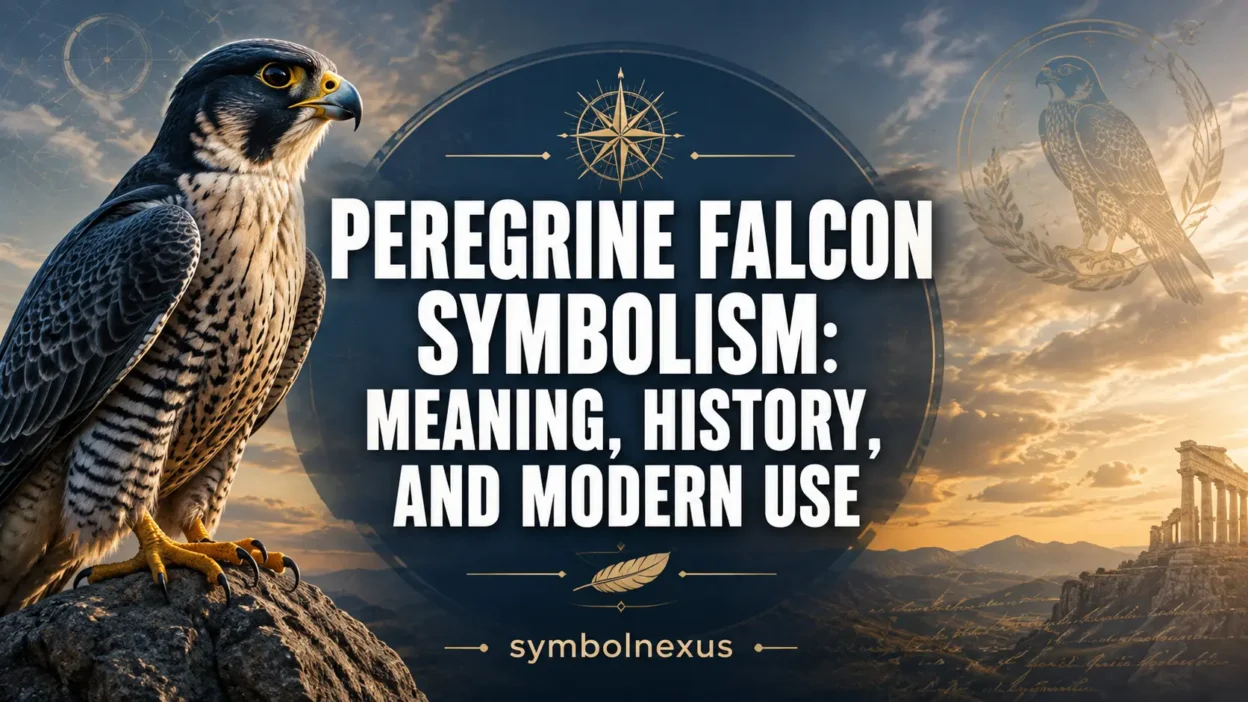
Peregrine falcon symbolism centers on speed, concentration, freedom, and the ability to act decisively. The bird’s dramatic hunting dives, long migrations, elevated nesting places, and successful recovery from near disappearance have also made it an American symbol of adaptability and environmental restoration.
Unlike a purely legendary creature, the peregrine gains most of its meaning from behaviors people can observe. It watches from a high position, selects a target, and commits to a rapid descent. That pattern has made the falcon a natural image for people who value clear goals, disciplined timing, and confident action.
Its meaning is not entirely positive or gentle. Because it is a skilled predator, the bird can also suggest aggression, competition, authority, and the risks of becoming too narrowly focused. Understanding the complete symbol requires looking at both its grace and its intensity.
Quick Answer
Peregrine falcon symbolism commonly represents speed, precision, freedom, and decisive action in modern American culture. Historically, falcons have also been connected with kingship, hunting skill, elevated vision, migration, and the disciplined relationship between humans and birds of prey.
TL;DR
- The peregrine represents speed, focus, and well-timed action.
- Its name and migration connect it with travel.
- Falconry linked the bird with skill and social status.
- Ancient Egyptian falcon imagery represented kingship and the sky.
- Its American recovery symbolizes conservation success.
- Urban nesting adds meanings of adaptation and resilience.
What the Peregrine Falcon Looks Like and Where It Appears
The peregrine falcon is a medium-sized raptor with long, pointed wings, a compact body, and a dark facial marking that resembles a helmet or sideburn. Adults generally have blue-gray backs, pale undersides with dark markings, and strong yellow feet. Females are noticeably larger than males.
Its body is shaped for speed. The pointed wings reduce drag, while its muscular chest and streamlined form allow it to pursue flying birds and perform steep hunting dives known as stoops. During a stoop, a peregrine may exceed 200 miles per hour, making it the fastest animal commonly measured in directed movement.
Americans may encounter peregrines on coastal cliffs, mountain ledges, river valleys, wetlands, bridges, water towers, and city skyscrapers. Instead of building a traditional nest, a pair usually creates a shallow scrape on a protected ledge. Tall buildings can function much like natural cliffs, while urban pigeons and starlings provide reliable prey.
These physical traits shape the bird’s symbolism. Its high perch suggests perspective, its sharp descent suggests commitment, and its ability to live in both wilderness and cities suggests adaptation.
Common Meanings in the United States
In American culture, the peregrine is usually interpreted through its visible behavior rather than through one fixed religious tradition. Speed is its best-known association, but the bird also communicates control, alertness, ambition, mobility, and recovery.
| Context | Meaning in the USA | Common Associations | Important Note |
|---|---|---|---|
| Personal growth | Focused progress | Goals, discipline, confidence | Emphasizes direction, not constant rushing |
| Sports and competition | Speed and accuracy | Performance, timing, victory | May also imply pressure or aggression |
| Conservation | Recovery and cooperation | Wildlife protection, restoration | Rooted in the bird’s U.S. comeback |
| Travel and change | Movement and independence | Migration, exploration, transition | Connected with its name and wide range |
| Urban culture | Adaptability | Skyscrapers, survival, modern nature | Shows wildlife adjusting to human spaces |
| Tattoos and design | Personal power | Vision, freedom, decisive action | Meaning depends on pose and surrounding imagery |
The symbol is especially appealing when someone wants to express strength without using the more familiar bald eagle. The peregrine feels faster, leaner, and more specialized. It represents competence developed through control rather than power based mainly on size.
Speed, Precision, and Decisive Action
Speed is the bird’s most immediate meaning, but speed alone does not explain its symbolic appeal. A peregrine does not simply fly in random haste. It climbs, observes, adjusts its position, and then accelerates at the right moment.
For that reason, the bird can represent decisive speed rather than impatience. It suggests that preparation should lead to action. Someone who identifies with this symbol may value making a clear decision once enough information has been gathered.
The peregrine also symbolizes precision. Its hunting success depends on judging distance, direction, wind, and the movement of another bird. In business, athletics, education, and personal development, this can represent the ability to reduce distractions and direct energy toward one meaningful objective.
There is also a warning within this meaning. Intense focus can become tunnel vision. A peregrine image may therefore serve as a reminder to choose targets carefully before committing fully.
Elevated Vision and Strategic Awareness
Peregrines often watch from cliffs, towers, bridges, and tall buildings. Their height gives them a broad view of the surrounding landscape and space to begin a fast descent.
Symbolically, this elevated position represents perspective. It encourages a person to rise above immediate confusion, examine the larger situation, and identify what actually matters. The falcon’s vision is therefore associated with strategy, awareness, and informed judgment.
This meaning differs slightly from ordinary watchfulness. An animal hiding from danger may represent caution, while the peregrine’s high observation point feels active and intentional. It is not merely waiting to avoid harm. It is studying the field before moving.
In leadership imagery, the falcon may suggest someone who understands both the broad plan and the exact moment when intervention is needed. In personal symbolism, it can represent stepping back emotionally before making an important choice.
Freedom, Migration, and the Meaning of Its Name
The scientific name Falco peregrinus reflects the idea of wandering or traveling. The word peregrinus is associated with a traveler, stranger, or one who comes from elsewhere. Some peregrine populations undertake long seasonal migrations, while others remain near the same territory throughout the year.
This connection gives the bird a more specific form of freedom than the general image of a bird in flight. It can symbolize purposeful movement across long distances, the ability to cross boundaries, and comfort with unfamiliar territory.
For immigrants, travelers, military families, students living away from home, or people beginning a new stage of life, the peregrine may represent maintaining identity while moving between places. Its symbolism suggests that belonging does not always depend on remaining in one location.
The bird can also represent independence without isolation. Peregrines travel widely, but breeding pairs establish territories and may return to dependable nesting sites. This combination makes the falcon suitable for expressing both personal freedom and loyalty to a chosen home.
Falconry, Discipline, and Human Partnership
Falcons have been trained for hunting in different regions of the world for thousands of years. Falconry began as a practical way to obtain food but developed into a cultural practice involving mentorship, specialized knowledge, social traditions, and a close working relationship between a bird and its handler. UNESCO recognizes falconry as a form of living cultural heritage practiced across many countries.
Through falconry, the peregrine became associated with discipline and skilled cooperation. A falcon cannot be controlled like a machine. Successful handling depends on patience, observation, trust, conditioning, and respect for the bird’s natural behavior.
Historically, trained falcons were also connected with wealth and social rank because keeping them required time, land, equipment, and expertise. Medieval European imagery sometimes used falconry to communicate refinement, authority, or aristocratic status.
Modern interpretation should not reduce falconry to domination. Within responsible practice, the bird symbolizes a partnership that depends on knowledge and care. The falcon retains its physical ability and independent nature, while the falconer accepts the responsibility of protecting its health.
Ancient Egyptian Falcon Imagery
One of the best-known historical uses of falcon imagery comes from ancient Egypt. Horus was frequently represented as a falcon or as a human figure with a falcon’s head. He was closely connected with kingship, the sky, divine authority, and the legitimacy of the ruler.
Egyptian objects sometimes show a falcon wearing the double crown representing Upper and Lower Egypt. In this setting, the bird communicates political unity and the ruler’s sacred right to govern. Falcon imagery was also associated with solar deities and the brightness of the sky.
These meanings apply to Egyptian falcon imagery generally, not always to the peregrine as a separately identified biological species. Modern articles and designs sometimes label every Egyptian falcon image as a peregrine, but ancient artists were not necessarily creating modern field-guide portraits.
Still, the resemblance matters. A sleek falcon with a strong eye marking naturally fits ideas of sky power, watchfulness, royal command, and protection from above.
Peregrines in Indigenous North American Art
Indigenous symbolism should never be treated as one universal system. Tribal nations have distinct languages, histories, ceremonies, and interpretations. Claims that a peregrine means exactly the same thing to all Native peoples erase those differences.
There is, however, specific archaeological evidence of peregrine imagery in parts of precontact North America. A well-known embossed copper plate found in Illinois depicts a peregrine falcon and has been interpreted within its cultural context as an image connected with the heavens. Other Southeastern ceremonial imagery combines human figures with peregrine-like wings and eye markings associated with the sky world, spirits, or ancestors.
This does not justify assigning one “Native American peregrine meaning” to the entire continent. A more accurate interpretation is that certain communities used falcon features within particular ceremonial and cosmological traditions.
Modern readers should distinguish documented cultural objects from generalized internet lists. Respectful interpretation identifies the people, region, and historical setting whenever that information is available.
An American Symbol of Conservation Recovery
The peregrine has acquired a distinctly modern American meaning because of its dramatic decline and recovery. During the mid-20th century, DDT and related pesticides accumulated through the food chain and interfered with eggshell formation. Thin eggs often broke during incubation, and peregrines disappeared from much of the eastern United States.
After restrictions on DDT, legal protection, captive breeding, nest management, and large-scale reintroduction programs, populations increased. The U.S. Fish and Wildlife Service removed the American peregrine falcon from the federal endangered species list in 1999 after recovery targets were exceeded. The species remains protected under federal migratory-bird law.
This history changed the bird’s symbolism. It no longer represented only hunting ability and elevated status. It became an emblem of ecological repair, scientific cooperation, public policy, and the possibility of reversing environmental damage.
The recovery was not automatic. It required pesticide regulation, breeding expertise, habitat protection, government agencies, universities, conservation groups, falconers, and public support. The peregrine therefore represents collective responsibility as much as individual strength.
Why the Bird Represents Urban Adaptability
A peregrine perched above a downtown street creates a striking contrast. The bird looks wild and ancient, yet it may be nesting on concrete, glass, steel, or a suspension bridge.
Urban environments recreate several features of the peregrine’s natural habitat. High ledges resemble cliffs, open air around towers provides room for flight, and city-dwelling birds offer abundant prey. Reintroduction projects also helped establish peregrines in metropolitan areas after researchers recognized that tall structures could support nesting pairs.
As a symbol, the urban peregrine represents adaptation without complete surrender. It uses the altered environment while remaining unmistakably wild. This meaning appeals to people who have learned to function within demanding cities, institutions, or careers without losing their individuality.
The falcon also challenges the assumption that nature exists only in remote parks. Its presence above traffic, offices, and apartment buildings shows that wildlife can occupy spaces people consider entirely human.
Emotional and Psychological Meaning
Emotionally, the peregrine often communicates confidence, intensity, and readiness. Its image is suitable for moments when a person wants to feel alert rather than passive.
For someone facing a difficult decision, the bird can represent clarity: observe first, select a direction, and commit. For someone recovering from failure, its conservation history adds a second message — that decline does not have to be permanent.
The symbol may also appeal to people who value competence. The peregrine is admired not because it is the largest raptor, but because it performs a specialized task exceptionally well. It can therefore represent mastery built through practice, self-knowledge, and the intelligent use of natural strengths.
Its shadow side includes restlessness, harsh competitiveness, emotional distance, and fixation on achievement. A person drawn to falcon imagery may benefit from asking whether a goal deserves such concentrated effort.
Meaning in Tattoos, Jewelry, and Modern Design
A peregrine tattoo usually expresses speed, freedom, focus, or survival. The exact meaning changes according to the bird’s position.
A diving falcon emphasizes commitment, courage, and sudden action. A perched bird suggests patience, watchfulness, and controlled power. Spread wings communicate independence or movement, while a falcon flying above a city may represent succeeding in a demanding modern environment.
Feathers, compasses, maps, or mountains can strengthen themes of travel and exploration. Clocks or arrows may emphasize timing and direction. Images of broken chains usually point toward liberation, while an eggshell, cliff nest, or young falcon can introduce themes of recovery and renewal.
In jewelry and logos, the peregrine’s profile is often simplified into pointed wings, a hooked beak, or a fast downward shape. Athletic teams and performance brands may use it to imply speed, accuracy, and competitive drive.
Because the bird is a protected wild species, possessing actual feathers, eggs, nests, or other parts may be restricted by law. Symbolic designs are more appropriate than collecting materials from wild birds.
Common Misunderstandings and Distorted Meanings
One common error is treating peregrines, hawks, and eagles as interchangeable. All are raptors, but their cultural associations differ. Eagles often represent national authority and broad power, while peregrines more strongly suggest speed, specialized skill, and rapid execution.
Another mistake is presenting falcon symbolism as completely peaceful. The peregrine is graceful, but it is also a predator that strikes other birds in flight. Its image can communicate beauty and control while still carrying meanings of danger and competition.
Online spiritual content sometimes claims that seeing a peregrine guarantees success, predicts a specific event, or delivers one universal supernatural message. Such claims go beyond what can be established historically. A sighting may feel personally meaningful, but its interpretation depends on the observer’s circumstances and beliefs.
Cultural blending can also create distortion. Egyptian religion, medieval European falconry, Indigenous North American imagery, and modern conservation history are separate contexts. Combining all of them into one supposedly ancient universal teaching removes the details that make each tradition meaningful.
How the Meaning Has Changed Over Time
The falcon’s earliest meanings developed from direct observation: height, speed, vision, hunting skill, and control of the air. Ancient societies connected those qualities with gods, rulers, warriors, hunters, or the sky.
Falconry added ideas of discipline, prestige, training, and partnership. Later art and heraldry often emphasized status, courage, and noble conduct.
In the 20th century, the American peregrine story introduced vulnerability. The fastest bird could still be harmed by invisible chemicals moving through an ecosystem. Its decline demonstrated the consequences of pollution, while its recovery showed the value of coordinated conservation.
Today, all of these layers remain available. The peregrine can represent an ancient sky ruler, a disciplined hunter, a traveler, an urban survivor, or a restored species. Its modern meaning is strongest when the chosen interpretation is connected to a real feature of the bird rather than a vague claim.
Frequently Asked Questions
Is seeing a peregrine falcon a good sign?
Many people read a sighting positively, since the bird carries associations with alertness, precise timing, confidence, and forward movement. Rather than treating it as a guaranteed omen of luck, it’s more accurate — and more useful — to take it as a personal prompt to observe carefully before acting on something important.
What does a peregrine falcon tattoo mean?
A peregrine tattoo most commonly represents speed, freedom, focus, or decisive action, with the bird’s pose doing much of the interpretive work — diving suggests commitment, perched suggests patience. Given the species’ history, it’s also a natural choice for commemorating survival or recovery after a difficult period, echoing the falcon’s own comeback from near disappearance.
Does the peregrine falcon have a biblical meaning?
No single, widely established meaning exists across biblical tradition for this specific species. Some people personally connect the bird with watchfulness, creation, or spiritual perspective, but that’s best understood as an individual interpretation rather than a doctrine shared across denominations.
What does a diving peregrine symbolize?
A diving peregrine represents full commitment, precise timing, and the courage to act rapidly once a decision has been made. It doubles as a useful caution, too — the image can remind the viewer to confirm a goal is genuinely worth pursuing before committing to it at full speed.
Is the peregrine falcon a symbol of freedom?
Yes, particularly when shown in open flight, and the symbolism runs deeper than most birds-in-flight imagery. Its wide geographic range, long seasonal migrations, and scientific name — rooted in a word for traveler or wanderer — all reinforce a specific kind of freedom built around purposeful movement rather than aimless flight.
What is the difference between falcon and eagle symbolism?
Falcons generally emphasize speed, precision, agility, and specialized skill, while eagles lean toward broad authority, national identity, and commanding strength. The distinction is part of why the peregrine appeals to people who want to express competence and focus without reaching for the more familiar, more overtly patriotic eagle imagery.
Can the peregrine represent resilience?
Yes, and this is one of its strongest modern American meanings. The species’ well-documented recovery from a pesticide-driven population collapse gives it real symbolic weight around resilience, while its success nesting on city skyscrapers adds a second, related meaning: the ability to adapt to drastically changed conditions without losing its essential nature.
Why is the peregrine falcon associated with ancient Egyptian kingship?
The connection comes through Horus, frequently depicted as a falcon or a falcon-headed figure closely tied to the sky, divine authority, and the legitimacy of the ruler. It’s worth noting this imagery reflects falcons generally rather than the peregrine specifically as a distinct species — ancient artists weren’t working from a field guide, even though the resemblance to a peregrine is often striking.
How did the peregrine falcon almost go extinct in the United States, and how did it recover?
The species collapsed in much of the eastern U.S. after DDT and related pesticides accumulated in the food chain and thinned eggshells until they broke during incubation. Recovery took a coordinated, multi-decade effort — DDT restrictions, legal protection, captive breeding, and reintroduction programs — culminating in its removal from the federal endangered species list in 1999, a case still cited as a major conservation success story.
Why do peregrine falcons nest on skyscrapers in cities?
Tall buildings function much like the natural cliffs peregrines have always favored, offering high, protected ledges and open airspace for hunting. Cities also provide a steady food source in pigeons and starlings, and deliberate reintroduction efforts helped establish urban nesting pairs once researchers recognized that skyscrapers could substitute for cliff habitat.
Conclusion
The peregrine falcon earns its symbolism the way few animals do: by actually performing, in observable fact, the qualities people want to claim for themselves. It doesn’t just suggest speed — it’s the fastest measured animal in directed movement. It doesn’t just suggest focus — its entire hunting strategy depends on eliminating everything except the one decision that matters. The bird isn’t a metaphor stretched to fit; it’s the real behavior that the metaphor was built from.
That grounding is what makes its layered history hang together instead of feeling like a list of unrelated facts. Ancient Egypt saw sky authority in the same silhouette that medieval falconers saw discipline and partnership in, that Indigenous artists in precontact North America incorporated into ceremonial imagery of the heavens, and that twentieth-century biologists watched nearly vanish and then deliberately brought back. Different eras, different meanings — but all of them responding to the same bird doing the same essential things: watching from above, waiting for the right moment, and committing completely once it comes.
That’s the version worth carrying forward, especially given the conservation chapter: the peregrine doesn’t just model decisive action, it models the fact that even a near-total collapse isn’t necessarily the end of the story — provided enough people are willing to do the slow, unglamorous work of bringing something back.


