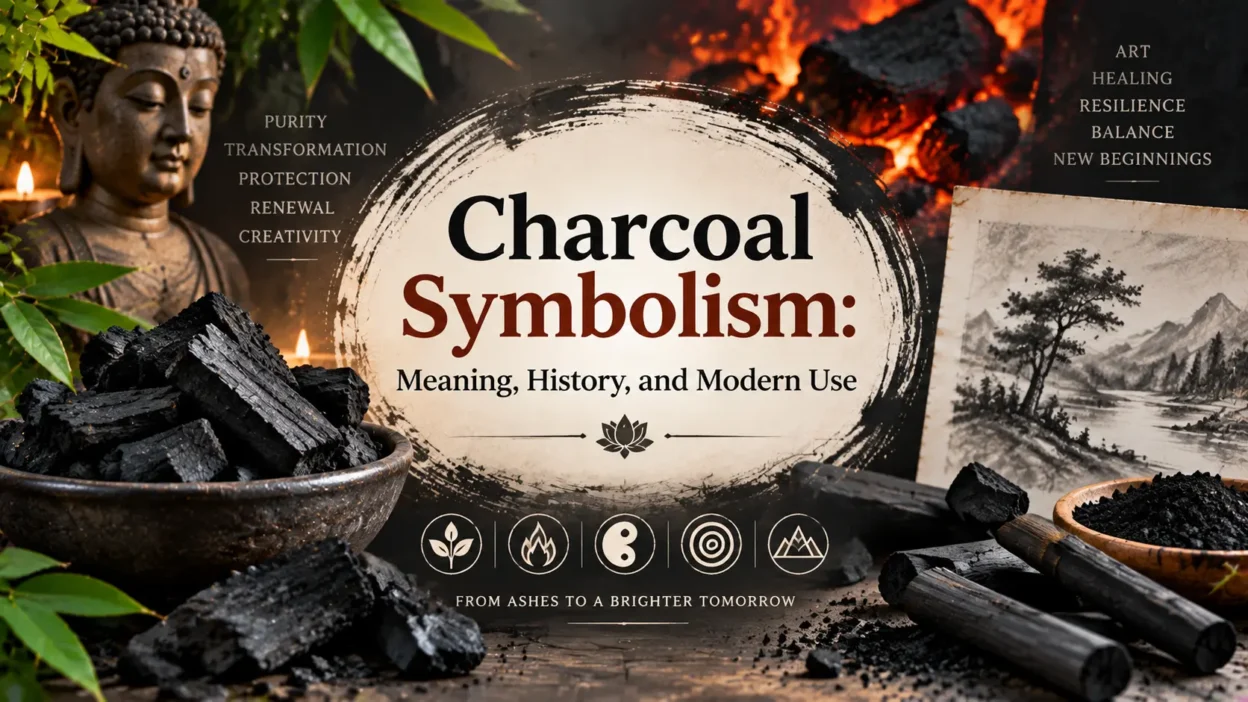
Charcoal symbolism reflects ideas of transformation, simplicity, resilience, and creativity. From ancient fires and survival tools to modern artwork and interior design, charcoal represents the connection between destruction and creation. People often associate it with change because charcoal forms when natural materials are transformed through heat.
In the United States, charcoal appears in many everyday contexts, including drawing, cooking, design, and personal expression. Its dark appearance can suggest seriousness and strength, while its connection to fire and renewal gives it meanings related to change and rebuilding.
Quick Answer
Charcoal symbolism commonly represents transformation, resilience, creativity, and simplicity in modern American culture, especially in art, design, and personal expression. Historically, charcoal has also been associated with fire, survival, purification, and the process of turning one form of matter into another.
TL;DR
- Charcoal symbolizes transformation through heat and change.
- Artists use charcoal to represent creativity and expression.
- Americans associate charcoal with grilling, design, and simplicity.
- Ancient cultures used charcoal for survival and rituals.
- Dark charcoal tones suggest strength and sophistication.
- Modern uses include tattoos, fashion, and home decor.
What Charcoal Looks Like and Where People Encounter It
Charcoal is a black carbon-rich material created when wood or other organic substances are heated with limited oxygen. Unlike ordinary burned wood, charcoal has a lighter structure and burns differently because many impurities have been removed during production.
People commonly encounter charcoal in several forms:
- Charcoal sticks and pencils used by artists
- Charcoal briquettes used for grilling
- Activated charcoal used in filtration and some wellness products
- Charcoal-colored designs in clothing, furniture, and architecture
Its appearance plays an important role in its symbolism. The deep black-gray color creates associations with earth, fire, mystery, strength, and refinement.
The Core Meanings of Charcoal Symbolism
The meaning of charcoal depends on the situation, but several interpretations appear consistently across cultures and modern life.
| Context | Meaning in the USA | Common Associations | Notes |
|---|---|---|---|
| Art | Creativity and expression | Sketching, imagination, emotion | Used for dramatic contrast |
| Fire | Transformation and survival | Heat, energy, renewal | Connected to human history with fire |
| Design | Elegance and simplicity | Modern interiors, fashion | Charcoal gray feels neutral and refined |
| Personal symbolism | Strength and resilience | Growth after hardship | Often linked with overcoming challenges |
Transformation
Charcoal is created through a process of change. Wood does not remain wood after intense heat; it becomes a different material with new qualities. Because of this transformation, charcoal often symbolizes personal growth, adaptation, and life changes.
Many people connect it with the idea that difficult experiences can create something valuable. Like charcoal emerging from fire, individuals may develop strength after facing challenges.
Creativity
Artists have used charcoal for thousands of years because it creates strong lines, deep shadows, and expressive marks. In artistic symbolism, charcoal represents imagination, experimentation, and the freedom to create.
Unlike permanent materials such as ink or paint, charcoal can be easily blended and erased. This quality gives it associations with exploration and the creative process.
Ancient Roots and Early Symbolism
Charcoal has been part of human civilization since people learned to control fire. Early humans used charcoal for practical purposes, including cooking, heating, and creating pigments.
Ancient artists used charcoal-based materials to create some of the earliest known drawings. The ability to transform burned wood into a tool for communication gave charcoal an important symbolic role: it connected fire, survival, and human creativity.
In several ancient societies, fire itself carried symbolic meanings related to purification, renewal, and connection between the physical and spiritual worlds. Charcoal inherited some of these associations because it was a product of controlled fire.
Charcoal Symbolism in the United States
In American culture, charcoal has practical and artistic meanings rather than one single traditional interpretation.
Art and Education
Charcoal remains a popular medium among artists because it allows strong contrast and emotional expression. Art students often learn charcoal techniques because the material teaches shading, texture, and composition.
In this context, charcoal represents:
- artistic development
- experimentation
- observation
- personal expression
Cooking and Gatherings
Charcoal grilling has become part of American food culture. Backyard barbecues, family gatherings, and summer celebrations often involve charcoal fires.
Here, charcoal symbolizes:
- community
- tradition
- shared experiences
- outdoor living
The smell and appearance of charcoal smoke can also create memories connected with holidays, reunions, and celebrations.
Interior Design and Fashion
Charcoal gray is widely used in American homes and clothing because it balances darkness with neutrality. Designers often choose charcoal tones for modern, minimalist spaces.
It can communicate:
- sophistication
- stability
- professionalism
- understated style
Fire, Ash, and Renewal: The Deeper Connection
Charcoal exists between two states: living material and ash. This middle stage gives it symbolic importance.
Wood represents growth and life. Fire represents change. Ash represents the final result. Charcoal stands between these stages, suggesting adaptation and survival.
This connection appears in many symbolic interpretations:
- leaving behind an old identity
- rebuilding after hardship
- finding value after loss
- changing through experience
However, charcoal does not always represent struggle. It can also symbolize preparation, patience, and controlled transformation.
Charcoal in Cross-Cultural Symbolism
Different cultures have interpreted charcoal through their relationships with fire, nature, and artistic traditions.
In some traditions, charcoal has been connected with purification because fire removes unwanted materials. In artistic traditions across Asia and Europe, charcoal became associated with discipline, craftsmanship, and careful observation.
Some spiritual practices have used burned materials symbolically because fire represents transition. However, meanings vary widely between cultures, and charcoal does not carry one universal spiritual interpretation.
Emotional and Psychological Meaning of Charcoal
The color and material qualities of charcoal often influence how people emotionally interpret it.
Charcoal shades can create feelings of:
- calmness
- seriousness
- security
- maturity
- focus
Because charcoal is darker than many neutral colors but softer than pure black, people often view it as balanced. It can feel strong without appearing overly aggressive.
In personal symbolism, charcoal may represent someone who has experienced change but remains grounded.
Charcoal Symbolism in Tattoos and Personal Style
Charcoal-inspired tattoos are usually connected with themes of transformation, resilience, and artistic identity.
People may choose charcoal imagery or charcoal-like shading to represent:
- surviving difficult periods
- personal reinvention
- creativity
- connection with nature and fire
Charcoal tones are also common in tattoo backgrounds because they create depth and contrast.
The meaning depends heavily on the individual. A charcoal tattoo does not automatically represent hardship or darkness; it may simply reflect appreciation for the material, color, or artistic style.
Charcoal in Modern Design and Digital Culture
Modern designers frequently use charcoal colors because they create a clean and professional appearance.
Common uses include:
- websites and technology products
- luxury branding
- furniture design
- clothing collections
- photography styles
Online, charcoal tones are often associated with minimalism and modern aesthetics. The color works well because it creates visual contrast while remaining less harsh than pure black.
Common Misunderstandings About Charcoal Symbolism
Because charcoal is dark and connected with burning, some people assume it always represents negativity. This interpretation is incomplete.
Charcoal can represent destruction, but it can also represent creation. The same fire that destroys wood can produce a useful material.
Another misunderstanding is that charcoal always has spiritual meaning. While some traditions connect fire and burned materials with rituals, many modern uses are practical, artistic, or decorative.
The meaning depends on context.
How Charcoal’s Meaning Has Changed Over Time
Charcoal began primarily as a survival material. Humans relied on it for heat, cooking, and early artistic expression.
Over time, its role expanded:
- ancient societies used it as a practical resource
- artists transformed it into a creative medium
- designers adopted charcoal tones for modern aesthetics
- individuals began using it as a symbol of personal change
Today, charcoal represents both ancient human connection with fire and modern ideas of creativity and simplicity.
Positive and Negative Interpretations of Charcoal
Charcoal has multiple symbolic meanings depending on perspective.
| Positive Associations | Negative Associations |
|---|---|
| Renewal | Destruction |
| Creativity | Loss |
| Strength | Darkness |
| Adaptability | Hardship |
| Simplicity | Emptiness |
These contrasting meanings are part of what makes charcoal an interesting symbol. It represents the ability to find usefulness after change.
Frequently Asked Questions
What does charcoal symbolize spiritually?
Charcoal can symbolize transformation, purification, and change in some spiritual interpretations because it comes from fire. However, spiritual meanings vary between cultures and personal beliefs.
What does charcoal represent in art?
In art, charcoal represents creativity, expression, and experimentation. Artists use it because it allows dramatic contrasts, emotional marks, and flexible techniques.
Is charcoal a positive or negative symbol?
Charcoal can represent both positive and negative ideas. It may symbolize resilience and renewal, but it can also represent destruction or loss depending on the context.
What does charcoal gray symbolize in design?
Charcoal gray often represents sophistication, balance, and modern simplicity. Designers use it when they want a strong neutral color that feels professional and refined.
Why is charcoal associated with transformation?
Charcoal is created when wood changes through heat. This physical process leads many people to associate it with personal growth, adaptation, and becoming something new.
What does charcoal mean in tattoos?
Charcoal tattoos often represent personal transformation, creativity, strength, or connection with natural elements. The meaning depends on the person’s own story and design choices.
Conclusion
Charcoal represents the meeting point between fire, change, and creation. Its history as a survival tool, artistic material, and design element gives it several layers of meaning across human cultures.
In modern America, charcoal symbolism is often connected with creativity, resilience, simplicity, and transformation. Whether found in artwork, clothing, home design, or personal expression, charcoal continues to represent the idea that change can produce something valuable.