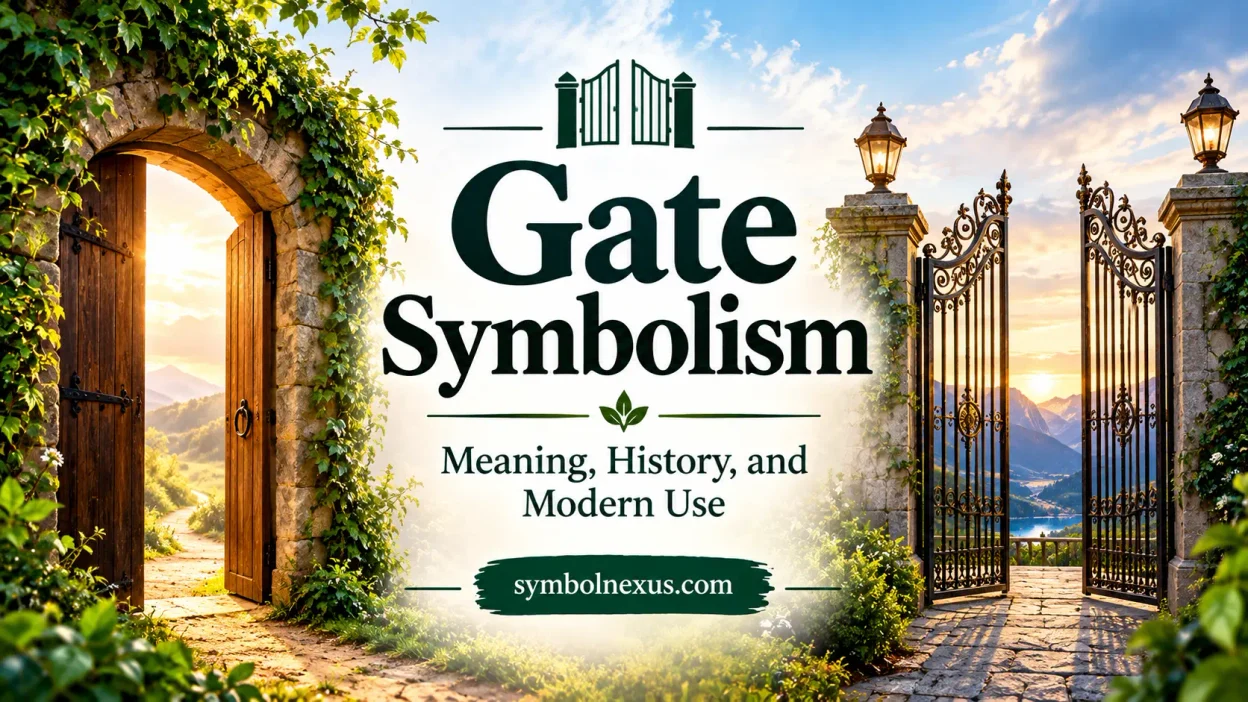
Gate symbolism often centers on access, protection, opportunity, and the boundary between one stage of life and another. A gate is more than an entrance in a fence or wall. It marks a point where someone can enter, leave, wait, or be turned away. Because gates control movement, people often associate them with decisions, permission, privacy, and change.
In the United States, gates appear in many settings, from garden entrances and ranch properties to courthouse grounds, cemeteries, schools, and gated residential communities. Their meaning depends on the setting. An open garden gate may suggest welcome, while a locked iron gate can communicate privacy, authority, or exclusion.
Gates also appear in religious stories, literature, architecture, dreams, and personal artwork. Understanding their symbolism means looking at who controls the entrance, what lies beyond it, and whether the gate is open, closed, locked, damaged, or inviting.
Quick Answer
Gate symbolism commonly represents opportunity, protection, boundaries, and the transition into a new stage of life in modern American culture. Historically, gates have also signified authority, social status, sacred entrances, and the control of access to communities or important places.
TL;DR
- Gates often represent choices, new opportunities, and transitions.
- Closed gates can symbolize privacy, limits, exclusion, or delayed progress.
- Open gates commonly suggest welcome, freedom, and available possibilities.
- Historic gates protected settlements, estates, temples, and important public spaces.
- Religious traditions use gates to represent spiritual entry, judgment, and belonging.
- Modern art and design use gates to express identity, security, and independence.
What a Gate Represents as a Symbol
A gate is a movable or controlled entrance in a fence, wall, barrier, or enclosed area. Unlike a solid wall, it creates a specific point through which people or objects may pass. This practical purpose gives the gate its central symbolic meaning: it regulates the movement from one space into another.
That movement can be physical, social, emotional, or spiritual. Entering through a gate may represent gaining access to a new community, accepting an opportunity, or beginning a different chapter. Leaving through one can suggest independence, escape, separation, or the end of a familiar period.
The gate itself does not automatically indicate whether the change is good or bad. An entrance can lead to safety or danger, freedom or responsibility. The surrounding setting and the person’s relationship to the gate determine the interpretation.
For example, a person standing before an open gate might feel hopeful because a new opportunity appears available. Someone facing a locked gate might feel frustrated because another person controls access. Both scenes involve boundaries, but they communicate different experiences.
The Main Meanings of Gate Symbolism
Several related ideas appear repeatedly in interpretations of gates. These meanings are not universal rules; they are common associations shaped by architecture, experience, religion, and storytelling.
Opportunity: An open gate can suggest that a possibility is within reach. It may represent a new job, relationship, home, educational path, or personal decision.
Protection: Gates help separate a private or secure area from the outside world. Symbolically, they can express the desire to protect family, possessions, beliefs, or emotional well-being.
Boundaries: A gate identifies where one space ends and another begins. It may represent personal limits, rules, privacy, or the distinction between what someone accepts and rejects.
Transition: Passing through a gate can mark a change in identity, circumstances, or responsibility. The image often works well when a person is leaving one phase of life and entering another.
Authority and permission: A locked gate, guarded entrance, or gate requiring a key suggests that access depends on a decision or rule. It can represent power, control, hierarchy, or institutional restrictions.
Belonging and exclusion: Gates can welcome people into a shared space, but they can also keep people outside. Their symbolism therefore includes both community and separation.
These meanings often overlap. A gate around a home may represent protection for residents and exclusion for strangers at the same time.
Open Gate Symbolism: Welcome and New Possibilities
An open gate usually communicates availability. It suggests that the way forward is clear, permission has been granted, or a person is welcome to enter. In American visual culture, this image often appears in gardens, rural driveways, welcoming homes, and illustrations about fresh starts.
An open gate can represent a practical opportunity rather than a promise of success. A person may have access to a new path, but they still need to decide whether to take it. This distinction makes the symbol useful in stories about personal growth, career changes, education, and independence.
An open gate can also express trust. A homeowner who leaves a garden gate open may be inviting neighbors to visit. In a fictional story, an open gate outside a secluded property may signal that a character is welcome, or that a previously restricted place is now accessible.
However, an open gate does not always mean safety. It may expose a protected area, invite unwanted entry, or reveal that someone has left a boundary unattended. The context determines whether openness feels generous, liberating, careless, or threatening.
Closed and Locked Gates: Boundaries, Delay, and Exclusion
A closed gate creates a pause between a person and the place they want to reach. If it is unlocked, the barrier may simply mark a boundary that someone can cross by choice. If it is locked, access depends on having a key, receiving permission, or finding another route.
In personal symbolism, a locked gate may represent an obstacle, an unanswered question, or a relationship in which communication has stopped. It can also reflect a healthy boundary. A person who refuses unwanted access to their private life is not necessarily rejecting others unfairly; they may be protecting their time, safety, or emotional space.
The distinction between protection and exclusion matters. A gate can keep danger out, but it can also prevent someone from reaching a needed resource. In social and political settings, gates may represent unequal access to housing, education, employment, or public facilities.
In fiction and visual art, a locked gate can create suspense because it makes the next step uncertain. The viewer may wonder who owns the key, why entry is restricted, and what lies on the other side. Those questions turn an ordinary structure into a symbol of power and limited choice.
Gates as Symbols of Life Transitions
Gates often represent transitions because people pass through them when moving between distinct spaces. This physical action offers a clear image for changes that are harder to see, such as becoming an adult, beginning a marriage, leaving home, changing careers, or recovering after a difficult period.
A gate at the entrance to a new house may suggest a fresh start. A gate at the edge of a school or workplace can mark the difference between one set of responsibilities and another. In a story, a character who crosses a gate may be leaving a familiar environment and accepting the uncertainty of what comes next.
This symbolism is related to the idea of a threshold. A threshold is the point at which someone moves from one condition or place to another. A gate is a more visible and controllable version of that boundary because it can be opened, shut, locked, or guarded.
The important detail is the act of crossing. Standing before a gate may suggest anticipation or hesitation, while passing through it can indicate commitment. Turning back may represent caution, regret, or a decision to remain where one is.
Historical Origins: Gates as Protection and Authority
Gates have served practical purposes for thousands of years. Settlements, fortified cities, estates, and enclosed compounds used controlled entrances to manage movement, protect residents, and regulate trade. Because access to a city or important property could depend on permission, gates became associated with authority as well as security.
City gates were often more than openings in defensive walls. In various ancient societies, they could serve as places for public announcements, legal proceedings, commercial activity, and meetings. Their position made them natural gathering points where people entered, exchanged goods, and encountered local officials.
The symbolism developed from these everyday functions. A gate could indicate that someone was entering a protected community, approaching a place of power, or crossing from ordinary surroundings into a space with special rules.
Not every historical gate had the same meaning. A fortified entrance communicated defense, while an elaborate gate at a palace or estate could display wealth and prestige. Religious entrances could mark a sacred boundary. The structure’s purpose, design, and social setting shaped how people understood it.
Gates in American Culture and Everyday Life
In the United States, gates carry meanings shaped by property, privacy, public access, and community life. A white garden gate may evoke hospitality, domestic calm, or an idealized neighborhood. A ranch gate may suggest rural independence, land stewardship, and the practical management of livestock or property.
Gates around apartment complexes and gated communities communicate controlled access. For residents, they may represent convenience, security, or a sense of privacy. For people kept outside, they can suggest separation, social status, or barriers between communities. These interpretations can coexist.
Public gates also have civic significance. Entrances to government buildings, memorials, parks, and historic sites can communicate order and controlled access. When such a gate is opened for a public event, the change may symbolize welcome or expanded access. When it is closed, the same structure may communicate restricted entry or a need for security.
American stories and visual media frequently use gates to distinguish the familiar from the unknown. A character may approach a gated mansion, enter a cemetery through an iron gate, or leave a childhood home through a garden entrance. Each setting changes the emotional meaning, even when the physical structure is similar.
Religious and Spiritual Meanings of Gates
Gates appear in several religious traditions as images of entry, belonging, protection, judgment, and access to the sacred. Their meanings vary by text and tradition, so it is important not to treat all religious gate imagery as interchangeable.
In Christianity, gates appear in biblical language connected with cities, judgment, salvation, and the way toward spiritual life. The image of a narrow gate, for example, emphasizes that a particular path may require discipline and commitment rather than convenience. Gates of a city can also represent the community and its security.
In Jewish tradition, gates can be associated with the entrances to cities and sacred spaces, as well as with poetic and prayerful images of entering the presence of God. Specific interpretations depend on the passage, liturgical context, and tradition.
In other spiritual settings, an entrance may mark the movement from ordinary space into a place set apart for worship or reflection. A gate at a shrine, temple, or sacred garden can help visitors recognize that they are crossing into a space governed by particular customs.
These examples share a general theme of passage, but their theological meanings differ. A gate in a religious image may represent an invitation, a test, a protected boundary, or a distinction between sacred and ordinary life. Its interpretation should follow the tradition in which it appears.
Gate Symbolism in Art, Literature, and Folklore
Writers and artists use gates because they create an immediate visual question: will the character enter, remain outside, or turn away? This uncertainty can move a story forward while giving the setting emotional weight.
In fairy tales and folklore, gates may guard a castle, garden, hidden realm, or dangerous place. A character who reaches the entrance may need to solve a problem, earn permission, or confront a fear before proceeding. The gate becomes part of a test rather than a simple piece of architecture.
In novels and poetry, gates can separate social classes, family histories, or competing versions of a person’s identity. A gate surrounding a wealthy estate might represent privilege, while a gate at a neglected property could suggest abandonment or a past that remains inaccessible.
Visual artists can communicate similar ideas through composition. A small figure standing before a large gate may appear vulnerable or uncertain. An open gate framed by sunlight may suggest hope, while a heavy gate in shadow may create tension. These effects depend on the whole image, not just the gate itself.
The symbol works because it makes an abstract conflict visible. Readers and viewers can understand the problem of access before they know exactly what the character hopes to find beyond the entrance.
Gate Colors, Materials, and Design
The appearance of a gate can influence its symbolism, although color and material do not carry fixed meanings across every culture or setting.
| Gate design | Common associations in the United States | Context to consider |
|---|---|---|
| White wooden gate | Welcome, domestic life, simplicity | Often linked with gardens, cottages, and idealized homes |
| Black iron gate | Authority, privacy, formality, mystery | May appear at estates, cemeteries, and historic buildings |
| Wooden ranch gate | Independence, rural life, land stewardship | Often reflects working property and agricultural traditions |
| Ornate ceremonial gate | Prestige, tradition, sacred or civic importance | Meaning depends on the building and its cultural background |
| Open metal gate | Access, movement, opportunity | Can also suggest vulnerability if security matters |
| Locked gate | Restriction, privacy, exclusion, protection | Interpretation depends on who is kept out and why |
A gate’s material can suggest durability or vulnerability. Iron may appear strong and permanent, while a weathered wooden gate may evoke age, rural life, or neglect. These are visual associations rather than universal symbolic rules.
Design also affects emotional tone. A low gate that can be opened easily may feel inviting, while a tall gate topped with spikes may communicate a serious barrier. The same property can feel welcoming or intimidating depending on how its entrance is designed.
Color should be interpreted cautiously. A white gate does not automatically symbolize purity, and a black gate does not necessarily signal danger. Architecture, location, and cultural expectations usually provide stronger clues than color alone.
The Emotional and Psychological Meaning of Gates
Gates can reflect how people experience access, safety, and personal choice. Someone who feels overwhelmed by demands may imagine a closed gate as a way to protect their time and attention. Someone facing a major decision may picture themselves standing before a gate, unsure whether to move forward.
The symbol can also express ambivalence. A person may want a new opportunity while fearing the responsibilities it brings. An open gate may look inviting, yet crossing it may require leaving familiar routines or relationships. The image captures the tension between wanting change and wanting security.
Gates may also represent the limits people place on emotional closeness. In a relationship, opening a gate can suggest trust or a willingness to communicate. Keeping it closed may signal caution, a need for privacy, or a refusal to accept harmful behavior. The meaning depends on the circumstances and the people involved.
These interpretations can be useful for reflection, but they are not psychological diagnoses. A gate in a dream or artwork does not prove that someone fears commitment, feels trapped, or needs to make a specific decision. Personal associations and real-life circumstances matter more than any fixed symbolic dictionary.
Gate Symbolism in Tattoos, Jewelry, and Home Decor
People may choose gate imagery in tattoos or decorative objects to express a personal relationship with change, boundaries, or belonging. A gate tattoo could mark a turning point, a new beginning, the memory of a childhood home, or the decision to protect one’s private life. The meaning becomes clearer when combined with other details.
An open gate surrounded by flowers may communicate welcome or renewal. A gate with a path beyond it may suggest ambition or a future that remains uncertain. A weathered gate may evoke memory, age, separation, or the passage of time. None of these interpretations is automatic; the wearer’s intention matters most.
In home decor, small garden gates, decorative ironwork, and gate-shaped ornaments can evoke hospitality, nostalgia, or traditional architecture. In landscaping, an actual garden gate may create a sense of invitation by framing the path into a private outdoor space.
On social media, gate imagery can accompany messages about starting over, setting boundaries, or choosing a different path. The image may be paired with a caption about an opportunity opening or a person deciding who deserves access to their life. Such use reflects modern personal storytelling rather than an ancient, universally agreed code.
Before choosing gate imagery for a permanent tattoo or meaningful gift, consider the details that make it personal. The location, condition, surrounding objects, and whether the gate is open or locked can all change the impression it creates.
Gates in Dreams: How to Interpret the Details
A gate in a dream can be interpreted as an image of choice, access, safety, or uncertainty, but dreams do not have one reliable meaning for every person. The most useful approach is to consider what the gate was doing and how you felt when you encountered it.
An open gate might remind you of an opportunity you are considering. A locked gate could reflect frustration about a situation that feels beyond your control, although it might also relate to a real concern about privacy or safety. A broken gate may bring to mind a boundary that no longer works as intended.
Your role in the dream matters. Were you opening the gate, closing it, searching for a key, guarding it, or watching someone else pass through? Each action suggests a different relationship to the barrier. Feelings such as relief, fear, curiosity, or disappointment can offer more useful clues than the image alone.
Dream interpretation is subjective. A gate may simply reflect a familiar place, a recent experience, or an ordinary memory. It should not be treated as a prediction or proof that a particular event will happen.
Common Misunderstandings About Gate Symbolism
One common misunderstanding is that an open gate always represents a positive opportunity. In reality, an open entrance can also signal exposure, carelessness, or an invitation into an unsafe situation. Its meaning depends on what lies beyond it and whether entry is desirable.
Another mistake is to assume that a closed gate always represents rejection. A closed gate may protect a private garden, prevent livestock from wandering, or keep a child away from a dangerous road. A boundary can serve a constructive purpose even when it limits access.
People may also mistake modern interpretations for ancient beliefs. A gate used today to represent personal growth may not have held that exact meaning in a historical setting. Earlier gates often had direct associations with defense, trade, authority, property, and sacred boundaries. Modern art can adapt those associations without proving that every contemporary interpretation existed in the past.
Finally, no single color, material, or gate design has one universal meaning. Cultural traditions, religious teachings, local architecture, and individual experiences all influence interpretation. The best reading explains the specific details rather than relying on a rigid symbolic formula.
How to Interpret a Gate in a Picture or Real-Life Setting
To understand a gate’s symbolism, begin with the practical question of what it controls. Is it the entrance to a home, a public building, a cemetery, a garden, a farm, or an imagined world? The location often reveals more than the structure alone.
Next, examine its condition and position. An open gate suggests that passage is possible, while a locked one emphasizes restriction or controlled access. A damaged gate may indicate neglect, vulnerability, or the failure of a boundary. A guarded gate draws attention to authority and permission.
Then consider who is on each side. A gate can feel welcoming to the person allowed inside and exclusionary to the person left outside. If someone is holding the gate open for another person, the image may emphasize generosity, assistance, or trust. If someone is closing it, the action may communicate protection, separation, or finality.
Finally, look at the wider story. A gate leading toward a bright garden may suggest a welcome change, while the entrance to a prison may emphasize restriction. In real life, a gate’s purpose may be entirely practical, so symbolic interpretations should not replace the obvious explanation.
The strongest interpretation connects the physical details with the emotional or social situation. Instead of asking only, “What does a gate mean?” ask, “Who can pass through this gate, who cannot, and why does that difference matter?”
Frequently Asked Questions
What does a gate symbolize spiritually?
A gate can represent entry into a sacred space, a spiritual choice, or the boundary between ordinary life and a religious experience. Its specific meaning depends on the faith tradition and the passage or practice in which it appears.
Is gate symbolism positive or negative?
Gate symbolism can be positive or negative depending on whether the gate welcomes, protects, restricts, or excludes someone. An open entrance may suggest opportunity, while a locked one may represent either a useful boundary or an unfair obstacle.
What does an open gate symbolize?
An open gate commonly represents welcome, access, freedom, and the possibility of change. It may suggest that an opportunity is available, but it does not guarantee that the path beyond it will be easy or safe.
What does a gate symbolize in a dream?
A gate in a dream may reflect a decision, a personal boundary, or uncertainty about entering a new situation. Consider whether the gate was open or locked and what emotions you experienced rather than treating the dream as a prediction.
What does a gate tattoo mean?
A gate tattoo may represent a life transition, independence, privacy, or the choice to let certain people into one’s life. An open gate can emphasize possibility, while a locked gate may express protection or firm personal boundaries.
What do gates symbolize in the Bible?
Biblical gates can represent city life, authority, judgment, protection, and spiritual entry. The narrow gate, for example, illustrates the demanding path associated with spiritual commitment, while city gates often appear in contexts involving community affairs and public justice.
What does a closed gate mean in art?
A closed gate in art often suggests separation, restricted access, waiting, or something that remains beyond reach. It may also communicate security and privacy, so the surrounding scene and the people on either side are important to its interpretation.
Conclusion
Gate symbolism centers on access, protection, boundaries, and the choices involved in moving from one stage of life to another. An open gate may suggest welcome or opportunity, while a locked entrance can communicate security, restriction, or exclusion. History, religion, architecture, and personal experience all influence these meanings.
In modern American culture, gates remain familiar objects that can express privacy, community, status, independence, and change. To understand what a particular gate represents, look beyond its appearance and consider who can cross it, what lies beyond it, and why that passage matters. A gate’s meaning often becomes clearest when you consider both the boundary it creates and the possibility of crossing it.