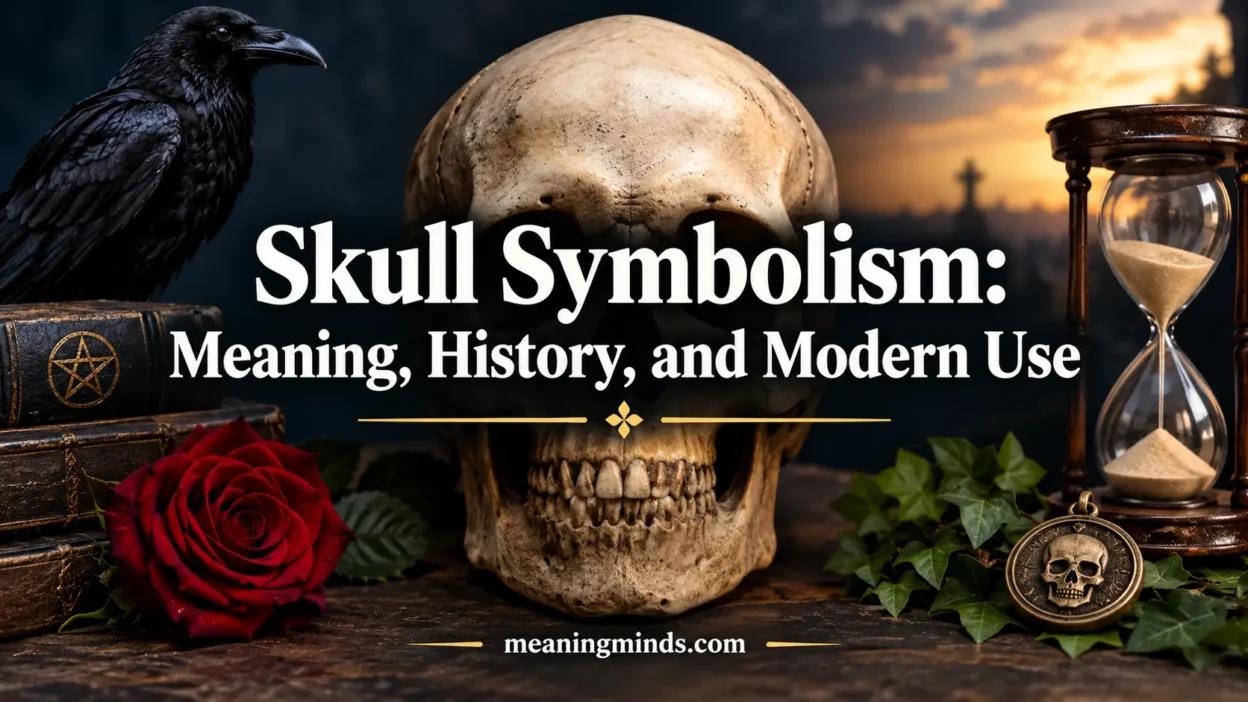
A skull is one of the clearest visual symbols of skull symbolism, often representing death, mortality, danger, or the limited nature of human life. In the United States, however, the skull can also suggest remembrance, rebellion, personal identity, humor, protection, or celebration, depending on its design and setting.
People encounter skulls in many places: Halloween decorations, tattoos, jewelry, warning labels, military imagery, fashion, artwork, video games, and Día de los Muertos celebrations. Because the same image can carry very different meanings, understanding the context is essential.
Quick Answer
Skull symbolism commonly represents death, mortality, danger, and the temporary nature of life in modern American culture. Historically, skulls have also represented remembrance, religious reflection, equality in death, and the need to value life while it lasts.
TL;DR
- Skulls commonly symbolize death, mortality, danger, and human impermanence.
- European memento mori traditions used skulls to encourage reflection on death.
- American culture often connects skulls with Halloween, rebellion, and warning.
- Día de los Muertos gives skull imagery a commemorative and celebratory meaning.
- Tattoos and fashion can turn skulls into symbols of identity and individuality.
- The meaning changes significantly with color, design, setting, and cultural context.
What a Skull Represents as a Symbol
A human skull is the bony structure of the head, recognizable even when separated from the rest of the skeleton. Its unmistakable appearance makes it particularly effective as a visual sign.
The most immediate association is death. Unlike many abstract symbols, a skull communicates mortality without requiring much explanation. This is why skull imagery has appeared in art, religious objects, warnings, memorials, and popular culture.
But death is only one layer of the meaning.
A skull can also represent the temporary nature of life. In this sense, it does not necessarily celebrate death. Instead, it reminds people that life is limited and that time, wealth, status, and physical appearance do not last forever.
That distinction explains why the same skull can appear frightening in one setting and reflective or even joyful in another.
What Skull Symbolism Means in the United States
In contemporary U.S. culture, skull imagery has several common meanings.
The first is mortality. A skull may be used to acknowledge death, remembrance, or the fact that everyone eventually dies.
The second is danger. The skull and crossbones is widely recognized as a warning associated with poisonous or hazardous substances. Historical U.S. poison-labeling regulations even specified the use of a skull-and-crossbones image on poison packaging. CDC Stacks
The third is rebellion. Skull imagery has long appeared in countercultural fashion, music, motorcycles, tattoo culture, and other settings where people want to communicate independence or rejection of conventional expectations.
A fourth meaning is remembrance. A skull can commemorate someone who has died or acknowledge mortality without necessarily expressing fear.
The surrounding imagery usually determines which interpretation makes the most sense.
Ancient Roots and Early Symbolism
Skull symbolism did not originate from a single culture or one historical event. Human remains have been part of ritual, art, religion, and burial traditions in many societies.
Ancient Roman imagery provides an important historical example. Representations of skeletons and mortality appeared in Roman art and were sometimes connected with reminders to enjoy life because human existence is short. Getty
Later European traditions developed more explicit forms of mortality imagery. Religious art frequently used death-related objects to encourage people to think about the temporary nature of worldly life.
This history matters because the skull was not always intended simply to frighten people. In many contexts, it served as a reminder: life ends, so human priorities should be considered carefully.
Memento Mori and the Reminder of Death
One of the most important historical ideas connected with skulls is memento mori, a Latin expression meaning a reminder of mortality.
In European art, skulls became a familiar memento mori image. Paintings and objects could combine skulls with hourglasses, extinguished candles, wilting flowers, books, money, musical instruments, or other objects associated with human life. These combinations emphasized that pleasure, knowledge, beauty, wealth, and social status are temporary. Getty
The message was not necessarily “death is good.” It was closer to “remember that life is limited.”
That difference is important when interpreting old paintings, cemetery art, religious objects, or antique jewelry featuring skulls.
Skulls in American Mourning Traditions
Skulls also have a place in American history through mourning customs.
Early American mourning jewelry sometimes incorporated memento mori imagery, including skeletons, coffins, and hourglasses. Such objects were used to commemorate deceased people and to acknowledge mortality. Over time, mourning jewelry increasingly favored less direct imagery, such as weeping willows and draped urns. The Metropolitan Museum of Art
This provides an important contrast with modern skull tattoos or fashion.
A skull can communicate grief and remembrance rather than danger or rebellion. The surrounding design, inscription, date, or connection to a deceased person can make that intention clearer.
Skull Symbolism in Día de los Muertos
One of the most important cultural contexts for skull imagery in the United States is Día de los Muertos, or Day of the Dead.
The holiday has roots in Indigenous traditions of Mexico and Central America and later became intertwined with Spanish Catholic observances connected with All Saints’ Day and All Souls’ Day. It is now observed in many communities, including Mexican American and other Latino communities in the United States. Smithsonian Institution
The colorful skull, or calavera, is not simply a symbol of horror.
Sugar skulls can represent the reality of death while also emphasizing remembrance and the value of life. Bright colors, flowers, decorations, photographs, food, and personal objects can transform an altar into a place of memory and connection.
This is why treating every decorative skull as a Halloween symbol can erase an important cultural distinction. Día de los Muertos has its own history, practices, and meanings.
La Catrina and the Meaning of the Calavera
The modern visual language of the decorated Mexican skeleton was strongly shaped by Mexican printmaker José Guadalupe Posada.
Posada created satirical calavera figures that portrayed people from different levels of society as skeletons. His imagery could comment on politics, class, vanity, and social behavior. La Catrina became one of his most recognizable creations and later became closely associated with Día de los Muertos. Smithsonian American Art Museum
The skeleton therefore carried an additional message: beneath clothing, wealth, titles, and social position, human beings share the same basic fate.
That interpretation connects the calavera with an older idea found in European memento mori traditions while developing within a distinctly Mexican artistic and cultural setting.
What Skulls Mean in Halloween Culture
For many Americans, the skull is strongly connected with Halloween.
Halloween uses imagery associated with death, ghosts, cemeteries, skeletons, monsters, and the supernatural. In this environment, skulls are usually intended to create a spooky or macabre atmosphere rather than provide a serious meditation on mortality.
Decorative skulls may appear on:
- Costumes
- Front-yard decorations
- Party supplies
- Candy packaging
- Posters
- Home décor
- Makeup designs
The meaning here is often playful. A skull on a Halloween decoration does not necessarily indicate grief, danger, or a philosophical belief about death.
Skulls in Tattoos and Personal Identity
Skull tattoos are especially flexible in meaning because the wearer can combine the skull with almost any other image.
A skull with roses may contrast death with beauty or suggest the shortness of life. A skull with a clock may emphasize limited time. A skull with wings can suggest remembrance, freedom, or the passage from life to death.
Some people choose skull tattoos because they identify with ideas such as independence, toughness, survival, nonconformity, or acceptance of mortality.
Others simply like the visual style.
This is why it is risky to assign one fixed meaning to a skull tattoo. The same design can communicate grief for one person and personal style for another.
Skulls in Fashion, Jewelry, and Design
Skull imagery has become common in American fashion and graphic design.
Jewelry may use small skulls as decorative elements without any serious reference to death. Clothing brands sometimes use skull graphics to create an edgy, rebellious, gothic, rock-inspired, or alternative aesthetic.
The design itself can change the emotional effect. A realistic skull tends to look more serious or unsettling, while a cartoon skull can feel playful. A brightly colored skull may suggest celebration or artistic expression, while a black-and-white skull may create a darker mood.
Context matters more than the object alone.
Common Skull Meanings by Context
| Context | Meaning in the USA | Common Associations | Notes |
|---|---|---|---|
| Halloween | Death, fear, spooky humor | Skeletons, ghosts, horror | Usually playful or decorative |
| Warning signs | Danger or toxicity | Poison, hazardous materials | Skull and crossbones is highly recognizable |
| Memento mori art | Mortality and impermanence | Death, time, reflection | Often has religious or moral context |
| Día de los Muertos | Remembrance and mortality | Calaveras, family, celebration | Distinct from Halloween |
| Tattoos | Identity, mortality, rebellion, remembrance | Personal experience, independence | Meaning depends heavily on design |
| Fashion | Individuality or edgy style | Gothic, rock, alternative culture | Sometimes purely aesthetic |
Why the Skull Can Symbolize Rebellion
The skull has an unusual ability to communicate resistance.
Part of this comes from its association with death. A person wearing a skull may intentionally reject polished or conventional imagery in favor of something darker and more confrontational.
The symbol has appeared in various forms of popular culture, including rock music, motorcycle culture, punk and alternative fashion, and graphic art.
In these settings, the skull can suggest “I am not afraid of what society considers uncomfortable.”
It can also communicate toughness or independence. However, these associations are cultural conventions rather than universal rules. A skull does not automatically indicate aggression or rebellion.
Religious and Spiritual Interpretations
Skull imagery appears in several religious and devotional traditions, but its meaning varies considerably.
In Christian art, skulls can function as reminders of mortality and repentance. Religious paintings and devotional objects sometimes use death imagery to encourage humility and reflection.
Some Christian traditions also associate skull imagery with saints, hermits, monks, or places of contemplation. The point is generally not to glorify death but to acknowledge human mortality.
Other cultures and religious traditions have their own approaches to death, ancestors, bones, and human remains. These should not be collapsed into one universal “skull meaning.”
The safest interpretation is always to consider the particular tradition and the object’s historical setting.
The Emotional Meaning of a Skull
Psychologically, skull imagery can produce very different reactions.
For some people, it creates fear because it provides a direct visual reminder of death. For others, it represents acceptance. Seeing mortality represented openly can make the subject feel less abstract.
A skull can also express grief. Someone who loses a loved one may use skull imagery as part of a memorial tattoo or artwork.
For another person, the same symbol might communicate humor. Dark humor often works by placing uncomfortable subjects such as death into unexpected or playful settings.
This range of responses explains why skull imagery remains useful in visual communication. It can be serious, frightening, humorous, reflective, rebellious, or commemorative.
Positive and Negative Skull Symbolism
Skulls are often described as either “positive” or “negative,” but that distinction is too simple.
A skull can have an unsettling meaning when it appears on a poison label or horror poster. It can have a reflective meaning in memento mori art. It can have a commemorative meaning in a memorial tattoo. It can have a celebratory meaning within Día de los Muertos traditions.
The image itself does not determine whether the meaning is positive or negative.
Instead, ask three questions:
- Where does the skull appear?
- What other symbols appear with it?
- What cultural or personal tradition does it belong to?
Those details usually reveal the intended meaning.
Modern Digital and Pop Culture Uses
Skulls are also common in digital culture.
Emoji, gaming graphics, social-media posts, album artwork, memes, avatars, and online communities frequently use skull imagery. In these settings, the meaning can become highly informal.
A skull may express shock, embarrassment, dark humor, danger, or the idea that something is extremely funny. Digital users can also use skull graphics simply because the image fits a particular visual style.
This is an important modern development because symbolic meaning can change rapidly online. A meaning that seems obvious in a historical painting may not be the intended meaning of a skull appearing in a modern meme.
Common Misunderstandings About Skull Symbolism
One common mistake is assuming that every skull represents evil.
A skull can represent death without representing evil. The distinction is especially important in mourning, religious art, memento mori traditions, and Día de los Muertos.
Another mistake is treating Día de los Muertos skulls as interchangeable with Halloween decorations. Although the holidays occur close together and may share visual elements, their histories and cultural purposes differ. Smithsonian Institution
A third mistake is assuming that a skull tattoo always signals rebellion or danger. Tattoo symbolism is highly personal, and the accompanying imagery can completely change the interpretation.
Finally, a skull should not automatically be interpreted as a prediction, omen, or supernatural warning. In most everyday contexts, its meaning comes from cultural convention, visual design, and personal association.
How Skull Meaning Has Changed Over Time
The history of skull symbolism shows a gradual expansion rather than one continuous meaning.
Earlier European traditions often emphasized mortality, religious reflection, and the temporary nature of worldly possessions. American mourning traditions later used death imagery to remember the deceased. Warning systems gave the skull a practical meaning connected with danger.
Popular culture then expanded its associations with Halloween, music, fashion, tattoos, gaming, and alternative identity.
Meanwhile, Mexican calavera traditions developed a different relationship with skull imagery, emphasizing remembrance, mortality, family, and celebration within Día de los Muertos.
Today, a skull can therefore carry several meanings at once. Its interpretation depends less on the shape alone and more on context, culture, design, and personal intention.
FAQs About Skull Symbolism
What does a skull symbolize spiritually?
A skull can symbolize mortality, humility, repentance, and the temporary nature of physical life. In religious settings, its meaning depends on the specific tradition and the artwork or practice involved.
What does a skull tattoo usually mean?
A skull tattoo may represent mortality, remembrance, independence, rebellion, survival, or personal identity. Some people choose one simply because they like the design, so the tattoo does not have one universal meaning.
Is skull symbolism always negative?
No. Skulls can represent grief or danger, but they can also symbolize remembrance, acceptance of mortality, celebration, humor, or individuality. Día de los Muertos is an important example where skull imagery is connected with honoring the deceased rather than simply creating fear. Smithsonian Institution
What does a skull and crossbones symbolize?
In modern American contexts, the skull and crossbones commonly signals poison or serious danger. Its use on hazardous-material and poison labeling helped establish the image as a widely recognizable warning symbol. CDC Stacks
What does a skull mean in Día de los Muertos?
A calavera can represent mortality while honoring people who have died. Sugar skulls and other skull imagery are part of a broader tradition involving remembrance, family, offerings, and celebration.
Why are skulls associated with Halloween?
Halloween incorporates imagery related to death, skeletons, ghosts, cemeteries, and horror. Skulls fit this visual tradition because they immediately communicate mortality and can create either a frightening or playful atmosphere.
Can a skull symbolize life?
Yes. A skull can remind people that life is temporary, which can encourage appreciation of the time they have. In some traditions, especially those involving remembrance of the dead, the skull is part of a larger message about the relationship between life, death, memory, and family.
Conclusion
The meaning of skull symbolism depends heavily on context. Death and mortality are its most recognizable associations in the United States, but skulls can also represent remembrance, danger, rebellion, humor, personal identity, and acceptance of life’s limits.
Its history explains why the symbol is so flexible. From memento mori artwork and American mourning objects to poison warnings, Halloween decorations, tattoos, and Día de los Muertos calaveras, the skull has developed different meanings across cultures and settings.
A skull, by itself, does not tell the whole story. The surrounding symbols, cultural tradition, historical period, and personal purpose determine what it is actually saying.